
 Deutsch
 Dansk
Dansk Suomi
Suomi Latviešu
 Lietuvių
 Norsk bokmål
 polski
 Русский
 Svenska
No products in the cart.
Uncategorized
Residential DC Wallbox: 2026 Home Fast Charging Guide
24
Sep
Sep
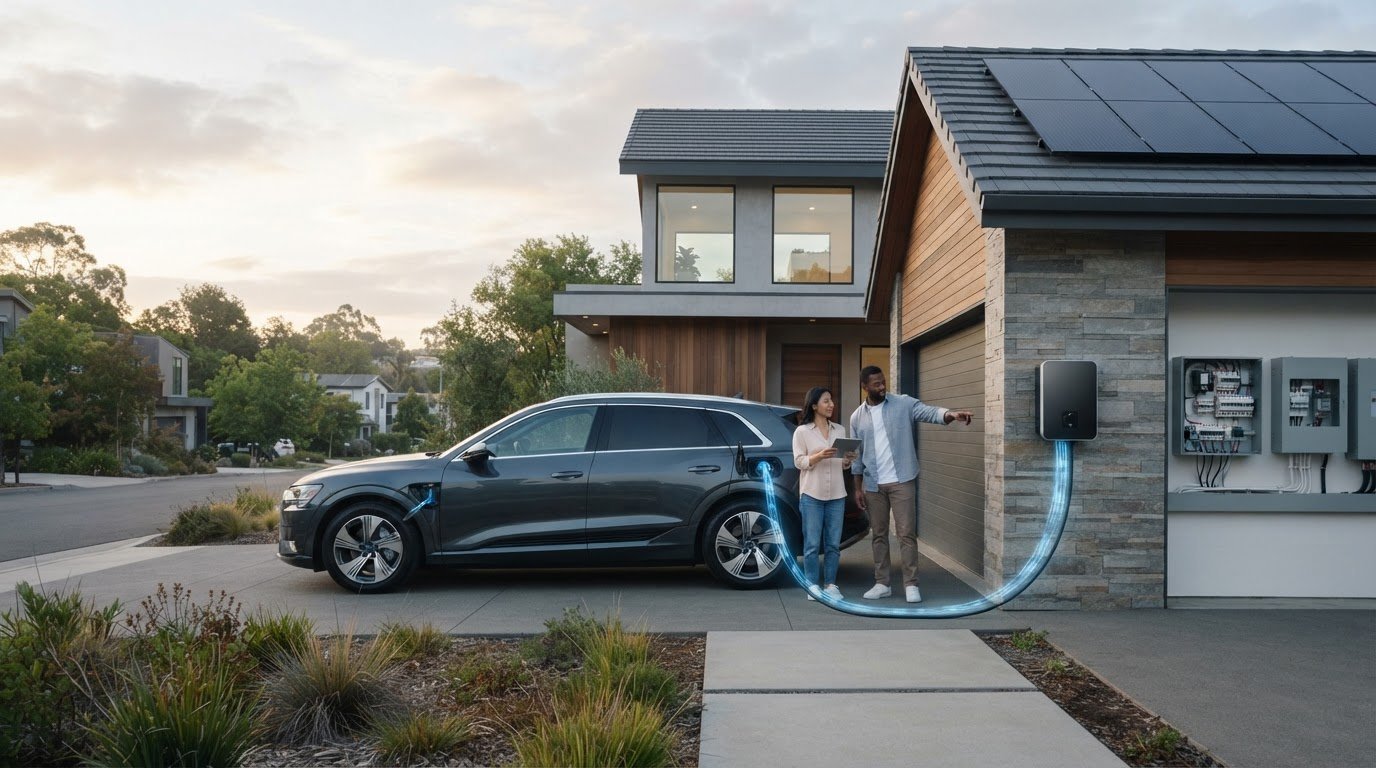
Your electric vehicle’s biggest charging bottleneck isn’t the battery; it’s the sluggish onboard AC converter hidden under the hood. Plugging a high-performance EV into a standard home charger often caps your speeds at a frustrating 7.4kW or 11kW, wasting precious hours while your car sits idle. Installing a dedicated DC wallbox for residential use completely shatters that ceiling by converting AC grid power inside the station itself, pumping fast direct current straight into your vehicle.
You probably already know that residential fast charging shouldn’t feel like an endless waiting game, especially if you drive daily or manage multiple EVs. You want commercial-grade velocity in your garage without blowing up your local breaker panel or navigating dense electrical jargon. We agree: home energy management should be fast, transparent, and direct.
In this practical 2026 guide, you will discover how domestic DC wallboxes bypass onboard vehicle limits to slash recharge cycles, evaluate the exact grid prerequisites like 32A three-phase supply, and select high-efficiency hardware like the compact V2C DENKA 20kW DC Wallbox for seamless home charging.
Key Takeaways
- Learn how direct battery replenishment bypasses restrictive internal AC converters to cut charging times drastically across 60kWh to 100kWh packs.
- Identify the core domestic grid prerequisites, including 32A to 40A three-phase service panel requirements, to safely power high-speed home hardware.
- Avoid costly vendor lock-in by selecting open OCPP-compliant units that integrate effortlessly with domestic energy baseloads and smart setups.
- Discover why investing in a DC wallbox for residential use like the high-efficiency V2C DENKA 20kW delivers commercial-grade reliability directly to your private estate.
What Is a Residential DC Wallbox and How Does It Work?
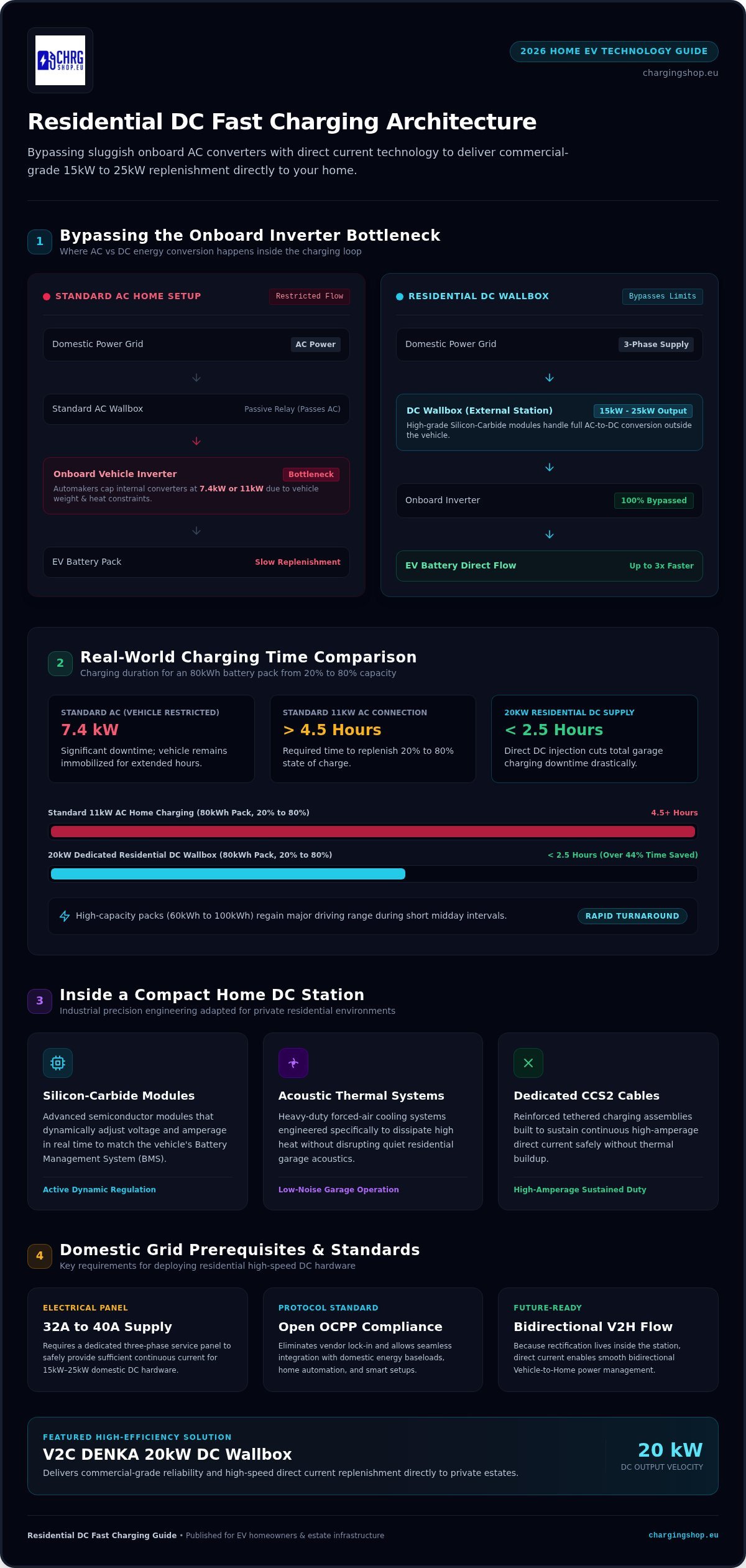
Most EV owners assume their charging speeds depend solely on the wall connector attached to their garage. That is a misconception. Standard residential units supply alternating current (AC), forcing your vehicle to convert that energy into direct current (DC) before it can enter the battery pack. A dedicated DC wallbox for residential use flips this dynamic. By shifting the entire rectification process outside the vehicle, the station pushes continuous direct current straight into the battery cells, delivering true commercial-grade velocity at home.
On typical residential three-phase connections, domestic DC stations reliably pump out speeds ranging from 15kW to 25kW. If your vehicle features a factory-restricted 7.4kW onboard converter, plugging into standard AC hardware leaves you waiting for hours. A domestic DC charger completely bypasses that internal restriction, enabling your vehicle to recharge up to three times faster right in your driveway.
AC vs DC Home Charging: The Onboard Inverter Bottleneck
Every electric vehicle carries an onboard AC-to-DC rectifier under its chassis. Automakers intentionally restrict these components due to weight, heat dissipation, and manufacturing costs, capping most cars at 7.4kW or 11kW AC acceptance. A specialized DC unit houses industrial-grade silicon-carbide power modules directly inside the wallbox, handling the heavy electrical conversion before power ever touches your charge port. Rather than behaving as passive electric vehicle supply equipment (EVSE), the station acts as an active power generator. Compare this performance against our 22kW home wallbox guide to see which technology fits your daily driving profile.
Key Components Inside a Compact Home DC Station
Delivering high-power direct current in a private residential setting requires precision engineering. High-performance compact units integrate several critical subsystems to ensure safety and quiet operation:
- Silicon-Carbide Power Modules: Advanced semiconductors that dynamically modulate voltage and amperage in real time to match the vehicle’s battery management system (BMS).
- Acoustic-Tuned Thermal Systems: Heavy-duty forced-air cooling systems engineered to keep internal electronics cool without disturbing quiet residential garage environments.
- Dedicated CCS2 Tethered Cables: Reinforced charging assemblies built to safely sustain continuous high-amperage direct current without excessive thermal buildup.
Investing in a high-efficiency DC wallbox for residential use gives you the ultimate home charging setup, unlocking the true speed potential built into your electric vehicle.
Comparing Home Charging Solutions: Standard AC vs High-Speed DC
Level 2 AC chargers remain the standard tool for charging overnight at home, but they fall flat when you need rapid turnaround times. Standard AC options send raw utility current directly to the car, leaving replenishment speeds at the mercy of internal conversion hardware. Installing a DC wallbox for residential use changes the equation entirely, transforming your garage into a high-throughput power hub that bypasses vehicle bottlenecks completely.
Direct current architectures also unlock genuine Vehicle-to-Home (V2H) bidirectional capabilities. Because the rectification circuitry lives inside the wall station, energy flows smoothly in both directions between your car pack and domestic distribution panel. Naturally, high-speed DC hardware demands a larger physical footprint on your wall compared to a sleek AC socket, but the operational leap in velocity makes the tradeoff undeniable.
Charging Speed Breakdown Across Battery Capacities
Real-world charging math is simple: higher direct power cuts garage downtime drastically. Moving an 80kWh battery pack from 20% to 80% takes over 4.5 hours on a standard 11kW AC connection. Feed that same vehicle via a 20kW DC supply, and the session drops to under 2.5 hours. Vehicles equipped with massive 100kWh packs regain significant range during a quick lunch break instead of sitting immobilized until tomorrow morning. If standard alternating current matches your schedule better, evaluate our Alfen Single Pro Line 22kW review before upgrading your setup.
Efficiency, Standby Consumption, and Thermal Impact
Modern domestic DC stations leverage high-efficiency silicon carbide semiconductors, reducing thermal conversion energy losses below four percent. You get clean, uninterrupted power transfer without worrying about damaging vehicle components:
- Direct BMS Supervision: Constant digital handshakes between the charger and vehicle battery management system monitor individual cell temperatures in real time, dialing back current instantly if cells run warm.
- Acoustic Garage Comfort: Modern residential units feature variable-speed, whisper-quiet cooling fans engineered specifically for domestic attached garages.
- Optimized Energy Flow: High conversion efficiency preserves household energy while delivering continuous current without the standby drain of older industrial rectifiers.
Ready to upgrade your home charging velocity? Browse our hardware catalog at Charging Shop to select the exact station engineered for your domestic setup.
Home Grid Requirements: Preparing Your Electrical Infrastructure
Deploying rapid conversion hardware requires serious electrical groundwork. You cannot simply plug high-throughput equipment into a conventional domestic circuit and hope for the best. Installing a high-output DC wallbox for residential use demands a verified 400V three-phase connection delivering at least 32A to 40A of continuous service capacity. Before ordering hardware, calculate your home’s total baseline demand alongside heavy consumers like geothermal heat pumps, climate controls, and induction cooktops.
Safety architecture must mirror commercial-grade protocols. Your breaker enclosure must feature a dedicated upstream Type B residual current device (RCD) alongside tailored overcurrent circuit breakers. Because Charging Shop operates strictly as a hardware supplier, you must hire an independent certified electrician to conduct an on-site electrical survey, pull local utility permits, run appropriate cabling, and execute final commissioning.
Three-Phase 400V Supply and Main Fuse Sizing
Standard residential grid drops often cap main fuses at 25A per phase. Supporting sustained 20kW output requires coordinating with your regional distribution network operator to upgrade main service fuses to 40A or 50A. Running high amperages over long garage runs also causes voltage drops if wiring is undersized. Your independent electrical contractor should install heavy-gauge copper wiring with a minimum cross-section of 10mm² to 16mm², ensuring clean voltage regulation during peak delivery.
Dynamic Load Management and Solar PV Synchronization
Balancing substantial charging demand against domestic appliances prevents tripped main breakers. Professional DC installations incorporate dynamic load balancing systems using active current clamps at the main meter. These sensors read live household draw in milliseconds, throttling charger delivery whenever heat pumps or ovens spike. Look for systems adhering to robust technical baselines like the National Electric Vehicle Infrastructure standards to guarantee interoperability and safety.
- Automated Amperage Modulation: Dynamically dials back charger intake during peak domestic consumption periods and ramps up when the house sleeps.
- Rooftop Solar Harvesting: Channels surplus photovoltaic generation straight to your battery as direct current, eliminating double-conversion AC losses.
- Smart Ecosystem Harmony: Review residential load balancing configurations in our V2C Trydan 22kW guide to understand how intelligent sensors coordinate domestic energy.
Proper electrical preparation guarantees that your new DC wallbox for residential use operates at peak efficiency without compromising the safety of your home.
Key Buying Criteria: How to Select the Right DC Wallbox
Selecting high-speed direct current hardware requires a clear evaluation of both physical ratings and internal software capabilities. Never buy hardware based purely on peak kilowatt numbers. When shopping for a DC wallbox for residential use, target a continuous power rating between 15kW and 25kW that matches your home panel’s real-world capacity without exceeding upstream fuse safety margins.
Hardware durability matters just as much as electrical sizing. Look for rugged enclosures carrying minimum IP54 or IP65 ingress protection ratings, paired with IK10 impact resistance. These certifications protect internal rectifiers against driven rain, dust intrusion, and accidental impacts along active driveways. Solid physical build quality prevents premature hardware failure in harsh outdoor environments.
Power Modulation and Continuous Output Ratings
Top-tier home DC stations provide granular output stepping, allowing you to manually or automatically dial delivery from 10A up to 32A per phase. This fine control prevents transformer strain during high household load periods. For residential garages, a tethered CCS2 cable assembly with an ergonomic holster delivers the safest, most convenient physical connection. If your charging requirements extend to commercial properties or higher vehicle turnover, evaluate our 40kW DC wallbox guide to see how higher-output hardware compares.
Software Protocols and Smart Cloud Management
Proprietary software ecosystems trap you inside single-brand apps that limit long-term control. Insist on open communication standards to maintain complete control over your equipment:
- Open OCPP Compliance: Demand Open Charge Point Protocol (OCPP 1.6J or 2.0.1) readiness so your station can link to any home automation system or third-party energy platform.
- Access Control and Remote Scheduling: Utilize digital platforms like CHRG Network access to control RFID permissions, configure automated off-peak charging schedules, and track energy usage in real time.
- Triple-Path Connectivity: Choose hardware featuring integrated Wi-Fi, Ethernet, and optional 4G LTE failover to maintain dependable cloud connections regardless of garage Wi-Fi dead spots.
- Continuous Firmware Evolution: Reliable over-the-air (OTA) updates keep your wallbox aligned with evolving ISO communication protocols as newer EV models hit the market.
Ready to upgrade your garage with cutting-edge direct current hardware? Explore our verified charging systems today to secure the ideal high-speed solution for your property.
Featured Solutions: High-Performance Hardware for Your Home
Upgrading to home fast charging requires proven, field-tested engineering rather than unverified OEM prototypes. If you demand commercial replenishment speeds inside a private residence, executive property, or boutique fleet garage, the V2C DENKA 20kW DC Wallbox sets the benchmark. It combines industrial-grade power conversion with the compact dimensions required for domestic living spaces.
Not every electrical service panel can immediately accommodate continuous high-draw direct current. In properties where utility supply upgrades remain cost-prohibitive, selecting a high-output AC alternative makes practical sense. Robust three-phase stations like the ABB Terra AC 22kW charger deliver exceptional build quality, intuitive load balancing, and dependable charging across standard alternating current setups.
V2C DENKA 20kW DC Wallbox: Engineering Overview
The V2C DENKA 20kW DC Wallbox bridges the gap between massive public chargers and compact garage hardware. Operating as a dedicated DC wallbox for residential use, it delivers high-performance direct current straight to your vehicle battery:
- True 20kW Direct Delivery: Pushes continuous power straight through an ergonomic, heavy-duty CCS2 tethered cable, bypassing internal onboard vehicle limiters.
- Architectural Form Factor: Features a sleek, ultra-compact enclosure designed specifically for clean mounting on residential garage walls or exterior brick driveways.
- Advanced Smart Integration: Pairs seamlessly with local energy monitoring networks, ensuring your high-throughput sessions run harmoniously alongside domestic appliances.
Selecting Your Hardware from Charging Shop
Charging Shop operates as an authorized European e-commerce hardware distributor, supplying certified charging hardware directly to homeowners, fleet managers, and developers. We maintain direct inventory access to cutting-edge units like the V2C DENKA 20kW DC Wallbox and connect you with remote software optimization through CHRG Network Access.
Our focus is strictly e-commerce distribution excellence. We do not provide on-site electrical installation services, running cables, or local panel upgrades. When you order your station, we ship certified hardware directly to your property with rapid European dispatch. You then coordinate with an independent licensed electrician who will pull local permits, verify your 400V supply panel, run the dedicated branch circuits, and complete final hardware commissioning safely. Browse our store to order your hardware, or request a Personalised Charging Offer tailored specifically to your vehicle fleet and residential electrical capacity.
Power Up Your Garage with Next-Generation DC Charging
Bypassing the restrictive onboard converter in your vehicle transforms daily EV ownership. Deploying a high-output DC wallbox for residential use eliminates standard AC bottlenecks, slashing charge cycles across large battery packs. Pair your station with verified 400V three-phase grid infrastructure and dynamic load management, and you get commercial charging velocity without risking domestic electrical overloads.
Hardware quality dictates your long-term success. As an authorized distributor of industry-leading hardware like the V2C DENKA 20kW DC Wallbox, Charging Shop specializes in premium European hardware distribution. We ensure rapid European dispatch directly to your door, backed by seamless remote optimization through CHRG Network Access. While you partner with an independent licensed electrician for final on-site installation and circuit protection, we supply the certified engineering your property demands.
Stop waiting hours for your battery pack to replenish. Explore premium residential chargers and get your personalised charging offer at Charging Shop today to take command of your daily charging speeds.
Frequently Asked Questions
Can I install a DC fast charger in a standard residential home?
Yes, you can install a compact DC fast charger if your home features a verified three-phase 400V electrical service. Older single-phase panels cannot deliver the high current required for rapid conversion hardware. You need an independent licensed electrician to inspect your distribution panel and verify adequate headroom before purchasing a unit.
How fast does a 20kW DC wallbox charge an electric car compared to an AC charger?
A 20kW unit cuts charging duration in half compared to a standard 11kW AC charger, and recharges nearly three times faster than a 7.4kW connection. Vehicles restricted by factory AC onboard converters receive full direct current immediately. An 80kWh battery pack charges from 20% to 80% in under 2.5 hours rather than sitting plugged in for 5 to 7 hours.
Will charging regularly with a residential DC wallbox degrade my EV battery?
No, moderate 15kW to 25kW DC replenishment generates significantly less heat than commercial 150kW or 350kW public highway stations. Using a DC wallbox for residential use allows continuous digital communication between the station and your car’s battery management system. The vehicle actively regulates incoming current and thermal loads to keep battery health well within safe operating tolerances.
What electrical supply is mandatory for installing a DC wallbox at home?
You must have a dedicated 400V three-phase grid connection with main utility breakers rated for at least 32A to 40A per phase. The physical branch circuit requires heavy copper wiring, an upstream Type B residual current device, and dedicated circuit protection. Always coordinate with your utility provider and an independent certified electrical contractor to evaluate supply limits.
Does a residential DC wallbox support Vehicle-to-Home (V2H) bidirectional power?
Yes, direct current architectures provide the natural foundation for true Vehicle-to-Home bidirectional power exchange. Because rectification electronics reside inside the wallbox hardware instead of the car, electricity flows in both directions without redundant AC conversion losses. Ensure both your specific EV model and the station firmware support bidirectional ISO communication protocols to utilize backup home power.
Why are DC wallboxes more complex to install than standard Level 2 AC chargers?
Unlike simple AC wall plugs that pass raw grid power forward, a DC wallbox for residential use houses silicon-carbide rectifiers, cooling systems, and specialized safety microcontrollers. This demanding architecture requires higher continuous current, dedicated Type B leakage protection, heavy-gauge cabling, and active dynamic load balancing sensors to prevent household panel overloads.
Does Charging Shop handle on-site electrical installation for residential chargers?
No, Charging Shop is strictly an e-commerce hardware specialist and does not perform on-site electrical installations, maintenance, or repair services. We supply certified European hardware like the V2C DENKA 20kW DC Wallbox directly to your doorstep. You must hire an independent certified electrician to inspect your panel, run wiring, and commission your equipment safely.
