
 Deutsch
 Dansk
Dansk Suomi
Suomi Latviešu
 Lietuvių
 Norsk bokmål
 polski
 Русский
 Svenska
No products in the cart.
Uncategorized
Cloud Managed EV Chargers: The Complete 2026 Professional Infrastructure Guide
12
Sep
Sep
Standalone EV chargers are becoming expensive liabilities. If your hardware isn’t connected, it’s falling behind. Managing multiple charging points is a complex, manual headache that drains your time and hides your true energy costs. You’re likely worried about hardware becoming obsolete in a market that’s moving faster than ever. It’s a common pain point for professionals trying to scale their infrastructure without losing control.
Effective EV charger fleet management is the only way to turn passive hardware into a high-performance revenue engine. This guide helps you master the transition from basic standalone plugs to cloud-integrated networks for maximum ROI and operational efficiency. You’ll learn how to gain total centralized control over every charging asset in your portfolio. We’ll show you how to automate billing to generate consistent revenue and implement dynamic load management to avoid those budget-breaking grid upgrades. From hardware-agnostic solutions like the CHRG Network to high-performance units from V2C and Alfen, we’re providing the professional 2026 roadmap you need to stay ahead.
Key Takeaways
- Move beyond basic hardware. Learn how cloud-integrated stations provide the real-time data flow needed for professional uptime.
- Optimize your energy usage. Discover how dynamic load balancing in EV charger fleet management protects your grid and cuts costs.
- Solve the connectivity dilemma. We’ll break down hybrid control models that keep your chargers running even if the internet goes down.
- Pick the right tools for the job. Identify which 2026 hardware options from brands like V2C and Alfen best support your long-term scaling goals.
- Automate your income. See how the CHRG Network simplifies billing and station management to maximize your infrastructure’s ROI.
What are Cloud Managed EV Chargers and Why Do They Matter?
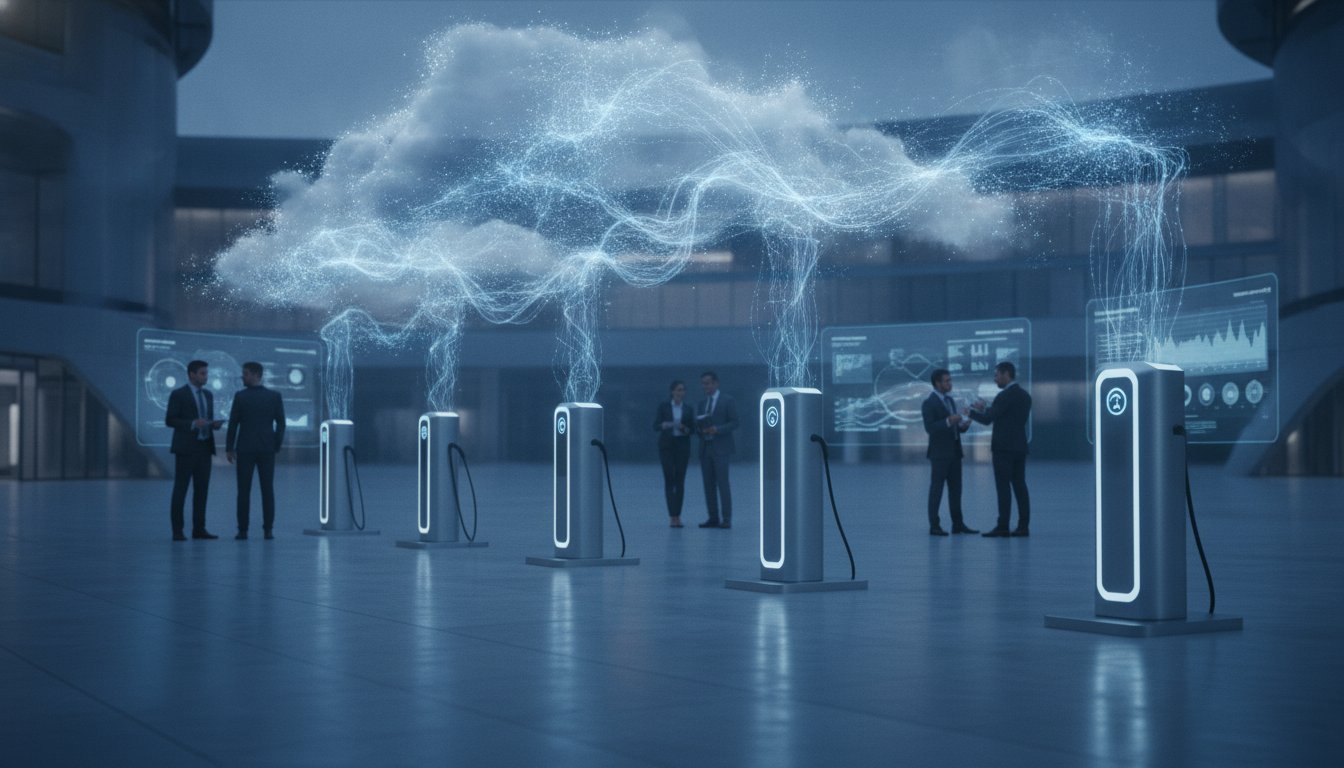
The era of the “dumb” plug is over. In the professional sector, a charging station is no longer just a piece of hardware bolted to a wall. It is a digital asset. Cloud-managed EV charging defines the integration of physical hardware with a central Software-as-a-Service (SaaS) platform via the internet. This connection transforms a passive electrical outlet into a dynamic, data-rich node within your business infrastructure.
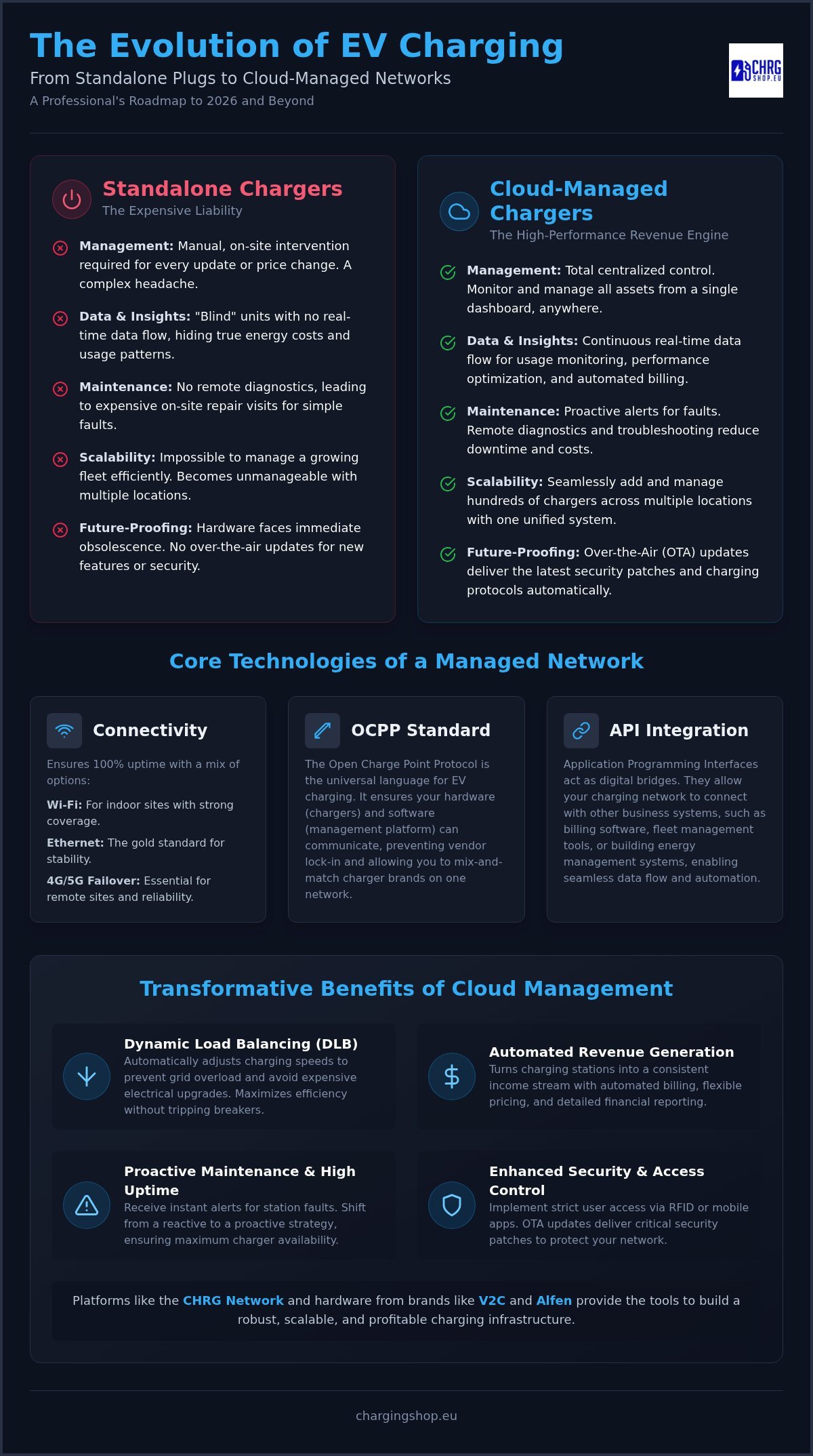
The difference between standalone and cloud-integrated stations is night and day. Standalone chargers are “blind” units that require manual intervention for every update or price change. Cloud-managed stations provide a continuous, real-time data flow. This allows you to monitor usage, adjust pricing, and troubleshoot faults from any location. By 2026, the industry has shifted from simple “connected” chargers to fully “managed” assets. While 2024 models focused on basic visibility, today’s EV charger fleet management requires autonomous optimization. Your system must now make smart decisions about power distribution and revenue collection without constant human oversight.
Central to this ecosystem is the Cloud Service Provider (CSP). The CSP acts as the brain of your operation, hosting the software that communicates with your hardware. This communication relies on the Open Charge Point Protocol (OCPP). It is the open-source standard that ensures your hardware and software speak the same language, preventing vendor lock-in and allowing for a mix of different charger brands on a single network.
The Core Technology: Internet Connectivity and APIs
Reliable management starts with a rock-solid connection. Most professional setups utilize a mix of connectivity types to ensure 100% uptime:
- Wi-Fi: Suitable for small, indoor installations with strong signal coverage.
- Ethernet: The gold standard for stability in commercial parking garages.
- 4G/5G LTE Failover: Essential for remote sites, ensuring the charger stays online even if the local network drops.
Application Programming Interfaces (APIs) are the secret sauce of integration. They allow your chargers to “talk” to external systems like your company’s billing software or a building management system. An API acts as the digital bridge, ensuring real-time data flows instantly between the charging station and the management dashboard.
The Death of the Standalone Charger
Local-only chargers are a liability in commercial environments. They fail because they cannot adapt. Without a cloud link, you have no way to perform remote diagnostics, leading to expensive on-site repair visits. Standalone hardware also faces immediate obsolescence. Cloud-managed assets receive over-the-air (OTA) updates, meaning your V2C or Alfen hardware stays current with the latest security patches and charging protocols. Scaling a fleet is impossible with disconnected units. You need one screen to manage fifty chargers across five locations to maintain a profitable EV charger fleet management strategy.
How Cloud Management Transforms EV Infrastructure Performance
Performance in 2026 is measured by reliability and financial efficiency. Cloud management allows you to strategically plan and control vehicle charging to avoid peak demand charges and maximize your existing electrical capacity. It shifts your operational strategy from reactive to proactive. Real-time monitoring gives you a birds-eye view of every port. If a station hangs or a session fails, you receive an instant alert. This visibility is the foundation of high-performance EV charger fleet management.
Dynamic Load Balancing (DLB) is your primary defense against grid overload. The cloud-based controller monitors your facility’s total power draw in real-time. It automatically throttles charging speeds when building demand spikes, ensuring you never trip a main breaker. Once demand drops, the system ramps speeds back up. This prevents expensive grid upgrades and keeps your infrastructure running at peak efficiency. Security is equally automated. Cloud platforms push firmware updates directly to your hardware. These over-the-air updates deliver new features and critical security patches without requiring a technician on-site. You can also implement strict User Access Control via RFID tags or mobile apps, ensuring only authorized personnel can access your power.
OCPP Compliance: The Universal Language of the Cloud
OCPP is the non-negotiable standard for any professional charging network. While OCPP 1.6 remains the baseline for basic connectivity, OCPP 2.0.1 is the 2026 requirement for advanced smart charging and enhanced cybersecurity. Using compliant hardware ensures your EV charger fleet management software remains flexible and future-proof. It allows you to swap software providers without replacing your physical chargers. For a deep dive into hardware-agnostic setup, see our CHRG Network Access guide.
Predictive Maintenance and Remote Troubleshooting
Hardware failure shouldn’t be a surprise. Cloud data identifies patterns, such as voltage fluctuations or overheating, to predict component failure before it happens. This allows you to schedule maintenance during off-peak hours rather than dealing with emergency outages. Most software glitches are solved through remote resets and configuration changes via the dashboard. Remote diagnostics save business owners up to 40% in O&M costs by eliminating the need for physical technician visits. Explore our professional wallbox range to find hardware designed for seamless remote management.
Local vs. Cloud Control: Solving the Connectivity Dilemma
The most common fear for any operator is the “offline” nightmare. What happens to your fleet when the internet connection drops? If you rely on a pure cloud model without local intelligence, your charging sessions might simply stop. This is why professional EV charger fleet management requires a nuanced approach to connectivity. You don’t have to choose between total cloud dependence and blind local control. The 2026 standard is the hybrid model.
Local control is reliable and fast. It handles immediate tasks like safety checks and cable locking without needing to talk to a server. However, it offers zero visibility into energy costs or user habits. Pure cloud control allows you to strategically control vehicle charging across multiple sites, but it introduces latency and a single point of failure. A hybrid setup provides the best of both. It uses the cloud for high-level data and billing while keeping critical operational logic on the device itself. Choose cloud control for scalability and local control for immediate session reliability.
The ‘Always-On’ Myth: Fallback Strategies
Don’t let a router failure paralyze your business. Professional hardware uses local caching to store authorization data. This means if a driver taps their RFID card while the station is offline, the charger recognizes them from a local “whitelist” and starts the session anyway. It syncs the data once the connection returns. For maximum reliability, look for hardware with integrated 4G/5G failover. The Alfen Single Pro Line 22kW Review highlights how this specific model maintains a constant link to the management platform, even when local Wi-Fi fails. It’s the ultimate insurance against downtime.
Security and Data Privacy in the Cloud
Your chargers shouldn’t be a backdoor into your corporate network. Modern cloud management platforms use end-to-end encryption to protect communication between the wallbox and the SaaS dashboard. This is critical for EV charger fleet management involving sensitive user data or payment information. Ensure your provider is fully compliant with GDPR and local data residency laws. This protects your business from liability and ensures that user charging sessions remain private. Secure your infrastructure by choosing hardware that supports the latest security certificates and regular, automated patches.
Selecting the Right Hardware for Cloud Integration
Hardware selection is the foundation of your EV charger fleet management strategy. In 2026, you shouldn’t buy a charger based on the plug alone. You need to evaluate the digital ecosystem. The goal is hardware-agnostic flexibility. This ensures you can switch software platforms without ripping out expensive infrastructure. Don’t get locked into a single manufacturer. A diverse fleet allows you to match specific hardware to the unique needs of different locations while keeping everything under one management screen.
To monetize your stations, MID-certified meters are mandatory. These ensure billing accuracy and legal compliance for commercial revenue generation. Without an integrated MID meter, your cloud management platform cannot legally charge users per kWh in most jurisdictions. Look for units that combine this metering with robust security features. High-performance hardware must support the latest encryption standards to prevent unauthorized access to your building’s network. Your choice today determines your operational freedom for the next decade.
Top AC Picks: V2C Trydan and Alfen Single Pro Line
The V2C Trydan 22kW leads the market in small business and residential multi-unit integration. It offers native compatibility with solar arrays and dynamic power control out of the box. It’s built for users who want deep integration with existing smart systems. In contrast, the Alfen Single Pro Line is an industrial-grade workhorse. It’s designed for high-traffic office and retail environments where durability is the primary requirement. Both units offer robust built-in connectivity, but Alfen excels in cellular failover stability for mission-critical uptime.
DC Power: V2C Denka and ABB Terra AC Solutions
When rapid turnaround is the priority, move to DC power. The V2C Denka 20kW DC wallbox provides fast charging in a compact, wall-mounted form factor. It’s the perfect solution for fleets that need quick top-ups between shifts without the footprint of a massive charging station. For a globally recognized fleet solution, the ABB Terra AC 22kW offers a robust platform with extensive technical support. Both options support advanced cloud-based load management, allowing you to prioritize specific vehicles based on departure times. This level of control is essential for a modern EV charger fleet management approach.
Ready to build your network? Shop our full range of cloud-ready chargers and get expert advice on your professional infrastructure.
The CHRG Network: Scaling Your Managed Infrastructure
Hardware alone won’t solve your logistics. You need a brain for your network. The CHRG Network acts as the ultimate hardware-agnostic management layer for your infrastructure. It doesn’t matter if you run V2C, Alfen, or ABB hardware; this platform unites them. Effective EV charger fleet management requires this level of cross-brand compatibility. It ensures you aren’t locked into a single vendor as you grow your footprint across different regions or facility types.
The transition from a cost center to a profit center is the primary goal for 2026 operators. You need tools that handle the “boring” parts of management-like billing and reporting-so you can focus on growth. The CHRG Network provides this through a streamlined activation process. Start with the right hardware, integrate with the management platform, and go live. We provide a Personalised Charging Offer to ensure your software configuration matches your specific business goals from day one.
Monetizing Your Assets: From Cost Center to Profit Center
Stop viewing charging as an expense. It is a revenue stream. Set custom tariffs for different user groups with a few clicks. You can offer discounted rates for employees while charging the public a market-competitive fee. The system handles all payment processing and provides monthly revenue reporting automatically. Transparency is built-in. The CHRG Network handles complex billing for multi-unit apartments by automatically splitting costs between residents and management based on individual usage data.
Fleet and Multi-Station Management
Managing one station is easy. Managing a thousand requires a professional dashboard. Track energy flow and station health across your entire global footprint from one screen. This centralized visibility allows you to spot issues before they impact your users. For corporate clients, the system generates detailed sustainability reports. These are essential for meeting ESG and carbon footprint requirements. You get the data you need for compliance without the manual spreadsheet work.
The path to a managed network is direct. Select your chargers, link them to the CHRG Network, and start generating ROI. Ready to lead the charge? Get a Personalized Charging Offer from Charging Shop today.
Future-Proof Your Charging Infrastructure Today
Transitioning from standalone hardware to a managed network is the single most important step for your long-term business ROI. You’ve seen how cloud integration turns a passive cost center into a high-performance revenue engine. By leveraging real-time monitoring, dynamic load balancing, and automated billing, you eliminate the complexity of manual oversight and grid strain. Professional EV charger fleet management is no longer a luxury; it’s the baseline for operational efficiency in 2026.
As an authorized distributor for V2C, Alfen, and ABB, we provide the high-performance hardware and the expert technical support needed for seamless CHRG Network integration. Our team is ready to help you navigate the transition from simple plugs to sophisticated, managed assets. We offer global shipping to ensure your project stays on schedule, no matter where your fleet is located. Don’t let your infrastructure become an expensive, disconnected liability. Take control of your energy future and start scaling your network with absolute confidence today.
Explore Cloud-Ready EV Chargers at Charging Shop
Frequently Asked Questions
Do cloud managed EV chargers require a monthly subscription fee?
Yes, most professional systems require a subscription to cover the costs of hosting, data processing, and continuous software updates. These fees allow you to access the central dashboard for monitoring and automated billing. While hardware is a one-time purchase, the cloud service provides the ongoing intelligence needed for profitable EV charger fleet management. It’s the engine that powers your remote diagnostics and revenue reporting.
Can I use any cloud management software with my OCPP-compliant charger?
Yes, that’s the primary benefit of the Open Charge Point Protocol. It prevents vendor lock-in by allowing hardware from V2C or Alfen to communicate with various management platforms. However, choosing an integrated solution like the CHRG Network ensures all features are fully optimized and supported. Always verify that your hardware supports the specific OCPP version required by your software provider to ensure seamless data transmission.
What happens to my EV charger if the cloud service provider goes out of business?
Your hardware remains functional because it follows open standards. Since professional units from brands like ABB or V2C use OCPP, you can simply point the charger to a new management server. You don’t need to replace the physical station. This flexibility is a core requirement for any long-term EV charger fleet management strategy. It protects your capital investment from software-related risks and ensures continuous operational uptime.
Is a cloud-managed charger more secure than a locally controlled one?
Cloud-managed chargers are generally more secure because they receive automated, over-the-air firmware updates. These patches fix vulnerabilities that a local-only charger would miss. Professional platforms use end-to-end encryption for all data transfers between the wallbox and the dashboard. While any internet-connected device requires basic network security, the ability to remotely monitor for suspicious activity provides a significant advantage over standalone units that lack visibility.
How much data does a cloud-managed EV charger consume per month?
Most stations consume between 50MB and 150MB of data per month under normal operation. This includes session data, heartbeats, and status updates. Consumption might spike briefly during firmware updates or when downloading high-resolution logs for troubleshooting. This low data requirement makes 4G or 5G LTE failover a highly cost-effective insurance policy for maintaining 100% connectivity in professional environments where Wi-Fi or Ethernet might be unstable.
Can I manage chargers from different brands under one cloud platform?
Yes, you can manage a diverse fleet of chargers under a single unified platform. Using a hardware-agnostic solution like the CHRG Network allows you to mix AC wallboxes like the V2C Trydan with DC units like the ABB Terra AC. This centralized dashboard simplifies your logistics by putting all usage data and billing tools in one place. It’s the most efficient way to scale infrastructure without managing multiple proprietary manufacturer apps.
Do I need a special internet connection for a commercial cloud-managed station?
You don’t need a special connection, but you do need a stable one. Commercial sites usually benefit from a hardwired Ethernet connection for maximum reliability. For outdoor or remote locations, hardware with integrated cellular modems provides a critical backup. Ensuring your network has a low latency connection is vital for real-time load management and instant payment authorization. Always prioritize stability to avoid session interruptions and revenue loss.
How does cloud management help with solar panel integration?
Cloud management acts as the coordinator between your solar array and your chargers. It uses real-time data to divert excess solar generation directly into your vehicles rather than selling it back to the grid for a lower rate. You can set specific rules to only charge when solar production is high. This optimization significantly lowers your total cost of ownership and maximizes the sustainability of your entire charging infrastructure.
