
 Deutsch
 Dansk
Dansk Suomi
Suomi Latviešu
 Lietuvių
 Norsk bokmål
 polski
 Русский
 Svenska
No products in the cart.
Uncategorized
EV Charging Infrastructure Hardware: The 2026 Comprehensive Guide

17
Aug
Aug
Would you spend $50,000 on technology that becomes a paperweight the moment you want to switch software providers? In 2026, choosing the wrong ev charging infrastructure hardware isn’t just a technical error; it’s a financial trap. You need hardware that works today and scales tomorrow without expensive rip-and-replace cycles. Efficiency is the only way to stay competitive in this fast-moving market.
We know the pressure. You’re facing a maze of AC versus DC requirements, shifting MID meter regulations, and the constant fear of hardware obsolescence. It’s frustrating to invest in infrastructure only to find it lacks the connectivity needed for modern billing. You want a system that’s compliant, efficient, and ready to generate a return on investment. We’re here to simplify that choice and secure your assets.
This guide changes everything. Master the technical components and industry standards required to build a high-performance, future-proof EV charging network. We break down essential hardware categories, from the V2C Denka DC Wallbox to the Alfen Single Pro Line. Get a clear framework for selecting hardware based on your specific use case while ensuring every unit meets critical 2026 standards like OCPP 2.0.1 and ISO 15118. Build a network that stays ahead of the curve.
Key Takeaways
- Recognize the shift from basic plugs to intelligent, networked assets that function as critical infrastructure in 2026.
- Determine the ideal power architecture by matching AC hardware to long-stay parking and DC fast chargers to high-turnover commercial hubs.
- Navigate essential 2026 standards like OCPP 2.0.1 and MID meter requirements to ensure your ev charging infrastructure hardware remains compliant and future-proof.
- Identify the best-fit hardware for your use case, from smart home solar integration with V2C Trydan to industrial reliability with ABB Terra AC.
- Learn how to transform physical charging units into managed, revenue-generating tools using the CHRG Network.
What is EV Charging Infrastructure Hardware in 2026?
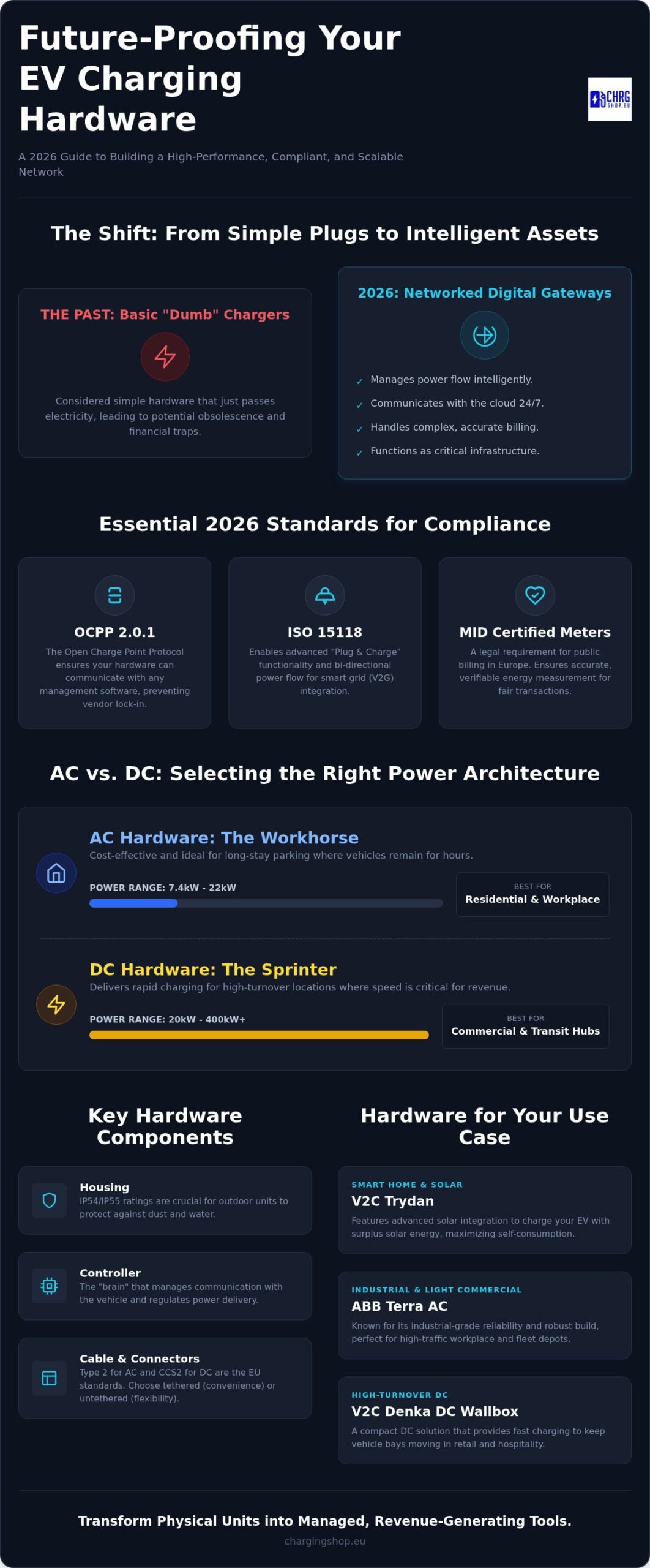
In 2026, ev charging infrastructure hardware isn’t just a plastic box on a wall. It’s a sophisticated, networked asset. We’ve moved past “dumb” chargers that simply pass electricity. Today’s hardware functions as a digital gateway between the vehicle and the grid. It manages power flow, communicates with the cloud, and handles complex billing. This hardware includes everything from the physical electric vehicle charging station unit to the internal metering systems and safety protection. You’re no longer just buying a plug; you’re investing in a communications hub that must remain online 24/7.
Safety and grid stability are the core priorities. High-quality hardware prevents overloads and protects both the vehicle’s battery and your building’s electrical system. Without robust internal components, you risk equipment failure or fire hazards. Every piece of ev charging infrastructure hardware must work in harmony to ensure reliable uptime. This reliability is what drives your return on investment. If the hardware is down, you aren’t just losing a charge; you’re losing revenue and customer trust. Don’t cut corners on the core build.
The Physical Components of an EVSE
Housing is your first line of defense. For outdoor deployment, look for IP54 or IP55 ratings. These protect against dust and water ingress. Inside, the controller acts as the brain. It manages the communication handshake with the car and regulates the exact amperage delivered. User interfaces have also evolved significantly. While some units use simple LEDs, others like the V2C Trydan feature advanced touchscreens for a premium user experience. These components must be durable enough to handle high-traffic commercial use without degrading over years of service.
Connectors and Cable Standards
Standardization is your friend. In the European market, Type 2 (Mennekes) is the dominant AC standard. If you’re looking at DC fast charging hardware, CCS2 is the industry go-to, though CHAdeMO still appears in specific fleet setups. You also need to decide between tethered and untethered cables. Tethered cables offer convenience for residential users. Untethered sockets provide flexibility in public spaces, as drivers bring their own cables. This reduces maintenance costs for you since cables are the most frequently damaged part of the hardware. Pick the standard that matches your local vehicle demographics to maximize usage.
AC vs. DC Hardware: Selecting the Right Power Architecture
Don’t guess your power needs. Choosing between AC and DC architectures determines your upfront costs and your long-term revenue. AC charging (Level 2) is the standard for long-stay parking. It’s the perfect fit for residential garages and workplace lots where cars sit for hours. DC fast charging (Level 3) is the heavy hitter. It’s critical for commercial fleets, transit hubs, and any location where time is money. The physical footprint difference is massive. AC units are usually compact wallboxes. High-power DC hardware requires large-scale cabinets to house heavy-duty transformers. Because DC systems convert power internally, they generate significant heat. This makes complex thermal management and cooling systems a requirement for any DC ev charging infrastructure hardware deployment. Understanding AC vs. DC charging hardware helps you avoid over-specifying or under-powering your site.
AC Hardware: The Workhorse of Residential Charging
AC units are cost-effective and easy to deploy. They typically range from 7.4kW single-phase to 22kW three-phase. For multi-unit dwellings, these are the gold standard. They balance grid load effectively without requiring massive electrical upgrades. The ABB Terra AC 22kW charger is a prime example of industrial-grade reliability in a compact form. It’s built for high-performance residential and light commercial use. If your users park for four hours or more, AC is the right move for your ev charging infrastructure hardware budget. It provides reliable energy delivery without the extreme infrastructure costs of high-voltage DC lines.
DC Hardware: Rapid Solutions for Business
Speed generates turnover. DC hardware bypasses the vehicle’s onboard charger to pump energy directly into the battery. This allows for 20kW to 400kW+ capabilities. High-turnover locations like hotels and retail centers need this speed to keep bays moving. The V2C DENKA 20kW DC Wallbox fills the gap between slow AC and massive, expensive ultra-fast units. It offers rapid charging in a compact cabinet. This is the ultimate tool for businesses that need to turn over charging bays quickly. If you want to maximize daily throughput, DC is your only choice. If you’re unsure which power level fits your site, check out our Personalised Charging Offer to get an expert recommendation tailored to your electrical capacity.
Core Standards: OCPP, MID Meters, and Connectivity
Standards aren’t just red tape; they’re your insurance policy. In 2026, the intelligence of your ev charging infrastructure hardware is defined by its ability to communicate. Without standardized protocols, you’re stuck with a closed system that can’t adapt to new software. Modern hardware must include robust connectivity modules. Ethernet provides the highest reliability for commercial sites. Wi-Fi offers easy setup for residential use. 4G/5G LTE modules are essential for remote locations where local networks are unavailable. These modules ensure your chargers stay visible on the network 24/7. Beyond communication, you need hardware-level load balancing. This allows you to manage multiple units on a single circuit. It prevents grid overloads without the need for expensive transformer upgrades. Following federal infrastructure standards ensures your hardware remains eligible for incentives and meets strict interoperability rules.
Why OCPP 2.0.1 is the 2026 Benchmark
Don’t get locked in. OCPP 2.0.1 is the mandatory foundation for professional 2026 deployments. It stops manufacturers from trapping you in their proprietary software. If you want to switch your management platform, OCPP-compliant hardware makes it a simple remote update. It also introduces advanced security features to prevent station hacking and unauthorized access. Crucially, it provides the backbone for ISO 15118 support. This enables “Plug & Charge” functionality. The car identifies itself and starts charging automatically. No cards. No apps. Just seamless utility for the driver and guaranteed revenue for you.
MID Meters and Billing Compliance
If you’re selling power, you need an MID meter. It’s a legal requirement for billing accuracy. Standard internal meters often lack the precision required for commercial electricity resale. You need ev charging infrastructure hardware with integrated, certified MID meters to stay compliant and avoid legal disputes. The Alfen Single Pro Line 22kW sets the benchmark here. It features built-in MID metering designed specifically for professional billing environments.
- Integrated meters: Save space and simplify the physical installation.
- Accuracy: Certified precision ensures you get paid for every kWh delivered.
- Compliance: Meets the EU Measuring Instruments Directive requirements for 2026.
Choosing hardware with these built-in standards protects your investment. It ensures your site is ready for the next decade of EV technology.
Hardware Requirements for Different Use Cases
One size does not fit all. Your environment dictates your ev charging infrastructure hardware requirements. A residential unit built for a private garage will fail in a high-traffic retail lot. Public and retail locations demand vandal-resistant builds with IK10 impact ratings. These sites also require integrated payment terminals to meet 2026 consumer protection standards. Fleet operations have different priorities. They need high-duty cycle hardware capable of running 24/7. Remote diagnostic capabilities are Auction essential for fleets to ensure every vehicle is topped up before the next shift. Don’t over-spec for a home or under-spec for a depot. Match the hardware to the mission. For those looking to expand their green mobility offerings to include electric bicycles, The Cycle Centre provides a range of world-class brands that complement a comprehensive charging strategy.
Homeowners in 2026 want more than just a plug. They want energy independence. Integrating your charger with Home Energy Management Systems (HEMS) is now the baseline. The V2C Trydan 22kW leads this category. It features native solar integration, allowing it to communicate directly with your PV inverters. It prioritizes excess solar gain to charge your car for free. Dynamic load balancing is another critical component. It monitors your home’s total electrical load in real-time. If you turn on a heat pump or an induction hob, the hardware automatically throttles the charger. This prevents blown fuses and keeps your household running smoothly.
Commercial and Multi-Tenant Solutions
Business environments demand control and durability. Workplace charging relies on multi-user management to track energy use by employee or department. You need RFID access control to prevent unauthorized sessions. The ABB Terra AC is the professional choice for these settings. It offers industrial-grade reliability and secure mounting options to prevent tampering. In multi-tenant buildings, space is a premium. Dual-socket hardware allows you to charge two vehicles from a single pedestal. This optimizes parking layouts and reduces the overall cost of your ev charging infrastructure hardware deployment. Secure locking mechanisms ensure the cables stay where they belong, even in shared parking zones.
Ready to secure the right units for your project? Browse our curated collection of professional EV hardware today.
Deploying Your Infrastructure with Charging Shop
Speed is your biggest advantage in the 2026 market. You need a partner that moves as fast as the technology. At Charging Shop, we don’t just sell boxes; we provide a gateway to a high-performance network. We curate world-leading ev charging infrastructure hardware from brands like ABB, V2C, and Alfen. These aren’t just random selections. Every unit is chosen for its reliability, compliance, and ease of integration. Our fast global shipping ensures your time-sensitive projects stay on track. Don’t let logistical delays stall your ROI. We get the gear to your site when you need it. If your project has unique constraints, our Personalised Charging Offer provides a tailored hardware list designed specifically for your location’s electrical capacity and user profile.
Procuring the right ev charging infrastructure hardware is only the first step. You need a deployment strategy that minimizes friction. We focus on accessibility and technical authority. This means we strip away the fluff and focus on the metrics that matter: uptime, compatibility, and durability. Whether you’re installing a single V2C Trydan or a fleet of ABB Terra AC units, our logistics team handles the heavy lifting. You get high-performance gear delivered with professional efficiency. We understand the practical needs of hardware owners because we live and breathe this technology every day.
The CHRG Network Advantage
Hardware is only half the battle. To truly own your assets, you need total control. Linking your units to the CHRG Network transforms your physical chargers into a managed ecosystem. You get a powerful management dashboard to monitor every session in real-time. Automated billing handles the complexity of electricity resale for you. It’s built for hardware owners who value their time. Maximizing uptime is easy with our integrated remote diagnostics. Instead of sending a technician for every minor glitch, you can often resolve issues directly from the cloud. This keeps your maintenance costs low and your chargers ready for action.
- Real-time Monitoring: Track energy consumption and station status instantly.
- Automated Billing: Secure payments and manage tariffs without manual intervention.
- Remote Diagnostics: Identify and fix hardware errors from your desk.
Next Steps for Infrastructure Success
Success starts with a plan. Before you select your hardware, audit your site’s electrical capacity. Knowing your peak load prevents expensive surprises during the installation phase. If you’re torn between top-tier options, read our ABB Terra AC vs Alfen Single Pro Line comparison guide. It breaks down the technical specs you need to make an informed choice. Once you’ve mapped out your needs, get a professional hardware quote from our team. We’ll help you secure a future-proof setup that’s ready for the 2026 standards and beyond. Don’t wait for the competition to move first. Build your network today.
Secure Your 2026 Infrastructure Today
The landscape has shifted. In 2026, your ev charging infrastructure hardware is either a strategic asset or a costly liability. You’ve learned how critical it’s to choose hardware that supports open standards like OCPP 2.0.1 to avoid vendor lock-in. You also know that matching your power architecture to your site’s specific turnover rate is the only way to maximize ROI. Whether it’s the solar-ready V2C Trydan for a home or the industrial reliability of the ABB Terra AC for a workplace, the right hardware choice defines your success.
Don’t let outdated gear hold your network back. We’re an authorized distributor of ABB, Alfen, and V2C, giving you direct access to the world’s most reliable chargers. Every unit we sell integrates seamlessly with the CHRG Network, putting total asset control in your hands. With our fast global shipping on all infrastructure assets, you can start building your high-performance network immediately. Take control of your energy future and generate revenue with confidence. Your future-proof network starts here.
Shop Premium EV Charging Hardware Now
Frequently Asked Questions
What is the most important hardware standard for EV charging?
OCPP 2.0.1 is the critical benchmark for 2026. This standard ensures your ev charging infrastructure hardware can communicate with any management software, preventing vendor lock-in. ISO 15118 is also vital for enabling Plug & Charge functionality. These protocols secure your investment for the next decade. Without them, you risk owning orphaned hardware that cannot update to meet new grid requirements or payment security protocols. Always verify compliance before purchase.
Do I need a DC wallbox for my business, or is AC enough?
You must install hardware with an integrated MID meter to bill tenants legally. Standard internal meters lack the legal precision required for electricity resale in many jurisdictions. Combine this with an OCPP-compliant station to link your hardware to a management platform like the CHRG Network. This setup automates the billing process. It ensures every kWh is tracked accurately and payments are distributed to you without manual bookkeeping errors or disputes.
Can I manage multiple hardware brands on one network?
Yes, you can manage a mix of brands like ABB, Alfen, and V2C on a single dashboard. The key is ensuring every unit is OCPP compliant. This open protocol acts as a universal language. It allows different ev charging infrastructure hardware to report data to the same central management system. This flexibility lets you expand your network with different models as your site needs evolve without needing multiple software accounts or specialized interfaces.
What is an OCPP compliant charging station and why does it matter?
An OCPP compliant station uses the Open Charge Point Protocol to communicate with a back-end management system. It matters because it gives you the freedom to choose your software provider. If you are unhappy with your current network, you can switch to another without replacing the physical hardware. In 2026, version 2.0.1 is the standard for enhanced security and smart grid features. It protects your business from being trapped by proprietary manufacturers.
How do I protect my charging hardware from vandalism in public areas?
Look for hardware with an IK10 impact rating for maximum physical protection. This rating confirms the housing can withstand high-energy impacts in public spaces. Use untethered stations to prevent cable theft or vandalism. Secure the units using professional mounting pedestals with internal cabling. Additionally, choose hardware with built-in RFID access or app-based locks to ensure only authorized users can initiate a session. This reduces the risk of unauthorized tampering and equipment damage.
Is 22kW hardware compatible with all electric vehicles?
Yes, 22kW hardware is compatible with all EVs using a Type 2 connector. However, the car’s onboard charger determines the actual speed. Most modern EVs only accept 7kW or 11kW via AC. The 22kW station will automatically communicate with the vehicle and throttle the power to the safe maximum the car can handle. Investing in 22kW hardware like the Alfen Single Pro Line future-proofs your site for vehicles with higher AC intake capacities.
What are the maintenance requirements for EV infrastructure hardware?
EV hardware is designed for low maintenance, but it isn’t a set and forget asset. Perform quarterly visual inspections for physical damage or cable wear. Keep the firmware updated via the cloud to ensure the latest security patches and vehicle compatibility. For public units, check the cooling vents for obstructions. While the hardware is robust, regular software health checks through your management dashboard help you identify and resolve minor communication errors before they lead to downtime.
