
 Deutsch
 Dansk
Dansk Suomi
Suomi Latviešu
 Lietuvių
 Norsk bokmål
 polski
 Русский
 Svenska
No products in the cart.
Uncategorized
Commercial EV Charging Station Management: The 2026 Business Guide
08
Aug
Aug
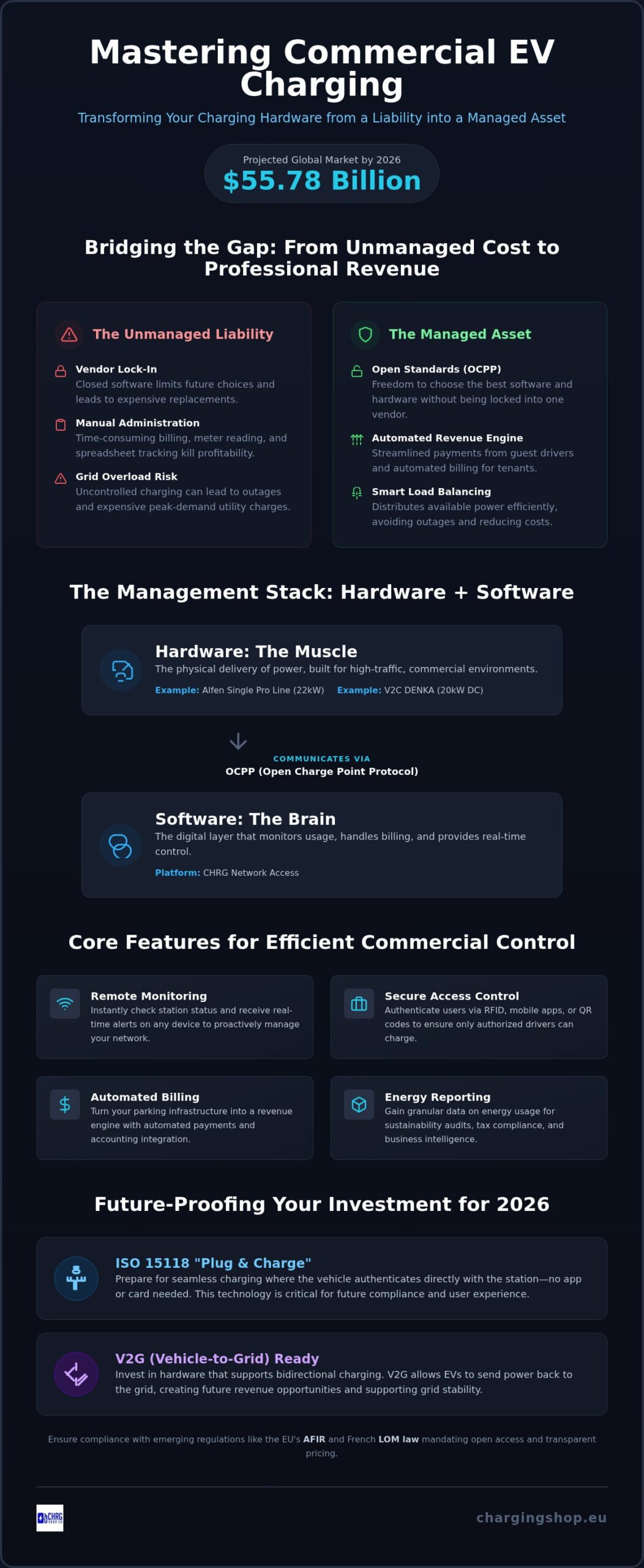
Your charging hardware is a liability until it becomes a managed asset. With the global market hitting $55.78 billion in 2026, the gap between a simple utility and a professional revenue engine has never been wider. Mastering commercial ev charging station management is the only way to bridge that gap. You need more than just a plug. You need a system that works while you sleep.
You likely feel the weight of administrative tasks like manual billing or the constant fear of grid overload. Nobody wants to be stuck in a vendor lock-in with closed software that limits your future choices. We agree that your infrastructure should be an asset, not a burden. It’s time to replace manual headaches with automated efficiency and turn technical complexity into a clear, measurable ROI.
This guide teaches you to master the technical and commercial requirements of the current charging landscape. We’ll show you how to build a network that’s both reliable and profitable. You’ll discover how the CHRG Network simplifies remote monitoring and why open standards are non-negotiable. From the industrial-grade Alfen Single Pro Line to the high-speed V2C DENKA, we’ll help you select hardware that secures your business for the long term.
Key Takeaways
- Learn to bridge the gap between physical hardware and business accounting with a dedicated digital management layer.
- Master commercial ev charging station management by implementing real-time remote monitoring and secure access via RFID or mobile apps.
- Turn your parking infrastructure into a revenue engine with automated billing systems that streamline payments from guest drivers.
- Match your site requirements to industrial-grade hardware like the Alfen Single Pro Line or V2C DENKA for maximum uptime.
- Future-proof your investment for 2026 with ISO 15118 “Plug & Charge” capabilities and V2G-ready technology.
What is Commercial EV Charging Station Management?
A charging station without management is just a glorified extension cord. In 2026, commercial ev charging station management is the digital layer that transforms raw power into a business asset. It controls who can charge, how much they pay, and how much electricity flows at any given second. This system bridges the gap between your physical wallboxes and your company’s accounting software. It’s the difference between an unmonitored cost center and a streamlined revenue stream.
Static “plug-and-play” stations are obsolete. New regulations like the EU’s AFIR and the French LOM law now mandate transparent pricing and open access for non-residential buildings. Effective management ensures you comply with these standards while maximizing your ROI. Whether you operate a parking lot, a workplace, or a multi-tenant residential complex, you need a system that handles the heavy lifting automatically. It secures your facility against unauthorized use while ensuring every kilowatt is accounted for, often with the support of industrial electrical and automation systems from Tesla Electrical Company.
The Management Stack: Hardware vs. Software
Think of your setup in two parts. The hardware is the physical delivery of power. We focus on industrial-grade units like the Alfen Single Pro Line 22kW or the V2C DENKA 20kW DC Wallbox. These are the workhorses of the electric vehicle charging infrastructure, built for durability in high-traffic parking environments. They provide the raw performance, but they need instructions to be useful.
The software is the brain. Systems like CHRG Network Access monitor usage in real-time and handle complex billing cycles. These two layers communicate via OCPP (Open Charge Point Protocol). This standard prevents vendor lock-in; it allows your software to “talk” to different hardware brands like ABB or V2C seamlessly. It’s the only way to build a flexible, scalable network that grows with your business needs.
Why Businesses are Moving to Managed Networks
Manual management is a recipe for failure. Nobody has time to read meters or track spreadsheets for tenant billing. Managed networks automate the entire process. The money moves from the driver to your account without a single administrative touchpoint. You get clean data and automated payouts, stripping away the administrative burden that kills profitability.
Managed systems also protect your local grid. Dynamic load management prevents expensive peak-demand charges by balancing power across multiple units. It’s about efficiency. You provide a professional user experience for guests and employees while keeping your operational costs low. Advanced commercial ev charging station management turns a technical requirement into a high-performance profit center.
Core Features for Efficient Commercial Control
Control is power. Without it, you’re just guessing. High-performance commercial ev charging station management relies on four pillars: visibility, access, safety, and data. Remote monitoring lets you check station status from any device instantly. You get real-time alerts. You fix problems before the customer even notices. Access control adds the security layer you need in public spaces. Use RFID cards, mobile apps, or QR codes to authenticate users. This ensures only authorized tenants or paying guests use your electricity. Energy reporting then provides the granular data you need for sustainability audits and tax compliance. It turns raw usage into actionable business intelligence.
OCPP Compliance: Avoiding Vendor Lock-in
OCPP (Open Charge Point Protocol) is non-negotiable for 2026. It’s the universal language between hardware and software. If your software provider raises prices or fails to innovate, you switch. You don’t rip out your chargers. You simply point the hardware to a new cloud. Investing in OCPP compliant charging stations is the only way to protect your long-term capital. Don’t buy into a closed ecosystem. It’s a trap that leads to expensive hardware replacement down the road. Open standards give you the leverage to negotiate better terms and access the latest features as the market evolves.
Dynamic Load Management for Parking Lots
Your local grid has physical limits. Dynamic load management prevents site-wide outages by distributing available power across your entire network. Whether you have 10 or 50 stations, the system balances the load based on real-time demand. Implementing Smart Charge Management reduces operational costs and avoids utility penalties for peak demand. It’s about working smarter with the capacity you already have.
You can even set priorities. Program your system to favor VIP guests or mission-critical fleet vehicles over standard guest charging. Many advanced systems now integrate directly with Building Energy Management Systems (BEMS). This allows your chargers to sync with the building’s total power draw, ensuring the lights stay on while the cars stay charged. This level of technical precision is essential for modern commercial ev charging station management. Ready to optimize? Check out our tailored commercial solutions to find the right fit for your facility.
Monetizing Your Parking Lot: Billing and Revenue
Stop viewing your parking lot as a sunk cost. High-performance commercial ev charging station management turns every parking space into a revenue engine. When you automate the billing process, you remove the human element that causes errors and delays. The money moves directly from the driver’s app or RFID card to your business account. You don’t need to chase payments. You don’t need to reconcile messy spreadsheets. The system does the work for you.
Success depends on a structured approach to EV charging station maintenance and management. You must offer flexible pricing models to stay competitive and profitable. Some sites work best with a simple flat fee per session. Others benefit from per-kWh pricing, ensuring you’re paid for every unit of energy delivered. You can even implement time-based fees to discourage “squatting” once a car is fully charged. This keeps your stations turning over and maximizes your daily throughput. It’s about optimizing every minute of uptime.
Managing different user groups is just as simple. You can set specific rates for employees, long-term tenants, and one-time guests. This allows you to offer charging as a free perk for staff while still generating a profit from visitors. Your management software handles these permissions instantly, applying the correct tariff the moment a session starts.
The Role of MID Meters in Commercial Billing
Selling electricity is a regulated activity. If you charge per kWh, you need hardware with a built-in MID (Measuring Instruments Directive) meter. This isn’t optional; it’s a legal requirement for commercial billing in most regions. These meters ensure the driver is billed for exactly what they receive. Units like the Alfen Single Pro Line 22kW come with these meters pre-installed. This hardware integrates directly with your management software, sending precise consumption data to the cloud for instant invoicing. It protects you from legal risks and provides transparency for your customers.
Using CHRG Network to Automate Revenue
The CHRG Network is your financial command center. It allows you to set up custom tariffs for different user groups without any technical headaches. Everything is handled within a single, intuitive dashboard. Automated payouts mean your revenue arrives on a predictable schedule, complete with tax-ready financial reporting that your accounting team will love. Learn how to reduce EV charging costs with CHRG Network to keep your margins high while providing a top-tier service. This level of automation is the backbone of profitable commercial ev charging station management in 2026.
Selecting Hardware for Managed Commercial Environments
Hardware selection is where your business plan meets reality. You can’t run effective commercial ev charging station management on consumer-grade gear. Your choice between 22kW AC and DC Fast Charging defines your customer base. High-traffic retail sites need speed. Long-stay parking needs volume. Select hardware that matches the dwell time of your visitors. If they stay for hours, AC is your best friend. If they’re in and out in thirty minutes, you need a DC solution to keep the revenue flowing.
Dual-socket configurations are a smart play for space-constrained lots. You double your charging ports without doubling your footprint or trenching costs. Connectivity is equally critical. Remote management fails without a rock-solid data link. Ethernet is the gold standard for reliability, but 4G/5G connectivity provides the flexibility needed for sprawling outdoor lots where running data cables is too expensive. To ensure maximum uptime, many businesses source their networking infrastructure from experts like GenX Systems LLC. Choose wisely. Your hardware is the only part of the system your customers actually touch. It must be durable, intuitive, and always online.
The Professional Choice: Alfen and ABB
Alfen and ABB are the industry benchmarks for a reason. The Alfen Single Pro Line 22kW is industrial reliability personified. It’s smart grid ready and built to handle constant, high-load cycles in semi-public environments. For those managing large-scale corporate fleets, the Abb terra ac provides a global standard for safety and integration. Before you commit to a purchase, compare single phase vs three phase EV chargers to ensure your electrical infrastructure can support the load. Selecting the wrong phase leads to bottlenecks that software can’t fix.
High-Performance DC Options: V2C Denka
Sometimes AC charging is too slow for your business model. The V2C DENKA 20kW DC Wallbox provides a middle ground. It delivers DC speed in a compact form factor, allowing for a rapid turnaround in high-traffic parking lots. This unit is perfect for retail environments where customers expect a significant charge in a short window. You manage these DC assets through the same unified dashboard as your AC units, keeping your operations simple and your data centralized. It’s high-speed performance without the massive utility transformer costs of ultra-fast chargers.
Ready to upgrade your infrastructure? Browse our professional commercial hardware here to find the perfect fit for your facility.
Future-Proofing Your Management Strategy for 2026
The technology landscape is moving fast. By 2026, a standard charging setup won’t be enough to stay competitive. You need a strategy that anticipates shifts in user behavior and grid demands. High-performance commercial ev charging station management is now about more than just uptime. It’s about integration. You must turn your parking lot into a smart energy hub that responds to the market in real-time. Planning for tomorrow today is the only way to protect your margins.
Scalability is your biggest asset. Don’t trap yourself with a system that requires a total software overhaul every time you add a new port. Your management platform should allow you to expand from two chargers to two hundred with zero friction. Cybersecurity is equally vital. As your network grows, so does your profile as a target. Protecting your data and your hardware from unauthorized access is a baseline requirement, not an optional extra. Use encrypted protocols and secure cloud gateways to keep your infrastructure safe from digital threats.
Vehicle-to-Grid (V2G) technology is also moving from concept to reality. This allows your fleet or guest vehicles to serve as a giant battery, pushing power back to the building during peak demand. It’s a powerful tool for reducing energy costs and supporting grid stability. Choosing V2G-ready hardware now saves you from expensive upgrades later. It turns your chargers into active participants in the energy market.
Preparing for Plug & Charge
The driver experience is evolving toward total invisibility. ISO 15118 enables “Plug & Charge,” a protocol where the vehicle identifies itself to the station automatically the moment it’s plugged in. The handshake happens in seconds. It eliminates the need for RFID cards, QR codes, or mobile apps. This is the ultimate seamless experience. To support this, you need hardware like the Alfen Single Pro Line with the correct communication controllers. It’s the new standard for premium commercial sites that value user convenience.
Scaling Your Network with Charging Shop
Growth shouldn’t be painful. We help you start small and scale as your demand increases. Whether you’re managing a single office lot or a global portfolio, our systems are built for expansion. Don’t guess your requirements. Get a personalised charging offer for your business to ensure your commercial ev charging station management strategy is built on solid ground. We provide the expert support and industrial-grade hardware you need for successful, long-term deployments. Secure your infrastructure now and lead the market in 2026.
Secure Your Infrastructure and Scale for 2026
You’ve seen how commercial ev charging station management bridges the gap between basic utility and a professional revenue engine. Success in this sector requires more than just high-performance hardware from brands like Alfen, ABB, or V2C. It demands a digital backbone like the CHRG Network to automate billing and protect your local grid. By choosing OCPP-compliant systems and preparing for ISO 15118 standards, you ensure your parking lot remains a competitive asset as the market evolves toward Plug & Charge simplicity.
Don’t let technical complexity slow your growth. We combine global shipping with deep technical expertise to deliver immediate solutions for your facility. It’s time to move beyond manual billing and unmanaged loads. Whether you need the industrial reliability of an Alfen Single Pro Line or the rapid turnaround of a V2C DENKA DC wallbox, the right strategy starts with a clear plan. We make the transition seamless so you can focus on your core business.
Get a Personalised Commercial Charging Offer Today and start building your future-proof network. Your path to efficient, profitable charging is just one click away.
Frequently Asked Questions
How do I bill different users for EV charging in a commercial parking lot?
Use a management platform like CHRG Network to set custom tariffs for specific user groups. Assign RFID cards to employees for discounted rates while requiring guests to pay full price via QR code or mobile app. The system automates the entire payout process. Money moves from the driver to your account without any manual administrative work.
What is the difference between managed and unmanaged EV chargers?
Managed chargers connect to a central cloud to control access, power distribution, and billing. Unmanaged or “dumb” chargers simply deliver power to any vehicle that plugs in. For commercial ev charging station management, managed units are essential. They prevent electricity theft and ensure your building’s electrical supply never overloads during peak hours.
Do I need a special subscription for commercial EV charging software?
Professional management requires a subscription to a Charge Point Management System (CPMS) like CHRG Network Access. This fee covers your cloud connectivity, real-time monitoring, and automated billing engine. It’s the operational cost that transforms your physical hardware into a scalable, profitable business asset. Think of it as the operating system for your charging revenue.
Can I manage chargers from different brands in one system?
You can manage multiple brands in one dashboard if every station is OCPP compliant. Open standards allow you to mix hardware from Alfen, ABB, and V2C seamlessly. This flexibility prevents vendor lock-in. It lets you choose the best hardware for specific parking zones while keeping all your usage data and financial reporting in one centralized location.
Is OCPP 2.0.1 necessary for my business in 2026?
It’s the gold standard for long-term future-proofing. While OCPP 1.6J remains functional, version 2.0.1 offers superior cybersecurity and supports advanced features like “Plug & Charge” via ISO 15118. Choosing 2.0.1 compliant hardware, such as the Alfen Single Pro Line, ensures your infrastructure meets the latest industry requirements and stays relevant for years to come.
How does load balancing work in a multi-charger parking environment?
The software monitors your site’s total power draw and throttles individual chargers to stay under a safe limit. It prevents blown fuses and expensive peak-demand penalties from your utility provider. You can even prioritize specific ports. Ensure your mission-critical fleet vehicles get maximum speed while guest cars charge at a balanced, reduced rate.
What are the legal requirements for selling electricity to EV drivers?
You must use hardware with certified MID meters to bill users by the kilowatt-hour. Regulations like the EU’s AFIR mandate transparent pricing and ad-hoc payment options for any public-facing station. Always verify local energy resale laws to ensure your commercial ev charging station management strategy remains fully compliant with regional transparency and consumer protection standards.
Can I remotely reset or troubleshoot a charging station?
Remote diagnostics are a standard feature of professional managed networks. You can restart stations, push firmware updates, or unlock stuck cables directly from your management dashboard. This capability slashes your operational costs. It reduces the need for physical maintenance visits and keeps your uptime high, ensuring a reliable experience for every driver in your lot.
