
 Deutsch
 Dansk
Dansk Suomi
Suomi Latviešu
 Lietuvių
 Norsk bokmål
 polski
 Русский
 Svenska
No products in the cart.
Uncategorized
The Complete Guide to Type 2 Level 2 EV Chargers (2026)
28
Jul
Jul
Stop treating your high-performance electric vehicle like a smartphone that can just trickle-charge on a standard household plug. If you’re still relying on a basic Level 1 cable, you’re losing hours of road time every single day. You want faster speeds and lower bills, but the technical jargon around phases and kilowatts makes every purchase feel like a risk. It’s time to simplify your setup. Choosing the right type 2 ev charger is the single most important upgrade you’ll make for your home or business.
We understand the frustration of slow charging and the fear of buying hardware that might be obsolete by next year. You need a solution that works for every Type 2 vehicle and integrates with smart energy management. This guide delivers exactly that. You’ll master the essentials of Level 2 charging to slash your wait times and future-proof your installation for 2026. No more guessing; just high-speed results.
Get ready to cut through the noise. We’re breaking down everything from the 22kW power of the V2C Trydan to the professional-grade Alfen Single Pro Line. You’ll learn how to optimize your charging phases and use the CHRG Network to take total control of your energy costs. Let’s get your EV powered up properly and ready for the road.
Key Takeaways
- Decode the technical jargon of the Mennekes plug to understand why Level 2 AC power is the universal standard for rapid daily charging.
- Learn how to maximize your output up to 22kW by choosing between single-phase and three-phase power configurations.
- Select the perfect type 2 ev charger for your property, from solar-integrated home units like the V2C Trydan to commercial-grade Alfen hardware.
- Ensure long-term battery health and site safety by moving away from standard domestic sockets to dedicated, stable Level 2 wallboxes.
- Future-proof your installation with OCPP smart features and the CHRG Network for seamless remote management and energy cost control.
What is a Type 2 Level 2 EV Charger?
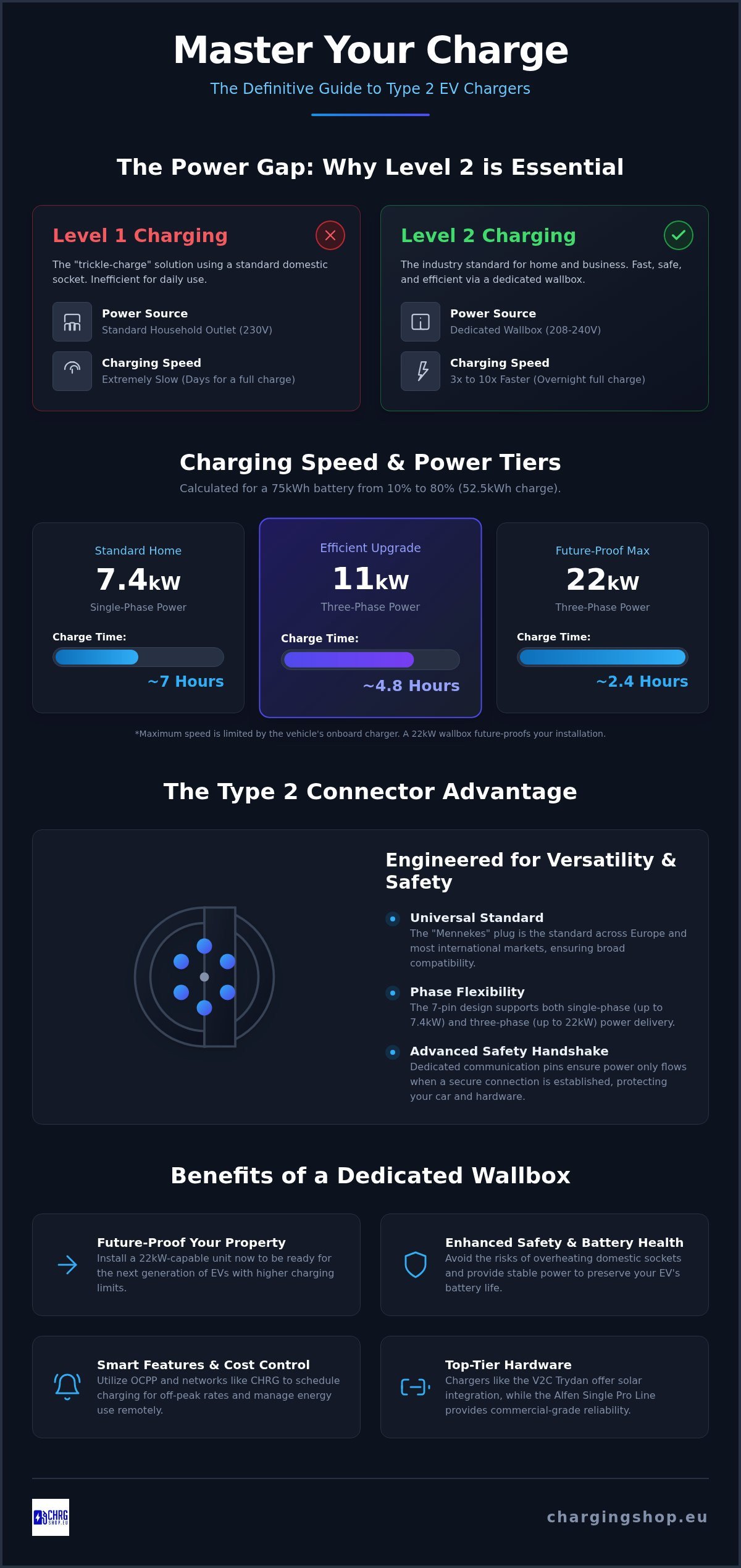
A type 2 ev charger is the bridge between the power grid and your vehicle’s performance. To master your setup, you must separate the plug type from the power level. Level 2 charging utilizes 208-240V AC power. This represents a significant jump from standard 230V domestic sockets. By using a dedicated circuit, Level 2 hardware delivers energy at a rate that basic outlets can’t sustain without overheating.
The Type 2 plug, globally recognized as the Mennekes plug, is the physical interface for this power. It is the universal standard across Europe and most international territories. If you own an EV, you likely interact with this seven-pin connector daily. It hits the perfect “sweet spot” for modern infrastructure. It provides enough speed to refill a long-range battery while you sleep, yet remains efficient for workplace parking. Almost every modern EV supports this standard. Whether you drive a luxury sedan or a compact commuter, a Type 2 wallbox is your gateway to reliable energy.
Level 1 vs. Level 2: The Power Gap
Stop waiting days for a full charge. Level 1 charging, which uses standard household outlets, is a “trickle” solution. It’s often too slow for anyone driving more than 30 kilometers a day. You’ll find yourself constantly checking the range and worrying about the next trip. Moving to Level 2 changes your entire ownership experience. A dedicated wallbox increases charging speeds by 3x to 10x, depending on your specific amperage and vehicle limits. Level 2 charging is the definitive industry standard for 2026 home installations because it delivers the fastest possible AC speeds without requiring industrial-grade grid upgrades.
The Anatomy of a Type 2 Connector
The seven-pin layout of the Type 2 connector is engineered for safety and extreme versatility. While the North American J1772 (Type 1) plug is limited to single-phase power, the Type 2 design handles both single-phase and three-phase electricity. This flexibility allows the same plug to deliver anywhere from 7kW to 22kW of power. Two pins are reserved for a sophisticated safety “handshake.” This protocol ensures that power only flows once the charger and the car are perfectly synced. It eliminates the risk of electrical arcs and protects your vehicle’s sensitive onboard electronics. This is professional-grade hardware designed for the demands of the modern driver.
Charging Speed and Power: 7kW vs. 11kW vs. 22kW
Power isn’t magic; it’s physics. To understand your type 2 ev charger performance, you must look at the math. Total kilowatts (kW) result from multiplying Volts by Amps. In a standard single-phase setup, 230V at 32A gives you roughly 7.4kW. Move to three-phase power, and that capacity triples. This is how high-performance wallboxes reach the 22kW mark. Understanding this relationship helps you avoid buying underpowered hardware that leaves you stranded with a half-empty battery.
Your wallbox is just one part of the equation. The car’s on-board charger acts as a gatekeeper. If your vehicle is capped at 11kW, plugging it into a 22kW Alfen Single Pro Line 22kW won’t make it charge faster. You’ll still get 11kW. Despite this, investing in a 22kW unit is the definitive move for 2026. It future-proofs your property. As battery technology evolves, higher on-board limits will become standard. Don’t build for the car you have today; build for the car you’ll buy tomorrow. You can browse our professional-grade 22kW chargers to see the latest options.
Calculating Your Charging Time
Stop guessing when your car will be ready for the road. Use this simple formula: Battery Capacity (kWh) / Charger Power (kW) = Hours to charge. Real-world factors often interfere. Cold weather, battery state of charge (SoC), and local grid load can all throttle your speed. Consider a 75kWh battery. To charge it from 10% to 80%, you need to deliver 52.5kWh of energy. On a standard 7.4kW charger, this takes over 7 hours. On a 22kW system, it drops to under 2.5 hours, provided your vehicle can handle the intake. Efficiency saves you more than just time; it optimizes your daily schedule.
Phase Optimization for Type 2
Phases are the secret to unlocking elite charging speeds. Most residential homes operate on single-phase power, which effectively caps you at 7.4kW. To hit 11kW or 22kW, you need a three-phase connection. This setup balances the electrical load across three separate wires, allowing for much higher energy flow without risking your home’s electrical integrity. If you want a complete breakdown of how these two power configurations compare in real-world performance, our guide on single phase vs three phase ev charger covers everything you need to know. For a deep dive into how to manage these loads, read our V2C Trydan 22kW: The Ultimate Smart Home Charging Guide (2026). Mastering phase management ensures you get the maximum speed your local grid allows while keeping your installation safe and reliable.
Key Benefits of Upgrading to a Level 2 Wallbox
Upgrading to a dedicated type 2 ev charger is a move toward total security. Stop gambling with your home’s electrical integrity by using standard domestic sockets. Those outlets weren’t designed to handle 32 amps of continuous draw for eight hours straight. They overheat. They fail. A professional wallbox uses a dedicated circuit, eliminating fire risks at the source. Beyond home safety, your battery will thank you. While DC fast chargers are convenient for road trips, the intense heat they generate can degrade lithium-ion cells over time. Stable, Level 2 AC charging is the gold standard for daily use. It preserves your vehicle’s range and resale value for years to come.
Think of your charger as a financial tool. Smart scheduling allows you to target off-peak electricity rates automatically. You save money while you sleep. If you want to go further and leverage real-time dynamic pricing to reduce ev charging costs using NordPool price tracking and solar charging, the CHRG Network provides the automation tools to make it happen. Additionally, EV readiness is no longer a luxury. In 2026, a high-quality Type 2 installation is a core property asset. It makes your home or office significantly more attractive to buyers and tenants who prioritize modern, high-performance infrastructure. You aren’t just buying a plug; you’re upgrading your real estate.
Safety Standards and Certifications
Quality hardware isn’t an accident. When selecting a type 2 ev charger, look for CE and TUV certifications. These aren’t just labels; they’re proof the device survived rigorous stress tests. Professional units include 6mA DC leakage detection and advanced surge protection. These features prevent damage to your car’s sensitive onboard computer during a grid spike. Don’t risk your vehicle on “cheap” unbranded chargers from massive online marketplaces. Those units often lack the critical safety communication protocols required to shut down power in an emergency. Stick to authorized hardware that prioritizes your safety.
Smart Grid Integration
Modern chargers are intelligent enough to talk to the grid. They prevent local blackouts by adjusting their draw during periods of extreme demand. This is where Dynamic Load Balancing (DLB) becomes essential. DLB monitors your home’s total power usage in real time. If you turn on the oven and the dryer, the charger temporarily scales back its power to prevent a tripped breaker. By managing consumption during peak hours, smart hardware pays for itself through consistent energy optimization and avoided grid penalties.
Smart Features: Beyond the Plug
Your type 2 ev charger is more than a power cable. It’s a data hub. In 2026, a basic “dumb” charger is a liability. You need hardware that communicates. This starts with OCPP (Open Charge Point Protocol). It is the industry standard that prevents vendor lock-in. If you want to switch your management software in three years, you don’t have to rip the charger off the wall. You just update the settings. This flexibility is essential for long-term value and ensures your hardware stays relevant as new software features emerge.
Energy management is the next frontier. Solar integration allows you to harvest excess PV energy and put it straight into your car. Hardware like the V2C Trydan specializes in this, turning your EV into a mobile battery for your home. You’ll stop exporting cheap energy to the grid and start using it yourself. You can track every cent in real-time via cloud-based remote monitoring. This data allows you to optimize your charging times based on live electricity prices. For shared spaces or offices, user access control via RFID cards or apps ensures only authorized drivers can draw power. It’s about total control and zero wasted energy.
The Power of the CHRG Network
Scaling your charging infrastructure requires professional oversight. The CHRG Network allows you to manage dozens of points from a single dashboard. It handles the heavy lifting of asset management. You get automated billing and seamless reimbursement for employees charging company cars at home. This eliminates manual paperwork and human error. Software like this is essential for business ROI because it tracks usage patterns and identifies inefficiencies. It transforms a cost center into a streamlined, automated utility. Explore our CHRG Network access packages to start managing your assets like a pro.
Advanced Connectivity: WiFi vs. Ethernet vs. 4G
Reliable hardware is useless without a stable connection. WiFi works for most suburban garages, but it often struggles in concrete underground parking or dense urban areas. Ethernet remains the gold standard for industrial reliability. It offers a hardwired, interference-free link that never drops during a firmware update. For remote sites or highway stops where local networks aren’t available, 4G/LTE modules are the solution. Always verify your signal strength before choosing your type 2 ev charger connectivity. Selecting the right link ensures your charger is always online, secure, and ready for the next generation of smart grid updates.
Choosing Your Type 2 Hardware: Top 2026 Recommendations
Selecting your type 2 ev charger isn’t just about the plug. It’s about matching professional hardware to your specific lifestyle or business needs. For tech-savvy homeowners, the V2C Trydan 22kW is the undisputed leader. It integrates directly with your solar panels, ensuring your car runs on pure sunshine. If you’re outfitting a high-traffic office or commercial site, the Alfen Single Pro Line 22kW offers industrial-grade durability that generic marketplace units can’t match. It’s built for constant, heavy-duty use.
For those prioritizing global safety standards and universal compatibility, the Abb terra ac is a powerhouse. It’s a reliable, set-it-and-forget-it solution that works with every modern EV on the market. If you need even faster turnaround times without jumping to massive industrial units, the V2C DENKA 20kW DC Wallbox bridges the gap perfectly. It delivers DC speeds in a compact wall-mounted form factor, making it ideal for small fleets or premium residential garages.
Tethered vs. Socketed: Which is Better?
Choose your cable setup based on your environment. A tethered unit has the cable permanently attached to the wallbox. It’s the peak of convenience for daily home use; you just grab the handle and plug it in. However, a socketed unit offers superior flexibility. You can swap cable lengths or use specific adapters if needed. If you’re outfitting a rental property or a public parking space, you should choose a socketed type 2 ev charger to future-proof the installation for any tenant or visitor who might have their own cable preferences.
Professional Hardware for Business
Scaling your infrastructure requires hardware that works together. The Alfen Eve Double Pro-line allows you to charge two vehicles simultaneously from a single footprint. It’s the ultimate tool for maximizing space in professional car parks. This hardware is designed to handle the load of multiple vehicles without stressing your local grid. If your business demands even higher speeds for delivery vans or high-turnover parking, check out our 40kW DC Wallbox Guide: Fast Charging for Businesses.
Don’t settle for underpowered or unreliable hardware. Your vehicle and your property deserve professional-grade equipment that lasts. Shop our curated selection of Type 2 Level 2 chargers today and secure your energy future with hardware that’s ready for 2026 and beyond.
Secure Your High-Performance Charging Future
Stop waiting and start driving. You’ve seen the data. Upgrading to a high-performance 22kW system isn’t just about speed; it’s about securing your energy independence. By choosing a smart type 2 ev charger, you unlock solar integration, remote monitoring, and long-term battery health. You’re no longer at the mercy of slow domestic outlets or rising peak energy costs. You now have the blueprint to navigate phases, kilowatts, and software protocols with total confidence.
We’re here to bridge the gap between complex hardware and daily utility. As an authorized distributor of V2C and Alfen hardware, we provide the industrial reliability your home or business needs. Every professional setup includes CHRG Network integration for seamless asset management. We offer global shipping to ensure your hardware arrives exactly when you need it. Don’t let your infrastructure fall behind the technology in your driveway.
Beyond your vehicle’s charging needs, maintaining a high-performance energy ecosystem for all your devices is essential. For professional-grade portable power, Horizon Battery specializes in high-capacity rechargeable batteries and charger bundles that ensure your high-drain electronics are always ready for peak performance.
Browse Premium Type 2 Level 2 Chargers and future-proof your property today. You’ve got the technical knowledge. Now, it’s time to get the power. Your EV is ready for peak performance, and we’re ready to help you reach it.
Frequently Asked Questions
Is a Type 2 charger the same as a Level 2 charger?
No, they describe different things. Type 2 refers to the physical seven-pin plug design, also known as the Mennekes connector. Level 2 refers to the charging protocol that uses 208-240V AC power. In most international markets, a type 2 ev charger is almost always a Level 2 device, providing the standard for home and workplace charging. One is the hardware shape; the other is the electrical speed.
Can I install a Level 2 Type 2 charger myself?
You should never attempt this installation yourself. Level 2 wallboxes require a dedicated high-voltage circuit and precise grounding to operate safely. Hiring a certified electrician is mandatory to ensure the installation meets local building codes and protects your vehicle’s warranty. Professional installation prevents electrical fires and ensures your high-performance hardware, like the ABB Terra AC, functions at its peak efficiency from day one.
Do I need a 3-phase power supply for a 22kW charger?
Yes, three-phase power is a requirement for 22kW output. Single-phase residential connections typically cap out at 7.4kW. If you want to unlock the full speed of an Alfen Single Pro Line, you’ll need a three-phase setup. Always verify your property’s electrical capacity with an expert before purchasing. If your site only has single-phase power, you’ll be limited to lower speeds regardless of the charger’s maximum rating. For a detailed technical comparison, see our complete guide on single phase vs three phase ev charger configurations to determine which setup is right for your property.
Will a Type 2 charger work with a Tesla?
Yes, every modern Tesla sold in Europe and most international markets uses the Type 2 standard. You don’t need proprietary Tesla hardware to get a fast, reliable charge. Any high-quality type 2 ev charger from our collection will sync perfectly with your Tesla’s on-board computer. This universal compatibility allows you to choose the best smart features, like solar integration, without being locked into a single vehicle brand’s ecosystem.
What is the difference between a tethered and untethered EV charger?
Tethered chargers have the cable permanently attached to the unit. They offer maximum convenience for daily home use because you never have to dig a cable out of your trunk. Untethered, or socketed, chargers have a port where you plug in your own cable. These are better for public spaces or rental properties. They allow drivers to use different cable lengths and ensure the hardware remains compatible with various vehicle types.
How much faster is a Level 2 charger than a standard wall plug?
The speed difference is massive. A standard domestic socket is a Level 1 “trickle” charger that adds roughly 10 to 15 kilometers of range per hour. A 22kW Level 2 wallbox can add over 100 kilometers of range in that same hour, provided your car’s on-board charger supports it. Upgrading to a dedicated wallbox saves you hours of wait time every day and ensures your car is always ready for long-distance travel.
What is OCPP and why should I care when buying a charger?
OCPP stands for Open Charge Point Protocol. It’s the industry standard that allows your charger’s hardware to communicate with different management software. You should care because it prevents vendor lock-in. If your hardware is OCPP-compliant, you can switch management apps or join the CHRG Network without replacing your physical charger. It’s a critical feature for future-proofing your investment and maintaining control over your energy data.
Can I use a Type 2 charger with solar panels?
Absolutely, and it’s one of the best ways to lower your driving costs. Hardware like the V2C Trydan is engineered specifically for solar integration. It monitors your home’s solar production in real-time. Instead of sending excess energy back to the grid for a minimal credit, the charger directs that “free” power straight into your vehicle. This setup maximizes your return on investment for both your solar panels and your EV. To automate this process further and combine solar charging with real-time dynamic pricing, our guide on how to reduce ev charging costs with the CHRG Network shows you exactly how to set it up.
