
 Deutsch
 Dansk
Dansk Suomi
Suomi Latviešu
 Lietuvių
 Norsk bokmål
 polski
 Русский
 Svenska
No products in the cart.
Uncategorized
Professional EV Charging Hardware: The 2026 Guide to Fleet Infrastructure
27
Jul
Jul
The hardware you install today determines whether your business thrives or stalls when the 30C tax credit expires on June 30, 2026. Choosing the wrong fleet EV charging hardware isn’t just a minor setback. It’s a fast track to stranded assets and network incompatibility. You need industrial-grade reliability that handles high-duty cycles without breaking a sweat.
It’s exhausting to keep up with shifting standards like NEC 2026 or the mandatory transition to OCPP 2.0.1. You want a system that supports automated billing and remote management without constant manual intervention. We understand the pressure to future-proof your site while avoiding massive grid upgrade costs. This guide simplifies those complex hardware choices into actionable steps for your business.
Master the technical requirements needed to deploy a reliable, high-performance infrastructure. We’ll explore the latest modular solutions from V2C, Alfen, and ABB. You’ll learn how to implement dynamic load balancing and select hardware that maintains 99 percent uptime. Let’s get your fleet ready for the 2026 landscape with gear that’s built to last and ready to scale.
Key Takeaways
- Prioritize 24/7 uptime and high-duty cycle performance to prevent your commercial infrastructure from becoming a stranded asset.
- Master technical standards like OCPP 2.0.1 and MID metering to ensure seamless software interoperability and certified billing accuracy.
- Determine the optimal mix of AC Level 2 and DC rapid charging for your fleet EV charging hardware to balance installation costs with operational speed.
- Tailor your hardware selection to your specific environment, whether you need workplace energy cost recovery or heavy-duty depot management.
- Compare high-performance solutions from industry leaders like Alfen, V2C, and ABB to find the perfect match for your 2026 infrastructure goals.
What Defines Professional Fleet EV Charging Hardware in 2026?
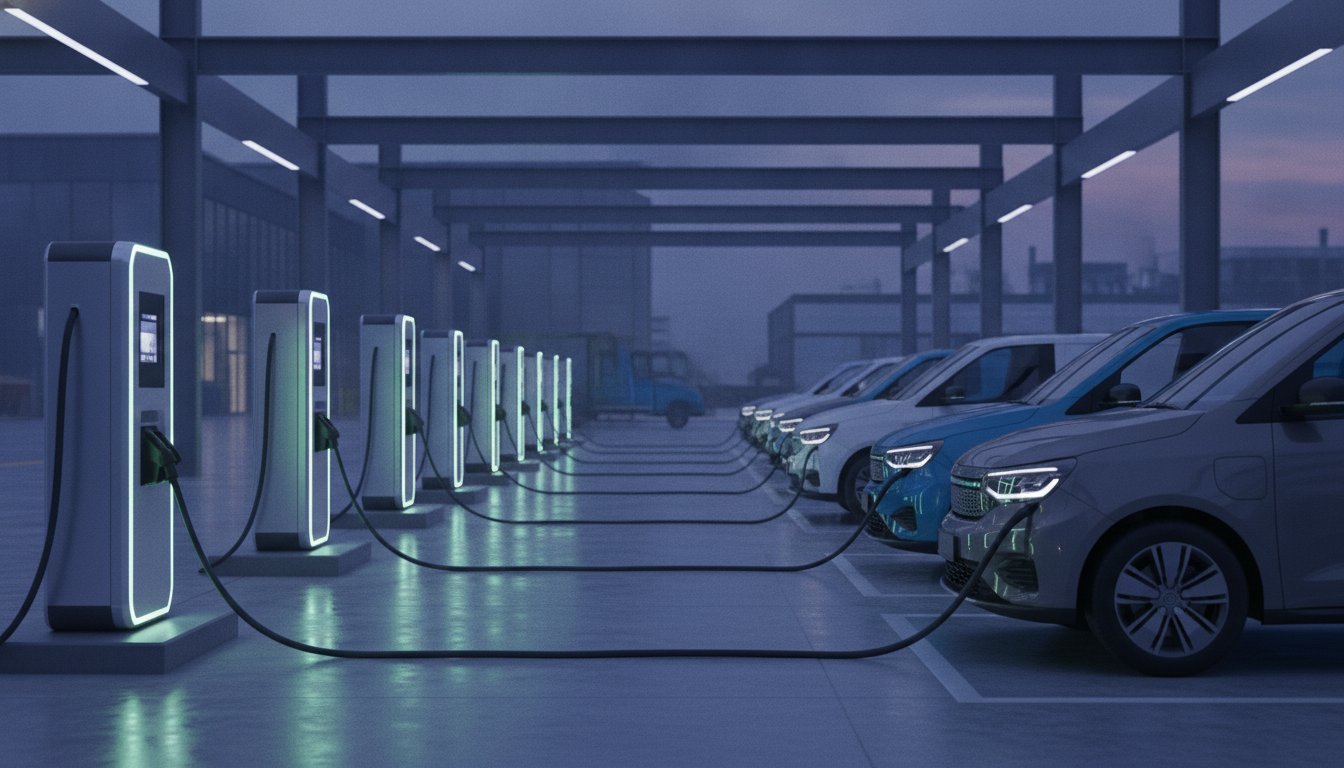
Professional fleet EV charging hardware is built for one thing: performance. In 2026, the gap between a home wallbox and a commercial unit is a canyon. You don’t buy professional gear for its sleek design. You buy it for 24/7 uptime and high-duty cycles. This is the core of electric vehicle supply equipment (EVSE) designed for the business world.
Modern units have shifted from "dumb" power outlets into intelligent, network-ready assets. They don’t just deliver power. They manage data, balance loads, and protect your bottom line. Consider these critical distinctions when evaluating your options:
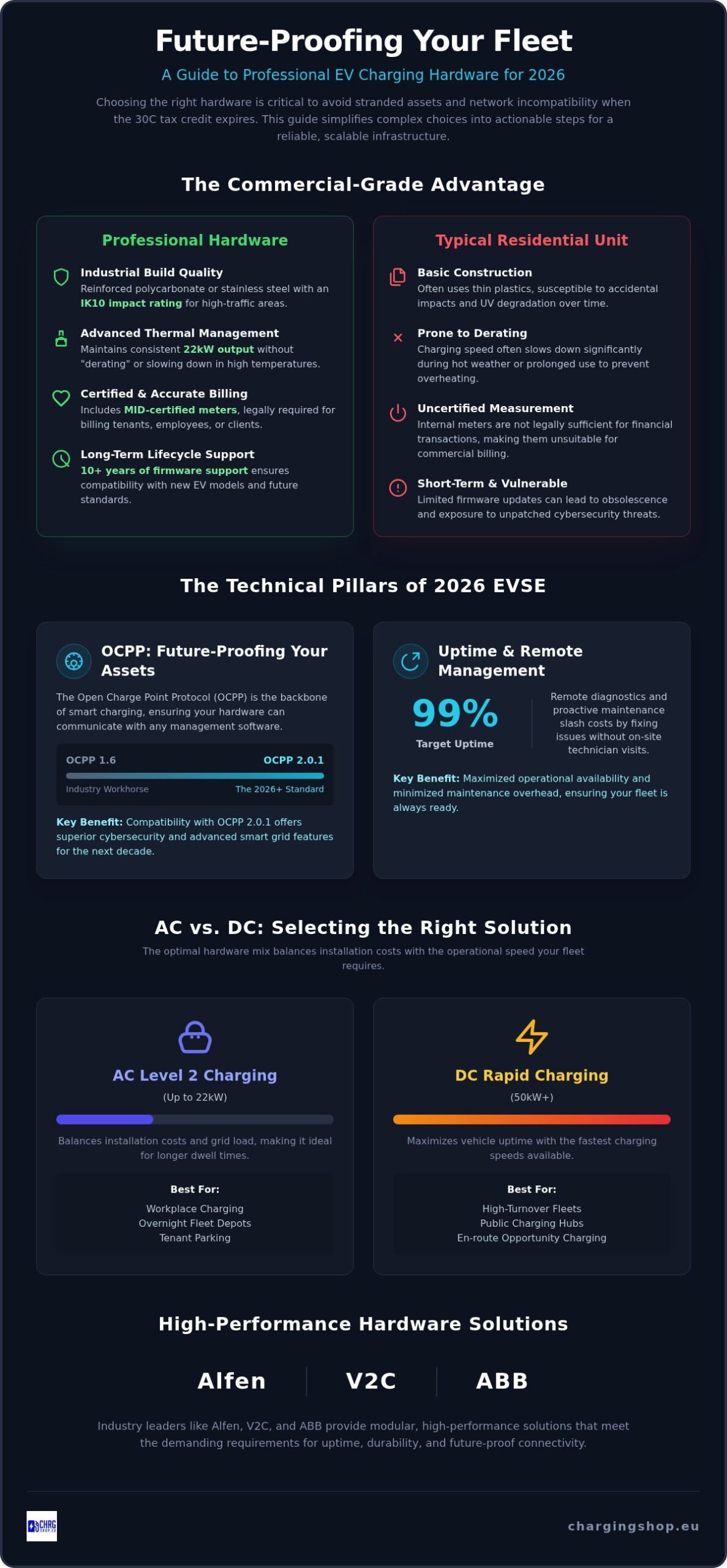
- Housing Materials: Residential units often use thin plastics. Professional hardware utilizes reinforced polycarbonate or stainless steel. Ensure your investment survives accidental impacts and harsh UV exposure.
- Certified Measurement: Commercial liability requires precision. Professional units must include MID-certified energy meters. This is mandatory if you plan to bill tenants, employees, or clients for energy used.
Industrial Build Quality and Weather Resistance
High-traffic areas demand an IK10 impact rating. This standard guarantees the unit can withstand significant physical force. It’s essential for public-facing sites or busy loading docks. Don’t settle for less than IP54 or IP55 ratings for outdoor installs. These certifications ensure your hardware remains operational through torrential rain and dust storms.
Thermal management is the silent hero of fleet EV charging hardware. Consumer units often "derate" or slow down charging speeds when they get hot. Professional models from brands like Alfen or ABB use advanced internal cooling to maintain a consistent 22kW output. This keeps your fleet moving on schedule, regardless of the ambient temperature. Efficiency matters when every minute of downtime costs you money.
The Role of Lifecycle Support and Firmware
Your hardware is only as good as the code running it. Professional brands commit to 10+ years of firmware support. This longevity protects you from obsolescence. It ensures compatibility with new EV models as they hit the market. Remote diagnostics are another game-changer. Identify and fix issues via the CHRG Network without sending a technician to the site. This proactive approach slashes your maintenance costs, and for those looking to optimize the software within the vehicles themselves, you can learn more about professional ECU remapping.
Cybersecurity is a non-negotiable standard. Connected stations are potential targets for digital threats. Professional-grade hardware implements encrypted communication protocols. This secures your data and your power supply. Invest in hardware that treats security as a foundation, not an afterthought. Protect your business from unauthorized access and ensure your infrastructure remains a reliable asset for years to come.
The Technical Pillars of Commercial-Grade EVSE
Deploying professional fleet EV charging hardware requires more than just high-voltage cables. You need a technical foundation that ensures your investment doesn’t become obsolete in three years. Commercial-grade systems rely on standardized protocols and precision measurement to function as business assets. Don’t treat these units like simple appliances. They’re data-driven nodes in your energy network.
OCPP is the backbone of this strategy. It allows your hardware to talk to different software platforms. If you want to switch your management provider, you don’t have to rip out the chargers. Most modern hardware, like the ABB Terra AC, supports these open standards. Reliability also depends on connectivity. Hardwired Ethernet is the gold standard for stability, but 4G or 5G modules are vital for remote locations where cabling isn’t feasible.
OCPP 1.6 and 2.0.1: Future-Proofing Your Assets
OCPP 1.6 is currently the industry workhorse, but the 2026 standard is moving toward OCPP 2.0.1. This version offers better cybersecurity and advanced smart grid features. It’s essential for integrating with the CHRG Network for professional asset management. Choosing 2.0.1 compatible hardware means you’re ready for the next decade of software innovation without hardware swaps.
Energy Management and Billing Accuracy
MID meters are a non-negotiable pillar for any commercial site. If you intend to bill employees or tenants for electricity, your hardware must have a Measuring Instruments Directive (MID) certified meter. Standard internal meters aren’t legally sufficient for financial transactions in many jurisdictions. Precision matters when you’re managing fleet charging infrastructure options across multiple sites.
Dynamic load balancing protects your building from grid overload. It monitors total site consumption and adjusts charging speeds in real-time. This prevents your chargers from blowing the main fuse during peak business hours. You can maximize charging speed without paying for expensive grid upgrades. Consider these key features for your technical stack:
- Hardware-level monitoring: Prevents costly peak-shaving issues by capping demand.
- Sequential charging: Optimizes power delivery for fleet depots with limited capacity.
- Redundant connectivity: Ensures 4G failover if your local Ethernet goes down.
Don’t leave your technical specs to chance. If you need a Personalised Charging Offer for your specific site requirements, our experts can help you navigate these technical hurdles and select the right fleet EV charging hardware for your needs.
AC vs. DC: Selecting the Right Professional Solution
Choosing between AC and DC isn’t just about speed. It’s about matching your fleet EV charging hardware to your operational rhythm. AC charging is the budget-friendly backbone for sites where vehicles park for four hours or more. DC rapid charging is for when every minute counts. You need to balance initial capital expenditure (CAPEX) with the daily demands of your business. Don’t overspend on power you don’t need. Don’t throttle your productivity with chargers that are too slow. It’s a strategic calculation for every site manager in 2026.
High-performance AC units remain the most cost-effective choice for offices and residential complexes. They offer a lower entry cost and simpler installation requirements. However, as fleets grow, the need for faster turnaround times often pushes businesses toward DC solutions. This is where the decision gets technical. You have to weigh the cost of hardware against the value of vehicle uptime. If a van sits idle because it’s charging too slowly, you’re losing revenue. Efficiency is the only metric that matters.
Professional AC Hardware: High-Capacity 22kW Units
In commercial settings, 22kW is the professional standard. Most business sites have 3-phase power available, making these units highly efficient. They’re perfect for offices, residential complexes, and employee parking. Maximizing space is a priority. Dual-socket configurations allow you to charge two vehicles from a single pedestal. This cuts down on civil works and infrastructure complexity. If you’re managing multiple vehicles at once, check out our Dual EV Charger Guide 2026 for the best multi-vehicle setups. These units are the workhorses of the industry.
DC Wallboxes: Rapid Power for Business Efficiency
The rise of the "Compact DC" wallbox has changed the game. Units like the V2C DENKA 20-40kW-80kW DC Wallbox deliver rapid performance without the massive infrastructure upgrades required by 150kW monsters. This niche is perfect for transit hubs, short-stay retail, and fleet depots requiring quick turnarounds. You get DC speed with a smaller footprint. By implementing smart charge management, you can optimize these high-power assets to avoid expensive peak demand charges. It’s about being smart with your available grid capacity.
When should you pull the trigger on DC? If your fleet vehicles return to base with low battery and need to be back on the road in under two hours, AC won’t cut it. DC hardware bypasses the vehicle’s onboard charger to deliver power directly to the battery. This significantly reduces charging times. Review our 40kW DC Wallbox Guide for a full breakdown of pricing and ROI analysis. It helps you decide if the faster turnaround justifies the higher hardware cost for your specific business model. Get the power you need without the waste.
Matching Hardware to Your Specific Professional Environment
Choosing the right fleet EV charging hardware depends entirely on where you park your vehicles. A logistics hub has different priorities than a luxury hotel. You need to match the hardware’s capabilities to your site’s operational flow. Don’t buy a generic solution when your environment demands specific features. Success starts with identifying whether you need high-visibility branding or heavy-duty industrial durability. Your hardware should solve your site’s unique challenges, not create new ones.
Workplace charging is about more than just plugging in. You have to balance employee perks with energy cost recovery. Use hardware that integrates with the CHRG Network to track every kilowatt hour used by specific staff members. For multi-unit residential sites, access control is the priority. RFID cards or app-based authentication ensure only authorized tenants use the power. In public retail spaces, your hardware is part of your brand. High-visibility units with integrated point-of-sale options turn charging into a seamless customer experience.
Fleet and Logistics Hardware Requirements
Fleet depots are high-pressure environments. Your hardware will likely handle 10 or more sessions every single day. This frequency demands industrial-grade components that won’t fail under constant use. Prioritize tethered cables to save time. Drivers shouldn’t have to hunt for cables in a busy yard. Robust holster designs are also essential to protect connectors from drops or accidental damage.
Integration with telematics is another critical factor for logistics. Your hardware needs to sync vehicle data with charger output. This allows for precise energy management and ensures every van is ready for its morning route. By working with providers like Fleetmaxx Solutions, fleet managers can leverage vehicle data to optimize these charging schedules. Look for units that support sequential charging. This feature allows you to charge a line of vehicles one after another without exceeding your site’s peak power limit. It’s a smart way to manage assets without expensive grid upgrades.
Hospitality and Multi-Tenant Solutions
In hospitality, aesthetics matter as much as performance. You want hardware that complements your premium location. Brands like Alfen and V2C offer sleek, modern designs that fit high-end environments perfectly. These units aren’t just functional; they’re professional assets that enhance your property’s value. User experience must be frictionless. Guests shouldn’t have to download five different apps just to get a charge.
Beyond technical amenities, maintaining a high standard of personal care is vital for residents in these premium settings; you can learn more about Providential Fijian Home Care to see how professional support can enhance the residential experience.
Reliability is non-negotiable for guests and residents. If a charger goes down, it reflects poorly on your business. You can discover the Alfen Single Pro Line for business to see how professional 22kW solutions handle multi-tenant demands with ease. These units offer stable performance and easy authentication via RFID. They ensure your guests stay powered up without the headache of constant maintenance visits or software glitches.
Ready to upgrade your business infrastructure? Don’t guess which units fit your site. Contact us today to request a Personalised Charging Offer tailored to your specific fleet EV charging hardware needs and site constraints.
The Professional Hardware Shortlist: Alfen, V2C, and ABB
Stop sifting through hundreds of consumer-grade brands. We’ve done the heavy lifting for you. We curate our inventory based on technical merit, field performance, and industrial durability. For high-performance fleet EV charging hardware, three names stand out in 2026: Alfen, V2C, and ABB. These manufacturers deliver the reliability your business needs to stay operational. They don’t just sell chargers; they provide infrastructure assets that protect your bottom line, much like how you can learn more about N2 Speed to optimize the performance and calibration of your American fleet vehicles.
Charging Shop selects these specific brands because they excel in interoperability and build quality. We focus on hardware that integrates seamlessly with the CHRG Network management layer. This allows you to manage your assets without the bias of a traditional installation firm. You get pure technical expertise and the best gear for your site’s specific demands. Don’t settle for "good enough" when your fleet’s uptime is on the line. Pick the hardware that’s built for the job.
Why Alfen Dominates the Professional Sector
Alfen is the gold standard for European grid stability. Their hardware handles the heavy lifting on sites where power management is a constant concern. They dominate the sector because of advanced load balancing capabilities. You can manage hundreds of chargers on a single site without blowing the main fuse. This makes Alfen the perfect choice for large-scale depots and commercial hubs.
Their systems are fully ready for the 2026 landscape. With full OCPP 2.0.1 readiness, your infrastructure is future-proofed against evolving grid requirements. You won’t have to replace your units when software standards shift. Explore the Alfen Single Pro Line for business specs to see why it’s the preferred 22kW solution for professional deployments.
V2C: The Choice for Smart Commercial Integration
V2C brings innovative, high-performance tech to the smart commercial sector. The V2C Trydan 22kW is a leader in dynamic power management. It adapts to your building’s real-time load, ensuring your vehicles charge at the maximum possible speed without overloading the system. It’s a smart, efficient way to manage energy. Read the V2C Trydan 22kW guide for the full technical breakdown of its capabilities.
If you need speed in a small footprint, the V2C DENKA 20-40kW DC Wallbox is the professional’s entry into rapid charging. It delivers the fast turnaround times your fleet needs without the massive infrastructure costs of larger DC stations. For those requiring industrial-grade AC power, the Alfen Single Pro Line 22kW sets the benchmark for precision-engineered commercial charging that integrates automated billing with seamless grid management. It’s built to withstand the toughest environments while maintaining consistent output. If you’re also evaluating how the ABB Terra AC vs Wallbox Pulsar Plus stacks up for sites that bridge commercial and residential use cases, our 2026 showdown breaks down the key differences in build quality, OCPP compatibility, and outdoor durability.
Ready to secure your infrastructure? Don’t leave your fleet EV charging hardware choices to chance. Contact our experts today for a Personalised Charging Offer that matches your specific business goals and site constraints.
Secure Your Fleet’s Power Strategy for 2026
Your infrastructure is the backbone of your business’s electric transition. Don’t let consumer-grade gear stall your operations. Professional fleet EV charging hardware must prioritize industrial durability and standardized communication to remain a high-performance asset. You now understand how OCPP 2.0.1 compliance and MID-certified metering protect your commercial liability and ensure future-proof interoperability.
Whether you’re deploying 22kW AC units for workplace parking or compact DC wallboxes for rapid turnaround, your hardware choice determines your long-term ROI. We provide the technical authority and premium hardware needed to keep your vehicles moving. Access our curated inventory of Alfen, V2C, and ABB units, all backed by expert-led technical support and global shipping on premium brands, utilizing specialized industrial-grade protection from Packaging For Industry (PFI) to ensure your equipment arrives in perfect condition.
Ready to scale? Get a Personalised Charging Offer for Your Business and secure your site’s energy future today. Build a reliable network with hardware that’s ready for the demands of the next decade. Your fleet deserves the best tech available.
Frequently Asked Questions
What is the difference between residential and professional EV charging hardware?
Professional hardware is built for high-duty cycles and industrial durability. Unlike home units, commercial gear like the Alfen Single Pro Line features IK10 impact-rated housings and advanced thermal management to handle back-to-back charging sessions. These units also include the networking hardware required for complex billing and fleet management.
Is OCPP compliance mandatory for commercial EV charging stations?
It isn’t a legal requirement in every jurisdiction, but it’s essential for protecting your investment. OCPP compliance allows you to switch management software without replacing your physical fleet EV charging hardware. In 2026, you should prioritize OCPP 2.0.1 to ensure compatibility with modern cybersecurity and smart grid standards.
Do I need an MID-certified meter for my workplace charging station?
You must use an MID-certified meter if you plan to bill employees or tenants for energy. The Measuring Instruments Directive (MID) ensures the meter’s accuracy is legally sufficient for financial transactions. Standard internal meters don’t meet the regulatory requirements for tax-compliant billing or energy cost recovery.
Can professional EV hardware be managed remotely?
Yes, remote management is a core feature of professional systems. By using the CHRG Network, you can monitor station status, update firmware, and perform diagnostics from any location. This digital-first approach slashes maintenance costs because you can resolve most software glitches without sending a technician to the site.
What is dynamic load balancing and why does my business need it?
Dynamic load balancing is a smart feature that protects your building’s electrical grid from overloading. It monitors your site’s total power consumption and automatically throttles charger output when demand peaks. This allows you to install more chargers without paying for expensive and time-consuming grid infrastructure upgrades.
Should I choose AC or DC hardware for my company fleet?
Base your choice on your fleet’s dwell time. AC 22kW chargers are the most cost-effective solution for vehicles parked for four hours or more, such as employee cars or overnight vans. If your vehicles require a fast turnaround in under two hours, invest in a compact DC wallbox like the V2C Denka.
How do I ensure my charging hardware is future-proof for 2026 and beyond?
Prioritize hardware with modular internal components and support for the latest communication protocols. Look for units that are ready for ISO 15118 to enable future vehicle-to-grid (V2G) capabilities. Choosing established brands like ABB or Alfen ensures you’ll receive firmware support and security patches for the next decade.
Does professional EV hardware require special maintenance?
Professional hardware requires periodic physical inspections but relies heavily on digital upkeep. You should check cables and connectors for physical wear every six months to maintain safety in high-traffic areas. Most operational maintenance is handled through automated remote updates, ensuring your fleet EV charging hardware stays current without manual intervention.
