
 Deutsch
 Dansk
Dansk Suomi
Suomi Latviešu
 Lietuvių
 Norsk bokmål
 polski
 Русский
 Svenska
No products in the cart.
Uncategorized
V2C Trydan vs Wallbox Pulsar: The Ultimate 2026 Comparison Guide
26
Jul
Jul
Your garage deserves better than a charger that drops its connection the moment you walk away. Choosing between the V2C Trydan vs Wallbox Pulsar isn’t just a matter of aesthetics. It’s a high-stakes decision about whether your home can meet the 2026 EPBD IV energy standards. You’re likely tired of managing complex solar integrations or fearing a grid overload every time the oven and the EV run at once. We’ve done the technical heavy lifting so you don’t have to. This guide breaks down exactly which premium wallbox wins the battle for your driveway. We’ll dive into the V2C Trydan 22kW’s wireless inverter communication and the Pulsar’s compact reliability. From firmware version 2.5.0 stability to real-world dynamic load balancing, you’re about to find out which hardware future-proofs your home for the next decade. We’ll analyze the updated MID standards and the impact of the latest AFIR regulations on your daily charging routine. It’s time to stop guessing and start charging with total confidence.
Key Takeaways
- Identify the best hardware for solar-heavy homes by comparing V2C’s wireless inverter syncing against the Wallbox Eco-Smart system.
- Simplify your decision in the V2C Trydan vs Wallbox Pulsar debate with a clear breakdown of 7.4kW and 22kW performance metrics.
- Assess long-term reliability using IP54 and IP55 ratings to ensure your charger survives the toughest outdoor conditions.
- Streamline your daily routine by choosing between the advanced Telegram alerts of V2C Cloud or the intuitive simplicity of myWallbox.
- Gain professional insight into installation efficiency, focusing on why internal wiring space matters for future-proof hardware reliability.
V2C Trydan vs Wallbox Pulsar: The 2026 Core Specs Face-Off
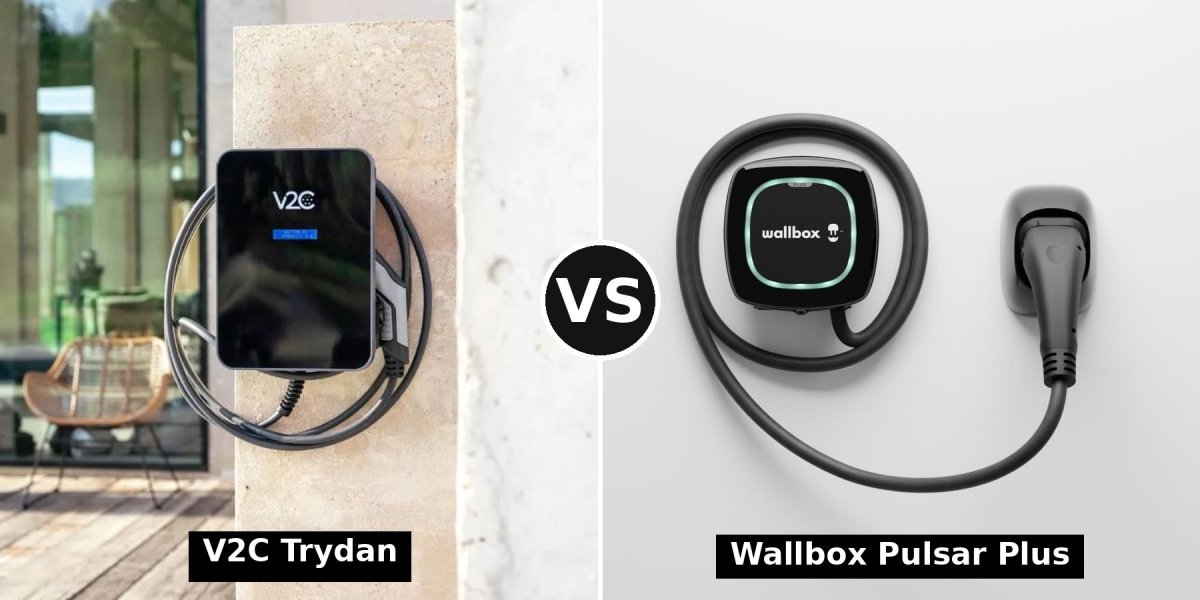
Selecting the right hardware for your driveway comes down to more than just a brand name. In the V2C Trydan vs Wallbox Pulsar showdown, we are looking at two distinct philosophies of electric vehicle supply equipment (EVSE). One prioritizes a "hide-it-away" footprint, while the other focuses on being an accessible energy hub for your entire home. You need to decide if you value sheer minimalism or technical transparency.
The technical gap is clear when you look at raw output. While both brands offer standard 7.4kW single-phase units, the V2C Trydan 22kW is built from the ground up for high-performance three-phase charging. This matters if you’re looking to future-proof your setup for larger EV batteries or commercial-grade home speeds. Wallbox Pulsar models often peak at 11kW or 22kW depending on the specific variant you select. Both units include DC leakage detection as standard. However, the V2C Trydan integrates internal surge protection more effectively within its functional chassis. This reduces the need for bulky external boxes during your installation process.
Design and Form Factor
Wallbox Pulsar Max wins the beauty contest every time. It is ultra-compact. It fits in the palm of your hand and disappears on your garage wall. If space is your primary constraint, it’s the logical choice. However, the V2C Trydan uses its larger industrial design to provide better internal airflow and more room for electricians to work. This makes maintenance faster. It also reduces the risk of thermal throttling during long, high-heat summer charging sessions. The Trydan is a tool, while the Pulsar is an appliance.
Charging Speed and Phase Support
Speed isn’t just about the max number. It’s about how the hardware handles your grid. The V2C Trydan features a standout capability: automatic phase switching. This allows the unit to jump between single-phase and three-phase charging dynamically. It’s a game-changer for solar users who want to capture every watt of surplus energy without tripping their home’s main breaker. Wallbox Pulsar is reliable and consistent, but it lacks this specific level of granular energy management for 2026 standards.
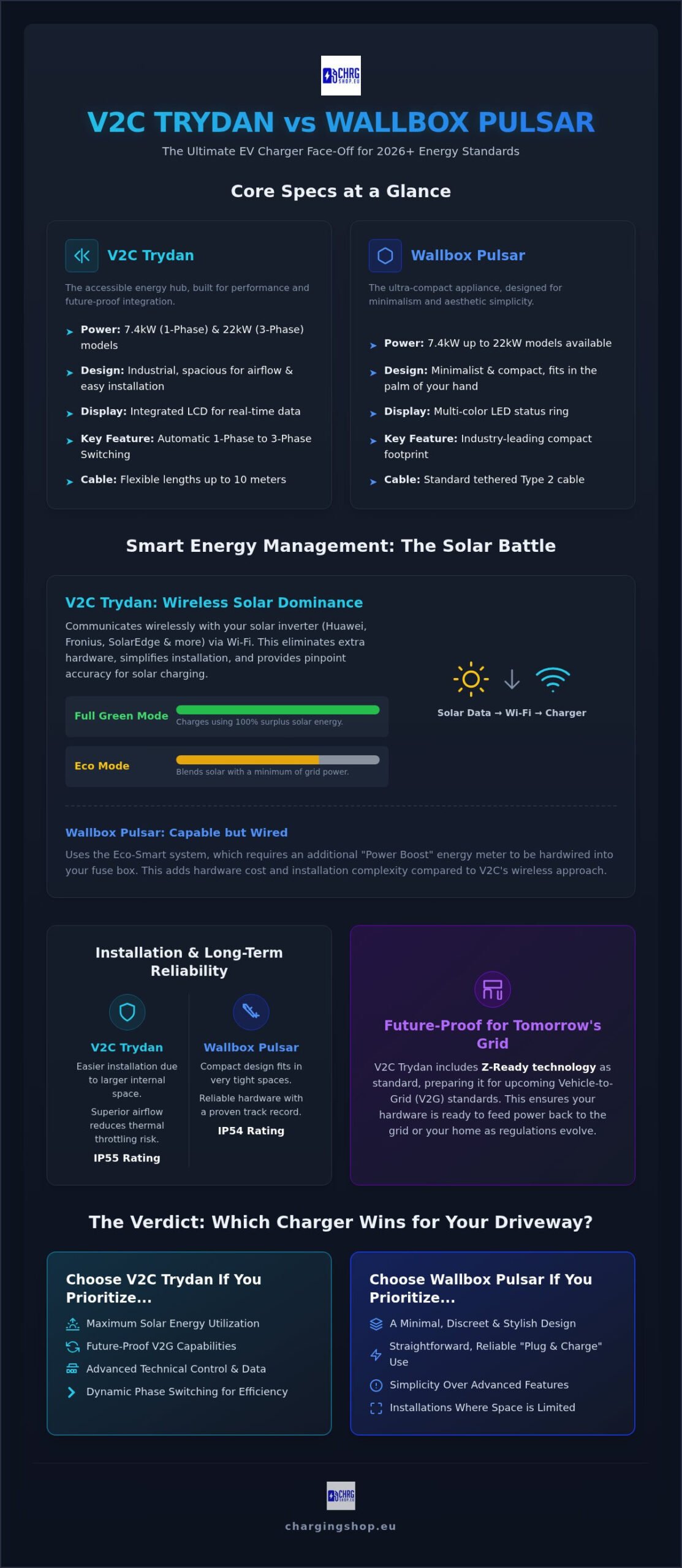
- V2C Trydan: Available in 7.4kW and 22kW. Features a built-in LCD screen for real-time data.
- Wallbox Pulsar: Compact 7.4kW to 22kW options. Uses an LED ring for status updates.
- Cable Options: Both offer tethered Type 2 cables, but V2C provides more flexibility for custom cable lengths up to 10 meters.
Smart Energy Management: Why V2C Trydan Dominates Solar
Solar panels are only as good as the hardware managing them. In the V2C Trydan vs Wallbox Pulsar debate, energy management is where the gap between "good" and "exceptional" becomes obvious. You need a system that talks to your house, not just one that sits on the wall. If you want to stop wasting surplus energy and start driving on pure sunshine, the communication protocol matters more than the max kilowatt rating.
The V2C Trydan 22kW offers a massive advantage: direct wireless communication. It connects to your existing Huawei, Fronius, SolarEdge, or GoodWe inverter via your home WiFi network. There is no need to run extra data cables through your walls. It pulls real-time production data straight from the source. In contrast, the Wallbox Pulsar uses the Eco-Smart system. It’s a capable feature, but it almost always requires an additional "Power Boost" energy meter installed in your fuse box. This adds hardware costs and increases the complexity of your installation.
Solar Integration: WiFi vs. Hardwired
Efficiency is the goal. V2C Trydan eliminates the physical mess of hardwired current clamps by using digital syncing. This allows for pinpoint accuracy when managing your solar modes. In the V2C software, "Full Green" mode ensures your car charges exclusively using 100% solar surplus, while "Eco" mode blends a small amount of grid power with your solar to maintain a steady, minimum charging speed. If you are serious about zero-emission driving, check out our solar integrated ev charger guide for a deeper technical breakdown of these configurations.
Dynamic Power Adjustment
Protecting your home from a total blackout is non-negotiable. Both chargers feature dynamic load balancing to prevent your main breaker from tripping when high-drain appliances like ovens or heat pumps kick in. However, V2C includes Z-Ready technology as standard. This isn’t just a marketing term; it’s a future-proofing protocol designed for upcoming Vehicle-to-Grid (V2G) standards. It ensures your hardware is ready to feed power back into your home or the grid as regulations evolve through 2026 and beyond. To understand exactly how this protection works in practice, our guide to wallbox with load balancing explains the critical differences between static and dynamic balancing and how smart hardware monitors your home’s energy demand in real-time.
Wallbox remains a reliable choice for standard setups, but it lacks the native, out-of-the-box inverter synergy that V2C provides. If your home setup is complex or you want to maximize every watt from your roof, you need a plan that fits your specific infrastructure. Request a Personalised Charging Offer today to see which smart energy features will save you the most on your monthly utility bill.
Connectivity and App Experience: V2C Cloud vs myWallbox
Connectivity isn’t just a luxury; it’s the lifeline of your charger. In the V2C Trydan vs Wallbox Pulsar comparison, how you talk to your hardware matters as much as the charge rate. Wallbox built its reputation on the myWallbox app. It remains the gold standard for clean, simple UX. It’s perfect for users who want to plug in and forget it. However, the V2C Cloud is a different beast entirely. It’s built for power users who want granular data, instant feedback, and total control over every electron. If you want to understand how app-based control transforms your daily charging routine, our guide to smart EV charger with app integration covers the full spectrum of scheduling, monitoring, and solar management features available in 2026.
Underground garages are the graveyard of Bluetooth-only chargers. If your signal is weak, you’ll feel the frustration of a failed connection. Wallbox relies heavily on Bluetooth and WiFi. In contrast, the V2C Trydan 22kW offers WiFi and Bluetooth as standard but allows for more robust integration options. Both systems are OCPP 1.6J compliant. This is critical for 2026 standards. It means you aren’t locked into one software provider. You can switch management platforms or integrate with professional systems like the CHRG Network Access without replacing your physical hardware. This flexibility is what separates professional-grade gear from basic consumer electronics.
Remote Management and Scheduling
Stop paying peak rates for your energy. Use your smartphone to schedule charging windows during the cheapest midnight hours. If you share a driveway or a parking area, managing access is simple. Wallbox uses a sleek app-based lock to prevent unauthorized use. V2C offers RFID support for quick, tap-and-go authorization, making it a favorite for multi-user environments. For those who need advanced reporting and fleet-style management, linking your V2C unit to the CHRG Network provides professional-grade insights that standard consumer apps simply miss. It’s about turning data into actual savings.
Smart Home Integration
Voice control is no longer a gimmick; it’s a tool for efficiency. Both chargers play nice with Alexa and Google Home. Tell your house to start charging while you’re still unloading groceries. The V2C Trydan goes a step further with a fully open API. This is a dream for Home Assistant enthusiasts who want to build custom automation and complex energy triggers. One of the most practical features is the native Telegram notification support. By receiving instant Telegram alerts for charging status, you get real-time updates on your phone without needing to keep a heavy, battery-draining app running in the background. It’s fast, lightweight, and keeps you informed with zero effort.
Installation and Long-Term Reliability
A charger is only as reliable as its physical build. When evaluating the V2C Trydan vs Wallbox Pulsar for a 2026 installation, you have to look past the software. You need to consider how the unit handles the elements and how easily it can be serviced. Reliability isn’t just about the first year of use. It’s about the next decade of daily cycles and changing weather patterns. You want hardware that survives the storm, not just a pretty box on the wall.
The Installer’s Perspective
Your electrician will have a clear favorite. While the Wallbox Pulsar is famous for its compact footprint, that small size makes internal wiring a tight, time-consuming job. The V2C Trydan 22kW offers a much more generous internal layout. This extra room allows for faster cable routing and more secure terminations. Both units feature built-in DC leakage protection. This is a massive cost saver. It eliminates the need for an expensive external Type B RCD in many jurisdictions. V2C goes a step further with an integrated mounting template that simplifies the drilling process on brick or concrete walls. For a deep dive into the technical requirements of these units, refer to our V2C Trydan 22kW pillar. It covers the specific wiring diagrams and breaker settings you’ll need for a 2026-standard home.
Durability in Extreme Conditions
Outdoor chargers take a beating. The casing needs to withstand constant UV exposure without yellowing or becoming brittle. V2C uses high-grade polymers designed to resist cracking over a five-year lifespan. There is also a slight difference in weatherproofing ratings. The Wallbox Pulsar typically carries an IP54 rating, while the V2C Trydan steps up to IP55. This higher rating provides better protection against dust ingress and low-pressure water jets. If you live in a region with heavy rainfall or high humidity, that extra level of sealing is a smart investment.
Impact resistance is the final piece of the puzzle. If your charger is in a public-facing driveway or a tight carport, look at the IK ratings. The V2C Trydan is built for toughness, often matching or exceeding the IK10 standards required for high-traffic areas. This ensures the unit survives accidental bumps from car doors or bicycles. Maintenance is straightforward because the internal components are modular. If a part fails after the warranty period, you don’t have to throw away the whole unit. You can replace specific boards and keep your charger running. Ready to upgrade your home setup? Buy the V2C Trydan 22kW now and secure a hardware solution built to last.
The Verdict: Which Charger Wins for Your Driveway?
The battle between the V2C Trydan vs Wallbox Pulsar isn’t about finding a universal winner. It’s about matching high-performance hardware to your specific home energy ecosystem. You need to decide if you want a charger that acts as a silent appliance or one that serves as a technical command center. By 2026 standards, both units deliver exceptional reliability, but their strengths cater to very different types of EV owners.
Your Return on Investment (ROI) depends on the hidden costs of installation. While the initial price of a Wallbox might look competitive, you must factor in the cost of external power meters if you want solar syncing or dynamic load balancing. The V2C Trydan 22kW often works out cheaper for complex setups because so much of its intelligence is built directly into the housing. Don’t just buy a box; buy the solution that minimizes your total bill of materials. If you’re also weighing other premium competitors, our V2C Trydan vs Easee Charge Up AC Charger: The 2026 Head-to-Head Comparison breaks down how the Trydan stacks up against another top-tier wallbox for 22kW future-proofing and load balancing compatibility.
Best for Solar Enthusiasts
If you have solar panels, the V2C Trydan is the undisputed winner for sun-powered driving. Its native inverter communication is a massive technical advantage. It talks directly to your Fronius, Huawei, or SolarEdge system without requiring extra physical meters in your fuse box. This "native" synergy ensures you capture every spare watt of green energy with surgical precision. It’s the most efficient way to achieve 100% sun-powered miles. Ready to maximize your roof’s potential? View the full technical breakdown on the V2C Trydan 22kW product page.
Best for Simplicity and Style
The Wallbox Pulsar Max remains the top choice for minimalist garages where aesthetics and space are the primary concerns. It’s small. It’s proven. The myWallbox app is incredibly stable and requires zero technical knowledge to operate. If you want a "plug and play" experience with a global brand that has a massive support network, the Pulsar is your best bet. It provides a clean, discreet look that disappears into your home’s architecture while delivering consistent power night after night. If your home setup is straightforward and you value a premium user interface, Get your Personalized Charging Offer today!
For 22kW home charging in 2026, the choice is clear. Choose the V2C Trydan if you want maximum energy control and solar integration. Choose the Wallbox Pulsar if you want a compact, stylish unit with an industry-leading app experience. Both will serve your driveway well, but only one will perfectly fit your lifestyle.
Secure Your 2026 Charging Standard
The choice in the V2C Trydan vs Wallbox Pulsar debate depends entirely on your home’s unique infrastructure and your personal style. If you want a charger that integrates seamlessly with your solar inverter and offers 2026 Smart Grid compatibility, the V2C Trydan is the clear winner for technical performance. For those prioritizing a compact, award-winning design and a proven app experience, the Wallbox Pulsar remains a top-tier contender for any modern garage.
As an Authorized V2C Global Distributor, we provide only OCPP 1.6J Certified Hardware that’s fully ready for the future. Don’t let a complex setup or grid overload slow you down. Our technical experts are ready to help you navigate these hardware nuances so you can charge with total peace of mind and maximum efficiency. Take the final step toward a smarter, more reliable driveway today. Compare V2C and Wallbox prices at Charging Shop and find your perfect match. Your electric vehicle is ready for the next decade of innovation; make sure your home charger is too.
Frequently Asked Questions
Does the V2C Trydan require a separate power meter for solar charging?
No, the V2C Trydan doesn’t require an external power meter if you use a compatible solar inverter. It syncs wirelessly with brands like Huawei, Fronius, and SolarEdge via your home WiFi. This direct integration is a major factor when comparing V2C Trydan vs Wallbox Pulsar, as the Pulsar typically needs additional Power Boost hardware for similar solar functionality. It simplifies your installation and cuts down on total equipment costs.
Can I use the Wallbox Pulsar with my Home Assistant setup?
Yes, you can integrate the Wallbox Pulsar with Home Assistant using the official integration or community-developed MQTT bridges. It allows you to monitor charging states and automate sessions based on your home’s total energy production. While the V2C Trydan offers a more open API for advanced power users, Wallbox remains highly compatible with most standard smart home ecosystems for basic automation and reporting.
Is the V2C Trydan 22kW compatible with single-phase homes?
Yes, the V2C Trydan 22kW is fully compatible with single-phase electrical installations. It will simply operate at a maximum output of 7.4kW until you decide to upgrade your home to a three-phase supply. Buying the 22kW model now is a smart way to future-proof your property. You won’t need to buy a new charger when your energy needs or your vehicle’s capabilities increase.
Which charger is better for outdoor installation in heavy rain?
The V2C Trydan is slightly better for extreme weather due to its IP55 rating. This provides superior protection against dust and low-pressure water jets compared to the IP54 rating found on most Wallbox Pulsar models. Both units are safe for outdoor use and feature UV-resistant casings. However, the Trydan’s industrial seal offers extra peace of mind if your driveway is frequently exposed to heavy, driving rain.
Do I need an RFID card to start charging with these models?
No, an RFID card isn’t mandatory for either charger. You can start and stop sessions directly through the V2C Cloud or myWallbox apps on your smartphone. The V2C Trydan supports RFID as an optional authentication method, which is perfect for shared parking areas. This allows for a quick, physical tap-to-charge solution without needing to open your phone or wait for a Bluetooth connection to sync.
Can I upgrade the firmware on these chargers remotely?
Yes, both chargers support Over-the-Air (OTA) firmware updates via WiFi. V2C released version 2.5.0 in July 2026 to enhance stability and solar syncing capabilities. Wallbox also pushes regular updates, such as version 6.11.26, to ensure your hardware stays compatible with the latest EV software and safety regulations. These updates happen automatically or with a single tap in the app, so you never need a technician.
What is the main difference between Pulsar Plus and Pulsar Max in 2026?
The Pulsar Max is the evolved version of the Plus, featuring improved thermal management and a more installer-friendly backplate. In the 2026 market, the Max is the residential standard. It handles high-amperage charging with less heat buildup, ensuring consistent power delivery even in warm environments. It also meets the latest European regulations for easily replaceable cables and enhanced internal safety protections.
Why is 22kW recommended even if my car only supports 11kW?
Installing a 22kW unit is the best way to future-proof your driveway. Most modern EVs support 11kW, but battery technology is advancing rapidly. A 22kW charger handles lower loads with ease, reducing heat and wear on internal components. When comparing the V2C Trydan vs Wallbox Pulsar, both brands offer 22kW versions that ensure you won’t need an expensive hardware replacement when you eventually upgrade to a newer car.
