
 Deutsch
 Dansk
 Suomi
 Latviešu
 Lietuvių
 Norsk bokmål
 polski
 Русский
 Svenska

No products in the cart.
Uncategorized
Level 1 vs Level 2 Charging Speed and Charging Time
22
Nov
Nov
The faster charger doesn’t always mean a faster full charge for every EV. The level 1 vs level 2 charging speed gap is substantial: Level 2 units typically charge six to eight times faster than Level 1 setups. The time you’ll actually spend charging also depends on your vehicle and its battery.
It’s easy to focus on charger power alone, but voltage and amperage matter too. According to the U.S. Department of Energy, Level 1 charging uses 120 volts, while Level 2 operates at 240 volts. Your EV’s ability to accept power also shapes how quickly it charges.
This guide explains how charging levels, voltage, amperage, and vehicle type affect charging speed. Compare typical charging times for plug-in hybrids and battery-electric vehicles to see which setup suits your driving routine.
Key Takeaways
- Understand how charger levels differ and what electrical setup a Level 2 unit may require.
- See how amperage and power output shape the charge your vehicle can accept.
- Estimate charging time by considering battery size, starting charge, and vehicle type.
- Use your daily driving needs to decide whether slower overnight charging or a faster home setup makes more sense.
What Are the Different Levels of EV Chargers?
EV charging is grouped into three levels. Level 1 uses a household outlet for slower charging, Level 2 uses a higher-voltage circuit for faster home or workplace charging, and Level 3 provides DC fast charging at compatible stations. For drivers choosing a home setup, the practical comparison usually centres on Level 1 versus Level 2.
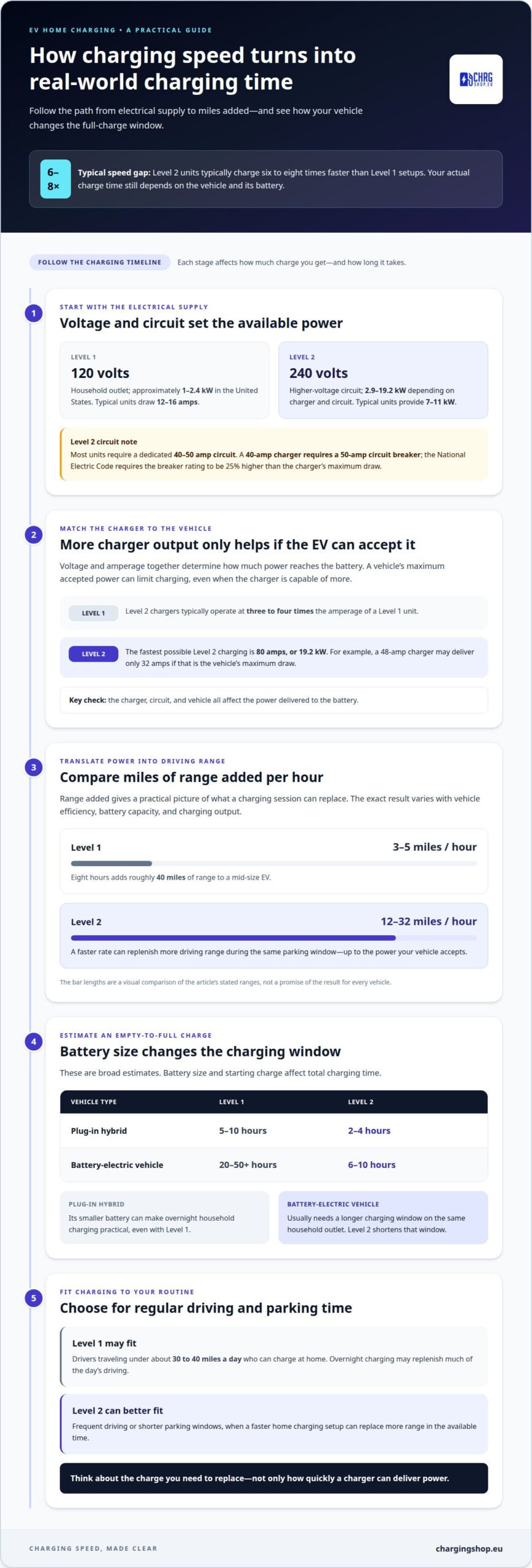
A Level 2 home charger needs an electrical circuit suited to its maximum draw. Most units require a dedicated 40-50 amp circuit, and a 40-amp charger requires a 50-amp circuit breaker. The National Electric Code requires the breaker rating to be 25% higher than the charger’s maximum draw. A licensed electrician can assess panel capacity, wiring, and the route from the panel to the charging location.
Installation cost depends on that electrical work, not just the charging unit. A short wire run and available panel capacity create a different project from a long run or panel upgrade. Hardwiring is recommended for Level 2 setups. Permit rules also depend on location: Seattle requires an electrical permit and inspection for EV charger installations.
Actual electricity use depends on how often you charge, how much energy each session delivers, and your local utility rate.
US tax credits, rebates, and utility incentives don’t have one universal value for every Level 2 home charger. Programs and eligibility depend on location and applicable program terms, so the available benefit can differ between households.
Level 1 is used for routine charging through a household outlet, but avoid plugging its charging cord into an extension cord. The added wire length can create resistance and overheat the extension cord. Keep the charging cord connected directly to the outlet, and use a Level 2 circuit designed for the charger’s electrical load.
Charger voltage, amperage, and power output
Voltage and amperage together determine how much power reaches an EV’s battery. Compare both ratings rather than relying only on a charger’s headline output.
Level 1 Voltage and Power
According to the U.S. Department of Energy, Level 1 charging uses a typical household outlet operating at 120 volts. In the United States, Level 1 chargers deliver approximately 1 to 2.4 kW, with typical units drawing 12-16 amps. That lower output means the battery gains charge gradually. For owners who can leave a vehicle connected for longer periods, the outlet can provide a straightforward charging option.
Level 2 Voltage and Power
According to the U.S. Department of Energy, Level 2 charging operates at 240 volts. Level 2 power ranges from 2.9 to 19.2 kW, depending on the charger and circuit; typical units provide 7 to 11 kW. A 240-volt, 24-amp unit can deliver about 6.0 kW of continuous power. Higher output can replenish a battery faster, provided the vehicle can accept it.
Amperage and Charging Output
Amperage measures electrical current, and higher current at a given voltage can deliver more power. Level 2 chargers typically operate at three to four times the amperage of a Level 1 unit. The fastest possible Level 2 charging is 80 amps, or 19.2 kW. A 48-amp charger may deliver only 32 amps if that’s the vehicle’s maximum draw, so the vehicle and circuit both affect output.
Match the charger, circuit, and vehicle connector to the charging setup you plan to use. A DC fast charging station uses a different charging approach, so its headline power isn’t a direct comparison with Level 1 or Level 2. To explore a setup matched to your charging needs, review these electric vehicle charging options.
Level 1 and Level 2 charging speeds
For home charging, compare miles of range added per hour, not just the time connected. In the United States, Level 1 typically adds 3-5 miles of range per hour. Most Level 2 units provide around 12-32 miles per hour. The level 1 vs level 2 charging speed difference depends on charger output and how much power your vehicle can accept.
That gap changes how drivers plan a routine. Eight hours of Level 1 charging adds roughly 40 miles of range to a mid-size EV. For a driver covering a similar distance daily, plugging in overnight may replenish much of the day’s driving. A longer commute can use more range than an outlet restores, leaving the battery at a lower charge the next morning.
Level 2 replenishes range faster during the same parking window. At 12-32 miles per hour, several hours at home can replace substantially more driving range than an overnight Level 1 session. The exact result varies with vehicle efficiency, battery capacity, and charging output. A faster charger also can’t exceed the maximum power the vehicle accepts.
A full charge takes longer than replacing a typical day’s miles. A battery-electric vehicle can take 20-50+ hours to charge from near-empty on Level 1, compared with 6-10 hours on Level 2. These are broad estimates, not a fixed timer: battery size and starting charge affect the total. The level 1 vs level 2 charging speed difference matters most when you need to replenish a large amount of charge within a short parking window.
Choose based on your regular driving, not the minutes needed for an occasional top-up. Level 1 may suit drivers who travel under about 30 to 40 miles a day and can charge at home. Level 2 can better fit frequent driving or shorter parking windows. A plug-in hybrid’s smaller battery can also mean a different full-charge schedule, explored in the vehicle comparison.
Charging-time comparison by vehicle type
Vehicle type changes the time needed for a full charge because plug-in hybrids and battery-electric vehicles have different battery capacities. For an empty-to-full comparison, a plug-in hybrid often takes 5-10 hours on Level 1 and 2-4 hours on Level 2. A battery-electric vehicle can take 20-50+ hours on Level 1 and 6-10 hours on Level 2.
Those ranges make the vehicle distinction clear. A plug-in hybrid’s smaller battery can make overnight household charging practical, even with Level 1. A battery-electric vehicle usually needs a longer charging window on the same outlet. Level 2 shortens that window, but the vehicle’s maximum accepted power still limits how much it can draw.
Range per hour adds useful context, but it doesn’t translate identically across vehicles. Level 1 typically adds 3-5 miles of range per hour, while Level 2 often provides around 12-32. A plug-in hybrid may gain a larger share of its total electric range during one overnight session. A battery-electric vehicle can gain more absolute miles, yet still need longer to reach full charge.
For EV owners, the practical comparison is the energy needed before the next drive, not only empty-to-full time. A household vehicle returning with charge remaining needs less replenishment than one starting near empty. Voltage and charger output shape the rate, while battery size and starting charge shape the session length. Match the charging window to the vehicle and daily driving pattern.
Compare your vehicle’s charging needs with the time it usually spends parked. For a setup suited to your vehicle and routine, explore a personalised charging offer.
Charging Shop
Charging Shop’s Personalised Charging Offer helps connect your charging needs with suitable EV hardware. It can help when daily driving, vehicle type, and available electrical capacity make it harder to choose between charging options.
Its selection includes the V2C Trydan 22kW, V2C DENKA 20kW DC Wallbox, and Alfen Single Pro Line 22kW. These options serve different charging requirements, so focus on the specifications that fit your vehicle and intended use rather than choosing by power rating alone. The right comparison starts with the vehicle’s charging capability and the setup available where you plan to charge.
Contact Charging Shop to narrow down a charging option that suits your needs.
Make your next charging choice with confidence
Your next step is to turn charging knowledge into a setup that fits how you use your vehicle. Let the level 1 vs level 2 charging speed comparison inform your decision, alongside your parking routine, daily driving, and electrical setup. The goal is a charger that matches your vehicle’s capabilities and the time available to recharge.
Look beyond the occasional low battery. Consider your usual weekly driving pattern, where you charge, and how much flexibility you need between drives. These details can help narrow your options without choosing more charging power than your vehicle can use.
Ready to turn those requirements into a hardware choice? Contact Charging Shop for charging advice. Share your vehicle and charging priorities, then take the next step toward a setup that supports your routine. A well-matched choice can make everyday charging feel simpler and more manageable.
Frequently Asked Questions
What are the different types of EV chargers?
EV charging is commonly grouped into Level 1, Level 2, and Level 3, each suited to different charging situations. Level 1 uses a household outlet, while Level 2 provides AC charging at home or work. Level 3 is DC fast charging, typically found at public stations. Your vehicle must support the charger and connector type to receive power.
Which Charger Is Best for Your Home?
The best home charger depends on your vehicle, electrical setup, and typical parking window. A 7 kW station is suited to overnight home charging, while 11-22 kW options support faster or public charging needs. Choose a power level your vehicle can use and your home circuit can support. A cable-type station can also make plugging in more convenient.
How fast is Level 1 EV charging in miles of range per hour?
Level 1 typically adds 3-5 miles of driving range per hour in the United States. Treat this as added range, not a fixed battery percentage each hour, because vehicles use energy at different rates. For a short daily commute and a long overnight parking window, that pace may cover routine replenishment without requiring a full charge.
How fast is Level 2 EV charging in miles of range per hour?
Level 2 typically adds around 12-32 miles of driving range per hour, depending on charger output and vehicle acceptance. A vehicle that can’t draw the charger’s full output won’t reach the upper end of that range. Compare compatible power ratings, then estimate how much charge your usual parking period can restore instead of treating the highest rate as constant.
What factors affect Level 1 and Level 2 EV charging speed?
Charging speed depends on the vehicle’s maximum accepted power, charger and circuit output, battery size, and starting charge. Vehicle efficiency also affects how far the car travels on the energy it receives. A smaller battery may charge fully sooner, while a less efficient vehicle gains less range from the same amount of energy. For a useful estimate, consider your specific vehicle and how much charge it needs.
What electrical outlet and circuit are required for Level 1 and Level 2 charging?
Level 1 uses a standard 120-volt household outlet. Avoid extension cords because added wire length can create resistance and overheat the cord. Level 2 uses 240 volts and commonly needs a dedicated circuit sized for its charger. Underground-garage installations must address fire-service regulations, ventilation, emergency shut-off devices, and steel conduit for power and network cables.
