
 Deutsch
 Dansk
 Suomi
 Latviešu
 Lietuvių
 Norsk bokmål
 polski
 Русский
 Svenska

No products in the cart.
Uncategorized
Multi-Family Building EV Charging: Choose a Scalable Setup for Residents
23
Oct
Oct
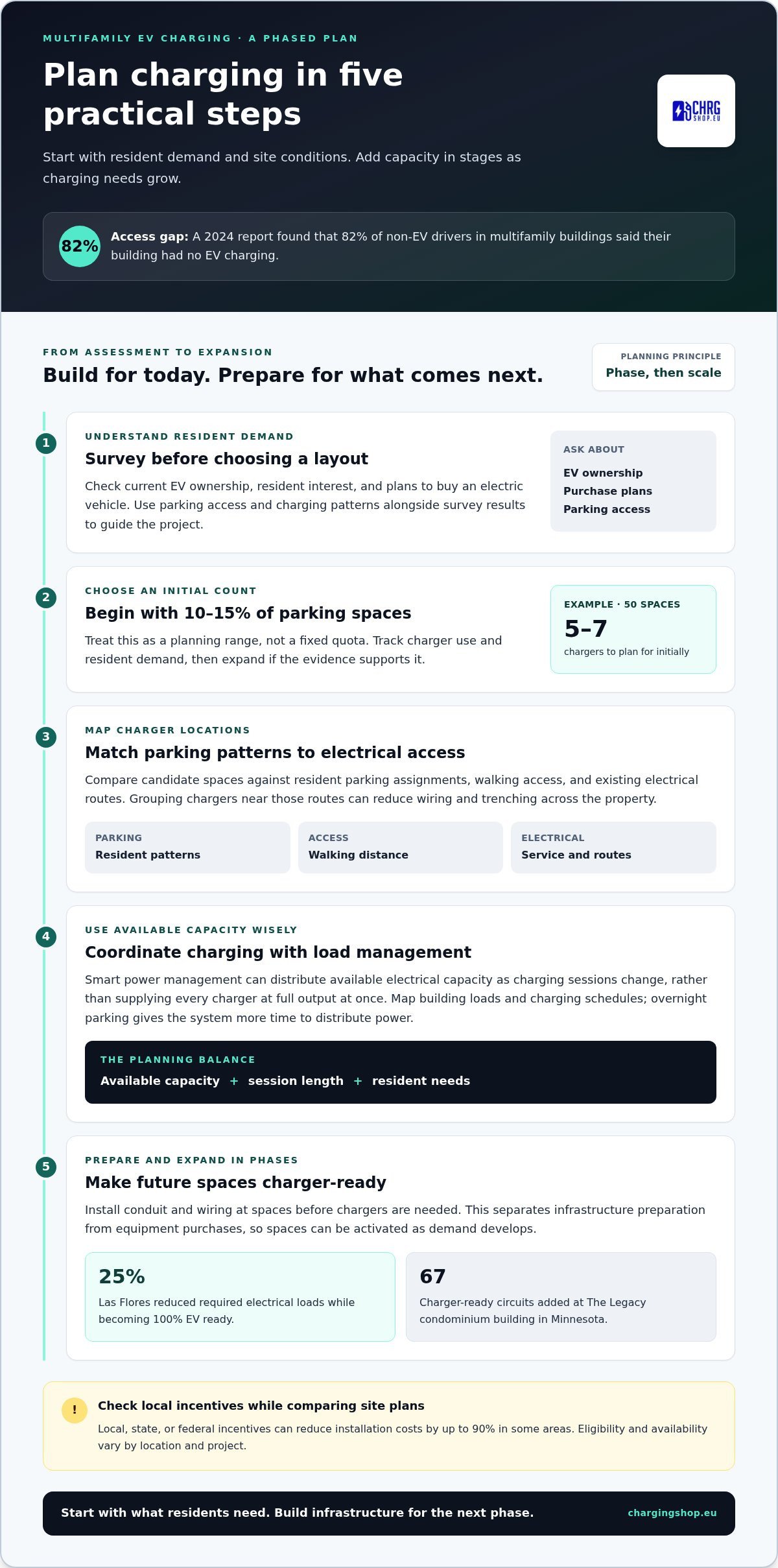
A 2024 report found that 82% of non-EV drivers in multifamily buildings said their building had no EV charging. For multi-family building EV charging, a practical starting point is to equip 10-15% of available parking spaces, then expand as demand and charger use grow. That gives residents access without requiring you to build out every space at once.
It’s reasonable to focus on electrical work and where chargers will fit. But placement and load management also affect the capacity a project needs, while a phased plan can make future expansion easier.
This guide explains how to estimate an initial charger count, choose between shared and dedicated access, and plan locations around resident parking. You’ll also learn how load management and charger-ready spaces can help manage infrastructure demands, along with what to consider when setting charging rules and planning for growth. Use these principles to create a setup that works for your community now and can adapt as more residents drive electric vehicles.
Key Takeaways
- Survey residents about EV ownership and purchase plans to understand future demand before committing to a charging layout.
- Assess parking access, electrical capacity, billing, and site constraints together so the setup works for residents and property operations.
- Plan overnight charging around how long vehicles typically stay parked, and choose a charging approach suited to that use.
- Consider preparing additional spaces for future chargers so expansion can build on existing infrastructure rather than start from scratch.
- View resident charging access as both a practical amenity and a way to support a more energy-efficient community.
How many EV chargers should I install at my multifamily property?
A practical starting point is chargers for 10-15% of available parking spaces. Then scale according to resident demand and charger use. For example, a property with 50 spaces could begin by planning for five to seven chargers, then track utilization before expanding. Treat this as a planning range, not a fixed quota: parking access, electrical capacity, and residents’ charging patterns all affect the right setup.
Access is a real gap for renters. A 2024 report found that 82% of non-EV drivers in multifamily buildings said their building lacked EV charging. Nearly half of U.S. EV owners in multifamily developments also lack access to home chargers. Assess resident interest, current EV ownership, and plans to buy an electric vehicle before choosing a final count. Installing EV chargers where residents can use them can make apartment living more compatible with electric driving.
There’s an environmental reason to widen access, too. A charging network that makes it easier for renters to buy and charge EVs supports the shift toward a carbon-neutral future. Chargers alone don’t guarantee lower emissions, but accessible charging removes a practical barrier for residents considering an electric vehicle. A phased plan lets a property expand access as demand grows, rather than equipping every parking space from the outset.
Networked chargers can support shared access, usage records, and billing through connected management tools. Basic chargers may suit dedicated parking with straightforward payment arrangements, but offer fewer network-management options. The right choice depends on how the property will manage access and payments.
Set clear rules before residents plug in. With shared chargers, drivers may need to move their cars when charging finishes, so define session limits, reservation windows, and how residents will know when a space is free. Unit-owned chargers provide dedicated access without scheduling or moving the vehicle. For billing, set a transparent rate based on electricity costs and associated fees or taxes. Operators can also vary prices by time or user type.
Incentives vary by location and project. Some local, state, or provincial programs can reduce installation costs by up to 90% in some areas, while utility make-ready programs in New York and California can cover 50-100% of multifamily charging infrastructure costs. According to the Internal Revenue Service, the U.S. Alternative Fuel Vehicle Refueling Property Credit can cover up to 30% of eligible costs when prevailing-wage and apprenticeship requirements are met, with a $100,000 cap per item; it applies only to equipment purchased or contracted for before September 25, 2025.
Before opening stations, assign responsibility for access, payment rules, upkeep, and issue reporting to help manage parking, maintenance, and liability. Map each proposed location against parking assignments and access to electrical service. Limited capacity may call for a smaller initial rollout or managed charging, while spaces near existing electrical service may be simpler to serve. Documented procedures help residents understand reservations, completed sessions, and how to report equipment issues.
Reducing costs through charger placement and load management
Charger locations, electrical capacity, and power controls all shape a multifamily charging project. Plan them together to avoid building infrastructure around a layout that limits future use.
Charger placement for cost reduction
Charger placement means choosing parking spaces that can connect efficiently to the building’s electrical service. Grouping chargers near existing electrical routes can reduce the wiring and trenching needed across a property. Compare candidate spaces against resident parking patterns, walking access, and electrical access before finalizing the layout.
Keep future expansion in view, too. A make-ready approach can install wiring and conduit at spaces before chargers are needed. One planning example prepares five additional parking spots this way. Local, state, or federal incentives can reduce installation costs by up to 90% in some areas, so account for eligible programs while comparing site plans.
Smart power management
Smart power management coordinates charging demand so connected vehicles share available electrical capacity. Instead of supplying every charger at full output simultaneously, the system can distribute power as charging sessions change. This can help a property use existing capacity more effectively and reduce the need for an electrical upgrade.
Start by mapping building loads and charging schedules. Overnight parking, for example, gives a system more time to distribute power across vehicles. The property can then match charger output to actual use instead of planning for every driver to plug in at once. The key is balancing available capacity, session length, and resident needs.
Load management and make-ready infrastructure
Load management controls how much power charging draws across the property, while make-ready infrastructure prepares spaces for later chargers. Together, they can support expansion without installing every charger at the outset. Las Flores reduced required electrical loads by 25% while becoming 100% EV ready.
Make-ready work can include conduits and wiring to parking spaces that don’t yet need a charger. The Legacy condominium building in Minnesota added 67 charger-ready circuits. This staged approach helps property teams separate preparation from equipment purchases, then activate spaces as demand develops. Coordinate each phase with electrical capacity and the parking layout.
Software features and charging analytics
Charging management software can organize station access, charging sessions, and billing in one system. Session records can help property managers explain usage and allocate electricity charges. Access controls can support shared charging rules, while usage reports show which locations and times are most popular.
Use those records to guide decisions, not assumptions. If a few stations stay busy while others see little use, review placement and access rules before adding equipment. Compare session times with building capacity to identify when managed charging could help. Clear billing records also make it easier to explain how residents are charged for electricity and related fees.
Use site capacity, parking plans, and expected operating needs to shape the project. To compare EV charging approaches for a property, consider how the equipment and management model fit the planned setup.
Scalable charging solutions for HOAs and residential communities
Multifamily properties can offer shared or dedicated chargers, with Level 2 equipment fitting many overnight-parking settings. Level 2 uses a 208/240-volt input and can charge vehicles while residents are parked for extended periods.
Resident onboarding and support
Resident onboarding explains how to access chargers, follow community rules, and get help with operating issues. Use a short survey to ask residents about current EV ownership and plans to purchase within the next five years. The National Multifamily Housing Council survey found 27% of residents interested in charging stations, a useful signal to pair with property-specific responses.
Before opening stations, share clear instructions for starting and ending sessions, reporting faults, and contacting the designated property support channel. Assign responsibility for routine equipment checks and issue tracking. A consistent process helps tenants know what to do when a charger is unavailable or a session doesn’t end as expected.
Resident payment models
Resident payment models determine whether drivers pay the full charging cost, receive a subsidy, or share costs with property owners. With resident-paid charging, tenants cover electricity and associated fees. Subsidized pricing lets owners absorb some costs as an amenity, while a hybrid model can subsidize access but charge for electricity use.
Set pricing rules before service begins. For example, a community might charge residents for electricity while subsidizing access to encourage adoption. Property operators can also set different prices for daytime and nighttime sessions, or for public and private users. Explain the rate structure and billing method in resident materials so tenants know what each session costs.
Charging options for multifamily buildings
Charging options include shared Level 2 stations, dedicated chargers assigned to individual units, and charging-ready spaces prepared for future equipment. Shared stations serve multiple drivers, while dedicated access gives a resident an assigned charger without booking around other users. Choose the model that fits parking assignments, electrical access, and expected use.
For most multifamily properties, Level 2 is a practical fit because cars often remain parked overnight. DC fast charging is generally excessive for communities where residents leave vehicles parked for long periods. A phased setup can combine active chargers with prepared spaces, allowing an HOA to add equipment as resident demand changes.
Resident attraction and sustainability benefits
Charging access can help owners attract and retain residents who drive EVs or are considering one. In a 2022 survey, 47% of millennials, 41% of Gen Zers, and 38% of Gen Xers said they wanted an EV as their next vehicle. Those figures point to interest across age groups, though each community should assess its own residents.
For HOAs, a charging plan can support a more energy-efficient community and generate revenue when tenants pay for access. Start with a resident survey, select a payment model, and define onboarding and maintenance responsibilities. Then review charging use and resident feedback to guide future expansion, rather than adding stations without a clear operational plan.
Benefits of installing EV chargers in multifamily buildings
EV charging can make apartments more useful to current residents and prospective renters. Requirements differ by location. California’s Title 24 (CALGreen) requires new multifamily developments to provide EV-ready parking for every dwelling unit, with updated shared-parking charger requirements taking effect in 2026. Texas has no statewide EV-ready mandate, although local jurisdictions are adopting requirements.
There’s no single installation cost for an apartment building or parking space. The project scope depends on charger count, parking layout, electrical service capacity, wiring routes, equipment, and whether upgrades are needed. Per-space costs also depend on whether spaces get active chargers or only charger-ready infrastructure. Compare these components separately to understand what drives the total.
For property owners, procurement starts with a site plan and an electrical-capacity assessment. Match charger equipment to resident use, parking access, and the building’s service. A Level 2 charger generally suits overnight parking; DC fast charging is usually excessive where vehicles stay parked overnight. Software can support station access, usage tracking, and billing once the equipment is operating.
Installation planning also covers engineering, permits, and coordination with the building’s electrical systems. Map charger locations, proposed wiring paths, service capacity, and any required upgrades before work begins. Then coordinate equipment delivery and construction with parking operations, so residents know which spaces are affected and when they can use them.
California’s rules illustrate why timing and project type matter: requirements for new construction differ from those for retrofits in existing buildings. Right to Charge laws address resident requests to install chargers in existing buildings, while EV-ready codes apply to new construction. The rules and approvals for a property depend on its location and whether the project is new construction or a retrofit.
Plan the work in phases. First, assess resident demand and parking constraints. Next, define charger locations and electrical requirements, then coordinate permitting and installation. Finally, establish access, billing, and maintenance procedures before residents begin charging. This sequence helps avoid selecting equipment before understanding the infrastructure it needs to connect to.
Proactive charging infrastructure can also support tenant retention. At least 80% of electric vehicle drivers in the United States charge at home, and roughly one-third of consumers cite a lack of reliable home charging as a reason for delaying or rejecting an EV purchase. For renters without private garages, convenient shared or dedicated stations can make charging at home practical. Build expansion capacity into the plan, so future upgrades don’t require starting the design process again.
Benefits of EV charging for multifamily housing
Charging stations can make a property more appealing to residents considering an electric vehicle. A 2024 report found that 67% of non-EV drivers in multifamily buildings said building charging would make them consider getting an EV. For housing providers, that finding connects a practical amenity with a possible shift in prospective residents’ vehicle choices.
The benefit extends beyond current EV drivers. Residents without a private garage may have fewer convenient places to charge near home, so shared stations can make electric driving more accessible. Property owners can position charging as part of a wider range of resident amenities, alongside parking and other shared facilities. A thoughtful multi-family building EV charging plan focuses on whether access meets community needs, not simply whether stations appear on a property listing.
Charging access can also support an energy-conscious community. A network that helps renters buy and charge EVs contributes to the broader move toward a carbon-neutral future. That’s a community-level benefit, not a promise that chargers alone reduce a building’s emissions. Pair charging solutions with clear access and operating rules so residents can use stations in everyday life.
There may also be a property-value connection. A California Nature Sustainability study analyzed nearly 14 million residential real-estate transactions from 1993-2021. It found that homes approximately 0.25-0.3 miles (0.4-0.5 kilometers) from an EV charging station had an average housing-price premium of approximately 5.8%. This finding describes an association in the study, not a guaranteed value increase for an individual multifamily property.
For owners, the practical takeaway is to connect the amenity to a clear community need. Ask residents whether charging would influence their decision to stay, recommend the property, or consider an EV. Then assess station access, parking arrangements, billing, and future expansion together. Multi-family building EV charging can support different needs, from shared parking access to dedicated resident stations.
Track results after stations open. Review resident feedback, station use, and requests for access to understand whether the amenity is serving its purpose. If usage grows, that evidence can inform the next expansion phase; if residents face access barriers, adjust the operating approach first. Build a charging plan around your community’s goals, and explore EV charging solutions for your property.
Charging Shop: V2C Trydan 22kW
Charging Shop helps property teams match EV charging hardware to their community’s charging plan. If your parking layout, electrical capacity, and resident access model are defined, compare the V2C Trydan 22kW, Alfen Single Pro Line 22kW, and V2C DENKA 20kW DC Wallbox as hardware options for your project.
A Personalised Charging Offer can help you assess a setup against your project requirements. Consider how residents will use the stations, whether charging will be shared or dedicated, and how the equipment fits your planned infrastructure. These details help make product selection more relevant to the property’s needs.
Contact Charging Shop to discuss a Personalised Charging Offer for your multifamily charging plan.
Build a Charging Plan That Can Grow
A durable approach to multi-family building EV charging starts with a decision that reaches beyond equipment: how will your community adapt as resident needs change? Treat the charging plan as part of ongoing property operations. Include ownership, access rules, billing, and future reviews in the same conversation, so the setup remains useful as the community evolves.
For your next planning discussion, compare equipment against the project’s intended use and operating model. Charging Shop offers the V2C Trydan 22kW, V2C DENKA 20kW DC Wallbox, and Alfen Single Pro Line 22kW. A Personalised Charging Offer can help connect your project requirements with a suitable hardware direction.
Bring your community’s priorities into the next step. Contact Charging Shop to discuss your project, and move forward with a charging plan built around your residents.
Frequently Asked Questions
Do Right to Charge laws apply to unassigned or shared parking?
Not necessarily. A Right to Charge law gives residents or tenants a legal right to install an EV charging station at home, subject to reasonable safety, permitting, and cost requirements. It doesn’t automatically assign a shared or unassigned parking stall to one resident. In a common garage, distinguish the right to request installation from control of the space, access scheduling, and responsibility for electricity. State and local rules shape those details.
How can property developers capitalize on EV charging mandates?
Developers can treat EV-ready requirements as a design opportunity by planning electrical pathways alongside parking rather than adding them later. For example, California requires new multifamily developments to provide EV-ready parking for every dwelling unit. A developer can plan for future charger connections during construction, then install active stations as residents need them. This can make the property’s charging capability easier to expand and explain to prospective renters.
What if the building doesn’t have enough electrical capacity?
If service capacity is tight, use load management to share available electrical capacity across active charging sessions. Coordinating charger output with building demand can reduce the need for electrical upgrades. Prioritize locations and resident schedules, then prepare additional spaces with conduit and wiring. This lets the property bring charging online in phases instead of sizing every circuit for simultaneous maximum charging.
How can landlords and HOAs allocate EV charging costs and billing?
Separate charging costs from general rent when residents can be billed by use. Set the resident rate at the cost of electricity plus associated fees or taxes, with an optional additional amount to recover installation costs. A shared station can bill by electricity consumed or session duration. For dedicated chargers, assign usage to the resident’s account. Publish billing rules and keep clear session records to help resolve questions.
What electrical capacity and infrastructure upgrades do multifamily EV chargers require?
A Level 2 charger uses a 208/240-volt input, and a typical installation requires a 40-amp circuit for each charger. Property capacity depends on existing service, building loads, charger count, and whether load management shares demand. Infrastructure work may include circuits, wiring, conduits, or electrical service upgrades. Assess electrical distribution and parking routes together before selecting equipment, so the design reflects site constraints and expansion plans.
What building codes and permitting rules apply to multifamily EV charging in the U.S.?
Requirements vary by jurisdiction and project type. California’s Title 24 (CALGreen) requires new multifamily developments to provide EV-ready parking for every dwelling unit; updates for installed chargers in shared parking take effect in 2026. Austin’s 2024 Energy Code took effect in July 2025 and applies to new multifamily construction. Texas has no statewide EV-ready mandate, although local jurisdictions are adopting requirements. Permitting rules also depend on location.
What steps should property owners take to plan and install EV charging?
Use a staged plan: assess demand and site constraints during weeks 1-4, choose a charging model during weeks 3-6, and research incentives and approvals during weeks 5-10. Schedule installation and commissioning during weeks 8-14. In parallel, document parking access, billing responsibility, and operating rules. Keep a record of project assumptions to guide later expansion and help connect design choices with approval requirements.
