
 Deutsch
 Dansk
Dansk Suomi
Suomi Latviešu
 Lietuvių
 Norsk bokmål
 polski
 Русский
 Svenska
No products in the cart.
Uncategorized
Controlling EV Charging Costs for Business: A Guide

17
Oct
Oct
What if the charging rate isn’t the biggest factor in your EV bill? Equipment, site work, network fees and daily operations all affect total cost. For controlling ev charging costs for a business, start by measuring each cost driver, including how peak demand and unmanaged charging may affect your electricity bill.
You’ll also need to decide whether charging should be free for employees or customers, priced to recover costs, or run as a revenue source. The right model depends on who uses your chargers, when they’re used and what your business needs from them. A lower energy rate alone won’t answer that question.
This guide explains how to identify and measure the main costs of business EV charging, compare practical controls and match charging hardware and management options to your site. You’ll also learn how to build a repeatable review process: track costs and usage, assess the results, then adjust charging and pricing decisions as your business changes.
Key Takeaways
- Separate total charging spend into cost categories to see which expenses your business can influence.
- Understand how energy use and simultaneous charging affect your site’s electricity costs, then track the measures that matter for your tariff.
- For controlling ev charging costs for a business, match each control, from scheduling to charging fees, to a clear goal and metric.
- Build a repeatable plan: set a baseline, choose a cost-control lever, measure results and review them regularly.
- Align charger selection and network access with your location, vehicle throughput and operating model.
Controlling EV Charging Costs for a Business Starts with a Clear Cost Map
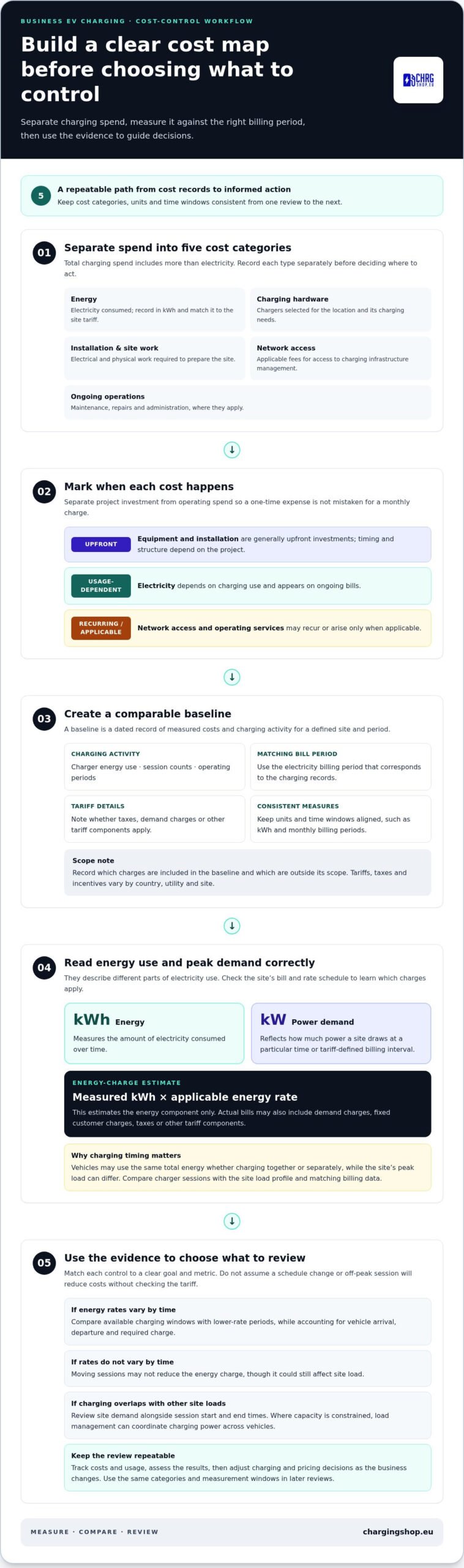
Total EV charging spend is not the same as controllable spend. Electricity, equipment, site work, network access and operating expenses all contribute, but each behaves differently. Some costs depend on usage or tariff terms; others come from site and equipment choices or the way charging is managed. Separate them before deciding where to act. That’s the starting point for controlling ev charging costs for a business.
- Energy: Electricity consumed by charging, recorded in kilowatt-hours (kWh) and billed under the site’s applicable tariff.
- Charging hardware: The chargers selected for the location and the charging needs they must support.
- Installation and site work: Electrical and physical work needed to prepare the site. Requirements vary between locations.
- Network access: Any applicable fees for access to charging infrastructure management.
- Ongoing operations: Costs such as maintenance, repairs and administration, where they apply.
This map helps separate costs you can influence from costs you can only monitor. Changing access rules, for example, may affect who charges and when, while a site-related expense may already be committed. The Electric Vehicle Charging Overview provides background on charging levels, connectors and infrastructure that can inform equipment and site decisions.
Which business EV charging costs recur, and which happen once?
Equipment purchases and installation are generally upfront investments, although their timing and structure depend on the project. Electricity is usage-dependent and appears on ongoing bills. Network access, maintenance, repairs and other service expenses may recur or arise only when applicable. Record each item by type and billing period so a one-time investment isn’t confused with the cost of operating the chargers. This makes it easier to compare operating costs over time without treating every expense as a monthly charge.
What belongs in a useful cost baseline?
A charging cost baseline is a dated record of measured costs and charging activity for a defined site and period. Include charger energy use, session counts, operating periods and the matching electricity billing period. Note tariff details, including whether taxes or demand charges apply. Keep units and time windows consistent, such as kWh and monthly billing periods, so comparisons reflect actual changes rather than different measurement methods.
Tariffs, taxes and incentives vary by country, utility and site. A tariff may bill energy use, include demand charges or use another structure, so use the relevant bill and rate information rather than a generic assumption. Record which charges are included in your baseline and which are outside its scope. This helps show whether a change in total spend came from charging activity, tariff terms or another cost category.
Start with what’s measurable, then mark each line as upfront, recurring or usage-dependent. This gives your team a practical cost map: it clarifies what to track, what may be adjustable and what needs to be accounted for before choosing a control. Use the same categories in later reviews to keep decisions grounded in comparable records.
How Energy Use, Peak Demand, and Charging Patterns Shape Business Costs
Energy use and peak demand describe different things. Kilowatt-hours (kWh) measure the amount of electricity consumed over time. Power demand, measured in kilowatts (kW), reflects how much power a site draws at a particular time or across a billing interval defined by its tariff. A fleet may use the same total energy whether vehicles charge together or at separate times, but the site’s peak load can differ.
Energy charges reflect electricity consumed; demand charges reflect peak power under the tariff’s rules, where applicable. The exact calculation and whether either charge applies depend on the local tariff, so use the bill and rate schedule for the specific site.
For a straightforward estimate of the energy charge, use:
Charging energy cost = measured kWh × applicable energy rate
This estimates the energy component only. Actual bills may also include demand charges, fixed customer charges, taxes or other tariff components. Check the site’s billing structure before using an estimate to compare charging periods or set a budget. For controlling ev charging costs for a business, compare charger activity with billing data from the same period.
How do charging schedules affect electricity spending?
First, check whether the business tariff has different energy rates at different times. If it does, compare the available charging windows with the lower-rate periods. If rates don’t vary by time, moving sessions may not reduce the energy charge, although it could still affect site load. Build schedules around vehicle arrival and departure times and the charge needed before vehicles leave. Don’t assume off-peak charging saves money without checking the tariff.
When do simultaneous charging loads matter?
Several vehicles charging at once can add to other site loads, such as building equipment operating during the same period. Review the site’s load profile alongside charger sessions to identify concentrated demand and see whether charging coincides with other peaks. Where site capacity is constrained, load management can coordinate charging power across vehicles. The goal is to understand the combined load and operating requirements, not to assume every session must start at once.
Use session start and end times, energy delivered, and site demand readings from matching time intervals where available. This makes it easier to distinguish a busy charging day from a high-demand interval. A single monthly kWh total shows overall energy use, but not when chargers drew power or whether their activity coincided with other equipment.
Once you’ve identified the relevant tariff periods and load patterns, compare options with actual operating needs. A workplace where vehicles park for hours may have more scheduling flexibility than a site where drivers need a rapid turnaround. For charging asset management, CHRG Network Access can be part of your operational approach.
Compare Business EV Charging Cost Controls by Goal and Trade-Off
Choose a control based on the problem it’s meant to solve. Scheduling can shift charging times, access rules can manage who uses chargers, and charging fees can recover some costs. These levers aren’t interchangeable. Avoiding or reducing a cost is different from recovering spending or aiming to generate revenue. For controlling ev charging costs for a business, define the goal first, then measure whether the chosen action is working.
| Control | Suitable objective | Metric to track | Key trade-off |
|---|---|---|---|
| Scheduling | Move flexible sessions into tariff periods that suit the business | Energy use by time period; tariff charges | Vehicles need to be available and sufficiently charged when required |
| Access rules | Limit charging to defined users or purposes | Sessions and kWh by user group or access category | Restrictions may reduce convenience or charger use |
| Load coordination | Manage overlapping charging alongside site demand | Site load and charger activity during matching intervals | Coordinating power may extend charging time |
| Equipment selection | Match charger capacity and quantity to site needs | Utilisation, energy delivered and operating requirements | Capacity that exceeds typical needs may be underused; too little may constrain service |
| Charging fees | Offer a benefit, recover defined costs or operate a paid-access model | Charging income compared with the costs the policy targets | Fees can affect user experience and demand |
| Maintenance planning | Support reliability and account for upkeep | Maintenance activity, downtime and unplanned expenses | Planned work has an operating cost and does not guarantee fewer repairs |
Should a business offer free, cost-recovery, or paid charging?
Free charging can be an employee or customer benefit, but include its operating cost in the budget. Cost recovery means setting fees to align with defined charging expenses, subject to local rules and applicable taxes. Paid access is a business-model choice, not an automatic route to profit: consider revenue alongside electricity, network and operating expenses. Select the model that fits the purpose of the chargers, then review usage and costs against that purpose.
Which hardware and management choices affect cost control?
Start with vehicle dwell times, expected throughput and site requirements. A location where vehicles remain parked for hours has different charging needs from one with frequent turnover. Compare charger capacity and relevant capabilities with verified site requirements and published specifications. For professional hardware context, explore the Alfen Single Pro Line 22kW review.
Management tools can support visibility and operational decisions. Evaluate them against the data and controls your cost plan requires. CHRG Network access is another option for managing charging assets. Include maintenance planning in the review so reliability and unplanned expenses are considered rather than assumed away.
Build a Business EV Charging Cost-Control Plan in Five Steps
A cost-control plan turns charging data into decisions you can test and repeat. Keep the process practical: set a baseline, define what should change, choose one lever, measure the result and review it on a schedule. For controlling ev charging costs for a business, assign clear ownership from the start. Otherwise, usage records, bills and policy decisions can become disconnected.
- Establish a baseline. Choose a defined period and collect charger usage alongside the matching electricity bills. Record the tariff and operating conditions that could affect results.
- Set an objective. Name the business outcome, such as improving cost visibility, managing peak-period usage where relevant, or recovering a defined share of charging expenses. Describe what success would look like.
- Select a lever. Choose one action that addresses the objective, such as adjusting schedules, changing access rules or reviewing charging fees. Check that the change fits vehicle and site requirements.
- Measure the result. Compare the same metrics across equivalent periods. Track operational effects as well as financial figures, so a lower cost isn’t mistaken for a better outcome if service is disrupted.
- Review and adjust. Keep the approach, refine it or test another lever based on the evidence. Revisit the plan after changes to tariffs, fleet size, operating hours or site configuration.
Cost controls are testable only when a baseline and review period are defined. Assign an owner for each part of the process: usage data, electricity bills, access policy and periodic reporting. One person may cover several responsibilities, but every task needs a clear owner.
Which metrics help a business evaluate charging costs?
Start with total charging kWh, session count, cost per kWh and cost per session where records allow. Add peak-period usage or demand measures only if they relate to the site’s tariff. Separate employee, fleet, visitor or public charging when records support that distinction. Use the same units, billing periods and group definitions each time to keep comparisons meaningful.
How can a business test a cost-control change?
Where practical, change one operating lever at a time and compare equivalent periods. Note differences in fleet size, operating hours, tariff terms or vehicle use that could affect the result. Record service, access and driver impacts alongside financial measures. If several conditions change at once, you may not be able to identify which change influenced the outcome. Revisit assumptions when the site or its operations change.
Set a review cadence that fits charging volume and your organisation’s reporting cycle. A higher-volume site may need more frequent checks than a location with occasional sessions. Keep a short record of each decision, measure and outcome to build a useful history for future reviews. To connect your cost plan with charging requirements, explore a personalised charging offer.
Choose EV Charging Hardware and Network Access That Fit Your Cost Plan
Your cost plan should shape the equipment brief. Start with where charging happens, how long vehicles stay, how many need to charge in a typical operating period, and whether the site serves a fleet, employees, visitors or public drivers. Then match charger type and capacity to those requirements. A site with longer parking periods may have different needs from one where vehicles turn over quickly.
How should the cost plan guide hardware selection?
Decide whether AC or DC charging suits vehicle needs, dwell time and site operations. Compare the required charger quantity and capacity with published product specifications, vehicle compatibility and site electrical requirements. Include equipment, site work, electricity, network access and ongoing operations in your ownership review. Charging Shop supplies business charging hardware. Include site installation as a separate project component in your planning.
Charging Shop offers the V2C Trydan 22kW, V2C DENKA 20kW DC Wallbox, Alfen Single Pro Line 22kW and ABB Terra AC. Use each product’s published specifications to assess fit rather than assuming functions based on charger category or power rating. For higher-power business charging context, see the 40kW DC wallbox guide. A personalised charging offer can also help frame equipment selection around project requirements.
Where can charging network access fit?
Network access can form part of a business’s approach to managing charging infrastructure. Consider how it fits your operating model, who needs access and what information your cost-control process must track. Include applicable network expenses in your cost plan and base decisions on the features and terms of the option.
For controlling ev charging costs for a business, hardware and network choices should support the same measurable objectives. If the plan focuses on charging access, choose equipment and management options that align with intended users and the operating process. If it focuses on throughput, prioritize verified capacity and site requirements needed to serve vehicles on time. Review total ownership categories together, not as isolated purchase decisions.
Set your requirements before comparing options: location, vehicle dwell time, expected throughput, access model, site constraints and the records needed for ongoing review. Then use published specifications to shortlist suitable hardware and include network access where it supports your management approach. Explore business charging hardware and network options to compare choices against your cost plan.
Turn Your Cost Plan into a Practical Next Step
Make your next charging decision easier to evaluate. Put the business goal, site requirements and measures you’ll review in one brief. That gives your team a shared reference point as charging needs change and keeps controlling ev charging costs for a business connected to evidence rather than assumptions.
Use that brief to compare suitable hardware and management options for your operating model. Charging Shop offers a specialised range of business EV charging hardware, alongside CHRG Network access and personalised charging offers. Focus on the requirements that matter to your site, then review product specifications and relevant options against them.
Explore business EV charging hardware and network options to shape your next step. With a clear objective and a consistent review process, you can make informed decisions and adapt with confidence.
Frequently Asked Questions
How much does it cost a business to charge an electric vehicle?
There’s no single business-wide rate because the total depends on energy use, the site’s electricity tariff and any applicable bill components. For a first estimate, multiply the kWh delivered in a session by the energy rate. Then account separately for relevant demand charges, fixed charges or taxes. For controlling ev charging costs for a business, use the actual site bill and charger records rather than a public charging rate as a proxy.
Can a business reduce EV charging costs by charging overnight?
Possibly, but only if the business’s tariff makes overnight electricity less expensive or shifting sessions affects another relevant charge. Check the rate schedule, then compare the overnight window with vehicle arrival and departure times. For example, a delivery vehicle needed before an early shift may not have a practical charging window overnight. Compare equivalent billing periods before changing a schedule, and include any operational impact in the decision.
What is the difference between EV charging energy costs and demand charges?
Energy costs relate to the electricity consumed, usually measured in kWh. A demand charge, where the tariff includes one, is based on the site’s power demand under that tariff’s measurement rules. For example, a short period when chargers and building equipment draw power together may affect measured demand even if total monthly energy use is unchanged. Check the utility’s tariff to see whether demand charges apply and how they’re calculated.
How can a business calculate its cost per EV charging session?
Divide the charging costs assigned to a defined period by the number of sessions in that same period. For a simple energy-only estimate, multiply each session’s kWh by the applicable energy rate. If you want a fuller operating figure, decide how to allocate relevant network, demand or other charges, then apply that method consistently. State whether the result is energy-only or includes shared site costs so comparisons aren’t misleading.
Should businesses charge employees for using workplace EV chargers?
That depends on the workplace goal, budget and access policy. Free charging can be an employee benefit, while a fee may recover some defined expenses or help manage demand for limited chargers. Before setting a rate, decide who can use the chargers, what costs the fee covers and how usage will be recorded. Check applicable local rules and tax treatment, and communicate the policy clearly so employees know what to expect.
Can businesses control how much power EV chargers use at one time?
Yes. Businesses can coordinate charging activity or set operating limits where the equipment and management setup support those controls. The right approach depends on site capacity, vehicle schedules and charger specifications. For example, a fleet that returns together may need charging coordinated across vehicles rather than every session drawing full power at once. Assess the practical charging window too, since limiting simultaneous power can affect how quickly vehicles are ready.
Are EV charging incentives available to businesses in every country?
No. Incentives aren’t universal, and availability can depend on country, region, utility, project type and timing. Some programs may apply to equipment or site work, while others may have eligibility conditions or limited application periods. Check current government and utility guidance for the specific site before including an incentive in a budget. Treat it as a potential project input, not guaranteed funding, and reassess the calculation if program terms change.
