
 Deutsch
 Dansk
Dansk Suomi
Suomi Latviešu
 Lietuvių
 Norsk bokmål
 polski
 Русский
 Svenska
No products in the cart.
Uncategorized
EV Charging for New Construction: 2026 Planning Guide
03
Oct
Oct
What if the hardest EV charging decision in a new-build project is the one made too late? Planning EV charging for new construction before parking and electrical plans are final helps coordinate charging capacity, infrastructure, and site use from the start, rather than requiring avoidable design changes later.
A building may need a practical charging plan, but it is not always clear how many charging points to prepare for or whether AC or DC equipment is the better fit. The right choice depends on who will use the spaces, how long vehicles will typically be parked, and how the site may grow. This guide explains how to set requirements early, compare equipment and management options, and prepare a useful procurement brief.
We’ll cover the planning decisions that shape capacity, explain where AC and DC charging make sense, and show how network access can support the management of charging assets. You’ll also find ways to compare options across Charging Shop’s AC and DC hardware range, and consider a personalised charging offer in the context of your project.
Key Takeaways
- Plan ev charging for new construction before parking and electrical layouts are fixed, so future expansion can be considered early.
- Estimate charging demand by identifying users, dwell times, daily needs, and peak simultaneous use.
- Compare AC and DC charging against how long vehicles stay parked and the role of each space.
- Build a procurement brief around use case, electrical inputs, communications, access, and growth, then verify equipment details in current datasheets.
- Compare AC and DC hardware options with CHRG Network access, based on the project’s intended use.
Why plan EV charging during new construction, not after handover?
Charging decisions are easier to coordinate before parking layouts, electrical pathways, and equipment locations are fixed. Waiting until handover can mean revisiting decisions that affect several parts of the building. Early planning gives the project team time to identify suitable parking spaces, map routes for electrical infrastructure, and consider where charging equipment could go. It also helps clarify what provisions could support adding capacity later.
EV charging infrastructure for new construction is the planned combination of parking provisions, electrical capacity, pathways, charging equipment, and management choices that enables a building to support EV charging. The broader electric vehicle charging infrastructure ecosystem includes different charging locations and equipment. A building project needs to translate that wider picture into choices that fit its users and site.
What does EV-ready mean in a new building?
EV-ready provisions prepare a parking space for charging, but don’t necessarily include a completed, working charging station. Planning may include designated spaces, conduit or other electrical pathways, and capacity for future equipment. Installed charging equipment is different: the charger is in place, connected, and commissioned for use. Define these terms clearly in project documents so “ready” isn’t mistaken for “operational.” Requirements vary by jurisdiction, so don’t treat one code definition as universal.
Which project teams should shape the charging brief?
Build the brief from distinct project inputs rather than starting with a single equipment decision. Building use and parking patterns set the context: residents may park overnight, while workplace, visitor, or retail spaces can have different dwell times and access needs.
- Developer: Sets project goals, priorities, and expectations for future expansion.
- Architect: Coordinates parking layouts, designated spaces, and equipment locations with the building plan.
- Electrical designer: Assesses electrical capacity and plans pathways and connections as part of the project design.
- Facilities team: Identifies operational needs, including how users will access and manage charging.
- Future users: Inform the brief through expected parking duration, charging habits, and access requirements.
Use these inputs to shape EV charging for new construction before the project brief and parking plan are locked. Charging Shop offers AC and DC hardware, while CHRG Network access supports consideration of how charging assets will be managed. Keep equipment selection aligned with the project’s intended use. It does not replace the project team’s design and construction responsibilities.
How should a new-build project estimate EV charging demand and electrical needs?
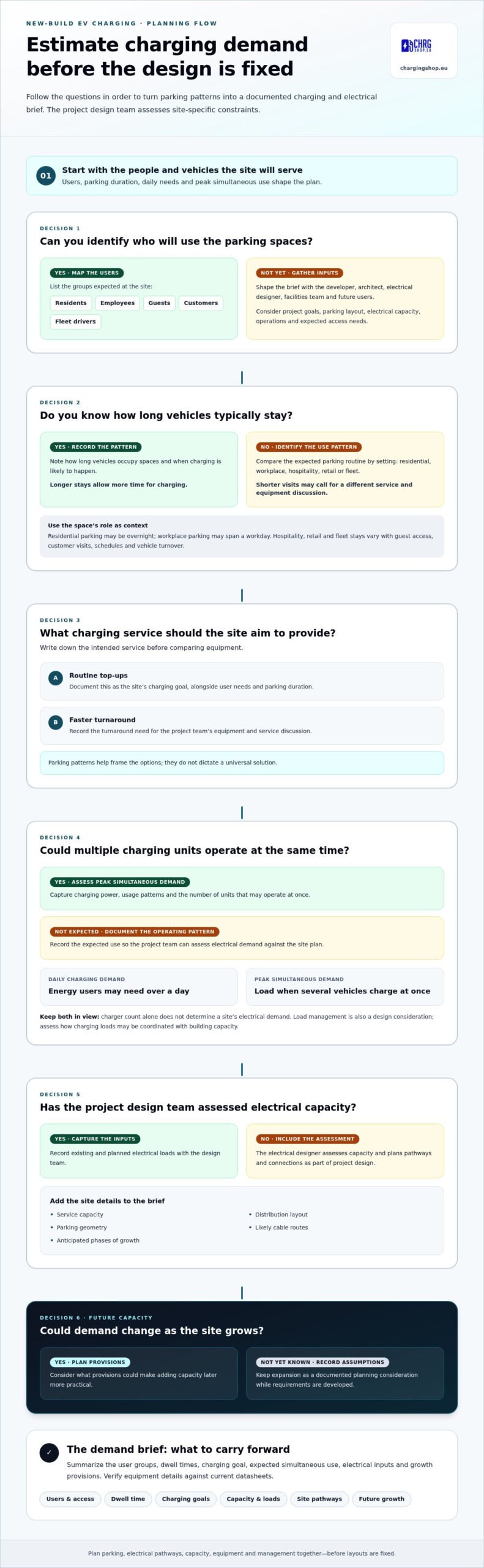
Start with the people and vehicles the site will serve, then turn expected use into electrical and equipment requirements. For EV charging for new construction, use a sequence the project team can document and revisit:
- Identify users: Residents, employees, guests, customers, or fleet drivers may have different access needs.
- Estimate dwell time: Record how long vehicles typically occupy spaces and when charging is likely to happen.
- Set charging goals: Define the service the site aims to provide, such as routine top-ups or faster turnaround.
- Assess capacity: Review existing and planned electrical loads with the project design team.
- Plan expansion: Consider how demand could change and what provisions could make later growth more practical.
Charger count alone doesn’t determine a site’s electrical demand; charging power, usage patterns, and the number of units that may operate at the same time all matter. Separate daily charging demand, the energy users may need over a day, from peak simultaneous demand, the load that could occur when several vehicles charge at once. Load management is another design consideration. The team can assess how charging loads may be coordinated with the building’s electrical capacity without assuming a particular charger has specific management features.
How do building use and dwell time affect charger selection?
Parking patterns help frame the options, but they don’t dictate a universal solution. Longer stays allow more time for charging, while shorter visits may call for a different service and equipment discussion. Use this matrix to guide the brief:
- Residential: Overnight or extended stays. What access and charging provision suits residents’ routines?
- Workplace: Workday parking. How many vehicles may need charging during the same shift?
- Hospitality: Guest stays vary. How will parking duration and guest access shape the offering?
- Retail: Visits may be brief or extended. What charging experience fits typical customer stays?
- Fleet: Schedules and vehicle turnover matter. When are vehicles parked, and when must they be ready?
What electrical and site inputs should the design brief capture?
Record service capacity, distribution layout, parking geometry, likely cable routes, and anticipated phases of growth. A qualified project design team assesses site-specific electrical constraints and coordinates these inputs with the building plan. Verify applicable utility and code requirements before design sign-off. Requirements vary by jurisdiction; the U.S. Department of Energy’s EV charger building standards resource discusses California-related provisions, not a universal rule.
Once the use case and design inputs are clear, explore a project-specific charging offer to compare hardware options with the brief.
AC or DC EV charging for new construction: how do the options compare?
Choose charging hardware based on how each parking space will be used. AC and DC describe different ways power is delivered to a vehicle, but the best fit also depends on expected parking time, site electrical design, and vehicle compatibility. That’s why EV charging for new construction calls for a use-case comparison, not just a charger-count decision.
| Option | Common use case | Dwell time to consider | Project fit and design question |
|---|---|---|---|
| AC charging | Residential, workplace, and other parking where vehicles remain for a while | Longer stays | How will the vehicle’s onboard charging capability and site electrical plan shape the delivered experience? |
| DC charging | Sites where a project is assessing a faster-turnover charging option | Shorter stays or scheduled turnaround | Does the use case justify assessing DC equipment alongside the site’s electrical and space requirements? |
These are planning cues, not fixed rules. Vehicle compatibility, the vehicle’s charging capability, equipment specifications, and site design all affect the charging experience. The U.S. Department of Energy’s EV charging infrastructure development checklist offers a broader framework for assessing charging projects. For residential context, see this home wallbox guide.
When does AC charging fit a new-build project?
Consider AC where vehicles are expected to remain parked for extended periods, such as in residential or workplace settings. The project team can weigh dwell time against user needs, vehicle compatibility, and electrical design. Charging Shop offers the Alfen Single Pro Line 22kW and ABB Terra AC for comparison. Review the Alfen Single Pro Line 22kW review for product-focused context, then check current datasheets for details relevant to the project.
When should a project assess DC charging?
Shorter parking periods or planned vehicle turnaround may lead a team to assess DC options. That doesn’t automatically make DC the right choice: compare the use case with electrical capacity, vehicle compatibility, and site constraints. Charging Shop offers the V2C DENKA 20kW DC Wallbox; consult its current datasheet for specifications relevant to the project. For a related comparison, explore this 40kW DC wallbox guide.
Keep the equipment decision separate from network management and user access. Hardware determines the charging unit; network access is a separate consideration for managing charging assets and how users interact with them. Compare both against the project brief rather than assuming one choice covers every building need.
What should an EV charging procurement checklist cover before construction begins?
A clear brief turns project needs into equipment decisions before procurement and construction schedules are locked. For EV charging for new construction, separate what the project requires from product details that need to be checked against current manufacturer datasheets.
A useful procurement brief connects site requirements to equipment specifications. Use it to record decisions, assumptions, and ownership across the project team.
- Use case: Identify intended users, parking patterns, and the charging experience the site aims to provide.
- Charger mix: Note whether the project is assessing AC, DC, or a combination, and the intended number and location of charging spaces.
- Electrical inputs: Capture planned capacity, distribution context, and relevant site constraints from the project design team.
- Communications and management: Document whether charging assets need network access, management, or reporting as separate selection criteria.
- Access: Describe who can use the stations and any expected access arrangements.
- Growth: Record anticipated expansion scenarios and the provisions the project wants to consider now.
Which charger specifications belong in the project brief?
State the required power range, connector compatibility, mounting context, and intended user groups as project needs. Keep management, access, and reporting requirements distinct so they can be compared alongside the hardware. Then review current datasheets for each candidate’s exact power ratings, communications, and installation requirements. Verify relevant standards and compliance requirements for the project’s location rather than assuming one set applies everywhere.
Make assumptions visible. Note how expected use was estimated, who owns each project decision, and what the commissioning scope must cover before handover. This helps the team distinguish agreed requirements from items that still need design or specification review.
How can the project team prepare for future expansion?
Describe likely growth scenarios, such as more users or additional charging spaces, then record what to consider now: parking allocation, cable routes, distribution planning, and space for added capacity. For multiple properties, include how charging assets may be managed across the portfolio. These are planning inputs for the project team, not assumptions about any one charger’s capabilities.
Bring these requirements together in a practical brief, then compare them with available AC and DC hardware. Explore EV charging hardware for your project and consider a personalised charging offer based on your project needs.
How can Charging Shop support EV charging decisions for new construction?
Once the project brief sets out users, parking patterns, electrical inputs, and growth plans, match those needs to hardware and network access. Charging Shop offers AC and DC charging options, plus CHRG Network access for EV station management. These are procurement considerations, not a replacement for the project’s construction workstream. Equipment selection can inform the brief, while design, installation, and commissioning remain part of the project team’s delivery scope.
Which Charging Shop products can project teams consider?
For projects assessing AC charging, the Alfen Single Pro Line 22kW and ABB Terra AC are options to compare against intended use, electrical planning, and user requirements. For a project considering DC equipment, the V2C DENKA 20kW DC Wallbox is another option to evaluate. These are not universal recommendations. Match equipment to the site brief, and review current product datasheets for specifications, communications, and installation requirements before finalising selections.
Hardware is only part of the decision. The project team can also consider how charging stations will be managed and how users will access them. The CHRG Network access guide provides context for this operational part of the plan.
How does network access fit into a new-build charging plan?
Treat network access as a project requirement alongside, but separate from, charger selection. Specify who needs access, what monitoring or management the operation calls for, and whether the approach needs to account for multiple locations. Clear requirements help the team compare options without assuming that every building or user group needs the same setup.
For a practical next step, bring your use case and equipment considerations together in a project-specific offer. Explore hardware and request a personalised charging offer for your new-build requirements.
Move your new-build charging plan forward
Strong EV charging for new construction starts with decisions made early. Set requirements around who will use the spaces, how long vehicles will stay, and how much charging capacity the project should prepare for. Then compare AC and DC equipment against site use, vehicle compatibility, and the building’s electrical design.
Include future operations in the plan, too. Charging Shop offers AC and DC hardware options, along with CHRG Network access for managing charging assets. A personalised charging offer can help you compare equipment in the context of your project, without treating one setup as the right fit for every building.
Ready to turn your project brief into equipment options? Explore EV charging hardware and request a personalised offer. Take the next step with a clearer plan and a charging setup designed around your site’s needs.
Frequently Asked Questions
What is EV-ready construction?
EV-ready construction prepares a building to support future electric vehicle charging. Depending on the project and local requirements, provisions may include designated parking spaces, electrical capacity, cable pathways, and planned equipment locations. EV-ready doesn’t necessarily mean chargers are installed or ready to use. Define exactly what “ready” means in the project documents, then verify the requirements that apply to the building type and jurisdiction.
When should EV charging be included in a new construction project?
Include EV charging requirements during early project planning, while parking layouts, electrical distribution, and cable routes can still be coordinated. The best point to document decisions varies by project, but waiting until construction is advanced can limit design choices. Start with a brief covering expected users, parking duration, charging goals, and possible future growth. Share it with the project design team before plans are finalised.
How many EV chargers should a new building install?
There’s no single charger count that fits every building. Estimate demand using expected users, parking occupancy, dwell time, and the service the project intends to provide. Also distinguish the number of charging points from peak electrical demand, since several vehicles may charge at the same time. Consider whether the project should plan for phased expansion, and verify local requirements before finalising quantities or parking allocations.
Should a new building use AC or DC EV chargers?
Choose AC or DC based on parking duration, building use, electrical design, and operating goals. AC may be considered where vehicles stay parked for longer periods; shorter dwell times may lead the team to assess DC options. Neither choice guarantees the same result for every vehicle or site. Compare the intended use with vehicle compatibility and current equipment specifications, rather than choosing by headline power alone.
Does a new construction project need networked EV chargers?
Network access may be useful when a site needs to manage user access, monitor charging assets, or support operational workflows. The right requirements depend on who will operate the chargers and how the property expects to manage them. Document access, monitoring, and management needs in the project brief, then compare them with hardware and network options. Check current product documentation before relying on specific feature or protocol claims.
Can EV charging be added to a building after construction?
EV charging can sometimes be added after construction, but the project may need to address electrical capacity, cable routes, parking arrangements, and equipment locations. The work involved depends on the completed building and applicable local requirements. Planning EV charging for new construction can preserve options for future expansion. For a retrofit, start with a site-specific assessment by qualified project design professionals to understand the building’s constraints.
