
 Deutsch
 Dansk
Dansk Suomi
Suomi Latviešu
 Lietuvių
 Norsk bokmål
 polski
 Русский
 Svenska
No products in the cart.
Uncategorized
Commercial EV Charging Station Cost: The Complete 2026 Budgeting Guide

11
Sep
Sep
What if the biggest barrier to your company’s EV transition isn’t the technology, but the hidden math behind the commercial ev charger price? You already know that electrification is the future. Still, you’re likely staring at a pile of inconsistent quotes and wondering why a simple hardware purchase feels like a high-stakes gamble. Between vague infrastructure costs and confusing software subscriptions, the path to a clear ROI often feels blocked.
It’s time to take control of your investment. This guide provides a transparent 2026 budgeting framework designed for speed and clarity. We’ll show you how to evaluate premium hardware like the Alfen Single Pro Line or the V2C DENKA DC Wallbox without the usual guesswork. You’ll discover how to navigate grid upgrade fears and use the CHRG Network to monetize your stations immediately. Stop guessing and start building a scalable charging solution. From hardware selection to long-term revenue management, here is your roadmap to a high-performance charging setup that pays for itself.
Key Takeaways
- Balance high-performance hardware with OCPP-compliant software to build a scalable and manageable charging network.
- Decode the commercial ev charger price by comparing standard AC units against rapid DC solutions to find your ideal budget fit.
- Avoid expensive grid upgrades and hidden trenching costs by implementing dynamic load balancing and smart infrastructure planning.
- Turn your investment into a profit center with the CHRG Network’s automated billing and remote monitoring tools.
- Select specialized hardware like the Alfen Single Pro Line or V2C DENKA based on your site’s specific dwell times and user needs.
The Three Pillars of Commercial EV Charging Investment
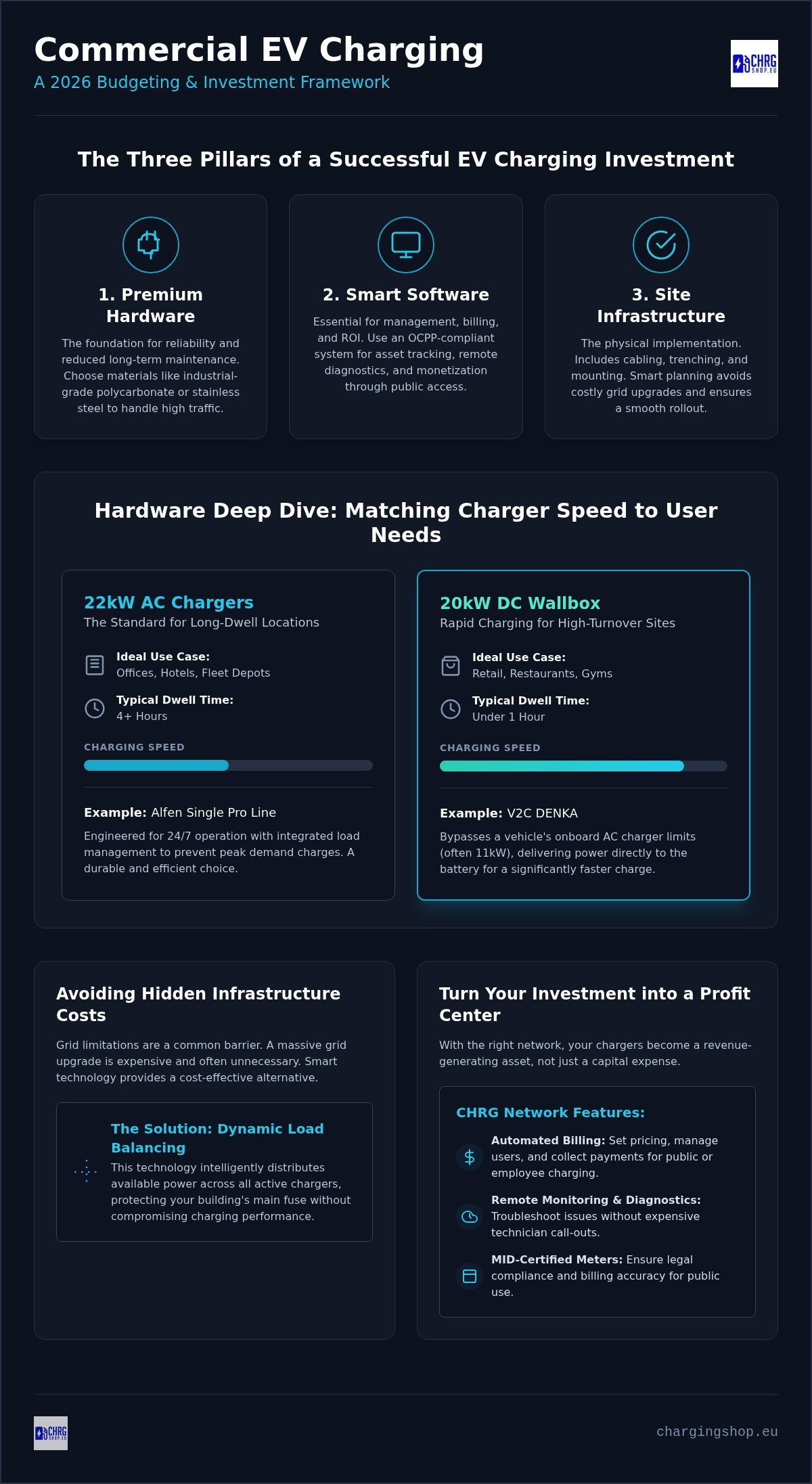
Success in electrification depends on a balanced strategy. You can’t just look at the commercial ev charger price as a single line item. A complete investment rests on three pillars: hardware, software, and physical infrastructure. Selecting premium hardware like the Alfen Single Pro Line or the ABB Terra AC is a proactive move. It reduces your long-term maintenance costs and ensures your site stays operational when demand peaks. Cheap hardware often leads to expensive repairs that wipe out your initial savings.
Hardware Tiers: AC vs. DC Selection
Choose your power level based on how long vehicles stay parked. 22kW AC units are the standard for offices and hotels where cars dwell for several hours. They’re reliable, efficient, and cost-effective. For sites requiring faster turnover, 20kW DC wallboxes like the V2C DENKA are changing the game. They provide the speed of a DC electric vehicle charging station without the massive infrastructure costs of high-power highway units. Look for hardware built with industrial-grade polycarbonate or stainless steel. These materials handle high-traffic abuse and keep your chargers looking professional for years.
Software and Connectivity Costs
Smart charging requires smart software. You need an OCPP-compliant management system like the CHRG Network to handle asset tracking and billing. Most commercial setups use a subscription model for these services. This isn’t just an overhead cost; it’s a tool for ROI. Remote diagnostics allow you to troubleshoot units from your desk, which eliminates the need for expensive technician call-outs. If you plan to monetize your chargers, ensure they have MID-certified meters. These are essential for billing accuracy and legal compliance when charging employees or the public for electricity.
Infrastructure and Grid Capacity
Don’t let grid limitations stop your project. Infrastructure costs include everything from cabling and trenching to mounting pedestals. If your building’s electrical capacity is tight, use dynamic load balancing. This technology protects your main fuse by shifting power between chargers based on real-time demand. It’s a smarter, cheaper alternative to massive grid upgrades. Factoring these elements into your initial commercial ev charger price analysis ensures there are no surprises during the final stages of your rollout.
Comparing 22kW AC and 20kW DC Hardware Performance
Hardware choice dictates your revenue potential. You aren’t just buying a plug; you’re buying a specific service level for your users. The commercial ev charger price varies significantly because the internal technology handles power delivery differently. AC chargers rely on the vehicle’s onboard converter, while DC chargers like the V2C DENKA push power directly to the battery. This technical distinction is often the difference between a happy customer and a frustrated one who leaves because their car didn’t charge fast enough.
The ROI of the Alfen Single Pro Line
The Alfen Single Pro Line 22kW remains the gold standard for high-traffic offices and hospitality sites. It’s engineered for 24/7 operation with professional-grade components that resist wear and tear better than entry-level units. Its integrated load management is a standout feature for facility managers. By implementing managed charging strategies, the Alfen unit optimizes fleet schedules without triggering expensive peak demand charges from your utility provider. It’s a smart, durable choice for any location where vehicles stay parked for four hours or more.
V2C Denka: Rapid Charging for Commercial ROI
If you run a restaurant, a gym, or a retail shop, speed is your primary metric. The V2C DENKA 20kW DC Wallbox provides a rapid turnaround without the massive six-figure investment required for highway-grade charging hubs. Most modern EVs have onboard AC chargers limited to 11kW. Even if you install a 22kW AC station, those cars won’t charge any faster. The Denka bypasses this bottleneck. It delivers a consistent 20kW direct current directly to the car’s battery. It’s compact, powerful, and fits into crowded commercial lots where space is at a premium.
Safety is non-negotiable in public-facing environments. The ABB Terra AC features industrial-grade protection against ground faults and overvoltages, making it a rugged solution for exposed driveways or shared parking garages. When selecting your hardware, always match the charging speed to your typical customer dwell time. Office workers staying eight hours don’t need expensive DC power. Retail customers staying 45 minutes absolutely do. You can explore these specific hardware configurations through our Personalised Charging Offer to find the exact fit for your facility’s needs. Balancing speed and durability ensures your commercial ev charger price translates into long-term utility rather than a maintenance headache.
Infrastructure and Grid Capacity: Avoiding Hidden Costs
Infrastructure determines the success of your rollout. The hardware is just the start. The real commercial ev charger price includes the cabling, trenching, and power upgrades required to keep the lights on. 3-phase power is the non-negotiable standard for any professional site. It’s the only way to deliver the 22kW speeds that keep fleet and visitor vehicles moving. Without it, you’re stuck with slow, residential-grade performance that frustrates users. Every meter of cable run through a parking lot adds significant labor and material costs, so strategic placement is vital.
Dynamic Load Management Explained
Don’t let grid limitations stop your expansion. Smart hardware like the V2C Trydan 22kW uses dynamic load management to protect your building’s main fuse. It monitors real-time energy consumption. When the building’s AC or machinery kicks in, the charger automatically throttles back its output. This prevents expensive grid upgrades that can cost thousands. You prioritize the building’s essential load while still providing reliable EV power. Scaling becomes easier too. Plan your infrastructure for future capacity today so you don’t have to dig twice tomorrow.
Mounting and Physical Protection
Where you put the charger matters as much as what’s inside it. Wall-mounting is the most cost-effective choice. It uses existing structures and simplifies cable runs. If your parking lot is far from a wall, you’ll need pedestal mounts. These require concrete foundations and specific hardware, which increases your initial outlay. Always look for an IK10 impact rating. This industrial standard ensures your station survives accidental bumps or vandalism in high-traffic public areas. Safety isn’t optional. Choose hardware with integrated surge protection and industrial-grade polycarbonate housing to shield your investment from the elements.
Trenching is the invisible budget killer. It’s often the most expensive part of a parking lot installation. Place your chargers as close to the electrical distribution board as possible. This simple logistical choice can slash your total project cost. By focusing on smart hardware features and strategic placement, you control the final commercial ev charger price without sacrificing performance or safety. Focus on these physical details early to ensure your project stays on budget and on schedule.
Monetizing Your Assets with the CHRG Network
Hardware is only half the story. To truly master your investment, you need a system that converts electrons into income. Understanding the total commercial ev charger price means looking beyond the physical unit and factoring in the software that manages it. Without a robust network, your stations are just passive drains on your utility bill. With the right management layer, they become active revenue generators that pay for their own footprint. Smart software turns a simple utility into a professional service.
The CHRG Network Advantage
Take full control of your infrastructure. Managing a single station is simple; managing a fleet across multiple office locations is a logistical nightmare without central oversight. You need a single dashboard to monitor health, track usage, and update firmware remotely. By choosing CHRG Network Access for EV Stations, you gain a seamless management interface designed for commercial scale. It provides real-time data that reduces downtime. If a station goes offline, you’ll know before your customers do. This proactive approach ensures your assets are always ready to charge and earn.
Revenue Models for Businesses
Recoup your costs with precision. You have the flexibility to set pricing based on your specific business goals. Some sites prefer a pay-per-kWh model to mirror utility costs exactly. Others opt for flat-rate session fees to encourage turnover in high-traffic retail spots. Modern hardware like the ABB Terra AC 22kW integrates directly with these billing systems to ensure every session is tracked accurately. The software even automates tax-compliant invoices. This removes the administrative burden from your accounting team and ensures professional transparency for your users.
Future-proof your network today. Industry standards like OCPP 1.6 and 2.0.1 aren’t just technical jargon. They’re your insurance policy. These protocols ensure your software remains compatible with new hardware as you scale your business. Don’t get locked into a proprietary system that limits your choices later. Factor these management tools into your total commercial ev charger price to get an accurate picture of your long-term profitability. Ready to start earning? Explore a Personalised Charging Offer to see how the right software-hardware combo maximizes your ROI.
Finalizing Your Commercial Procurement Strategy
Your final procurement strategy shouldn’t be a shot in the dark. It’s about matching technical specs to real-world behavior. The commercial ev charger price you pay today must account for how your users actually interact with your site. Are they parking for eight hours or fifteen minutes? That single question dictates whether you invest in high-density AC clusters or rapid DC turnover points. Scalability is your next priority. Don’t build for today’s five EVs; build for tomorrow’s fifty. Ensure your electrical backbone can support additional units as your fleet or customer base grows from the start.
Matching Hardware to Business Type
Location dictates technology. For hotels and multi-family apartments, reliability and long-term dwell time are the priorities. The Alfen Single Pro Line 22kW approach works best here. It offers professional-grade durability for vehicles parked overnight. Retail and quick-service restaurants need a different edge. The V2C Denka DC advantage provides the rapid boost shoppers expect during a short visit. If you’re managing fleet depots, you can leverage 22kW Home Wallbox technology scaled for business environments. It’s a cost-effective way to ensure every van is ready for the morning shift without overspending on industrial-grade DC hubs where they aren’t needed. This tailored approach maximizes your ROI by avoiding over-speccing.
The Procurement Checklist
Success is in the details. Before you sign any contract, verify that your hardware includes a built-in MID meter. This isn’t just a feature; it’s a legal requirement for transparent billing in most commercial jurisdictions. If you don’t have MID certification, you can’t legally sell electricity to the public. Next, confirm absolute OCPP compatibility. A hardware-agnostic network like CHRG gives you the freedom to switch software providers without replacing your physical chargers. This flexibility protects your commercial ev charger price investment from vendor lock-in. It ensures your infrastructure remains a versatile asset. You don’t want to be stuck with “bricks” if a software company changes its terms or goes out of business.
Ready to deploy? Large-scale rollouts require more than just a shopping cart. You need a partner who understands the logistics of bulk procurement and technical compatibility. Request a Personalized Charging Offer from Charging Shop today! We’ll help you bridge the gap between technical requirements and budgetary constraints. Our team focuses on delivering high-performance hardware that fits your specific site profile. Whether you’re outfitting a single office lot or a nationwide retail chain, we provide the hardware and network tools to make it happen. Secure your 2026 charging infrastructure with confidence and start recouping your investment from day one.
Secure Your 2026 Charging ROI Today
Mastering the commercial ev charger price isn’t just about the initial purchase. It’s about building a system that delivers long-term value. You’ve seen how matching hardware like the Alfen Single Pro Line to your specific dwell times prevents overspending. You now know how to bypass expensive grid upgrades using dynamic load management and smart infrastructure planning. These choices turn a technical necessity into a profitable business asset.
Success requires the right partners. We provide OCPP 2.0.1 ready hardware and global shipping for premium brands to ensure your rollout is seamless. With integrated CHRG Network management, you can automate billing and monitor your assets from anywhere. Don’t let complex math slow your transition. Take the next step toward a scalable, high-performance charging network that powers your business forward.
Build your commercial charging infrastructure with Charging Shop hardware and start leading the electrification race today.
Frequently Asked Questions
How much does a commercial EV charging station hardware cost?
Hardware costs vary by power output and build quality. Level 2 AC units like the Alfen Single Pro Line are more affordable than DC wallboxes like the V2C DENKA. The total commercial ev charger price depends on features like MID meters and OCPP compatibility. Premium units reduce ownership costs by lasting longer in high-traffic areas. Select hardware matching your site’s usage patterns, or request a Personalised Charging Offer to maximize value.
Do I need a special permit for commercial EV charging installation?
Yes, most jurisdictions require specific electrical permits for commercial installations. You must consult with a local certified electrician to ensure your project complies with building codes and grid requirements. Since Charging Shop focuses strictly on hardware distribution and network access, we recommend checking with your local authority before starting any physical work. Proper documentation prevents costly legal issues and delays during the infrastructure phase of your rollout.
Can I charge drivers for using my commercial EV station?
You can absolutely monetize your stations. By using management software like the CHRG Network, you can set custom rates for employees, visitors, or the general public. You’ll need hardware with an integrated MID meter to ensure legal billing accuracy. This allows you to recoup electricity costs and turn your parking lot into a consistent revenue stream. It’s a simple way to offset the initial commercial ev charger price through automated session fees.
What is the difference between Level 2 and DC fast charging for businesses?
Level 2 charging uses AC power and is ideal for long-stay parking like offices or hotels. DC fast charging, such as the 20kW V2C DENKA, delivers power directly to the battery for much faster turnaround. Businesses with high customer turnover, like restaurants or retail shops, benefit more from DC speed. Matching the charger type to your typical customer dwell time is essential for a high-performance and cost-effective setup.
Is load management necessary for a commercial charging setup?
Dynamic load management is vital for sites with multiple chargers. It protects your building’s main fuse by balancing power delivery based on real-time demand. Units like the V2C Trydan 22kW use this technology to avoid expensive grid upgrades. It ensures your building stays powered while your fleet or customers charge efficiently. It’s a proactive way to scale your infrastructure without massive upfront utility costs or site modifications.
How does the CHRG Network help with commercial ROI?
The CHRG Network maximizes ROI by automating the management of your charging assets. It handles complex billing, provides remote diagnostics to reduce downtime, and gives you a central dashboard for multiple sites. By streamlining the administrative side of charging, you reduce overhead. It turns your hardware into a managed service that generates profit with minimal intervention. This allows you to focus on your core business while your chargers work for you.
Do commercial EV chargers require a monthly subscription?
Most professional-grade chargers require a subscription for advanced network features. While basic charging often works offline, you need a subscription for automated billing, remote monitoring, and firmware updates via the CHRG Network. These services are vital for commercial operators who need to track usage and ensure legal compliance with OCPP 2.0.1 ready hardware like the Abb terra ac. It’s a small cost that unlocks full revenue potential.
What is an MID meter and why does my business need one?
An MID meter is a Measuring Instruments Directive certified device that ensures billing accuracy. If you plan to charge users for electricity, your hardware must have one to comply with legal standards. It guarantees that the kilowatt-hour data used for invoicing is precise and tamper-proof. Choosing units like the Alfen Single Pro Line ensures your business remains compliant while providing transparent and trustworthy data to your employees or customers.
