
 Deutsch
 Dansk
Dansk Suomi
Suomi Latviešu
 Lietuvių
 Norsk bokmål
 polski
 Русский
 Svenska
No products in the cart.
Uncategorized
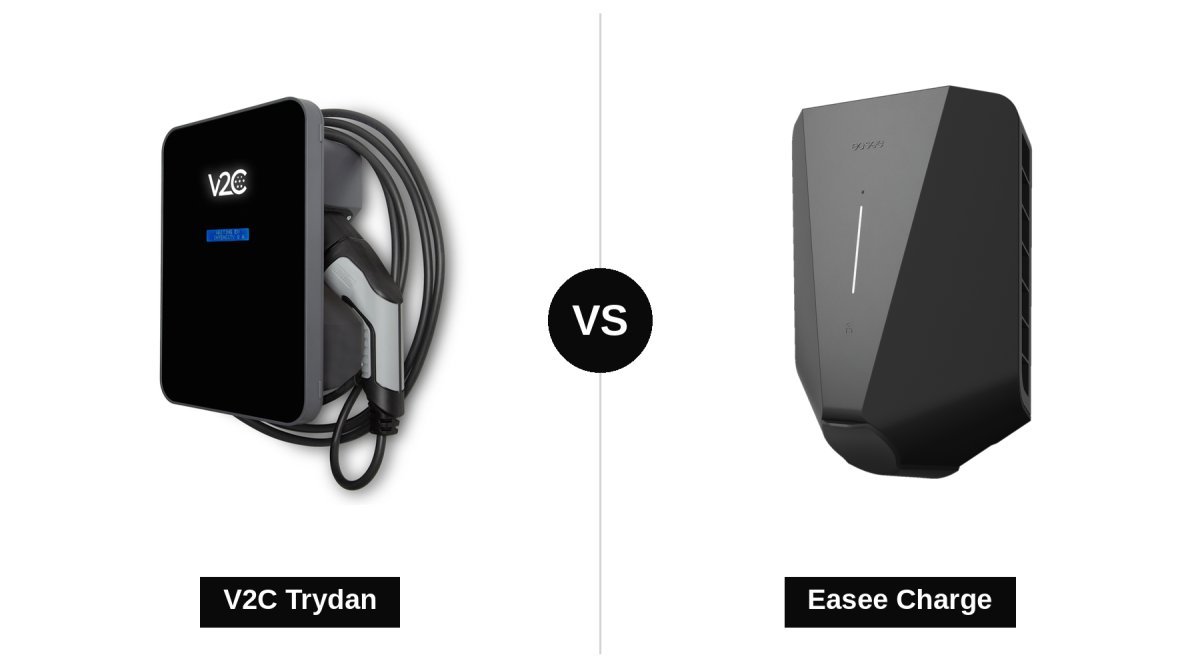
V2C Trydan vs Easee Charge: 2026 Head-to-Head Comparison
02
Sep
Sep
Choosing between the market’s two heavyweights isn’t about finding the ‘best’ charger; it’s about matching hardware to your energy ecosystem before the 2027 standards shift. You want a wallbox that handles 22kW speeds without requiring a degree in electrical engineering to operate. It’s stressful to navigate jargon about load balancing or solar compatibility while fearing your hardware might be obsolete in twelve months. We understand that you need a solution that works today and stays relevant tomorrow.
This V2C Trydan vs Easee Charge Up AC Charger: The 2026 Head-to-Head Comparison cuts through the noise to show you exactly which premium unit fits your specific home or business setup. We’ll break down the V2C Trydan 22kW, our flagship smart option, against the Easee Charge Up’s compact scalability to help you choose with certainty. You’ll get the technical truth on firmware stability and 22kW future-proofing. By the end, you’ll have a clear path to secure a verified unit and gain CHRG Network access for seamless station management. Stop guessing and start charging with total confidence in your hardware investment.
Key Takeaways
- Get the definitive V2C Trydan vs Easee Charge Up AC Charger: The 2026 Head-to-Head Comparison to identify which unit secures your home’s energy independence.
- Understand why the V2C Trydan 22kW remains the flagship smart option for households prioritizing direct solar inverter communication and technical control.
- Evaluate the Easee Charge Up for multi-car setups where a compact footprint and modular scalability are your primary requirements.
- Compare hardware durability and app-based grid protection features to ensure your 2026 wallbox investment remains relevant through 2027 and beyond.
- Discover how integrating your premium hardware with the CHRG Network simplifies long-term station management and provides professional technical oversight.
2026 Home Charging: Why the V2C Trydan and Easee Charge Up Lead the Market
By 2026, the baseline for a home electric vehicle charging station has evolved. It’s no longer about simply delivering power; it’s about intelligence. The V2C Trydan vs Easee Charge Up AC Charger: The 2026 Head-to-Head Comparison highlights why these two models dominate the premium sector. They offer 22kW speeds, integrated grid protection, and sophisticated app ecosystems that generic competitors can’t match. V2C acts as the ‘Energy Architect’ for solar owners, managing complex energy flows with ease. Easee provides a ‘Minimalist Powerhouse’ for those who value Scandinavian efficiency and space-saving design. Both brands represent the pinnacle of current hardware, leaving unbranded units in the dust with superior reliability and safety features that protect your home’s electrical panel from overloads.
The Shift Toward 22kW Future-Proofing
7.4kW is now the floor, not the ceiling. As battery capacities grow, 22kW is the new standard for serious EV owners who want to maximize their time. Modern 22kW home wallboxes handle high-capacity packs with ease, cutting down charge times significantly compared to older hardware. In the 2026 European grid, three-phase power is essential for stability and speed. You don’t want hardware that feels slow or inadequate by next year. Choosing 22kW ensures your setup remains relevant as vehicle technology advances and charging demands increase. It’s about buying once and buying right. We see a clear trend where owners are moving away from basic chargers toward units that offer true, high-speed energy management.
V2C vs Easee: Brand Philosophies Compared
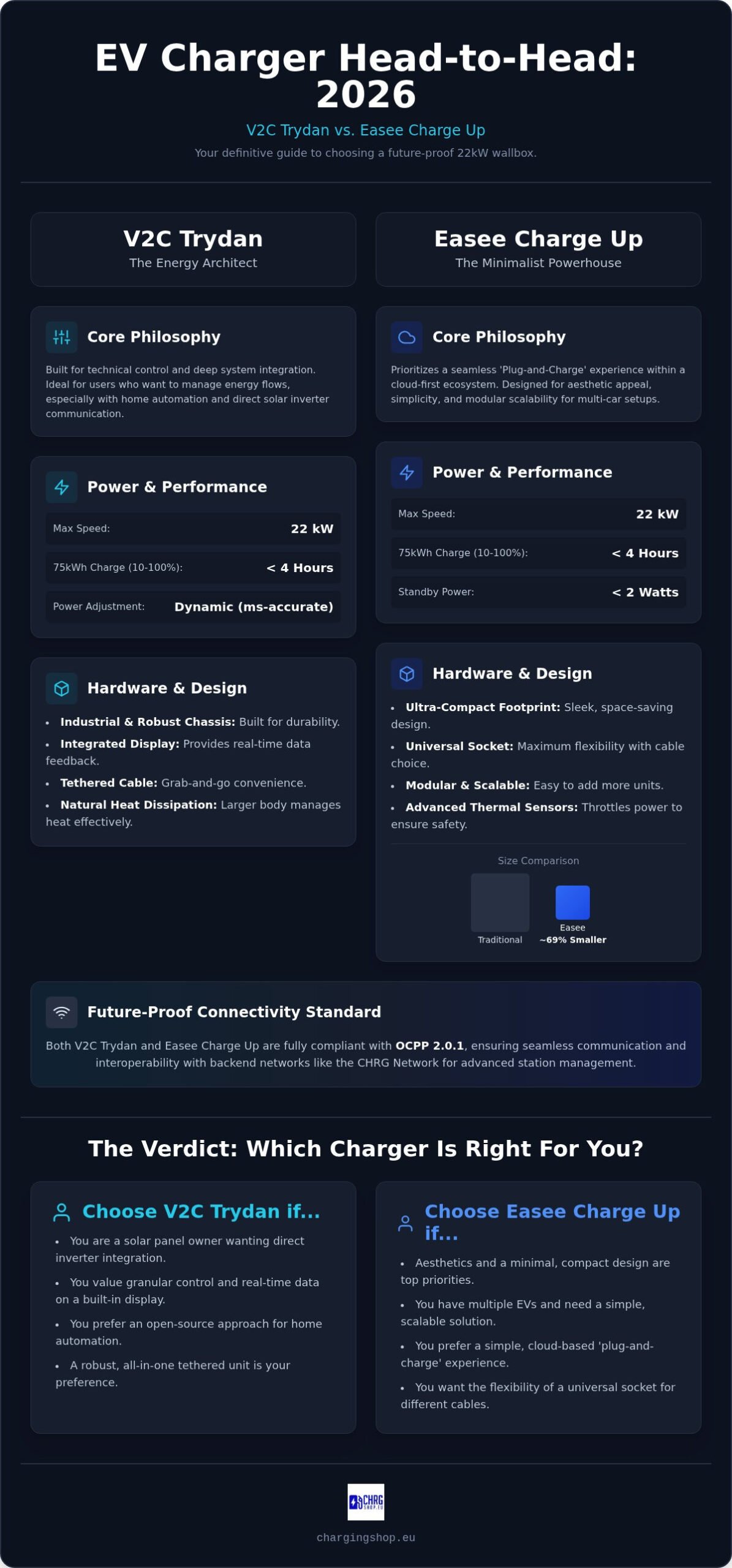
When conducting a V2C Trydan vs Easee Charge Up AC Charger: The 2026 Head-to-Head Comparison, you’ll notice these brands take different paths to excellence. V2C focuses on hardware-level control and open-source integration. It’s built for users who want to see exactly how their energy flows and integrate it with complex home automation systems. Easee prioritizes a ‘Plug-and-Charge’ experience within a cloud-first ecosystem. It’s sleek, modular, and virtually invisible on your wall. Both have successfully transitioned to the latest OCPP 2.0.1 standards. This ensures they communicate flawlessly with various backend networks, including our CHRG Network access. Whether you want deep technical integration or effortless daily use, one of these models will fit your lifestyle perfectly. They’ve adapted to modern demands while maintaining the high build quality required for long-term outdoor durability.
Raw Power and Hardware Specs: Comparing 22kW Performance
When you look under the hood of a V2C Trydan vs Easee Charge Up AC Charger: The 2026 Head-to-Head Comparison, you see two different engineering paths to the same 22kW goal. Both units utilize a three-phase, 32A setup at 400V to deliver maximum AC speed. The V2C Trydan 22kW feels industrial and robust, featuring a built-in display that provides immediate data feedback. In contrast, the Easee Charge Up prioritizes a compact footprint, being roughly 69% smaller than traditional wallboxes. While V2C typically ships as a tethered unit for grab-and-go convenience, Easee uses a universal socket that offers maximum cable flexibility. As of 2026, the V2C Trydan’s Dynamic Power capability enables real-time, millisecond-accurate adjustments to charging speeds based on total household load and solar production.
Charging Speed and Efficiency Metrics
Speed is the primary reason to consult our V2C Trydan vs Easee Charge Up AC Charger: The 2026 Head-to-Head Comparison when upgrading your home charging for electric vehicles. For a standard 75kWh battery, both chargers will take you from 10% to 100% in under 4 hours at full 22kW capacity. Thermal management is where they diverge. V2C’s larger chassis naturally dissipates heat during high-load summer sessions. Easee relies on advanced internal sensors to throttle power if temperatures spike, ensuring safety without hardware damage. Standby power consumption remains negligible for both, sitting well below 2W when idle. If you aren’t sure which speed profile fits your grid, you can request a Personalised Charging Offer to clarify your requirements.
Build Quality and Environmental Ratings
Durability is non-negotiable for outdoor hardware. Both models carry IP54 ratings for water and dust resistance, making them suitable for harsh European winters. The V2C Trydan offers an IK10 impact rating, protecting the internal electronics and the integrated LCD from physical damage. Easee favors aesthetics with interchangeable covers, allowing you to match the unit to your home’s exterior. Longevity expectations for these premium units now stretch toward a 10-year lifecycle, provided firmware is kept current. V2C’s integrated display offers a more technical interaction, while Easee’s clean faceplate relies entirely on its app for communication. Both represent the gold standard for hardware reliability in the 2026 market.
Smart Features & Solar Integration: V2C’s Dynamic Edge vs. Easee’s Ecosystem
The V2C Trydan vs Easee Charge Up AC Charger: The 2026 Head-to-Head Comparison reveals a massive gap in how these units handle energy intelligence. V2C Trydan 22kW, our flagship smart option, integrates everything you need for solar and load management into a single, cohesive package. Easee Charge Up relies on its modular ecosystem, requiring the separate Easee Equalizer accessory to match this functionality. This distinction matters if you want a clean installation without adding extra hardware to your distribution board. While both units are highly capable, the V2C Trydan acts as a standalone brain for your home’s energy flow.
Dynamic Load Balancing is a non-negotiable feature in 2026 to prevent main fuse trips. V2C Trydan 22kW includes this capability natively, communicating with your meter to adjust charging speeds in milliseconds. Easee’s approach is equally effective but modular; you’ll need to purchase and install the Equalizer to unlock these safety features. If you’re managing multiple chargers on a single circuit, Easee’s load-sharing logic is exceptionally polished. However, for a single-point home installation, V2C’s all-in-one technical control is often more efficient and cost-effective.
Mastering Solar Diversion with V2C Trydan
V2C Trydan communicates directly with your solar inverter, often eliminating the need for external physical clamps. It’s built to maximize your self-consumption by toggling between ‘Solar Only’ and ‘Solar + Grid’ modes instantly. You can charge your vehicle using 100% sun power, ensuring your driving is as green as possible. Check our solar integrated EV charger guide for a deep dive into setting up these advanced diversion rules. Easee is solar-capable through the Equalizer, but it lacks the direct, hardware-level inverter integration that makes V2C the ‘Energy Architect’ of 2026.
Easee App vs. V2C Cloud: User Interface Comparison
Both brands offer a premium Smart EV Charger with App experience that goes far beyond basic scheduling. The V2C Cloud app provides granular data visualization for technical users, tracking costs and energy flows with high precision. It’s designed for those who want total transparency over their hardware’s performance. Easee’s app is famously responsive and user-focused, offering a sleek interface that simplifies complex tasks like remote start/stop and access control. Over-the-Air (OTA) updates are standard for both, ensuring your 2026 wallbox stays current with evolving grid requirements and new vehicle protocols.
By late 2026, both units are effectively ‘V2G-Ready’ for AC bidirectional charging. V2C’s hardware-level control makes it a favorite for early adopters testing bidirectional protocols. Easee’s cloud-first approach ensures that as soon as your vehicle and local regulations allow, the software will be ready to facilitate energy export. Whether you want deep technical independence or a streamlined ecosystem, these chargers provide the smartest path to future-proofed energy management. Integrating either unit with our CHRG Network access further enhances your ability to manage and monitor your station remotely.
Aesthetics, Installation, and Reliability: Which Wallbox Fits Your Lifestyle?
Physical presence matters when hardware sits on your driveway for a decade. In this V2C Trydan vs Easee Charge Up AC Charger: The 2026 Head-to-Head Comparison, the visual contrast is striking. Easee is famous for its 69% smaller footprint, making it the go-to for tight spaces or minimalist architecture. V2C Trydan 22kW takes a different approach, prioritizing a display-centric design that puts real-time data front and center. While older V2C models were bulkier, the 2026 chassis is significantly slimmer, closing the gap with its Norwegian rival. Both units handle high-traffic environments well, but V2C’s robust industrial feel often makes it the preferred choice for semi-public parking where physical interaction is frequent.
Reliability extends beyond the hardware shell to the software management. We provide CHRG Network access with every unit to ensure you can manage your station remotely with professional-grade tools. This integration is vital for tracking usage across different drivers or monitoring performance in real-time. Your electrician will find both units straightforward to wire, though Easee’s backplate system is specifically designed for rapid deployment. V2C’s internal layout is spacious, allowing for easier maintenance if components ever need inspection. To secure the right hardware for your specific site conditions, browse our verified 22kW wallbox collection today.
Visual Impact and Footprint
Easee remains the king of discretion. It blends into the wall, offering a clean look that won’t disrupt your home’s aesthetic. The 2026 product line includes multiple color options to match your exterior finishes perfectly. V2C Trydan 22kW wins on immediate utility. Its front-facing LCD means you don’t need to pull out your phone just to check the current charging speed or solar diversion status. It’s a functional piece of tech that looks the part of a high-performance energy hub. If you value a “glanceable” status check before you leave the house, the V2C display is a significant advantage.
Scalability for Multi-EV Households
If you’re charging a growing fleet, scalability is your top priority. Easee excels with its native daisy-chaining capability, allowing up to three units to share a single fuse without complex external wiring. V2C manages multi-unit setups through the CHRG Network, using cloud-based load sharing to distribute power efficiently across multiple stations. This makes V2C highly effective for larger installations where you need detailed oversight of every kilowatt. Both models ensure you won’t need a total grid upgrade just to add a second or third vehicle to your household. Choosing between them depends on whether you prefer Easee’s hardware-linked approach or V2C’s network-managed logic.
The Verdict: Choosing Your Ultimate 2026 Charging Solution
The V2C Trydan vs Easee Charge Up AC Charger: The 2026 Head-to-Head Comparison settles a critical debate for 2026 EV owners. You’ve seen the specs. You’ve analyzed the solar diversion capabilities and the physical footprints. Now, it’s time to decide. Your choice depends entirely on your home’s energy architecture and your personal preference for hardware interaction. V2C delivers a technical masterclass in solar integration and local control. Easee offers a masterclass in Scandinavian design and effortless scalability. Both chargers are 22kW powerhouses that will keep your setup relevant well into the next decade.
Choose the V2C Trydan if…
This is the definitive choice for the energy-conscious homeowner. If you have solar panels, the V2C Trydan 22kW is your path to maximum ROI. It communicates directly with your inverter to ensure you’re driving on 100% sun power whenever possible. You’ll appreciate the front-facing LCD for quick status checks without needing your smartphone. It’s the perfect fit for those who want a V2C Trydan 22kW that integrates seamlessly with existing smart home hubs. If you value technical transparency and hardware-level control, stop looking. This is your unit.
Choose the Easee Charge Up if…
Easee is the winner for users who prioritize a clean, minimalist aesthetic. If space is at a premium on your driveway or in your garage, Easee’s compact frame is unbeatable. It’s also the superior choice for households planning to add a second or third EV. The native daisy-chaining capability makes expanding your charging capacity simple and cost-effective. You’ll get a highly polished, app-first experience that feels modern and intuitive. Choose Easee if you want a discreet, reliable powerhouse that stays out of sight while delivering consistent, high-speed performance every single night.
Decision time is here. Both units represent the gold standard of 2026 charging technology. Whether you prioritize solar savings or operational simplicity, you’re investing in premium hardware backed by the CHRG Network’s management tools. Don’t wait for 2027 standards to shift and leave your current setup behind. Take the final step to secure your energy independence. Get a Personalised Charging Offer today and confirm which of these top-tier wallboxes is the perfect match for your specific electrical setup.
Secure Your 2026 Charging Infrastructure Today
Choosing between these two industry leaders comes down to your specific energy goals. If you want a solar-integrated architect that maximizes ROI through direct inverter communication, the V2C Trydan 22kW is your winner. For those prioritizing a minimalist footprint and the ability to scale to a multi-car setup easily, the Easee Charge Up remains the top contender. This V2C Trydan vs Easee Charge Up AC Charger: The 2026 Head-to-Head Comparison proves that 22kW performance is no longer a luxury; it’s the standard for modern electric driving. Both units offer the reliability and technical depth needed to stay ahead of 2027 grid shifts.
As an Authorized Premium Distributor, we ensure you receive verified hardware with Free CHRG Network Access Included for professional station management. Don’t let technical uncertainty stall your progress. Request one of our Personalised Charging Offers in 24h to get a solution tailored to your home’s unique electrical capacity. Compare the V2C Trydan and Easee Charge Up in our shop now! You’re now equipped to make a high-performance choice that powers your lifestyle for years to come.
Frequently Asked Questions
Is the V2C Trydan 22kW compatible with all electric cars in 2026?
Yes, the V2C Trydan 22kW is fully compatible with all electric vehicles using the standard Type 2 connector in 2026. This includes everything from Tesla and BMW to newer models from emerging manufacturers. It handles both single-phase and three-phase charging, automatically adjusting to your car’s maximum intake speed. You don’t need to worry about proprietary plugs or outdated hardware. It’s a universal solution built for the current and future European EV market.
Does the Easee Charge Up require a separate load balancer like the Equalizer?
The Easee Charge Up requires the Easee Equalizer accessory if you want to enable dynamic load balancing. While the charger has basic safety features, the Equalizer communicates with your building’s smart meter to prevent main fuse trips. This is a critical addition for homes with high power demands or multiple heavy appliances. In our V2C Trydan vs Easee Charge Up AC Charger: The 2026 Head-to-Head Comparison, this modular approach contrasts with V2C’s built-in capabilities.
Can I use the CHRG Network with both the V2C Trydan and Easee Charge Up?
Absolutely. Charging Shop provides integrated CHRG Network access for both the V2C Trydan and Easee Charge Up units sold through our store. This platform allows you to manage your station remotely, track energy costs, and control user access from a single dashboard. It’s a powerful tool for both residential and commercial users who need professional oversight of their infrastructure. We ensure every hardware purchase includes the digital tools necessary for efficient long-term management.
Which charger is better for 100% solar-powered charging?
The V2C Trydan 22kW is the superior choice for 100% solar-powered charging. It communicates directly with your solar inverter via WiFi, allowing it to divert excess energy into your car without extra hardware clamps. This hardware-level integration makes it the ‘Energy Architect’ of the 2026 market. While Easee is solar-capable with the Equalizer, V2C offers a more seamless, native experience for homeowners looking to maximize their photovoltaic investment and drive on free sun power.
Do I need a three-phase power supply to install a 22kW charger?
Yes, a three-phase 400V power supply is mandatory to achieve the full 22kW charging speed. Without three-phase power, these units will typically be limited to 7.4kW on a standard single-phase connection. You should verify your home’s electrical capacity before purchasing high-performance hardware. If you’re unsure about your specific setup, we recommend requesting a Personalised Charging Offer to confirm which charger best matches your current grid connection and future needs.
How do the V2C Trydan and Easee Charge Up handle software updates?
Both chargers utilize Over-the-Air (OTA) updates to keep their firmware current. Your unit will automatically download and install the latest improvements via WiFi or cellular connection, ensuring compatibility with new EV models and grid regulations. This V2C Trydan vs Easee Charge Up AC Charger: The 2026 Head-to-Head Comparison highlights that both brands prioritize software longevity. Regular updates mean your hardware won’t become obsolete as charging protocols and smart home integrations evolve over the coming years.
What is the warranty period for these chargers when bought through Charging Shop?
When you purchase through Charging Shop, you receive the full manufacturer’s warranty for your specific hardware. As an Authorized Premium Distributor, we facilitate the connection between you and the manufacturer to ensure your unit is protected against defects. While specific terms vary by brand, most premium wallboxes in 2026 carry a multi-year guarantee. We focus on providing verified hardware that meets the highest reliability standards, giving you total peace of mind for your investment.
Can I manage multiple Easee chargers on a single home circuit?
Yes, you can manage up to three Easee chargers on a single home circuit using their native load-sharing technology. This allows the units to communicate with each other and distribute available power safely across multiple vehicles. It’s an ideal solution for growing EV households that don’t want to perform expensive grid upgrades. The system automatically prioritizes cars based on demand, ensuring every vehicle is ready to go when you need it without overloading your panel.
