
 Deutsch
 Dansk
Dansk Suomi
Suomi Latviešu
 Lietuvių
 Norsk bokmål
 polski
 Русский
 Svenska
No products in the cart.
Uncategorized
How to Manage Employee EV Charging: The 2026 Professional Guide
29
Aug
Aug
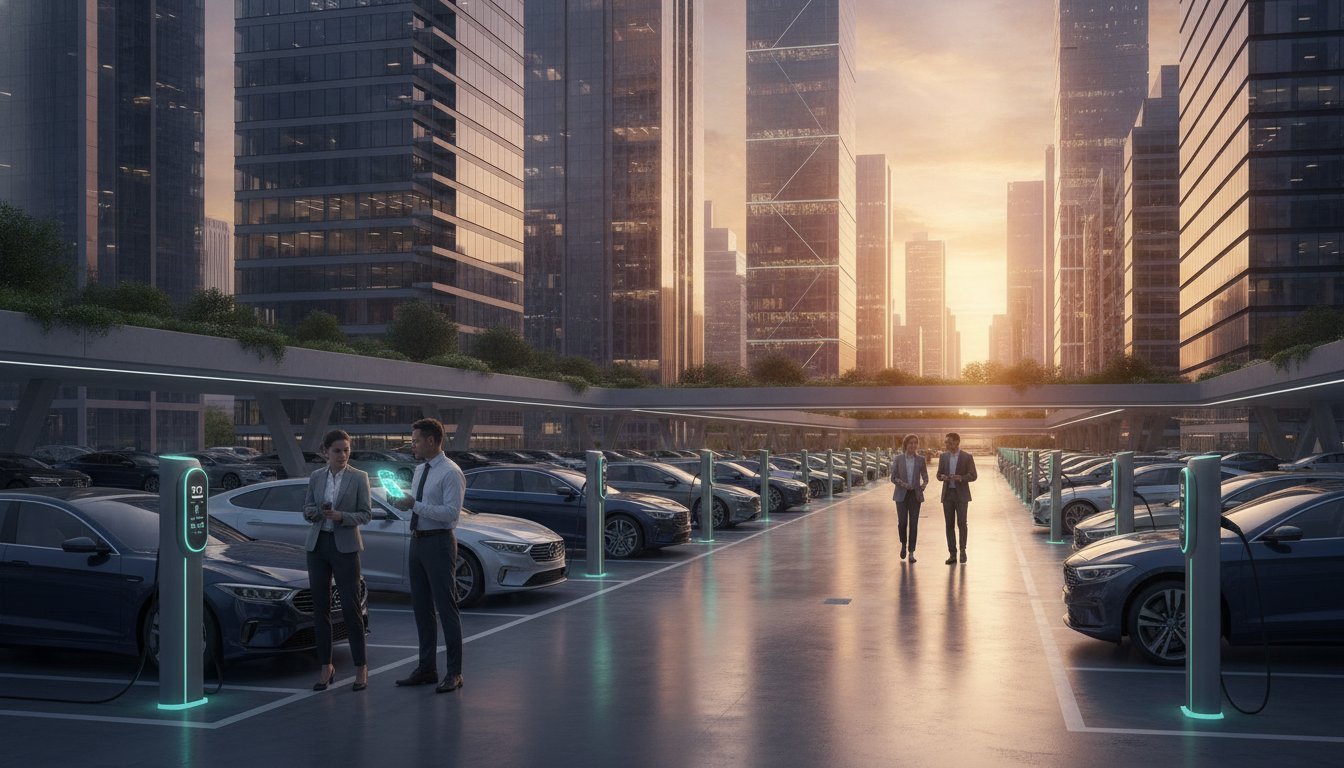
In 2026, your company parking lot isn’t just a place for cars; it’s a high-stakes energy hub where manual spreadsheets go to die. If you still use paper logs or basic apps to manage employee ev charging, you’re losing money to billing errors and unauthorized use every single day. It’s a common frustration for modern facility managers who feel trapped between complex grid limits and the urgent demand for fair, scalable access across the workforce.
We agree that your time is too valuable for manual data entry and constant troubleshooting. This guide promises to help you master the synergy of high-performance hardware and smart software to automate your entire operation. You’ll learn how to implement professional-grade reliability using MID-certified hardware and OCPP 2.1 automation. We’re diving into the CHRG Network’s smart management capabilities, high-performance V2C Trydan units for home reimbursement, and the technical standards required to keep your infrastructure future-proof. Stop guessing and start scaling with a system that delivers results without the friction.
Key Takeaways
- Learn why shifting from free perks to a managed utility boosts ROI by 30% through smart energy optimization.
- Identify why professional hardware like the Alfen Single Pro Line is necessary to handle the daily demands of a corporate parking lot.
- Master the legal requirements of MID compliance and OCPP to manage employee ev charging with automated, error-free billing.
- Implement fair access policies using tiered pricing and financial incentives like overstay fees to keep your stations moving.
- Integrate the CHRG Network with premium hardware to automate access control and reporting for your entire global fleet.
Scaling Workplace EV Charging: Why Management is Critical in 2026
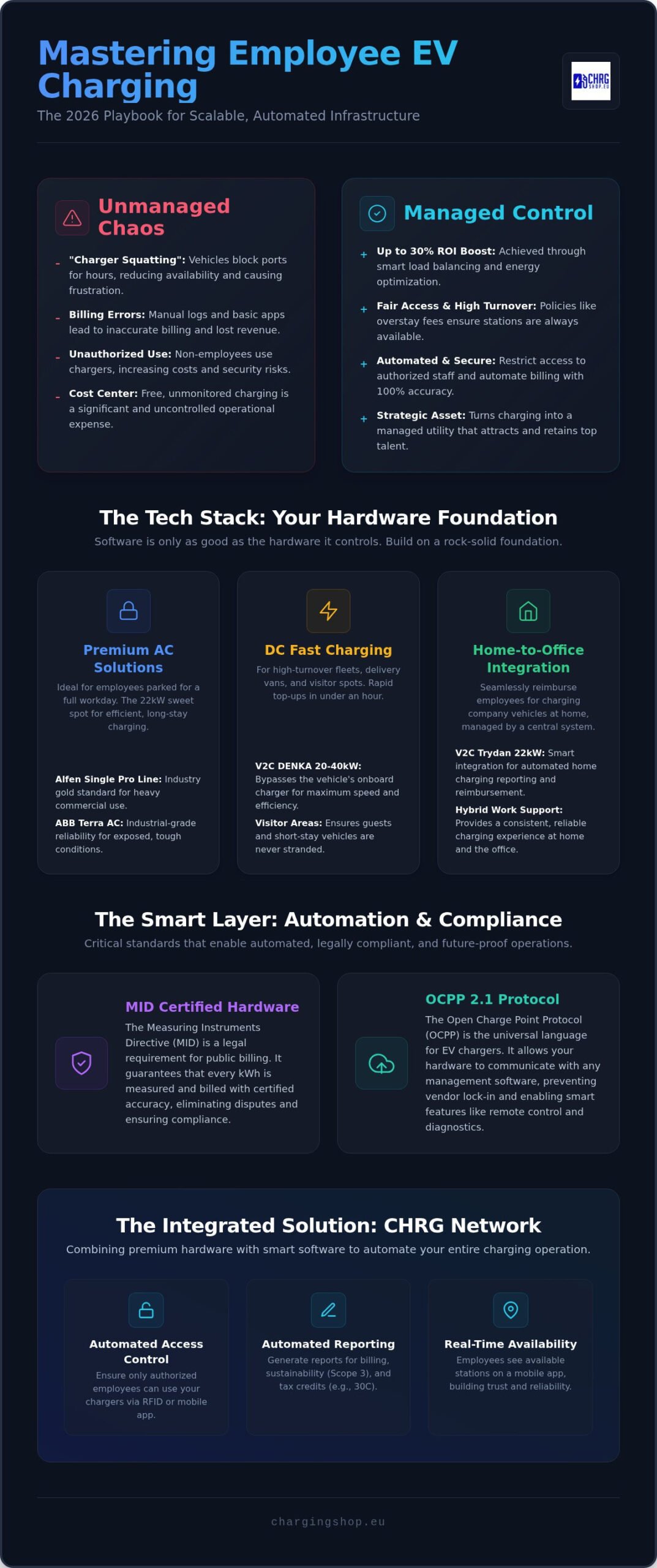
The era of “plug and pray” is over. In 2026, businesses must treat power like any other corporate asset. If you don’t effectively manage employee ev charging, you’re inviting chaos into your parking lot. Unmanaged stations lead to “charger squatting” where one vehicle blocks a port for eight hours, even when the battery is full. This isn’t just a nuisance; it’s a drain on productivity and a waste of expensive infrastructure. Stop treating charging as a passive perk and start viewing it as a managed utility.
Moving to a managed model allows you to reclaim control over your operational costs. By utilizing professional electric vehicle supply equipment (EVSE), you turn a cost center into a strategic advantage. Managed charging can increase ROI by up to 30% through energy optimization alone. You aren’t just giving away electricity; you’re orchestrating a high-performance network that balances demand and reduces peak load costs. This is how you protect your grid while providing a premium experience for your team.
The ROI of Managed Infrastructure
Smart load balancing is the secret to avoiding expensive grid upgrades. Instead of digging trenches for more cables, use software to distribute available power across your fleet. This protects your facility from massive demand spikes that drive up utility bills. Don’t leave money on the table. The U.S. Federal Section 30C Tax Credit offers up to 30% off equipment costs for commercial property placed in service by June 30, 2026. Documenting every kilowatt helps you track and reduce Scope 3 emissions, giving your sustainability reports the hard data they need to be credible.
Employee Expectations in the Hybrid Era
Your staff expects the same reliability at the office that they have at home. In a hybrid work environment, a broken or occupied charger is a legitimate reason for an employee to skip the office. Transparent management software, like the CHRG Network, builds trust by showing real-time availability on a mobile app. Employees need to know they have a guaranteed charge, not a gamble. Unmanaged stations frequently suffer from unauthorized use by neighbors or visitors. Secure your assets with hardware like the Alfen Single Pro Line or the Abb terra ac to ensure only authorized staff can draw power. This proactive approach makes your workplace the preferred destination for top talent who value efficiency and reliability.
The Tech Stack: Hardware Requirements for Employee Charging
Your software is only as good as the hardware it controls. To effectively manage employee ev charging, you need equipment that survives 2,000 plus plug-in cycles per year. Consumer-grade wallboxes are built for light home use. They lack the thermal management and housing durability required for a busy corporate parking lot. Stick to professional-grade hardware with Type 2 sockets to ensure compatibility with every EV on the market. This prevents hardware failure from becoming a bottleneck in your operations.
Connectivity is the backbone of your data. Without a constant link to the cloud, you can’t track usage or bill employees accurately. Prioritize Ethernet for rock-solid stability. If your site lacks wired infrastructure, ensure your hardware has 4G failover to maintain communication. Scalability is equally vital. Look for units that support daisy-chaining. This allows you to install multiple chargers on a single power line, which slashes your initial electrical setup costs and simplifies future expansion.
Premium AC Solutions for Long-Stay Parking
For employees parked for the full workday, 22kW AC charging is the sweet spot. The Alfen Single Pro Line 22kW is the industry gold standard. It is built for heavy commercial use and features a high-resolution display for clear user feedback. If you need industrial-grade reliability for exposed driveways, the Abb terra ac delivers a rugged build that handles tough conditions with ease. For smaller boutique offices that value smart integration and seamless home-to-office reimbursement, the V2C Trydan 22kW offers the most flexible software handshake in its class.
DC Fast Charging for High-Turnover Fleets
Sometimes 22kW AC power isn’t fast enough. If you manage a fleet of delivery vans or have high-turnover visitor spots, you need DC power. The V2C DENKA 20kW DC Wallbox provides rapid top-ups in under an hour, bypassing the vehicle’s onboard charger for maximum efficiency. While AC units handle the bulk of your staff needs, adding 40kW DC wallboxes in visitor areas ensures your guests are never stranded. Balancing these two technologies allows you to meet every charging profile without overspending on power capacity. If you aren’t sure which hardware mix fits your site, you can request a personalised charging offer to get a technical breakdown tailored to your specific fleet requirements.
Smart Access and Automated Billing: Navigating OCPP and MID Standards
You can’t manage what you don’t measure. To effectively manage employee ev charging, you need a system that identifies every user and tracks every watt. Relying on trust or manual logs is a recipe for billing errors and administrative headaches. Modern workplace charging requires a digital handshake between the vehicle, the station, and your back-office software. This ensures that only authorized staff draw power and that every session is logged for tax and payroll purposes.
Identification is the first step in your security chain. RFID cards remain the corporate favorite because they’re cheap, reliable, and easy to integrate with existing office badges. However, app-based access is gaining ground. Apps provide employees with real-time data on their charging speed and battery status. Whichever you choose, the goal is the same: eliminate “ghost” charging and ensure total accountability across your infrastructure.
Why MID Meters are Non-Negotiable
If you plan to bill employees or guests for electricity, you are legally acting as a reseller. In the EU and UK, you cannot legally charge for energy based on kilowatt-hours without a Measuring Instruments Directive (MID) certified meter. Non-certified meters are for “internal reference only” and won’t hold up in a tax audit or a legal dispute. The Alfen Single Pro Line 22kW is built specifically for this. It features an integrated MID meter that provides forensic accuracy for every transaction. This hardware protects your business from liability and ensures your billing is 100% compliant with financial regulations.
OCPP: Future-Proofing Your Management Software
Don’t get trapped in a closed ecosystem. The Open Charge Point Protocol (OCPP) is the universal language that allows hardware to talk to management platforms. By choosing OCPP-compliant chargers, you avoid “vendor lock-in.” If you decide to switch software providers in three years, you won’t have to rip out your physical stations. Using CHRG Network Access gives you the power to monitor multiple brands from one central dashboard. This software allows for remote troubleshooting, meaning you can reset a stuck station from your desk without sending a technician to the parking lot. It is the most efficient way to maintain a high-performance network across multiple locations.
Designing Your Policy: Pricing, Fairness, and Station Sharing
Designing a policy is where hardware meets human behavior. To successfully manage employee ev charging, you need clear rules that prevent station hogging. Without a structured policy, your most expensive assets sit idle while cars with full batteries block the ports. Implement a tiered pricing model immediately. Charge employees a subsidized rate to encourage EV adoption while setting a higher market rate for visitors. This ensures your infrastructure pays for itself without alienating your team or your budget.
Overstay fees are your best friend for maintaining flow. Set a grace period, perhaps 30 to 60 minutes after charging finishes, before a per-minute fee kicks in. This financial nudge keeps the rotation moving and ensures every staff member gets a turn at the plug. Data privacy is also non-negotiable. Ensure your management software complies with GDPR by anonymizing charging logs once payroll processing is complete. You need the data for billing, but you don’t need a permanent map of every employee’s movements stored in your cloud.
Setting Fair Pricing Structures
Choosing between flat-rate and per-kWh billing depends on your local regulations and administrative capacity. Per-kWh is the fairest method but requires precise hardware. The ABB Terra AC 22kW charger provides the industrial-grade accuracy needed for these calculations. It tracks energy consumption with surgical precision, allowing you to bill to the exact watt. If your local laws make energy reselling difficult, consider a time-based fee or a flat monthly subscription for unlimited access. This simplifies the paper trail while still covering your utility costs.
Managing the Hybrid Workforce
The biggest gap in modern fleet management is the “home-to-work” scenario. Employees with company cars often charge at home, and they expect reimbursement for that electricity. You can bridge this gap by using the V2C Trydan 22kW for home installations. This smart unit sends home charging data directly to your central office dashboard, treating the home charger as an extension of your corporate network.
Consolidating home and office data into one view simplifies your life. You get automated monthly reports that feed directly into your payroll system. No more manual receipts or “guesstimate” payments that lead to tax errors. This level of automation reduces administrative overhead and ensures your staff is paid accurately and on time. Managing a hybrid workforce doesn’t have to be a logistical nightmare when you use hardware that talks to the same cloud. If you’re ready to streamline your entire fleet operation, request a personalised charging offer to see how these systems integrate for your specific business size.
Solving the Management Gap with CHRG Network and Premium Hardware
Charging Shop isn’t just a hardware retailer. We are the bridge between high-performance assets and automated management. To effectively manage employee ev charging across a global footprint, you need a partner that understands the technical nuances of every unit. We prioritize a “Buy Once, Manage Forever” philosophy. This means we only stock industrial-grade equipment designed to last a decade or more, even under the stress of daily corporate use. Don’t waste your budget on fragile consumer units that require constant replacement.
Transitioning from a single trial station to a 100-station network requires a methodical approach. We help you streamline this rollout by providing a Personalised Charging Offer that matches your specific fleet size and power constraints. This ensures you don’t over-invest in capacity you can’t use or under-equip your parking lot. Our goal is to move you through the infrastructure funnel with maximum speed and minimal distraction.
The Power of the CHRG Network
The CHRG Network is the brain of your operation. It provides real-time monitoring that lets you spot issues before an employee even plugs in. You can create specific user groups to set different permissions for departments, executives, or visitors. Want to reinforce your corporate identity? Use the white-labeling feature to put your company logo on the charging app. This turns a simple utility into a premium, branded employee benefit. You get total control over access and energy flow from one central, digital-first dashboard.
Choosing Your Hardware Mix
Every office layout requires a different technical strategy. You might need the Alfen Single Pro Line for its robust public-facing display or the Abb terra ac for industrial reliability in exposed driveways. For staff who take company vehicles home, a mix of 22kW wallboxes for home and office is the most efficient setup. This ensures your fleet stays charged regardless of where the driver starts their day. We provide direct-to-business shipping to simplify your logistics. This allows you to scale your infrastructure without managing multiple vendors or complex supply chains. Choose a unified solution that delivers professional-grade reliability from day one.
Future-Proof Your Workplace Infrastructure Today
The transition from a free perk to a managed utility is the only way to scale your operations without breaking your budget or your grid. By combining Alfen professional reliability with ABB industrial standard hardware, you eliminate the downtime that plagues unmanaged systems. You’ve seen how MID compliance and OCPP automation remove the administrative burden, allowing you to manage employee ev charging with surgical precision across your entire fleet.
Your next step is to move from theory to implementation. Whether you need the V2C Trydan smart features for home-based staff or a high-capacity office network, the right tech stack is ready for deployment. Stop wrestling with manual spreadsheets and unauthorized use. It’s time to build a reliable, scalable system that works for your business and your team. Get a Personalized Charging Offer for Your Business and start optimizing your energy assets today. You’ve got the roadmap; now take the lead.
Frequently Asked Questions
How do I legally charge employees for EV use at the office?
You must use MID-certified hardware to bill by kWh. This ensures energy measurement accuracy for tax compliance. Hardware like the Alfen Single Pro Line 22kW is built for this. If you don’t have MID meters, you can only charge via flat fees or time-based subscriptions. This prevents legal risks during financial audits and ensures fair billing for every staff member.
What is the best EV charger for employee management?
The Alfen Single Pro Line 22kW is the gold standard for office environments. It features a high-resolution display and integrated MID meters for professional billing. For smaller fleets or hybrid home-office scenarios, the V2C Trydan 22kW offers superior smart integration. Both units allow you to effectively manage employee ev charging by connecting to management software for real-time tracking and access control.
Can I manage employee home charging and office charging in one app?
Yes, you can consolidate all charging data using the CHRG Network. By installing V2C Trydan units at employee homes and Alfen or ABB units at the office, all data flows into a single dashboard. This allows for automated home-reimbursement reports and centralized billing. It eliminates manual spreadsheet entries and ensures your payroll department receives accurate monthly energy consumption data for every driver.
What is an OCPP compliant charging station and why do I need it?
OCPP is the universal language that lets hardware talk to management software. You need it to avoid vendor lock-in. If you buy OCPP-compliant chargers like the Abb terra ac, you can switch software providers without replacing your physical stations. It enables remote troubleshooting, firmware updates, and complex load balancing. It’s the essential technical standard for any scalable, professional-grade workplace charging network.
Do I need a MID meter for employee EV charging reimbursement?
Yes, a MID meter is legally required if you are reimbursing based on actual energy used. It provides the forensic accuracy necessary for tax records and payroll processing. Using non-certified meters for financial transactions is a liability risk. Hardware like the Alfen Single Pro Line 22kW includes these meters internally, making it easy to generate compliant reports for your accounting team.
How can I prevent non-employees from using my workplace chargers?
Use RFID access control or app-based authentication to lock your stations. By integrating your chargers with the CHRG Network, you can create specific user groups. This ensures that only authorized RFID cards or registered employee accounts can start a session. You can also set different pricing tiers, making the cost prohibitively high for the public while keeping it subsidized for your staff.
What are the benefits of the CHRG Network for business owners?
The CHRG Network provides total visibility over your energy assets. You get real-time monitoring, automated billing, and detailed usage reports. It allows you to manage employee ev charging with white-labeled apps and custom access permissions. This software reduces administrative overhead by automating the reimbursement process and protecting your grid through smart load management. It’s the brain of your high-performance infrastructure.
Is a 22kW charger necessary for an office parking lot?
A 22kW AC charger is the optimal choice for long-stay parking. While most cars charge at 11kW, 22kW hardware like the Abb terra ac provides future-proofing and handles higher-capacity vehicles. It ensures that even employees with short office stays get a meaningful top-up. For rapid turnover or fleet vans, consider adding a V2C DENKA 20kW DC Wallbox to complement your AC network.
