
 Deutsch
 Dansk
Dansk Suomi
Suomi Latviešu
 Lietuvių
 Norsk bokmål
 polski
 Русский
 Svenska
No products in the cart.
Uncategorized
EV Station Billing: 2026 Revenue & Management Guide
11
Aug
Aug
Is your EV charging station actually making you money, or is it just another utility expense on your monthly balance sheet? Many owners realize too late that hardware alone doesn’t generate profit. You need a way to track every kilowatt and bill every driver without lifting a finger. That’s where CHRG Network EV station management comes in. It bridges the gap between your Alfen or V2C hardware and the automated revenue you expect. You want a system that works, not a technical puzzle that eats your time.
Setting up complex tariffs shouldn’t feel like a full-time job. You’re likely worried about software clashing with your chargers or losing hours to manual billing errors. We agree that managing energy shouldn’t be this difficult. This guide helps you master the complexities of EV charging monetization and discover how the right billing software turns hardware into a high-yield asset. We’ll explore automated revenue collection, real-time energy visibility, and how to provide a seamless user experience for every driver. From smart tariffs to 2026 management trends, let’s get your station performing at its peak.
Key Takeaways
- Understand why hardware alone can’t sell electricity and how billing software acts as your transactional brain.
- Discover essential features like PCI-DSS compliant payments and automated fault reporting to keep your uptime high.
- Learn to maximize profits by choosing between per-kWh, per-minute, or membership tariffs while using idle fees to boost turnover.
- Master CHRG Network EV station management to seamlessly connect OCPP-compliant hardware like Alfen or V2C to your revenue stream.
- Explore how the Alfen Single Pro Line 22kW integrates with advanced billing systems for a professional turnkey solution.
The Role of Billing Software in Modern EV Charging Infrastructure
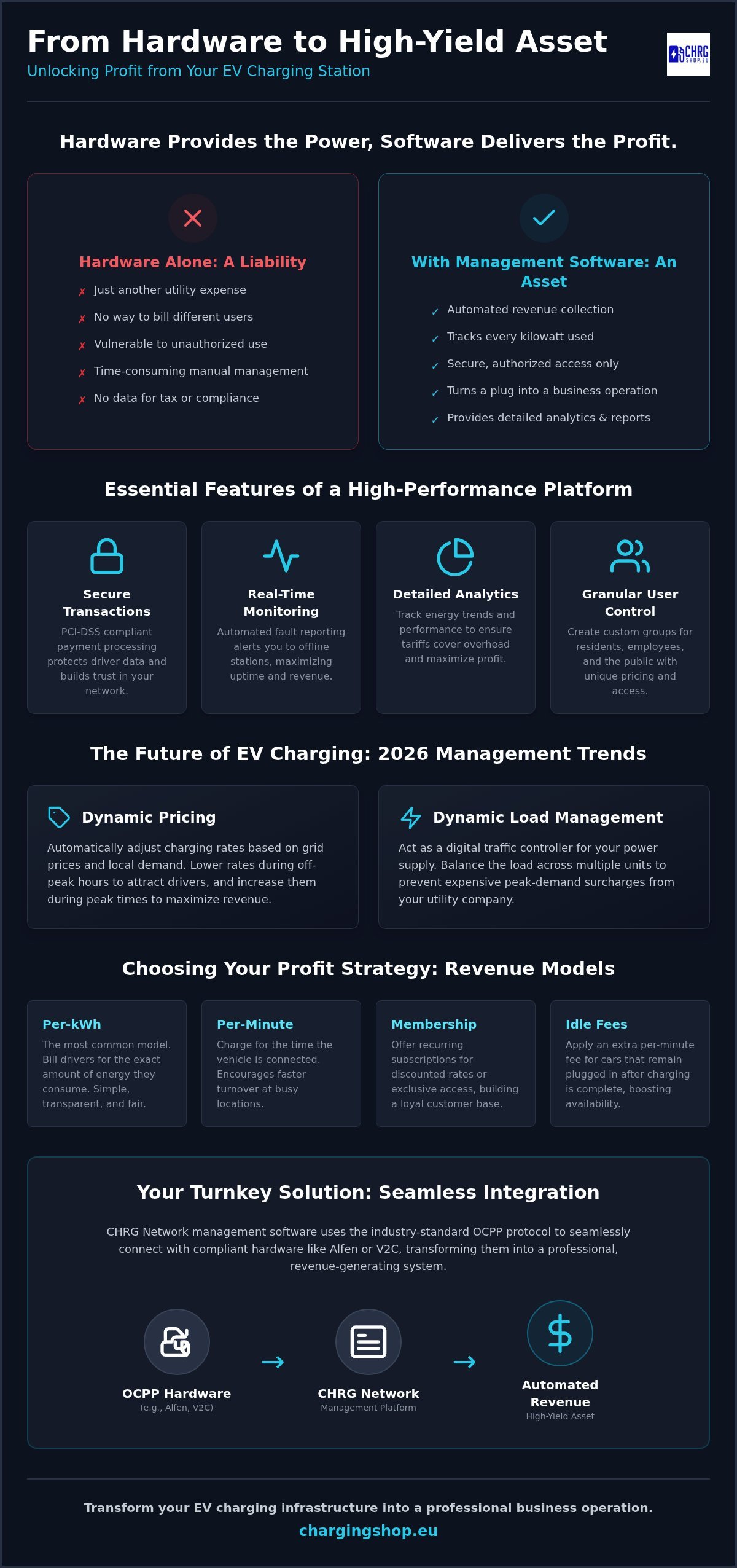
Hardware provides the power, but software provides the profit. Think of your charging station as a digital storefront. Without a transactional layer, it’s just an expensive piece of metal. In the context of Modern EV Charging Infrastructure, EV billing software, or a Charging Station Management System (CSMS), acts as the brain. It handles the handshake between the vehicle, the grid, and your bank account. By 2026, the industry has shifted away from “free charging” as a loss leader. Today, stations are high-yield monetized assets that require precision management.
For multi-tenant buildings and public hubs, software isn’t optional. You need to split costs, manage user access, and ensure every kilowatt is accounted for. CHRG Network EV station management provides the infrastructure to turn these complex logistics into automated revenue. It transforms a simple plug into a professional business operation.
Why Hardware Needs a Management Brain
A “dumb” charger is a liability in a commercial setting. It lacks the ability to identify who is plugging in or how much they should pay. Connected stations solve this by creating a digital paper trail for every session. This data logging is essential for tax compliance and corporate reimbursement programs. If you can’t prove who used the energy, you can’t claim the revenue or the deductions.
Security is another critical factor. Management software prevents unauthorized users from siphoning your electricity. It ensures that only paying customers or authorized tenants can activate a charge. This protects your margins and guarantees that your hardware remains available for those who actually contribute to your bottom line. You gain total control over your assets while reducing manual oversight.
The Evolution of CSMS in 2026
Modern management systems have evolved far beyond simple on/off switches. We now see deep integration with Building Management Systems (BMS) to balance loads across entire facilities. This prevents expensive peak-demand surcharges from the utility company. CSMS is the critical link between the grid, the car, and the bank account. It uses real-time energy forecasting to determine the best times to charge based on current grid prices and local demand.
This level of control allows station owners to offer dynamic pricing. You can lower rates during low-demand hours to attract drivers or increase them during peak times to maximize yield. CHRG Network EV station management makes these adjustments effortless. It gives you total control over your energy economy without needing a degree in electrical engineering. You focus on the business while the software handles the technical heavy lifting.
Essential Features of a High-Performance EV Billing Platform
High-performance charging isn’t just about the plug. It’s about the data behind it. To maximize your return on investment, your platform needs real-time monitoring. If a station goes offline, you lose revenue every minute it stays dark. Automated fault reporting alerts you instantly so you can fix issues before drivers even notice. Secure transactions are equally vital. Every station must offer PCI-DSS compliant payment processing. This protects driver credit card data and builds long-term trust in your brand. It’s the only way to operate a professional network in 2026.
Detailed analytics aren’t just “nice to have” stats. They’re your commercial heartbeat. You can track energy consumption trends to see if your current tariffs cover your overhead. If electricity prices spike, you can adjust your rates in seconds. CHRG Network EV station management simplifies this by putting all your data into one dashboard. You’ll see exactly which chargers are your star performers and which ones need better visibility to attract more traffic. This level of control is a core recommendation in the Public EV Charging Playbook for sustainable, long-term deployments.
Effective management also allows for granular user control. You can create specific groups for residents who get a discount, employees who charge for free, and public guests who pay a premium rate. This flexibility ensures your infrastructure serves multiple purposes without compromising on profit.
Dynamic Load Management & Energy Optimization
Software acts as a digital traffic controller for your power supply. It balances the load across multiple units to prevent your building from hitting peak demand limits. This saves you from expensive utility surcharges that can eat your margins. If you have on-site solar, the management layer prioritizes that green energy first. You can avoid massive costs by optimizing what you already have instead of paying for expensive, time-consuming transformer upgrades.
Automated Billing and Reimbursement
Manual invoicing is a relic of the past. Modern systems offer self-service portals where drivers manage their own payment methods and download receipts. For corporate clients, the software generates automatic invoices for fleet drivers. In multi-family apartments, it accurately splits utility costs based on individual usage. This removes the administrative burden from property managers and eliminates errors. Accuracy is everything when you’re dealing with other people’s money. If you’re ready to automate your revenue, consider a Personalised Charging Offer to see which features fit your specific site.
Comparing Revenue Models: Fixed, Variable, and Membership Tariffs
Choosing a revenue model isn’t just about picking a price. It’s about matching your strategy to your location’s behavior. You need a system that adapts to how drivers use your space. CHRG Network EV station management gives you the granular control to swap between models instantly. Whether you run a retail hub or a private fleet, your tariff structure determines your long-term ROI. Don’t settle for a one-size-fits-all approach when you can optimize for every session.
Per-kWh billing is the gold standard for fairness. Drivers pay exactly for the energy they consume. It’s transparent and easy to understand. Per-minute billing, however, works better for high-traffic areas where you need to move cars quickly. If a driver occupies a 22kW station with a car that only accepts 7kW, they stay longer and block others. Charging per minute incentivizes them to unplug and move. You can also implement hybrid tariffs. Charge a flat starting fee to cover the initial connection cost, then add a per-kWh rate for the energy delivered. This protects your margins on short sessions that would otherwise be unprofitable.
Don’t let your chargers become free parking spots. Idle fees are the solution. Once a vehicle reaches a full charge, the system starts a timer. If the driver doesn’t move within a grace period, they pay a per-minute penalty. This ensures your hardware is always available for the next paying customer. Membership models are another powerful tool. They create predictable monthly income and are perfect for residential complexes or employee parking. You trade a lower per-session rate for a guaranteed recurring fee.
Fixed vs. Variable Pricing Strategies
Managing User Groups and Permissions
Your hardware should recognize who is plugging in. CHRG Network EV station management allows you to segment your audience with ease. Use RFID cards to grant free access to your staff while the public pays your standard rate. You can even set “Friends & Family” tiers for private chargers that you share with neighbors. This flexibility turns your hardware into a versatile tool that serves your community and your bottom line simultaneously.
Implementing Your System: From OCPP Integration to RFID Management
Setting up your charging network shouldn’t require a degree in computer science. The goal is a plug and play experience that gets your revenue flowing immediately. To achieve this, you must prioritize OCPP compliant charging stations. This standard is the universal language of EV chargers. It ensures your hardware can talk to any management backend you choose. Without it, you’re locked into a single vendor’s ecosystem. CHRG Network EV station management thrives on this open architecture, allowing you to mix and match brands like Alfen, ABB, and V2C on a single dashboard.
Connecting your hardware to the cloud management backend is a straightforward process. First, install your physical units and ensure they have a stable internet connection via Ethernet, Wi-Fi, or 4G. Next, enter the CHRG Network URL into your charger’s internal configuration settings. Once the handshake is complete, your station appears in your management portal. From there, you can set up remote EV charger management to monitor uptime and energy flow across multiple sites from your smartphone. It is efficient, direct, and eliminates the need for on-site technicians for daily operations.
The Importance of Open Standards
OCPP 1.6J and 2.0.1 are the industry benchmarks for 2026. These protocols allow for advanced features like smart charging and diagnostic reporting. If your software provider changes their pricing or service quality, open standards let you move your hardware to a new platform without replacing a single bolt. This future-proofs your investment. It ensures compatibility across different hardware generations, keeping your network cohesive even as you expand with newer models like the V2C Trydan or ABB Terra AC.
RFID and Mobile App Authentication
Drivers want speed. Physical RFID cards offer a “Tap and Charge” convenience that remains the most reliable method for regular users. You can manage a database of thousands of unique RFID identifiers through your portal, assigning them to specific employees or residents. For ad-hoc public guests, mobile apps provide a QR-code based payment solution. This dual-layer approach ensures that everyone can access your power, whether they’re a daily commuter or a one-time visitor. Explore our full range of OCPP-ready hardware to find the right fit for your site.
CHRG Network EV station management simplifies the backend logistics of these authentication methods. You can authorize tags for offline use, ensuring drivers can still charge even if the local internet connection drops temporarily. This level of reliability is what separates a professional charging hub from a frustrating user experience. To fully unlock these capabilities, securing CHRG Network access for EV stations is the essential final step that transforms your hardware into a fully managed, revenue-generating asset. Focus on the setup now to enjoy automated, hands-off management for years to come.
The CHRG Network & Hardware Synergy: Your Turnkey Solution
Stop juggling multiple vendors. You need a unified solution that connects your physical assets to your bank account without the friction of third-party integrations. CHRG Network EV station management is that bridge. It’s the premium management layer designed specifically for Charging Shop customers who value efficiency. By sourcing your hardware and software from one partner, you eliminate compatibility headaches and streamline your support. It’s about speed, technical reliability, and immediate ROI. You buy the hardware, we provide the brain.
The Alfen Single Pro Line 22kW represents the gold standard for this synergy. It integrates natively with CHRG Network’s billing logic, making it the preferred choice for commercial hubs and fleet depots. For residential projects or multi-family apartment blocks, pairing the V2C Trydan 22kW with our network software simplifies the often-messy process of cost-splitting among neighbors. You get professional-grade billing in a package that stays accessible for non-technical users. It’s a complete ecosystem that works right out of the box.
Premium Hardware Meets Intelligent Software
In high-traffic environments, reliability is non-negotiable. That’s why the Abb terra ac and Alfen units are our top recommendations for business owners. These chargers feature MID-certified meters. This is critical for legal commercial billing across Europe, ensuring every session is recorded with utility-grade accuracy. The CHRG Network simplifies the Personalised Charging Offer process by pre-configuring these technical settings. You don’t have to guess which protocols work; we’ve already done the testing for you. This single-vendor approach means one point of contact and zero finger-pointing if you need support.
Scale Your Infrastructure with Confidence
Growth shouldn’t be painful. Start with a single station in your office lot or residential driveway. As demand increases, scale to a nationwide network using the same intuitive interface. You get 24/7 visibility into your revenue streams through the CHRG dashboard. Monitor usage, adjust tariffs, and track your profits from any device in real-time. It’s a professional-grade ecosystem that grows with your ambitions. Don’t leave your revenue to chance. Get started with the CHRG Network and premium hardware today.
Maximize Your Charging ROI Today
Your hardware is ready, but your revenue depends entirely on the software driving it. We’ve explored how a robust management system handles complex tariffs and automates your billing while you focus on scaling your business. By prioritizing open standards and smart load management, you ensure your infrastructure remains flexible and profitable well into 2026. CHRG Network EV station management provides the technical authority you need to transform a simple charger into a high-yield commercial asset. You deserve a system that works as hard as your hardware does.
Don’t settle for manual processes or technical friction that eats your margins. As an authorized Alfen and ABB dealer, we offer more than just premium hardware. You gain exclusive CHRG Network access along with our global shipping and expert technical support. It’s time to simplify your operations and secure your energy future with a partner who understands the high-energy retail landscape. Explore CHRG Network Solutions for Your Business and start scaling your network with confidence. Your path to effortless monetization starts here.
Frequently Asked Questions
What is the difference between a CSMS and billing software?
A CSMS is the technical platform used to monitor and control your hardware, while billing software is the transactional layer that handles the money. Most professional systems combine these functions into one interface. The CSMS manages technical health and firmware updates. The billing side focuses on payment gateways, tax invoices, and revenue distribution. You need both to run a profitable commercial station.
Do I need a special electricity meter for commercial EV billing?
You need a MID-certified meter if you plan to sell electricity to the public in European markets. These meters are legally required for commercial transactions to ensure accuracy and consumer protection. Many professional chargers, such as the Alfen Single Pro Line 22kW, include these meters by default. Without a certified meter, you can’t legally bill drivers based on their exact energy consumption.
Can I use any charging station with the CHRG Network software?
You can use any station that supports the Open Charge Point Protocol (OCPP) 1.6J or higher. This hardware-agnostic approach prevents vendor lock-in and lets you build a diverse fleet. CHRG Network EV station management works seamlessly with top brands like V2C, ABB, and Alfen. Always verify that your hardware is OCPP-ready before you attempt to connect it to the management backend.
How do I set different prices for different users on the same charger?
You create specific user groups within your management dashboard to assign unique tariffs. For instance, you can authorize employee RFID tags for free charging while guests pay a public rate via a QR code. This segmentation happens instantly in the cloud. It allows you to manage multi-tenant buildings or corporate offices without needing separate physical hardware for each different user type.
Is there a monthly subscription fee for EV charging network software?
Yes, most professional management systems operate on a subscription model with recurring fees. These costs cover the secure cloud infrastructure, real-time data processing, and ongoing security updates required for PCI-DSS compliance. You trade a small monthly overhead for automated revenue collection and 24/7 technical visibility. It’s a standard operational expense for any serious commercial charging business in the current market.
What happens if the internet connection to the station is lost?
Most smart chargers continue to function using locally stored authorization data until the connection is restored. If a driver has a pre-authorized RFID card, the station allows the session and syncs the transaction data once it is back online. However, ad-hoc mobile app payments usually require an active connection. CHRG Network EV station management ensures your revenue isn’t lost during brief local network outages.
How do drivers pay for charging if they don’t have an account?
Drivers use ad-hoc payment methods like scanning a QR code on the station to pay via a web portal. This allows one-time users to enter credit card details without downloading an app or creating a permanent account. It is the most efficient way to capture revenue from traveling guests or occasional visitors. Secure gateways process these transactions instantly and deposit the funds into your business account.
Can I manage multiple locations from a single software dashboard?
You can monitor and control an unlimited number of sites from one centralized portal. Whether you have two chargers in a local lot or a nationwide network, the software aggregates all data into a single view. You can adjust prices for specific regions, check hardware status, and download consolidated revenue reports with a few clicks. It’s designed for effortless scalability as your business grows.
