
 Deutsch
 Dansk
Dansk Suomi
Suomi Latviešu
 Lietuvių
 Norsk bokmål
 polski
 Русский
 Svenska
No products in the cart.
Uncategorized
AC vs DC Home EV Chargers: 2026 Power Selection Guide
07
Aug
Aug
Stop letting your car’s onboard converter bottleneck your daily routine. Most drivers assume a higher kW rating guarantees a faster charge, but the technical bottleneck is often the hardware, not the grid. When comparing an AC vs DC ev charger for home, you must decide if you want the standard efficiency of AC or the high-performance speed of a dedicated DC unit. Since 80% of charging happens at home, this single hardware choice defines your driving freedom and total cost of ownership for years.
You want maximum range without the fear of battery degradation or grid compatibility issues. We understand the frustration of seeing a 22kW charger deliver half that speed because of vehicle limitations. This guide promises to help you master these technical specs to secure a high-performance setup that matches your driving lifestyle. We will analyze the ROI of premium hardware like the V2C Trydan and the V2C Denka 20kW DC Wallbox. Expect a clear verdict on which charger fits your vehicle and how to future-proof your garage for the 2026 EV landscape.
Key Takeaways
- Identify your vehicle’s onboard charger limits. Stop overpaying for power ratings your car’s hardware can’t actually process.
- Compare AC vs DC ev charger for home to balance cost-effective overnight charging with elite, high-speed performance.
- Discover the V2C Denka DC Wallbox advantage. Bypass slow onboard converters for up to 3x faster home charging.
- Evaluate your home’s grid capacity. Ensure your 22kW installation is future-proof without requiring expensive utility upgrades.
- Apply our 2026 decision framework. Match your hardware selection to your specific daily mileage and turnaround requirements.
AC vs DC EV Charging: The Technical Basics Simplified
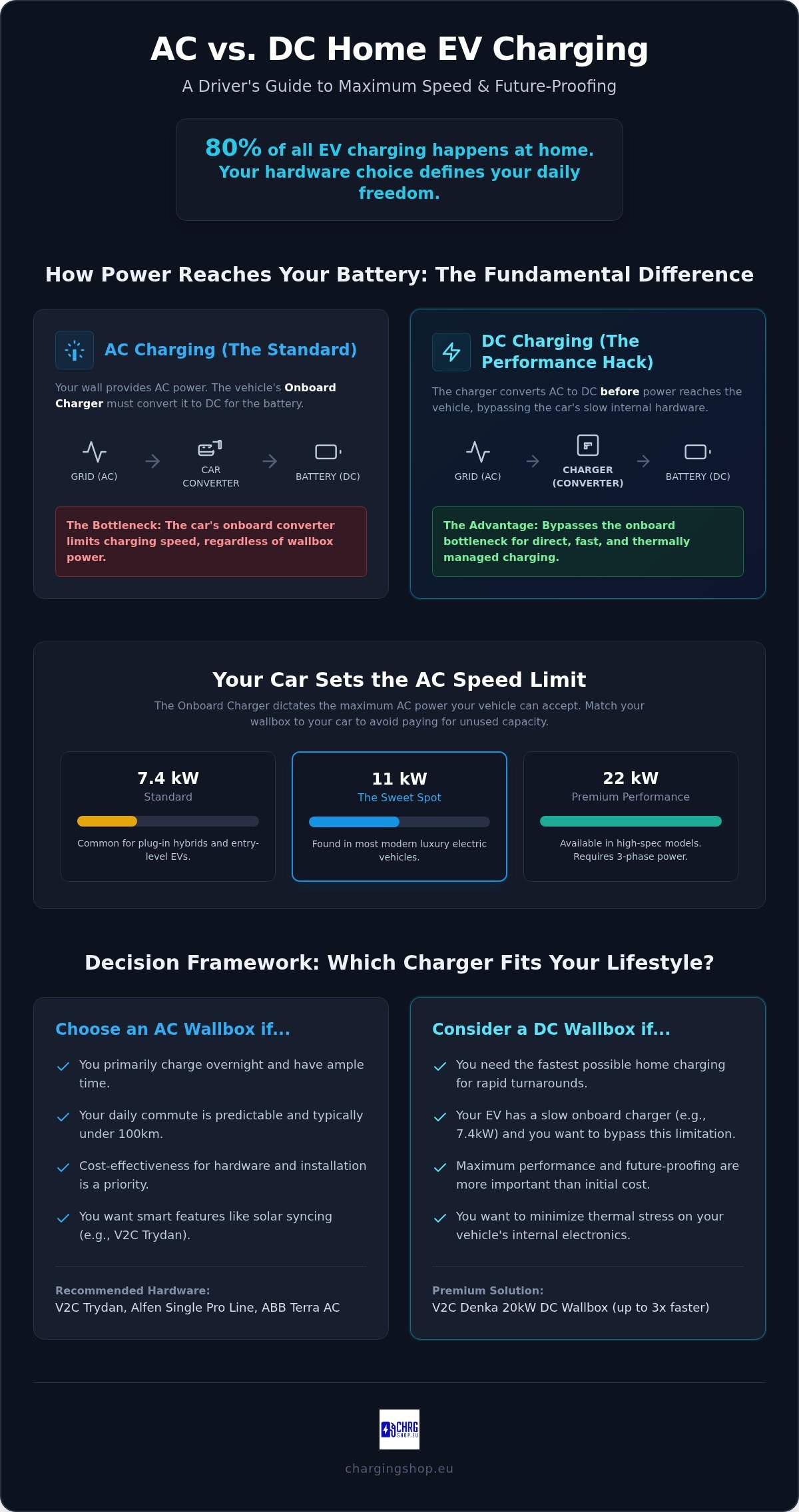
The electricity in your wall is Alternating Current (AC). Your car battery only accepts Direct Current (DC). This gap is the core of the AC vs DC ev charger for home debate. To bridge it, the power must be converted. In AC charging, the car converts the power; in DC charging, the station does the heavy lifting before the cable even touches the car. Most drivers ignore this technicality, but it determines exactly how fast you can hit the road. Reviewing AC and DC charging basics helps clarify why your hardware choice matters more than your utility’s peak output.
The Role of the Onboard Charger
Your car has a built-in gatekeeper called the onboard charger. This component limits how much AC power the vehicle can take in at once. If you install a high-end unit like the Alfen Single Pro Line 22kW, but your car’s onboard charger is capped at 7kW, you will only get 7kW. The car protects its battery by refusing more power than its internal converter can handle. Identifying your vehicle’s limit is essential before buying hardware. Common caps include:
- 7.4kW: Standard for many plug-in hybrids and entry-level EVs.
- 11kW: The sweet spot for most modern luxury electric vehicles.
- 22kW: Premium performance found in high-spec models.
Don’t waste money on a 22kW wallbox if your car can’t process it. Match the hardware to the vehicle’s internal capacity for the best ROI. If your car is capped at 11kW, an ABB Terra AC unit provides the perfect balance of speed and cost without paying for unused capacity.
Bypassing the Bottleneck with DC
DC charging is the ultimate performance hack. It sends energy straight to the battery cells, skipping the slow onboard converter entirely. This allows for massive speed gains. A DC wallbox, such as the V2C Denka 20kW DC Wallbox, communicates directly with your car’s Battery Management System (BMS). It asks the battery for its maximum safe intake and delivers it instantly. This direct communication ensures the fastest possible charge without the car’s internal hardware slowing things down.
This method offers superior thermal management. Since the conversion happens outside the car, the heat is managed by the charging station’s own cooling systems. This reduces stress on your vehicle’s internal electronics. Just as specialists like JB Helpdesk are essential for maintaining personal electronics, choosing the right charging setup is critical for protecting your vehicle’s internal hardware. You get consistent, high-speed power that isn’t limited by the car’s AC hardware. It’s the most efficient way to ensure your EV is ready to go when you are, especially for vehicles with weak internal AC converters.
Why AC Charging is the Practical Standard for Most Homes
Efficiency doesn’t always mean raw speed. For most residential setups, the AC vs DC ev charger for home comparison ends with AC as the clear winner. It’s the cost-effective choice. AC hardware is significantly more affordable to purchase and install than its DC counterparts. Because the conversion happens inside the car, the wallbox itself is simpler, lighter, and easier to maintain. When charging electric vehicles at home, most drivers find that a reliable AC unit provides all the range they need during an overnight session. Since approximately 80% of EV charging is done at home, according to Qmerit, optimizing this AC connection is the highest priority for most owners.
Grid compatibility is another major win. Most residential properties can support an 11kW or 22kW AC unit without requiring massive, expensive infrastructure upgrades from the utility company. These units generate less heat during operation. This lower thermal stress is ideal for the daily “top-up” habits of the average commuter driving under 100km a day. You get smart integration features like solar syncing with the V2C Trydan 22kW, which allows you to fuel your car directly from your roof. It’s a high-performance solution that respects your home’s electrical limits.
Optimising Your AC Setup
To hit the 22kW ceiling, you’ll need 3-phase power. Single-phase homes are typically capped at 7.4kW. Upgrading to 3-phase unlocks the full potential of high-performance hardware. Use dynamic load balancing to protect your home. This technology monitors your total energy draw. It slows the car’s intake when you turn on the heat or oven, preventing tripped breakers. For those who demand professional-grade reliability, the Alfen Single Pro Line 22kW is the industry benchmark. It’s built for heavy use and seamless network integration.
Best Use Cases for AC Wallboxes
AC charging thrives in specific scenarios. It’s perfect for overnight charging. Plug in at 8 PM, and your car is ready by morning. It’s also the best choice for homes with solar arrays. You can dump excess energy into the battery during the day instead of selling it back to the grid for pennies. Multi-vehicle households benefit too. Dual-socket AC stations allow two cars to share a single connection point efficiently. Don’t settle for a basic setup when weighing your AC vs DC ev charger for home options. Browse our high-performance AC hardware to find your perfect match.
The Rise of Home DC Charging: When Speed is Non-Negotiable
Public charging stations aren’t the only places for Direct Current anymore. The arrival of the 20kW DC Wallbox has shifted the AC vs DC ev charger for home conversation toward high-performance residential hardware. This technology serves as the perfect middle ground between standard overnight AC charging and the ultra-fast public hubs. If your car has a weak 7kW onboard charger, an AC unit will always be slow. A 20kW DC unit bypasses that internal bottleneck. It can be 3x faster than a 7kW AC unit. For owners of massive 100kWh+ batteries or high-mileage drivers, this speed is a game-changer. It ensures your vehicle is ready for a second trip in hours, not an entire day.
Choosing DC is also about future-proofing. It is the gateway to Vehicle-to-Home (V2H) technology. This allows for true bi-directional energy management. You can use your car to power your home during peak hours, turning your EV into a mobile energy storage unit. When weighing AC vs DC ev charger for home options, consider the long-term utility of your investment. High-mileage commuters and courier businesses require a rapid turnaround that standard AC hardware simply cannot provide. Secure a setup that keeps your fleet or family car moving without the wait.
The V2C Denka Advantage
The V2C Denka 20kW DC Wallbox is engineered specifically for residential and small office footprints. It offers professional-grade build quality without the industrial noise. Most high-power chargers are loud; the Denka prioritizes quiet operation and high efficiency. It features full CCS2 compatibility, making it a reliable partner for almost every modern EV on the road today. Its compact design means you don’t need a commercial warehouse to house elite charging power.
Debunking the Battery Longevity Myth
Many drivers fear that frequent DC charging destroys battery health. This is a misunderstanding of scale. While 350kW public chargers generate intense heat, 20kW DC is considered “slow-fast” charging. It is gentle on modern lithium-ion chemistry. Modern DC wallboxes provide rapid recovery without the extreme thermal stress of 150kW+ public chargers. Integrated active cooling in the hardware further protects your vehicle’s longevity. You get the speed you need without sacrificing the long-term health of your battery cells. Trust the hardware to manage the thermals while you focus on the drive.
Decision Framework: Which Charger Fits Your Lifestyle?
Stop guessing and start measuring. Choosing the right AC vs DC ev charger for home requires a clinical look at your vehicle’s limits and your daily schedule. Don’t buy power you can’t use. Follow this four-step framework to secure the right hardware for your driveway. First, confirm your car’s maximum AC intake. If your vehicle is capped at 7kW, an AC wallbox will never exceed that speed. Second, audit your “turnaround” time. If your car sits for 10 hours overnight, AC is sufficient. If you need a full battery in under 3 hours for back-to-back trips, DC is your only viable path.
Factor in your energy source and long-term costs. Solar owners should prioritize smart AC units like the V2C Trydan for its superior ability to sync with fluctuating sun power. Finally, evaluate the total cost of ownership against the value of your time. A premium DC unit requires a higher initial investment but provides hours of reclaimed time every week. If your daily routine demands high-performance availability, the ROI on a DC bypass is immediate and significant.
The “Onboard Charger” Test
The math is direct. If your car is capped at 7kW AC, moving to a 20kW DC wallbox provides a massive 300% speed upgrade. You are bypassing the internal bottleneck. However, if you drive a vehicle that already supports 22kW AC, a 20kW DC unit offers diminishing returns for the higher price point. Many entry-level EVs and older models are stuck in the slow lane because of weak internal converters. In these cases, a DC unit is the only way to unlock high-performance charging speeds at home.
Infrastructure and Grid Requirements
Elite speed requires a robust foundation. Both high-end 22kW AC and 20kW DC units typically require a 3-phase electrical connection. Without it, you are limited to standard single-phase speeds regardless of the hardware you buy. Consider your physical space as well. Compact wall-mounted units like the ABB Terra AC save space, while pedestal installs provide better access for multi-car garages. Always ensure your hardware is OCPP compliant. This ensures you can receive future software updates and integrate with management platforms like the CHRG Network.
Ready to upgrade your home setup? Explore our professional power selection to find the perfect match for your car’s technical profile.
Finding Your Solution: Premium Hardware at Charging Shop
Selecting the right AC vs DC ev charger for home is the first step toward energy independence. Securing reliable, professional-grade hardware is the second. Charging Shop delivers the world’s most trusted power brands with a focus on technical authority and global logistics. We don’t just sell wallboxes; we provide the high-performance infrastructure that keeps your driving lifestyle fluid. Our specialists focus on OCPP-compliant hardware like the Alfen Single Pro Line 22kW to ensure your setup is ready for the grid demands of 2026. Stop settling for entry-level equipment that lacks the smart features required for modern energy management.
Hardware is only half the battle for a smart home. You need CHRG Network Access to unlock the full potential of your station. This platform provides sophisticated station management, allowing you to track every kWh and optimize charging cycles based on utility rates. It is a critical tool for users managing multiple units across a home and office environment. Digital oversight eliminates the guesswork. By combining elite hardware with the CHRG Network, you transform a simple charger into a strategic energy asset. We ensure your hardware and software work in perfect synchronization.
Top Picks for Residential AC
For those choosing the AC path, the V2C Trydan is the undisputed king of solar integration. It doesn’t just charge your car; it communicates with your inverter to prioritize green energy. If you prefer industrial-grade durability, the ABB Terra AC is the premium driveway standard. These units outperform generic budget chargers by offering superior build quality and long-term reliability. A budget charger might save money today, but a failed unit costs you more in downtime and electrician fees tomorrow. Invest in hardware that is built to last the life of your vehicle.
The DC Performance Tier
When speed is the priority, the V2C Denka 20kW stands alone. It is the ultimate rapid-recovery solution for residential footprints. Integrate this DC unit into your existing CHRG Network subscription for a unified view of your charging ecosystem. You get the speed of a public hub with the convenience of your own garage. This unit bypasses the onboard converter bottleneck mentioned earlier, delivering power directly to your battery cells. Don’t navigate the AC vs DC ev charger for home market alone. Get a Personalised Charging Offer today to find your perfect technical match and secure your driving future.
Future-Proof Your Garage for 2026 and Beyond
Mastering your power selection means matching your hardware to your car’s technical limits. AC charging remains the practical standard for overnight reliability and solar integration. However, if your daily routine demands rapid turnaround, the 20kW DC bypass is your elite performance solution. Choosing an AC vs DC ev charger for home isn’t just about speed; it’s about reclaiming your time and maximizing your vehicle’s utility.
As an authorized V2C and Alfen retailer, Charging Shop specializes in 20kW+ high-performance hardware. We provide the technical authority you need to navigate these complex specs with confidence. Our integrated CHRG Network management solutions ensure your hardware stays smart, efficient, and connected. Don’t let a weak onboard converter dictate your schedule. Secure a setup that matches your driving lifestyle and home grid capacity.
Take control of your charging experience today. Browse the Full Range of AC and DC Wallboxes at Charging Shop to find your perfect technical match. Your high-speed driving future starts here.
Frequently Asked Questions
Is a DC charger better for my EV battery than an AC charger?
AC charging is the standard for daily longevity due to lower heat generation. However, 20kW DC units are specifically designed for residential use and don’t cause the extreme thermal stress found at 350kW public hubs. Modern battery management systems handle 20kW loads easily. Use AC for standard overnight top-ups and DC when you need a rapid turnaround without compromising the long-term health of your battery cells.
Can I install a 20kW DC wallbox at a standard residential home?
Yes, but you typically require a 3-phase electrical connection to support the power draw. Most modern homes can be upgraded to handle a 20kW DC wallbox like the V2C Denka. You should check your local grid capacity and main breaker limits with a qualified professional before purchasing. This setup is the ultimate upgrade for high-mileage drivers who need faster recovery than standard AC units provide.
Why does my 22kW AC charger only charge my car at 7kW?
Your vehicle’s onboard charger is the technical bottleneck. Even if your wallbox can deliver 22kW, the car will only accept what its internal converter can process. Many EVs are limited to 7kW or 11kW for AC intake. To bypass this limit when comparing an AC vs DC ev charger for home, you need a DC unit that feeds power directly to the battery, skipping the internal converter entirely.
Do I need a special cable for home DC charging?
No, because DC home chargers like the V2C Denka come with a tethered CCS2 cable attached to the unit. Unlike AC wallboxes that often allow for separate Type 2 cables, DC units require a fixed, heavy-duty cable to manage the direct current flow and constant communication with the car. Ensure your vehicle has a CCS2 port, which is the standard for most modern electric cars in the 2026 market.
Is it worth the extra cost to get a DC charger for home use in 2026?
It depends on your driving habits and vehicle specifications. If your car has a weak onboard charger but you drive long distances daily, the time saved makes the ROI significant. A DC unit provides a 300% speed boost for 7kW-limited cars. For standard commuters with 11kW or 22kW AC capacity, a high-end AC unit like the V2C Trydan usually offers better value for the investment.
How does solar power integration work with AC vs DC chargers?
AC chargers like the V2C Trydan are currently superior for direct solar syncing. They dynamically adjust their output to match your roof’s real-time production, ensuring you use every bit of free energy. DC chargers are generally built for raw speed and constant power delivery. If your primary goal is to maximize “free” miles from your solar panels, a smart AC wallbox is the most efficient choice for your home.
What is the CHRG Network and do I need it for my home charger?
The CHRG Network is a management platform for tracking energy use and optimizing charging schedules. While not strictly required for the hardware to function, it is essential for smart management. It allows you to monitor costs, manage multiple users, and ensure your charger operates during the cheapest utility windows. It’s a critical tool for anyone serious about maximizing their charging ROI and maintaining digital oversight.
Can all electric cars use both AC and DC charging ports?
Most modern electric vehicles feature a CCS2 port, which handles both AC and DC charging. However, some older models or specific imports might only support one type. Always check your car’s inlet before selecting an AC vs DC ev charger for home. If your car has the larger CCS2 combo port, you can utilize both standard AC wallboxes and high-performance DC units for maximum flexibility.
