
 Deutsch
 Dansk
Dansk Suomi
Suomi Latviešu
 Lietuvių
 Norsk bokmål
 polski
 Русский
 Svenska
No products in the cart.
Uncategorized
Remote EV Charger Management: The 2026 Setup & Strategy Guide
25
Jul
Jul
A standalone wallbox is just a plug; a managed charging station is a professional energy asset. If you’re still driving to your site just to reset a charger or check a meter, you’re losing time and money. Professional remote ev charger management is the only way to scale your infrastructure in 2026. You need real-time visibility. You need the power to stop unauthorized usage directly from your smartphone. Don’t let your hardware manage you.
We know that technical confusion over OCPP and cloud protocols shouldn’t stand in your way. Managing a fleet or a private site should be simple, not a source of constant downtime anxiety. This expert guide simplifies the complex world of remote monitoring and control. You’ll learn how to automate your billing, troubleshoot errors instantly, and slash electricity costs through smart scheduling. We’ll explore high-performance hardware like the V2C Trydan and Alfen Single Pro Line, alongside the CHRG Network software that makes professional remote control possible. Let’s turn your charging setup into a seamless, high-performance operation today.
Key Takeaways
- Master the “Visibility vs. Control” framework to transition from simple hardware monitoring to professional energy asset management.
- Select OCPP-compliant hardware like the V2C Trydan or Alfen Single Pro Line to ensure your remote ev charger management strategy stays flexible and future-proof.
- Identify the ideal connectivity stack-choosing between LAN, WiFi, or 4G/LTE-to maintain a reliable, real-time link between your stations and the cloud.
- Leverage the CHRG Network to automate complex billing cycles and manage user access from a single, centralized dashboard.
- Execute a professional setup by correctly pointing your hardware to a CMS URL, eliminating the need for expensive on-site troubleshooting visits.
What is Remote EV Charger Management?
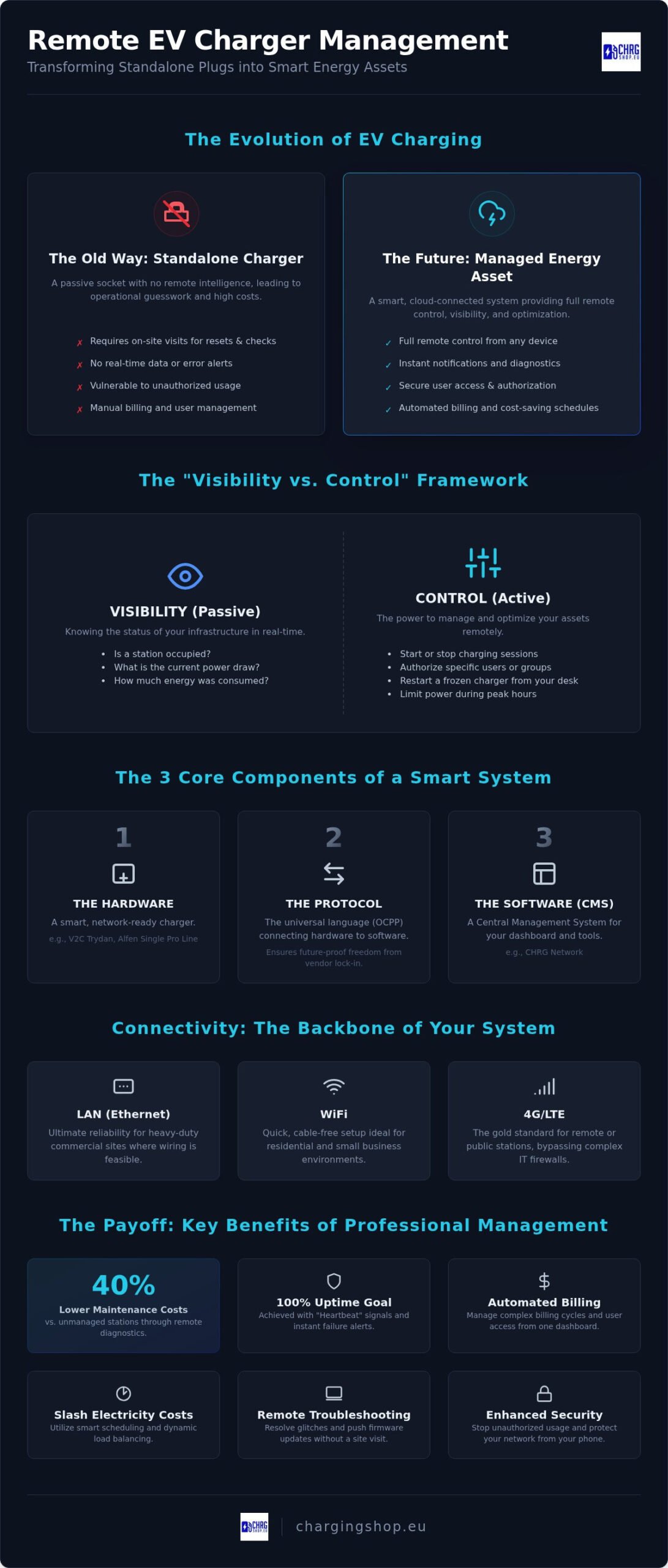
Remote EV charger management isn’t just a luxury for tech enthusiasts. It’s a comprehensive cloud-based system that allows you to monitor, control, and optimize your charging infrastructure from any location. Think of it as the digital brain of your charging operation. Without it, your station is just a passive socket. With it, you’re managing a smart energy asset that responds to your commands in real time.
We define professional management through the “Visibility vs. Control” framework. Visibility is passive; it tells you a car is currently plugged in. Control is active; it gives you the power to limit power draw, authorize specific users, or restart a jammed station without leaving your desk. In 2026, the connected charger has become the baseline. Whether you’re running a single V2C Trydan at home or a fleet of Alfen units at a warehouse, remote ev charger management is how you ensure 100% uptime. This philosophy of remote precision is mirrored in other industries, such as how Educator Collars enables owners to maintain control and safety through advanced remote technology.
To build a functional setup, you need three core components working in harmony:
- The Hardware: A smart, network-ready charger like the V2C Trydan or Alfen Single Pro Line.
- The Protocol: The digital handshake, usually OCPP, that lets the hardware talk to the internet.
- The Software: A Central Management System (CMS) like the CHRG Network that provides your dashboard and tools.
The Role of OCPP in Remote Access
OCPP, or Open Charge Point Protocol, is the universal language of the EV industry. It’s what allows a charger from one brand to communicate perfectly with software from another. When you choose OCPP compliant charging stations, you’re buying future-proof freedom. You aren’t locked into a single vendor’s ecosystem. While OCPP 1.6J remains the current industry workhorse for most tasks, the newer OCPP 2.0.1 standard is gaining ground by offering richer remote diagnostics and enhanced device management features.
Cloud-Based vs. Local App Control
Don’t confuse a simple Bluetooth app with a professional management platform. Local apps are fine for residential users who just want to set a timer while standing in their driveway. However, true remote ev charger management requires the cloud. Cloud-based systems provide the real-time data flow necessary for dynamic load balancing. If your building’s power limit is reached, the CMS can instantly throttle the chargers to prevent a blackout. These platforms also offer superior security, using encrypted protocols to keep your charging network safe from unauthorized remote access.
The Tech Stack: How Remote Monitoring Actually Works
Your remote ev charger management strategy is only as strong as its connection. Connectivity is the backbone of the entire stack. You have three main paths to the cloud. LAN provides the ultimate reliability for heavy-duty commercial sites where wiring is feasible. WiFi offers a quick, cable-free setup for residential and small business environments. For remote locations or public stations where local networks are restricted, 4G/LTE is the gold standard. It bypasses complex IT firewalls and ensures your station stays live regardless of local network stability.
Data flows in a fast, methodical loop. The vehicle communicates its state of charge and power requirements to the wallbox. The wallbox pushes this data through a gateway to your management dashboard. Central to this is the “Heartbeat” signal. This is a digital pulse sent from the charger to the software every few seconds. If the pulse stops, you get an instant notification. This prevents the “silent failure” scenario where a driver arrives at a dead station that you thought was operational.
Remote firmware updates are the ultimate cost-saver in this stack. In the past, a software glitch required a technician to drive to the site. Now, you can push security patches and performance improvements to an entire fleet simultaneously. This capability alone transforms a static piece of hardware into a dynamic, evolving asset. Choose a managed charging solution to start monitoring your infrastructure today.
Real-Time Monitoring and Diagnostics
Proactive management means watching current, voltage, and internal temperatures before they reach critical levels. You don’t wait for a hardware failure; you prevent it. Automated error alerts flag issues like ground faults or communication errors instantly. Remote Diagnostics is the practice of identifying technical faults via cloud data, which remains the primary driver for achieving 40% lower maintenance costs compared to unmanaged stations. You resolve glitches from your laptop, not from a service van.
Energy Management and Load Balancing
Remote systems allow you to throttle power draw during peak grid demand, protecting your local infrastructure from overloads. This is where hardware like the V2C Trydan 22kW shines. It integrates directly with solar data, allowing you to prioritize green energy for your charging sessions remotely. By using software to “shave” peak demand, you avoid expensive utility surcharges and maximize your return on investment. It’s about precision control that turns electricity from a raw cost into a managed expense.
Hardware Selection: Best Chargers for Remote Management
Your choice of hardware dictates your long-term software freedom. Buying a “closed” system means you are stuck with a single provider’s interface forever. To execute a professional remote ev charger management strategy, you must prioritize open-standard, high-performance units. These chargers feature superior network controllers and robust antennas that maintain a stable cloud link even in challenging environments. If the hardware goes offline, your management tools are useless. Reliability starts at the circuit board.
Commercial and residential needs differ significantly in the remote space. For any site where you intend to bill users, a physical MID-certified meter is non-negotiable. You cannot legally charge for electricity based on estimated software data alone. High-end hardware integrates these meters directly into the chassis. This ensures that every kilowatt-hour reported to your dashboard is accurate and audit-ready. Don’t settle for “smart” chargers that lack the physical components required for professional oversight. Understanding how to turn that accurate data into automated revenue is covered in depth in our guide to CHRG Network EV station management and billing automation.
Alfen Single Pro Line: The Commercial Standard
Alfen is the benchmark for professional CHRG Network integration. The Alfen Single Pro Line 22kW is built for multi-user environments where uptime is the only metric that matters. It features advanced data logging that feeds high-resolution metrics directly into your management dashboard. This unit is designed for heavy-duty cycling. It handles thousands of sessions without the connectivity drops common in budget hardware. It is the industrial-grade choice for serious operators.
V2C Trydan and Denka: Smart and Fast
V2C Trydan leads the high-end residential market by offering deep integration with the V2C Cloud. It is the perfect entry point for home users who want professional-grade monitoring. However, businesses looking for rapid turnaround often move toward DC solutions. Managing a 40kW DC wallbox remotely presents unique challenges, including intense thermal monitoring and complex load balancing. V2C hardware addresses this with an open API. This is a playground for custom setups, allowing you to build a remote management system tailored to your specific operational needs.
Step-by-Step: Setting Up Your Remote Management System
Deploying a professional remote ev charger management system requires a methodical approach. It starts with the physical layer. Don’t bolt the hardware to the wall until you’ve verified a stable internet connection at the mounting site. Once the unit is powered, access the charger’s internal web interface. This is where you perform the OCPP configuration. Point your charger to the specific CMS URL provided by your software provider. Without this digital handshake, your hardware remains an isolated island, unable to receive commands or send data.
Next, move to network registration. Log into your management platform and add the charger using its unique serial number. This step links the physical unit to your digital dashboard. After registration, define your user access parameters. You can issue RFID cards to authorized employees or set mobile app permissions for residents. Finish the setup with a live test. Trigger a remote start and stop command from your smartphone. If the car responds instantly, your link is active, secure, and ready for service.
Configuring Connectivity
Stability is the foundation of remote control. For LAN setups, assign static IP addresses to prevent signal dropouts during router reboots. If you’re installing 4G-enabled units like the Alfen Single Pro Line in underground garages, verify signal strength before finalizing the position. A “Charger Offline” status in your CMS is usually a signal interference issue, not a hardware failure. Fix the connection to ensure 100% visibility.
User and Billing Management
Take control of your revenue and access. Set up “White-lists” to allow free charging for authorized staff while billing external visitors automatically. The software handles the heavy lifting, turning charging sessions into clean, itemized invoices without manual intervention. Use this data to monitor individual driver behavior. It helps you optimize fleet schedules and identify power-hungry users before they impact your grid limits. For a deeper look at how the right ev charging station management software can automate revenue collection and eliminate manual billing headaches, explore our complete 2026 platform guide. Get your CHRG Network access to start automating your billing and user permissions today.
The CHRG Network: Your Remote Management Solution
The CHRG Network is the final piece of your infrastructure puzzle. While high-performance hardware from Alfen or V2C provides the physical power, this platform provides the intelligence. It is a comprehensive Central Management System (CMS) designed for station owners who demand total oversight. The CHRG Network acts as the bridge between your chargers and your business goals. It’s the definitive tool for remote ev charger management, giving you a centralized hub to monitor every session in real time.
Managing 100 chargers should be as easy as managing one. The platform allows you to scale your operations without increasing your administrative workload. From a single login, you can view the status of your entire network, push firmware updates, and adjust power limits. This level of control is the ultimate upgrade for any OCPP-compliant charger. It transforms a collection of individual wallboxes into a unified, high-performance network that responds to your commands instantly.
Monetizing Your Charging Station
Turn your charging station into a revenue stream with precise remote control. The CHRG Network allows you to set public and private pricing tiers from your dashboard. You can offer free charging to employees while simultaneously charging visitors a premium rate. The software handles all payment processing and billing automation, so you don’t have to manage manual invoices. Use the built-in reporting tools to generate ROI reports. These documents track your energy costs against your revenue, giving you a clear picture of your infrastructure investment’s performance. For a complete walkthrough of setting up profitable tariffs and automating your revenue collection, see our EV station billing and revenue management guide for 2026.
Future-Proofing with Cloud Management
Cloud connectivity keeps your hardware from becoming obsolete. A managed charger holds its value longer because it can adapt to new regulations and grid requirements through software updates. As the industry moves toward Vehicle-to-Grid (V2G) technology, having an advanced software layer like the CHRG Network is essential. It ensures your system is ready for the bidirectional energy demands of the future. Don’t leave your infrastructure stuck in the past. Get CHRG Network Access and take control of your chargers today!
Take Control of Your Charging Future Today
The transition to a fully connected charging network is the most significant step you’ll take for your infrastructure in 2026. You’ve seen how the right hardware, like the Alfen Single Pro Line or V2C Trydan, provides the physical foundation for reliability. You’ve also discovered that the CHRG Network is the essential software layer that transforms these units into profitable, manageable assets. Mastering remote ev charger management isn’t just about convenience. It’s about securing your investment, slashing maintenance costs, and ensuring 100% uptime for every driver.
We’re ready to help you bridge the gap between simple hardware and a professional energy network. As an authorized distributor of V2C, Alfen, and ABB, we provide the premium wallboxes and expert technical support required for seamless OCPP configuration. We offer global shipping on all units to ensure your site is ready for the future, no matter where you are located. Stop reacting to downtime and start managing your power with precision.
Upgrade your infrastructure with Professional CHRG Network Access. Let’s make your charging operation smarter today.
Frequently Asked Questions
Can I manage any EV charger remotely?
No, you can only manage chargers that feature built-in network connectivity and smart hardware. Your station must be OCPP-compliant to communicate with a third-party management platform. Basic wallboxes without a communication module or internet gateway are “dumb” chargers and cannot be accessed or controlled from a remote location. Always verify the technical specifications before purchase to ensure the hardware supports external cloud links.
What is the difference between a smart charger and a managed charger?
A smart charger refers to the hardware’s capability to connect to the internet and process data. A managed charger is a smart unit that has been actively linked to a Central Management System (CMS) like the CHRG Network. Smart is the potential; managed is the active state. Without the software layer, a smart charger’s advanced features remain locked and inaccessible for professional oversight or automated billing.
Do I need a special subscription for remote management?
Yes, professional-grade management typically requires a software subscription. While some manufacturers offer basic mobile apps for free, these are often limited to simple start and stop functions. A professional CMS provides the robust tools needed for multi-user authorization, automated payment processing, and detailed energy reporting. It’s the essential investment that turns a standard charging point into a scalable, high-performance energy asset.
Can I remotely reset my EV charger if it stops working?
Yes, you can trigger a full system reboot directly from your management dashboard. This is a primary feature of remote ev charger management that eliminates the need for expensive on-site technician visits. Most software glitches or communication hangs are resolved with a simple remote command. It’s the fastest way to restore service and maintain high uptime for your drivers without leaving your desk.
How much data does a remote managed EV charger use?
Data consumption is remarkably low, typically ranging between 10MB and 50MB per month. The charger only transmits small packets of text data, such as session status, energy meter readings, and periodic “heartbeat” signals. Even if you manage a large fleet of stations, the bandwidth requirements remain minimal. This makes 4G or LTE connectivity a highly cost-effective option for locations where a stable WiFi or LAN signal is unavailable.
Is remote EV charger management secure from hackers?
Security is a top priority in professional management systems. These platforms use encrypted communication protocols and secure certificates to protect the data flow between the charger and the cloud. For maximum safety, you should ensure your hardware supports the latest OCPP security profiles. Using a private APN for 4G connections adds another layer of protection, keeping your charging infrastructure isolated from the public internet and unauthorized access.
Can I manage multiple charging stations across different locations?
Yes, professional platforms allow you to consolidate every charger into a single digital interface. Whether you have stations at home, in the office, or across multiple retail branches, you can monitor them all from one login. Effective remote ev charger management is designed for scaling. You can apply global pricing rules or individual power limits across your entire network with just a few clicks, regardless of the physical distance between sites.
