
 Deutsch
 Dansk
Dansk Suomi
Suomi Latviešu
 Lietuvių
 Norsk bokmål
 polski
 Русский
 Svenska
No products in the cart.
Uncategorized
Safe home charging with DLM
24
Jul
Jul
You don’t need to spend £2,500 on a massive electrical panel upgrade just to charge your electric vehicle at maximum speed. Most homeowners live in constant fear of tripping the main breaker while cooking dinner or running the laundry. It’s a valid concern, but that anxiety is completely avoidable. Safe home charging with DLM allows your charger to communicate directly with your home’s power supply in real time. It’s the ultimate financial bypass for expensive grid upgrades that pays for itself the moment you plug in.
We know the technical side often feels overwhelming. Dealing with CT clamps and complex sensor wiring shouldn’t be a headache for anyone. This guide simplifies the entire process. You’ll learn how to bypass high utility costs and achieve the fastest possible charging speeds without ever risking a blackout. We’re breaking down how professional hardware like the V2C Trydan or Alfen Single Pro Line uses advanced sensors to balance your household load automatically. Get ready to charge smarter and faster while keeping your home’s electrical system perfectly protected.
Key Takeaways
- Save thousands by bypassing expensive electrical panel upgrades with smart load management technology.
- Guarantee safe home charging with DLM using real-time CT clamp monitoring to protect your main house breaker.
- Evaluate premium wallboxes from V2C, Alfen, and ABB to find the perfect balance of technical precision and ease of use.
- Master the setup process with a professional 5-step audit for your main fuse rating and phase count.
- Maximize your energy efficiency by linking your system to the CHRG Network for live stats and solar optimization.
The Grid Bottleneck: Why Fast Charging Trips Your Breakers
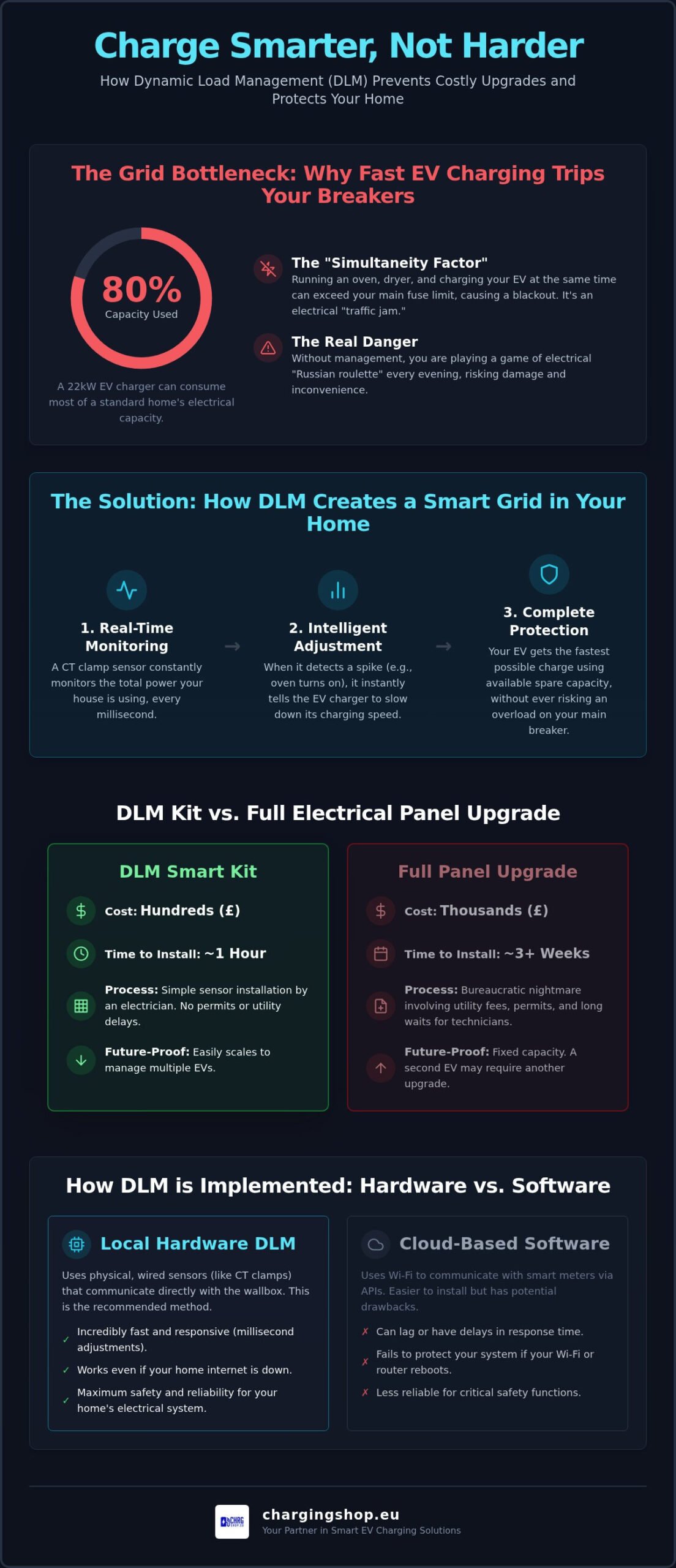
Standard home electrical setups face a massive challenge when you introduce an EV. Most residential grids weren’t designed for the sustained, heavy draw of a high-power wallbox. A 22kW charger pulls a staggering amount of current. This often exceeds the total capacity of your main fuse. When you plug in, you aren’t just adding another appliance; you’re essentially adding a second house to your power bill. Safe home charging with DLM ensures this massive demand doesn’t cripple your infrastructure or leave you in the dark.
The real danger lies in the “simultaneity factor.” This is a technical way of saying everything happens at once. You arrive home, turn on the induction hob, start the dryer, and plug in your car. Your main fuse has a breaking point. Without a management system, you’re playing a dangerous game of electrical Russian roulette every evening. It is a physical limitation that requires a digital solution.
The 100-Amp and 3-Phase Limit Explained
In the UK and Europe, many homes operate on a single-phase 60A or 100A supply, or a 3-phase system limited to 3x16A or 3x25A. A standard 32A EV charger takes a huge bite out of that capacity. If your main fuse is 40A and you’re pulling 32A for the car, you only have 8A left for the rest of the house. One kettle boil will trip the breaker instantly. Dynamic Load Management acts as the intelligent traffic controller for your home’s electrons, directing power exactly where it’s needed without overloading the system.
Cost Comparison: DLM Kit vs. Full Panel Upgrade
Upgrading your physical grid connection is a bureaucratic nightmare. You’ll face utility fees, permit costs, and the frustration of waiting weeks for a technician to arrive. In contrast, a DLM sensor or CT clamp costs a fraction of a full service upgrade. It’s the difference between spending thousands on infrastructure work and a few hundred for a smart sensor that installs in minutes.
- Time-to-install: 1 hour for a CT clamp vs. 3 weeks for a service upgrade.
- Hardware cost: Hundreds for a kit vs. thousands for a new panel and utility work.
- Future-proofing: DLM scales easily as you add a second or third EV to your garage.
Safe home charging with DLM isn’t just about safety; it’s about speed and ROI. You avoid the “grid tax” and gain a system that’s ready for future multi-EV households. Stop waiting for the utility company to grant you more power. Take control of the power you already have.
How Dynamic Load Management (DLM) Works in 2026
Safe home charging with DLM relies on a constant, high-speed conversation between your house and your car. It isn’t a static setting. Instead, the system monitors the total current flowing through your main phases every single millisecond. When your heat pump kicks in or you turn on the induction hob, the DLM system detects the spike. It instantly instructs your wallbox to throttle down. This happens in real-time. You won’t even notice the car charging slightly slower while you’re preparing dinner.
The throttling mechanism is incredibly precise. It calculates the exact “headroom” available in your electrical system. If your main fuse is rated for 63A and your household appliances are currently pulling 40A, the system knows it has exactly 23A of spare capacity. It adjusts the EV’s draw to stay within that limit. Most high-end systems include a safety buffer, typically around 10%, to ensure you never actually hit 100% capacity. This prevents “nuisance tripping” from sudden, small surges that occur when motors start up.
Hardware vs. Software Load Management
You have two main paths for implementation: local hardware or cloud-based software. Local DLM uses physical, wired sensors that communicate directly with the wallbox via Modbus or dedicated signal wires. It’s incredibly fast and works even if your internet goes down. Cloud-based systems use APIs to talk to smart meters over Wi-Fi. While easier to install, cloud systems can lag or fail during a router reboot. We always recommend local hardware sensors for maximum safety and reliability. Explore our range of DLM-compatible wallboxes to find a solution that fits your specific home layout.
The Role of the CT Clamp
The CT (Current Transformer) clamp is the heart of the monitoring system. These are non-invasive devices that simply snap around your main power cables. You don’t need to cut any wires or pay for massive infrastructure changes. CT clamps measure magnetic fields to calculate real-time current without making a direct electrical connection. For homeowners, this means a clean, fast installation that provides industrial-grade data. Safe home charging with DLM starts with this simple, snap-on component that keeps your entire electrical system protected from overloads.
Hardware Showdown: V2C vs. Alfen vs. ABB Load Balancing
Choosing the right wallbox is the difference between a seamless install and a technical nightmare. Safe home charging with DLM starts with hardware that prioritizes communication. We’ve vetted the market’s heavy hitters. V2C, Alfen, and ABB lead the pack, but their approaches to load management vary. Some brands package everything you need in one box. Others treat sensors as optional extras for custom configurations. Your choice depends on your specific home layout and technical requirements.
Configuration has never been easier. Modern premium wallboxes use dedicated smartphone apps to guide you through the setup. You can set your main fuse limit, adjust safety buffers, and monitor real-time consumption from your phone. This transparency is vital. It turns a complex electrical concept into a simple, visual dashboard. You see exactly how much power your car is taking and how much is left for your home.
V2C Trydan: The Native DLM Master
The V2C Trydan is the undisputed king of integration. It doesn’t treat load management as an afterthought. For a full breakdown of its capabilities, see our V2C Trydan 22kW Guide. This charger integrates directly with most solar inverters and uses CT clamps to monitor house demand. It features dynamic power adjustment exclusive to the V2C ecosystem. This allows it to prioritize solar energy or grid headroom instantly. It is the top choice for DIY-savvy homeowners who want a high-performance, all-in-one solution that works straight out of the box.
Alfen & ABB: Industrial Precision for Home Use
Alfen and ABB bring industrial-grade reliability to residential driveways. The Alfen Single Pro Line 22kW is engineered for environments where failure isn’t an option. It utilizes high-precision load balancing that is often found in commercial hubs. While it may require an additional “Active load balancing” license, the technical accuracy is unmatched. It favors wired RS485 connections over wireless links. Wired connections are significantly more reliable as they aren’t prone to Wi-Fi interference or signal drops.
The Abb terra ac focuses on global standards and safety synergy. It combines robust load management with built-in surge protection. This creates a double layer of defense for your vehicle and your home. While V2C excels in software flexibility, Alfen and ABB win on pure hardware durability. Safe home charging with DLM is guaranteed with these units, provided you choose the right sensor kit for your phase count.
- V2C Trydan: Includes CT clamps; best for solar integration and app-based control.
- Alfen Single Pro Line: Industrial precision; requires wired connection for maximum stability.
- ABB Terra AC: Rugged build; excellent surge protection and global compliance.
Installation & Setup: 5 Steps to Worry-Free Charging
Ready to install? Don’t skip the prep work. Safe home charging with DLM starts long before you drill the first hole. You need a clear roadmap to ensure your hardware and house work in perfect harmony. Follow these five steps to get your system online without the stress.
- Step 1: Pre-purchase Audit. Check your main fuse rating. It’s usually found on the service head near your meter. Note whether you have a single-phase or 3-phase supply. This determines which CT clamp kit you need for your wallbox.
- Step 2: Clamp Placement. Install the CT clamps on the main incoming power cables. They must sit before the consumer unit. This ensures they measure the total load of the entire house, not just a single branch circuit.
- Step 3: Data Wiring. Connect the sensor to the wallbox. Most professional units like the Alfen Single Pro Line 22kW prefer a wired twisted-pair cable, such as Cat5 or Cat6. This guarantees a stable Modbus connection that won’t drop out.
- Step 4: Software Configuration. Open the charger’s app. Navigate to the load management settings. Enter your “Max Home Current” based on your fuse audit. We recommend setting a 10% safety margin below your fuse limit.
- Step 5: The Oven Test. Start a charge on your EV. Then, turn on your oven and several hobs. Watch the app in real time. You should see the car’s amperage drop instantly as the house load rises.
The Importance of Professional Commissioning
You still need a certified electrician for the final connection. It’s a legal requirement and a safety must. A professional ensures the earthing is correct and that the DLM firmware is updated to the latest version. If you are looking for larger-scale solutions for a workplace, check our 40kW DC Wallbox Guide for commercial insights. Once the hardware is live, order your DLM-ready wallbox today to start charging with total confidence.
Common Troubleshooting Tips
If your charger thinks you’re generating power when you’re clearly consuming it, check your clamp orientation. CT clamps are directional. If they face the wrong way, the readings will be inverted. Most systems have a built-in fail-safe mode. If the sensor loses connection, the charger will automatically drop to a minimum safe current, often 6A. This prevents a total blackout if a wire gets snagged or your Wi-Fi drops. Optimizing your response times in the settings can also prevent “nuisance tripping” during short power spikes. Safe home charging with DLM is about precision, so take the time to dial in these settings correctly.
Beyond Safety: Maximizing Savings with CHRG Network
Safe home charging with DLM isn’t just about protecting your fuses. It’s a powerful tool for financial optimization. Once you’ve secured your infrastructure, you can start leveraging that data to slash your energy bills. Most users stop at safety, but the real value lies in how you manage that power over time. You’ve already invested in the hardware. Now it’s time to make that hardware pay for itself through intelligent energy routing and monetization.
Thinking about a second EV? Don’t call the utility company for a second grid connection. DLM allows you to scale up by sharing the existing headroom between multiple chargers. The system acts as a digital arbiter. It ensures neither car pulls enough current to trip the main breaker. This same logic applies to guest charging. You can offer your station to neighbors or visitors and monetize the access. Safe home charging with DLM ensures that even if a guest plugs in a thirsty vehicle, your home’s appliances remain powered and protected. You maintain total control while your charger generates a passive return on investment.
Solar Integration: The Ultimate DLM Use Case
The most impactful use case for this technology is solar integration. Many homeowners export their excess solar energy back to the grid for pennies. With “Zöld Mód” (Green Mode), your system diverts 100% of that excess production directly into your EV battery. The DLM sensors detect exactly when your solar panels are producing more than your house needs. It then signals the wallbox to ramp up the charging speed to match the surplus. V2C Trydan is the undisputed leader in this field. It offers native solar-DLM synergy that doesn’t require complex third-party controllers. You turn your car into a giant battery for your home’s renewable energy, ensuring not a single watt of “free” power goes to waste.
The CHRG Network Advantage
CHRG Network Access takes this hardware capability and adds a professional software layer. You get real-time monitoring of your load balancing stats from anywhere in the world. Detailed energy reporting helps you justify your ROI by showing exactly how much grid power you’ve avoided. For shared driveways or small businesses, the CHRG Network handles remote management and automated billing. It turns your private charger into a professional-grade charging hub with minimal effort. Stop leaving money on the table and take full command of your energy ecosystem. Upgrade your home setup with a DLM-ready wallbox today!
Take Control of Your Home Power Today
Stop letting infrastructure limits dictate your EV experience. You’ve seen how dynamic load management bypasses expensive grid upgrades while keeping your household appliances running smoothly. By choosing premium hardware like the V2C Trydan or Alfen Single Pro Line, you turn a potential electrical hazard into a smart energy asset. You don’t need a new panel; you just need a smarter way to manage the power you already have.
Safe home charging with DLM is the most cost-effective way to future-proof your garage. We provide expert technical support for your DLM configuration and include CHRG Network access with our premium stations to help you track every watt. With global shipping available on all major wallboxes, the solution to your charging bottleneck is just a few clicks away. Secure your home grid and start charging at maximum speed without the stress of a tripped breaker.
Browse our DLM-compatible chargers and secure your home grid
Your journey to worry-free, high-speed charging starts now. We’re here to help you bridge the gap between your car and your home’s electrical capacity with confidence.
Frequently Asked Questions
Will DLM make my car charge slower during the day?
Your charging speed only drops when your household demand hits its limit. If you are running high-power appliances like an induction hob or a heat pump, the system throttles the car to protect your main fuse. The moment those appliances turn off, the wallbox automatically ramps back up to its maximum capacity. Most users find that their car still recovers a full charge overnight without any noticeable delay.
Can I install DLM myself or do I need an electrician?
You must hire a certified electrician for the final connection and commissioning. While snapping a CT clamp onto a cable is physically simple, working inside your main electrical panel is dangerous and requires professional expertise. A certified sparky ensures that the sensor orientation is correct and that the DLM firmware is properly configured to match your specific fuse ratings and local regulations.
Does every EV charger support Dynamic Load Management?
No, many budget wallboxes lack the necessary ports or software for real-time monitoring. Safe home charging with DLM requires specific hardware, such as the V2C Trydan or Alfen Single Pro Line, which are engineered with dedicated sensor inputs and high-speed processors. Always verify that a charger explicitly supports external CT clamps or Modbus meters before you commit to a purchase.
What is the difference between static and dynamic load balancing?
Static load balancing sets a permanent, fixed limit on the charger regardless of what the house is doing. This often means you are stuck with slow charging even when the house is empty. Dynamic load balancing is intelligent; it constantly monitors available headroom and adjusts the car’s draw in real time. Dynamic is the only way to maximize charging speed while avoiding a costly panel upgrade.
Is a CT clamp the same as a smart meter?
These are different devices with different jobs. A smart meter is owned by your utility provider and is used primarily for billing and grid-level data. A CT clamp is a local sensor that you own. It talks specifically to your EV wallbox to manage your home’s internal electrical load. It provides the high-speed data needed for safe home charging with DLM without relying on the utility company’s infrastructure.
Can DLM protect my home from power surges as well?
DLM manages current volume, not voltage spikes. While it prevents your main breaker from tripping due to high demand, it does not replace surge protection. You still need dedicated surge protection devices (SPDs) to protect your car and home from lightning or grid-side voltage surges. Many premium chargers, like the ABB Terra AC, include some level of built-in protection, but DLM itself is strictly for load management.
How much does a DLM sensor kit typically cost?
Sensor kits are affordable additions compared to the alternative. While prices vary by brand and whether you need single-phase or 3-phase monitoring, a sensor kit is always a fraction of the cost of a full utility-side grid upgrade. Investing in a sensor kit pays for itself instantly by allowing you to install a high-speed 22kW charger on your existing electrical service without any grid-side fees.
Do I need internet for DLM to work safely?
Local hardware-based DLM does not require an internet connection to function safely. Wired sensors like CT clamps use physical data cables to talk directly to the wallbox. However, you will need an internet connection if you want to monitor your load stats remotely via the CHRG Network or perform firmware updates. Your safety remains fully intact even if your router goes offline or your Wi-Fi signal drops.
