
 Deutsch
 Dansk
Dansk Suomi
Suomi Latviešu
 Lietuvių
 Norsk bokmål
 polski
 Русский
 Svenska
No products in the cart.
Uncategorized
40kW DC Wallbox Guide: Fast Charging for Businesses
20
Jul
Jul
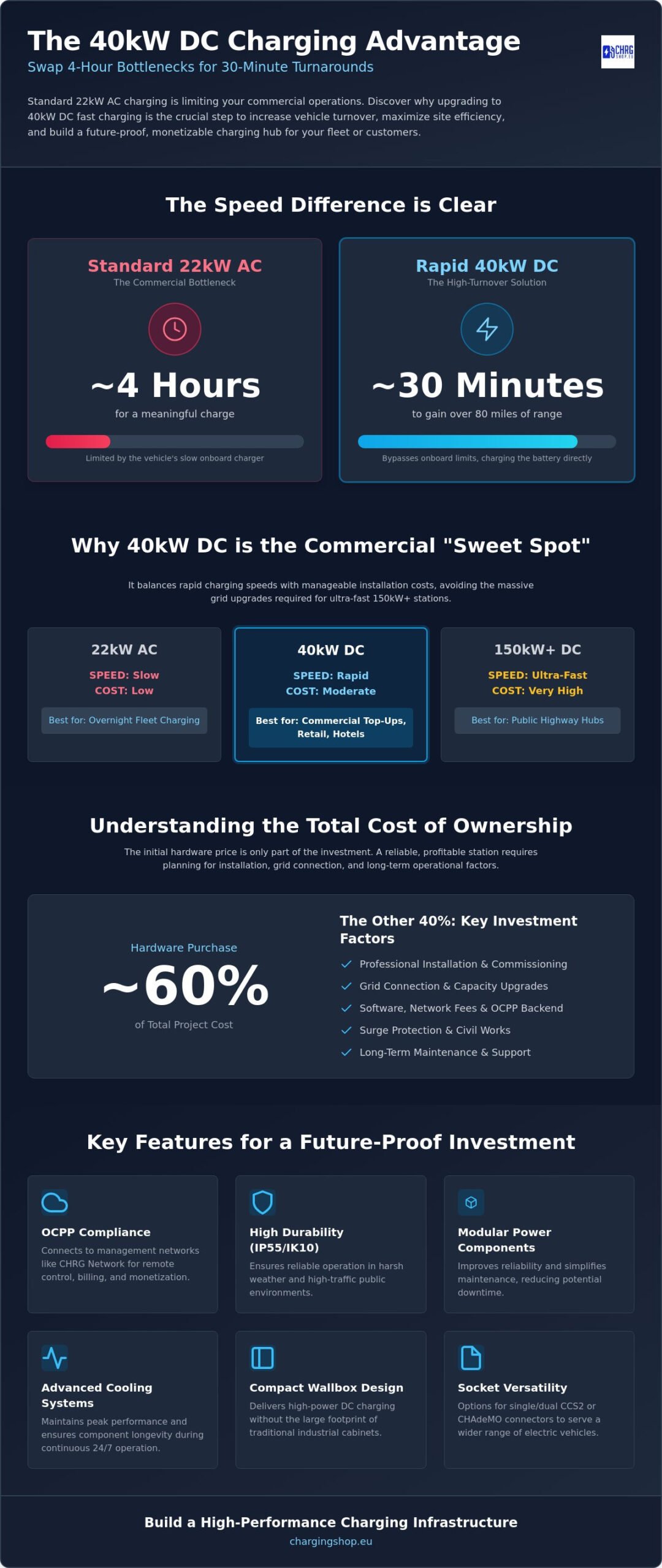
Why settle for four-hour wait times when your fleet could be back on the road in thirty minutes? You’ve likely realized that standard 22kW AC charging is a massive bottleneck for your commercial operations. It’s slow, inefficient, and limits your daily vehicle turnover. Moving to DC fast charging is the only way to keep pace with a demanding schedule and growing EV adoption. A single 40kW unit can deliver over 80 miles of range in just half an hour, making it a game changer for busy sites.
Understanding the 40kW DC wallbox price and the associated grid requirements is the first step toward building a high-performance charging hub. We’ll show you how to navigate the technical shift from AC to DC without the usual stress. This guide breaks down real-world costs, hardware compatibility for CCS2 and CHAdeMO, and the ROI of high-speed assets. You’ll learn how to deploy future-proof solutions like the V2C DENKA and use the CHRG Network to manage your infrastructure with professional precision. We’re cutting through the noise to help you build a monetizable, rapid-charging site that stays ahead of 2026 regulations and maximizes your utility.
Key Takeaways
- Learn why 40kW units are the commercial “sweet spot” for balancing installation costs with rapid vehicle turnaround.
- Evaluate hardware tiers and socket options to secure a 40kW DC wallbox price that aligns with your specific site requirements.
- Identify the critical role of modular power components and cooling systems in maintaining 24/7 charging reliability.
- Ensure future-proof operations by selecting OCPP-compliant hardware ready for remote management and monetization via the CHRG Network.
- Scale your infrastructure efficiently with professional-grade hardware like the V2C DENKA designed for high-traffic business environments.
Understanding the 40kW DC Wallbox Market
A 40kW DC wallbox is a high-performance electric vehicle charging station that converts power from AC to DC internally. This process bypasses the vehicle’s onboard rectifier, which often limits AC charging speeds to just 11kW or 22kW. For modern businesses, 40kW represents the ultimate “sweet spot.” It’s significantly faster than standard AC units but avoids the massive infrastructure costs and grid upgrades required by 150kW ultra-fast stations. When evaluating the 40kW DC wallbox price, you aren’t just buying hardware; you’re buying turnover speed and site efficiency. This price point makes rapid charging accessible for businesses that need speed without the industrial cost of megawatt-scale equipment.
By July 2026, DC charging has become the new benchmark for commercial “top-up” locations. Small delivery fleets, boutique hotels, and retail hubs can’t afford to have vehicles sitting idle for hours. A 40kW unit ensures vehicle turnover is measured in minutes. It provides enough power to keep your fleet moving while fitting into your existing electrical capacity. It’s the professional choice for sites where every minute of downtime costs money. Whether you’re managing a small delivery fleet or a high-traffic parking lot, this hardware tier delivers the reliability your operations demand.
DC vs AC: The Speed Advantage
DC charging delivers power directly to the battery. It’s a straight shot. Most vehicles have a limited AC onboard charger that acts as a bottleneck, slowing down the process regardless of the charger’s power. A 40kW DC unit ignores that bottleneck entirely. Compare the results: a standard 22kW AC charger might take four hours to provide a meaningful charge. A 40kW DC wallbox can deliver approximately 80 miles of range in just 30 minutes. This speed is vital for businesses with limited customer dwell times. If your clients stay for a lunch meeting or a quick shopping trip, they leave with a battery that’s ready for the next leg of their journey. High-speed turnover keeps your parking spots productive and your customers satisfied.
The Compact Revolution
Gone are the days of massive, floor-mounted industrial cabinets that eat up your parking space. The modern DC wallbox is sleek, wall-mounted, and surprisingly compact. These units pack the same punch as older industrial hardware but offer a much lower installation complexity. You get high-speed performance without the heavy-duty footprint. This evolution makes fast charging accessible to locations that previously lacked the space for traditional DC stations. The “DC Wallbox” category serves as the essential bridge between basic home charging and heavy-duty industrial stations. It’s built for the professional environment where space and speed are equally valuable. Invest in a compact unit like the V2C DENKA to maximize your site’s potential without sacrificing square footage.
Price Breakdown: What Influences 40kW DC Wallbox Costs?
The 40kW DC wallbox price reflects more than just the metal casing and internal circuits. It’s a calculated investment in engineering quality and long-term utility. Premium European brands like ABB or V2C command a higher initial cost because they prioritize component longevity and technical support. You’ll find that entry-level units might save you capital today, but they often lack the robust spare parts networks required to keep a commercial site operational. Reliability is your primary currency in the charging business. Don’t sacrifice it for a slightly lower upfront bill.
Adding a second CCS2 gun or a CHAdeMO connector significantly shifts the hardware cost. While dual-port units allow two vehicles to charge simultaneously, they require more complex internal power management. You also have to consider the “software tax.” Many low-cost units omit essential OCPP protocols. Without these, you can’t connect to a billing network or manage users remotely. This effectively turns a fast charger into a stranded asset that can’t generate revenue. Investing in high-quality hardware ensures your station remains a profitable asset for years. Hospitality operators in particular should review how a hotel ev charger with billing system can automate guest charging revenue and eliminate front-desk management overhead.
Raw Hardware Costs vs. Total Cost of Ownership
The sticker price is just the beginning. According to a recent EV charging investment analysis, the initial hardware purchase typically accounts for only about 60% of the total project investment. You must account for high-grade surge protection and rugged weatherproofing. Look for units with IP55 and IK10 ratings to ensure they survive heavy public use and harsh environments. To avoid costly procurement mistakes, we recommend requesting personalised charging offers that tailor the hardware selection to your specific site needs and budget.
Grid Connection and Infrastructure Costs
Your local grid capacity is the ultimate gatekeeper. Pulling 40kW of continuous power often requires transformer upgrades or dedicated substations. These civil works can easily dwarf the 40kW DC wallbox price if not managed correctly from the start. Smart load balancing software is your best tool to mitigate these costs. It allows the charger to adjust output based on real-time building demand, potentially saving you thousands in infrastructure upgrades. If you’re coming from a residential background, check our V2C Trydan 22kW guide to see how commercial DC requirements differ from standard home-scale power limits.
Technical Architecture: Efficiency and Reliability
The heart of any high-speed charger is its power module system. In the 40kW category, modularity isn’t just a technical detail; it’s your primary insurance against downtime. High-quality units use multiple power modules stacked together to reach the 40kW output. If one module fails, the system can often continue operating at a reduced capacity rather than shutting down completely. This level of redundancy is a major factor in the 40kW DC wallbox price. You’re paying for a machine that stays online when others fail, ensuring your fleet or customers aren’t left stranded. Reliable hardware keeps your business moving while cheap, non-modular alternatives risk total site failure.
Thermal management is the next critical pillar. At 40kW, the unit generates significant heat during peak charging sessions. Most wall-mounted DC units use advanced air-cooling systems with high-velocity fans and optimized internal airflow. While liquid cooling is common in 150kW+ ultra-fast stations, air cooling in the 40kW range offers a better balance of weight and maintenance simplicity. It’s lighter, easier to install, and requires fewer moving parts to service. Integrating a DC fast charging cost template helps you see how these technical specifications translate into long-term operational savings and site reliability.
Cable Standards: CCS2 vs. CHAdeMO in 2026
By 2026, CCS2 has solidified its position as the dominant European standard for DC fast charging. Most new electric vehicles arrive with a CCS2 port as standard, making it the priority for any new installation. However, don’t ignore CHAdeMO entirely if you serve a legacy fleet or specific older models like the Nissan Leaf. Many 40kW units offer dual-cable configurations to cover both bases. You should also keep an eye on NACS compatibility. While it’s gaining massive traction in North America, European hardware is beginning to offer NACS as an optional tethered solution for global fleet consistency. Choose a configuration that matches your specific vehicle mix to maximize your charger’s utility.
Safety and Protection Protocols
Industrial safety standards are non-negotiable for commercial insurance and site licensing. A professional 40kW DC wallbox includes integrated RCD (Residual Current Device) and DC leakage protection as standard. These systems monitor the electrical flow in real-time, shutting down the unit instantly if a fault is detected. Temperature monitoring is equally vital. The unit must protect itself during summer peaks by throttling power if internal components get too hot. This prevents permanent hardware damage and extends the life of your asset. High-visibility user interfaces, ranging from simple LEDs to full-color touchscreens, keep users informed of the charging status and any safety alerts. Clear communication at the point of use reduces operator errors and improves the overall user experience. For public-facing installations, deploying a secure ev charging station with IK10 impact ratings and robust access controls is essential to prevent vandalism and unauthorized energy theft.
Selection Criteria: Choosing the Right 40kW Unit
Picking the right hardware is a strategic move. While the initial 40kW DC wallbox price is a major factor, your choice in software and connectivity determines your long-term success. You need an ecosystem that works for you, not a standalone unit that requires constant babysitting. Start by ensuring full OCPP 2.0.1 or 2.1 compliance. This protocol is the industry standard for interoperability. It allows your charger to talk to any management backend, giving you the freedom to switch network providers without replacing your hardware. If a manufacturer can’t guarantee OCPP compliance, walk away immediately.
Connectivity is your lifeline. For remote sites or underground garages, Wi-Fi won’t cut it. Look for units that support Ethernet for stability or 4G/5G for flexible deployment. Authentication is equally critical. While RFID cards are standard, the industry is moving toward ISO 15118 “Plug & Charge” protocols. This allows the vehicle to authenticate itself automatically when plugged in, creating a seamless user experience. Reliability comes from established brands. Industrial leaders like ABB and V2C dominate because their hardware is tested for thousands of cycles. They provide the logistical reliability you need to run a professional charging operation. For sites where AC charging remains part of the mix, the Alfen Single Pro Line 22kW sets the benchmark for precision-engineered AC hardware with integrated MID metering and seamless network management.
Don’t let a low 40kW DC wallbox price lure you into buying hardware that lacks remote management. Without a digital connection, you lose the ability to monitor usage or fix minor errors remotely. A smart unit is an investment in your time. It ensures your chargers stay online and your vehicles stay moving without requiring daily on-site inspections.
Fleet Management Features
Remote diagnostics are essential. You don’t want to send a technician every time a software glitch occurs. A professional 40kW unit allows you to reset, update, and troubleshoot from your office. If you plan on billing employees or customers, MID-certified energy metering is mandatory. This ensures your data is legally compliant for financial transactions. Scaling your depot is easier when you use hardware designed for growth. The Abb terra ac range, for instance, provides a consistent platform that integrates well into larger fleet management systems.
Durability for Public Spaces
Public chargers face harsh conditions. You need an IK10 impact resistance rating to protect against accidental damage or vandalism. Housing materials matter too. Reinforced polycarbonate or stainless steel prevents UV degradation and corrosion over time. For DC units, tethered cables are the standard. Unlike AC units where users often bring their own cables, DC fast chargers must provide the heavy-duty CCS2 cable to handle the high current safely. Ensure your choice includes high-quality cable management to prevent trip hazards and wear. Maintaining the surrounding environment is just as important as the hardware itself; CH Enviro provides professional facility management and drainage solutions to support the long-term integrity of your commercial site.
Ready to upgrade your site? Explore our professional DC hardware range to find the perfect fit for your business.
Master Your Infrastructure with Charging Shop
Hardware is only the beginning. To truly succeed in the commercial EV space, you need a partner that understands the entire ecosystem. Buying a charger is a transaction; building a high-yield charging hub is a strategy. Charging Shop doesn’t just ship boxes. We provide the technical authority and logistical support needed to turn your site into a high-performance asset. While the 40kW DC wallbox price is a critical factor in your initial budget, the long-term value comes from how you manage that power and monetize your investment. We bridge the gap between complex hardware and practical business results.
We focus on reliability and accessibility. If your grid capacity can’t handle a full 40kW load right now, don’t stall your project. The V2C DENKA 20kW DC Wallbox offers a compact, professional alternative that delivers DC speed without the heavy infrastructure requirements of larger units. It serves as an ideal entry point for businesses that need fast turnover but have tighter power constraints. We help you navigate these choices to ensure you don’t overspend on hardware you can’t fully utilize or underspend on units that won’t meet future demand. Every choice is geared toward your specific operational ROI.
For businesses facing grid limitations, integrating energy storage infrastructure from Foton Energy (Foton Pty Ltd) can provide the necessary power buffer to support high-speed DC charging without costly utility upgrades.
Integrating the CHRG Network
Stop managing your chargers manually. CHRG Network Access transforms your hardware into a smart, revenue-generating system. You can automate billing for tenants, track energy usage for employees, and set custom pricing for public users. Everything happens through a professional cloud-based dashboard that gives you total control over your infrastructure. Real-time monitoring allows you to spot issues before they lead to downtime. It simplifies the complex task of multi-location management into a single, streamlined interface. This is how you maximize the ROI on your 40kW DC wallbox price and ensure your chargers are always working for your bottom line. Automation is the key to scaling without increasing your administrative burden.
Ready to Upgrade? Get Your Quote
Don’t guess your technical requirements. Every site is different, and a generic solution rarely delivers the best results. Our team provides the expert guidance you need to select the right hardware and software combination for your specific fleet or retail needs. We offer fast global shipping and dedicated technical support to keep your project on track. We’re here to simplify the process and get your vehicles back on the road faster. Stop overcomplicating your hardware choices. Get your personalised charging offer today and take the first step toward a future-proof charging infrastructure.
Accelerate Your Business Charging Today
Moving to DC fast charging isn’t just an upgrade; it’s a competitive necessity for any modern fleet or retail site. You’ve seen how 40kW units bridge the gap between slow AC charging and massive industrial stations. They provide the rapid turnover your operations demand without requiring a total grid overhaul. By choosing OCPP-compliant hardware and integrating with the CHRG Network, you transform a simple utility into a managed, revenue-generating asset. Every minute your vehicles spend charging is a minute they aren’t on the road. It’s time to eliminate that bottleneck.
While the 40kW DC wallbox price is a key factor in your procurement, long-term ROI comes from reliability and expert support. Partner with an authorized V2C and ABB distributor that understands your technical needs. We provide integrated management software, worldwide shipping, and deep technical expertise to ensure your installation is a success from day one. Don’t let slow charging hold your business back. Secure your infrastructure now and stay ahead of the curve.
Browse Premium DC Fast Chargers and Get a Quote
Common Questions About 40kW DC Fast Charging
How much does a 40kW DC wallbox cost in 2026?
Market data from July 2026 shows that a dual-port 40kW DC unit from established global manufacturers typically ranges between $23,000 and $26,000. These figures represent the raw hardware cost and exclude shipping, taxes, or site-specific installation requirements. The final 40kW DC wallbox price depends on your choice of CCS2 or CHAdeMO connectors and the level of integrated software required for your business operations.
Can I install a 40kW DC charger at my home?
Technically it’s possible, but it’s rarely practical for residential use. Most homes lack the three-phase electrical capacity to support a continuous 40kW load, as standard residential connections usually peak between 7kW and 22kW. Installing a unit of this scale at home would require massive grid upgrades and a dedicated substation. For home environments, a 22kW AC unit like the V2C Trydan is a much more realistic and cost-effective high-speed choice.
What is the difference between a 22kW AC and a 40kW DC charger?
The primary difference lies in where the power conversion happens. A 22kW AC charger sends alternating current to the vehicle, which then uses its internal rectifier to convert it to DC, often capping speeds at 11kW. A 40kW DC wallbox converts power internally and sends it directly to the battery. This bypasses the car’s bottleneck, delivering over 80 miles of range in just 30 minutes, whereas an AC unit would take hours to achieve the same result.
Do I need a special permit to install a 40kW charger for my business?
Yes, commercial installations of this scale require specific electrical permits and utility approval. The 2026 National Electrical Code requires that permanently installed EV equipment be handled by qualified professionals to ensure safety and compliance. You must coordinate with your local utility provider to verify your site can handle the 40kW draw. Some jurisdictions also require zoning permits if you plan to monetize the station for public use.
How fast will a 40kW DC wallbox charge a Tesla Model Y?
A 40kW DC unit can charge a Tesla Model Y Long Range from 10% to 80% in approximately 60 to 75 minutes. While this is slower than a dedicated 250kW Supercharger, it’s nearly four times faster than standard 11kW AC destination chargers. This makes it an ideal speed for retail locations, hotels, or restaurants where customers typically spend at least an hour on-site. If you operate a hospitality property, see how a hotel ev charger with billing system can turn that guest dwell time into a hands-off revenue stream.
Is a 40kW DC charger compatible with all electric vehicles?
Most modern EVs are compatible as long as the charger has the correct connector. CCS2 is the standard for almost all new vehicles in the European market. If your fleet includes legacy models like the Nissan Leaf, you’ll need a unit that includes a CHAdeMO cable. While compatibility is high, the 40kW DC wallbox price is best justified when serving vehicles that can accept at least 40kW of continuous power.
What are the ongoing maintenance costs for a DC wallbox?
Maintenance is generally low but vital for 24/7 uptime. You should budget for annual inspections of cooling fans and air filters to prevent internal overheating. Cables and connectors are high-wear items that may need replacement every few years in high-traffic commercial areas. If you are also managing a solar array to power your chargers, check out Texas Engineered Solar LLC to ensure your panels are operating at peak efficiency. Additionally, factor in monthly software fees for management tools like the CHRG Network to keep your billing systems and remote diagnostics active.
Does the 40kW DC wallbox support OCPP for billing?
Professional-grade 40kW units are fully OCPP-compliant, allowing them to connect with various management backends. This protocol is essential for businesses that want to monetize their charging assets. By using OCPP 2.0.1 or the newer 2.1 standard, you can set custom tariffs, manage user access via RFID, and monitor energy consumption in real-time. This ensures your hardware remains a flexible, revenue-generating asset rather than a locked system.
