
 Deutsch
 Dansk
 Suomi
 Latviešu
 Lietuvių
 Norsk bokmål
 polski
 Русский
 Svenska

No products in the cart.
Uncategorized
EV charging for visitors: when to charge and what to pay
14
Nov
Nov
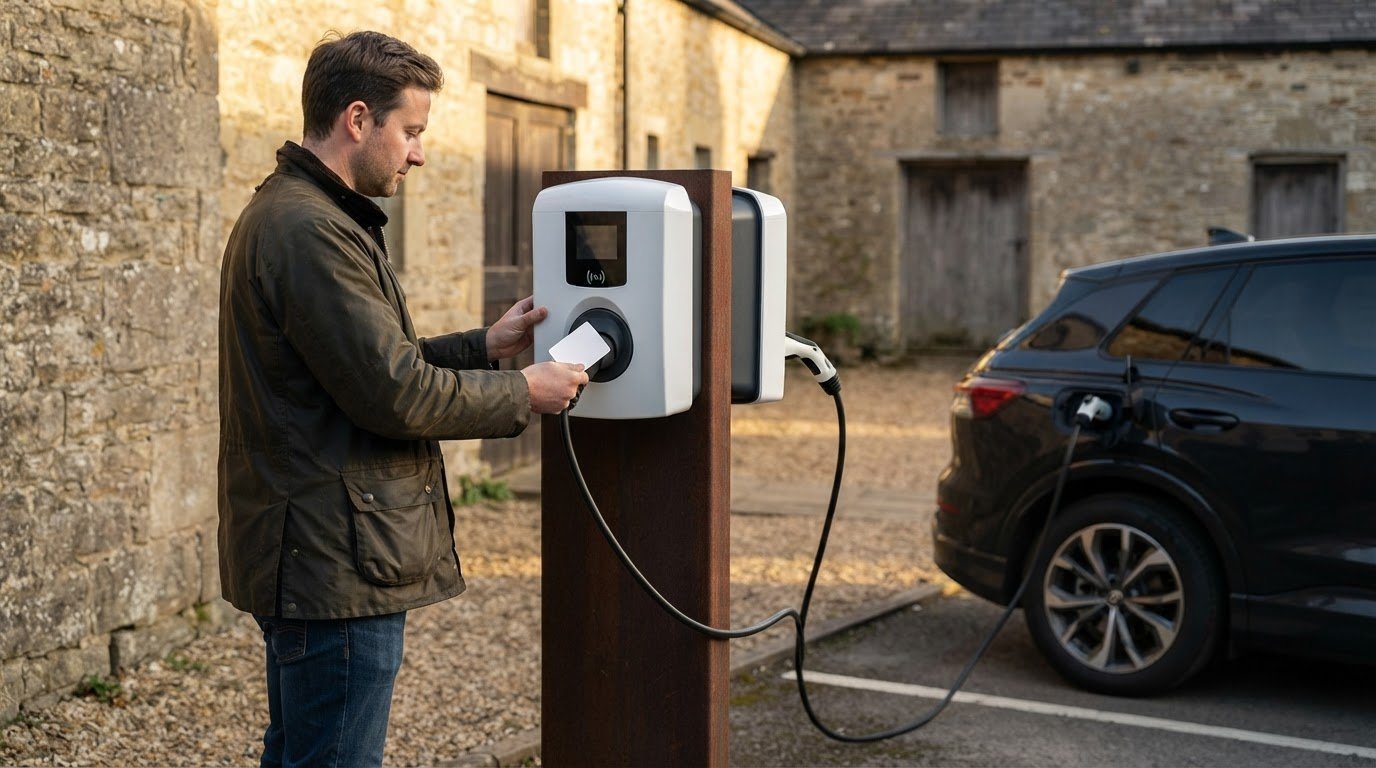
Should you charge a visiting EV driver to plug in? For ordinary hospitality at home, the courteous norm for EV charging for visitors is to let guests use a compatible charger without charge. At attractions and other public destinations, access and payment depend on the charging arrangement, so don’t assume every plug is free.
It’s reasonable to want clear expectations before connecting, whether you’re visiting someone’s home or stopping at an attraction. The key is to distinguish a courtesy charge from charging offered as a paid service, then follow the host’s or station’s stated terms.
This guide explains the charging options visitors may encounter, when a host might treat charging as a paid arrangement, and how to understand payment instructions before you plug in. You’ll also find practical etiquette for sharing chargers respectfully, so you can plan your stop and avoid awkward surprises.
Key Takeaways
- Match your charging stop to your route and how long you’ll be parked; campground outlets may offer another option for compatible vehicles.
- Set expectations with your host: a courtesy home charge is different from a paid charging arrangement.
- Attractions can have charging access on-site or along the route, so plan your stop around where you’ll spend time.
- Know how the station accepts payment before connecting, and leave the charger ready for the next driver.
Charging options for drivers
Visitors can charge at public stations, destination chargers, or compatible outlets. The right option depends on access, payment terms, and how long you’ll stay.
Visitor Incentives and Discounted Rates
Visitor discounts are reduced charging rates offered under a station’s or host’s pricing arrangement. In the United States, EV charging for visitors has no universal discount: rates depend on the location and its terms. A hotel may include charging for guests, while a public station may charge separately. Check the posted rate or ask the host before connecting, so you know whether access is complimentary or paid.
For example, a destination may include charging with a guest stay, while a nearby public charger has its own pricing. Treat each location as a separate arrangement. If charging affects where you park or how long you stay, understand the terms before choosing your stop.
Finding Nearby Public Charging Stations
Nearby public stations are charging points open to drivers beyond a private home or workplace. Search a navigation system or charging directory for public EV stations near your destination. Compare each station’s location with your route and planned stop to choose a convenient option without an unnecessary detour.
Review access and payment details in the station listing before setting off. A hotel charger, for example, may be for overnight visitors, while one near a restaurant could suit a shorter stop. Use the location details to match the charging stop to your plans. Planning EV charging for visitors around existing stops can make a route easier to manage.
Charging at Visitor Destinations
Hotels, workplaces, and apartment buildings may provide chargers for guests, employees, or residents. An on-site charger doesn’t automatically mean every visitor can use it. Ask the host or reception about access, payment, and the charging space before parking. These details matter when deciding whether to charge during a meeting, meal, or overnight stay.
Charging time varies by station output, vehicle, and battery level. At one location discussed by Geoff Quinn, a vehicle gained about 15 miles of range per hour. Treat that as an example, not a universal rate. A compatible campground outlet can also be an option where available. Check the charger’s displayed information and plan around your visit length.
Guest etiquette around EV charging
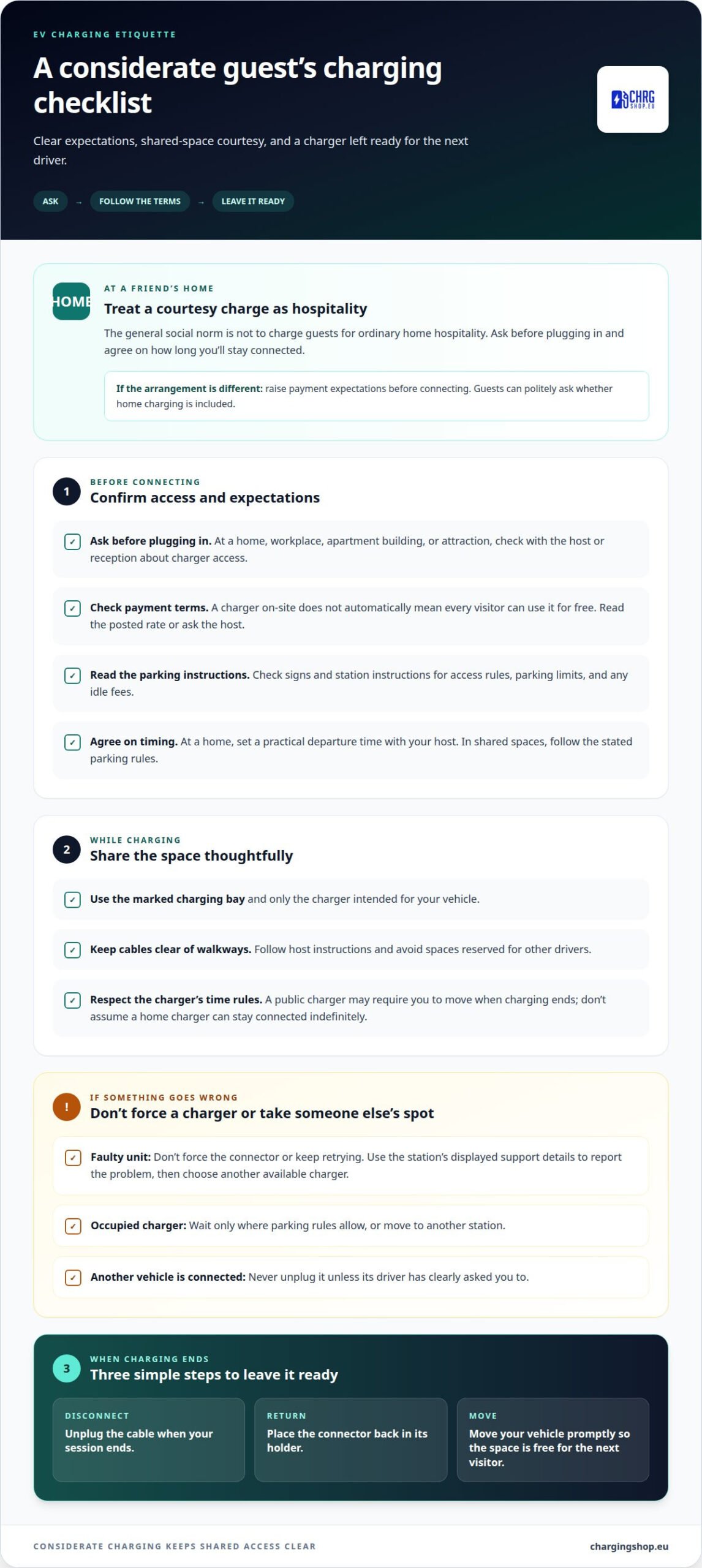
Good charging etiquette means following parking instructions and keeping access clear for other drivers. At a friend’s home, ask before plugging in and agree on how long you’ll stay connected.
Parking limits and idle fees depend on the location’s posted terms. Read the signs and station instructions before charging; a public charger, for example, may require you to move when charging ends. At a home, agree on a practical departure time with your host instead of assuming you can leave the vehicle connected indefinitely.
Be considerate in shared spaces. Park within the marked charging bay, use only the intended charger, and keep cables clear of walkways. At an apartment building or workplace, follow the host’s access instructions and avoid spaces reserved for other drivers. A quick message to your host can prevent confusion about timing or access.
If a public charger is broken, don’t force the connector or keep retrying a faulty unit. Use the station’s displayed support details to report the problem, then choose another available charger. If a charger is occupied, wait only where parking rules allow, or move to another station. Never unplug another electric vehicle unless its driver has clearly asked you to.
When your session ends, disconnect the cable, return the connector to its holder, and move your vehicle promptly. That simple sequence frees the space for the next visitor. If you’re hosting guests regularly, a visitor charging setup can help make access and expectations clearer.
For a home visit, treat charging as part of ordinary hospitality, not an automatic bill. A general social norm is not to charge guests for ordinary hospitality while they stay in a home. Hosts can use that as a helpful default: if you’re happy to offer a plug, there’s no need to turn the favor into a separate transaction.
If you prefer a different arrangement, raise it before the guest connects and agree clearly on what to expect. Guests can politely ask whether home charging is included rather than assume. A calm conversation in advance keeps expectations mutual and lets both sides choose without pressure. The aim isn’t to set a universal rule for every visit, but to make the arrangement clear and considerate.
Charging access for EV travelers at tourist attractions
Charging access can make an attraction easier to reach by electric vehicle. Availability varies by destination, so plan around your route and the time you’ll spend there. Grand Canyon National Park has installed EV charging stations at various locations within the park. Visitors can charge while exploring, rather than relying only on stops outside it.
Access also develops through broader initiatives. Ahead of its centennial in 2016, the National Park Service was ramping up an effort to install public charging stations at parks across the country. The parks had 292 million annual visitors, making visitor travel a significant part of the initiative’s focus.
Route planning matters beyond national parks. Australia’s Great Ocean Road has several EV charging stations along its route for electric vehicle travelers. On a scenic drive, these stops can help you plan charging around destinations and travel segments. Treat the route and attraction as one itinerary: identify where charging is available, then plan your visit around those locations instead of assuming every site has a charger.
Before setting out, look for charging at the attraction and at nearby stops along your route. Check station locations and payment details, then consider how long you’ll be parked. A charger inside a large park may suit a longer visit; a roadside station may work better during a travel break. If a destination charger is occupied or unavailable, having another stop in mind helps you continue without relying on a single option.
Charging with an app, RFID, or credit card
Public chargers use different payment methods, and the station’s instructions explain which ones it accepts. An app may start a session through your phone; an RFID card or tag can identify your account at the charger. Some stations also have a credit card reader. Choose a method supported by that specific station.
Before arriving, check the station listing or charging app for availability, connector type, and access details. Compare the listed connector with your vehicle’s charging inlet, then review the charging instructions. This helps you avoid reaching a station that cannot serve your vehicle or doesn’t fit your plans.
At the charger, follow the displayed payment steps before connecting. With an app, select the station and the correct charging unit, then start the session as instructed. With RFID, use the reader identified on the station. For a credit card, follow the terminal prompts. The process varies by charger, so use its screen or labels rather than guessing.
Check the station display or app after starting. Confirm that the session is active and that the vehicle is receiving power. If payment doesn’t work, stop and read the error message before trying another supported method. Don’t assume a card reader or RFID option is available just because another station uses one.
When charging ends, use the station’s stop control or the method shown in its instructions. Check that the session has closed before unplugging. Keep the payment method you used available until the charger confirms completion. For a destination planning visitor access, explore a Personalised Charging Offer to shape a suitable charging arrangement.
Charging Shop
Charging Shop supplies EV charging hardware and tailored charging options for visitors and destination operators. If you’re planning access for guests, consider the vehicles using the charger, the site’s charging needs, and how visitors will access it.
Charging Shop offers the V2C Trydan 22kW, V2C DENKA 20kW DC Wallbox, and Alfen Single Pro Line 22kW. A Personalised Charging Offer can help align a charging choice with your specific requirements, rather than treating every location the same.
Use this guide to clarify your needs, including visitor access, payment expectations, and charging location. Then contact Charging Shop to discuss charging hardware and options for your plans.
Make your next visit easier to plan
A clear plan for EV charging for visitors starts before the next trip. Think beyond the charging stop: consider where guests will park, how they’ll access the charger, and what information they need before arriving. For hosts and destination operators, making these details clear can help visitors feel confident about using the charging space.
Use your next visit to notice what works. Is the charger easy to find? Are the payment steps clear? Can another driver use the space when your session ends? These practical details can improve the charging experience without adding complexity.
If you’re planning charging access for a home, workplace, or destination, Charging Shop can help you explore suitable hardware and a tailored offer. Contact Charging Shop for advice and take the next step toward a charging setup that fits your plans.
Frequently Asked Questions
Is it okay to charge guests to plug in?
For ordinary hospitality at home, the customary approach is to let guests charge without payment. If charging is part of a paid stay or another agreed arrangement, discuss the charge before the visit. For example, a host and overnight guest can agree in advance whether charging is included. Clear expectations distinguish a courtesy from a paid service.
How do visitors use public EV chargers, including app or payment requirements?
Visitors use the payment method supported by the specific station, which may include an app, RFID card, or credit card. No single method works at every charger. If a station uses an app, set up access and payment before your stop. Keep the confirmation available until the charger indicates that charging has started.
What are the differences between Level 2 and DC fast charging for visitors?
Level 2 charging supplies AC power, which the vehicle converts for its battery. DC fast charging supplies DC power to the battery and is generally designed for quicker stops. Actual charging speed depends on the vehicle and station, so the charger type alone doesn’t determine your wait. Choose based on your route, parking time, and vehicle compatibility.
