
 Deutsch
 Dansk
 Suomi
 Latviešu
 Lietuvių
 Norsk bokmål
 polski
 Русский
 Svenska

No products in the cart.
Uncategorized
How to Avoid EV Charging Peak Hours and Lower Your Bill
23
Nov
Your EV doesn’t have to charge as soon as you plug it in. Learning how to avoid EV charging peak hours starts with scheduling charging during the lower-rate periods in your electricity plan. The right time depends on your utility’s schedule, so there is no single off-peak window that applies everywhere.
It makes sense to look for a cheaper time to charge: electricity rates can vary by time of day, and overnight charging may cost less than charging during peak periods. Scheduling is a practical way to manage charging after you get home.
This guide explains how off-peak rates affect charging costs, how to schedule charging around your utility’s hours, and how shifting demand can help households and businesses manage electricity use. You’ll also learn when peak-hour charging may still be the practical choice, and how to avoid peak periods without compromising an urgent trip.
Key Takeaways
- Compare your utility’s peak and off-peak rates to see whether shifting charging hours could lower your electricity costs.
- Use your vehicle’s charging schedule to start during your utility’s lower-rate window instead of relying on a universal off-peak time.
- For a business or fleet, stagger charging starts to help limit simultaneous demand spikes.
- Balance lower rates with how soon you need the vehicle and how much charge it needs; urgent charging may take priority over timing.
1. Charging cost comparisons at peak and off-peak rates
Compare your utility’s time-based rates before changing your charging routine. Peak electricity can cost 3-4 times more than off-peak electricity, so charging time can change the cost of replenishing the same battery. If you’re deciding how to avoid EV charging peak hours, begin with the rates on your own plan.
Consider a Tesla Model 3 with a 75 kWh battery. These figures illustrate the difference between the listed rates, not a universal bill reduction.
Your driving distance also affects potential savings.
To schedule charging, open your vehicle’s charging controls or a compatible app, choose a start time within your utility’s off-peak window, and plug in. Most vehicles have a charging schedule; if you plug in early, the vehicle waits until the scheduled time to draw power.
If your battery is nearly depleted and you urgently need the vehicle, charge during peak hours rather than delaying an essential trip. The higher rate may apply, but having the vehicle when you need it takes priority.
Compare the rate difference with your usual charging frequency and driving needs. Your actual savings depend on your utility’s rates, the energy used, and when you charge. This comparison is a practical starting point for avoiding peak hours without sacrificing a necessary trip.
2. How charging time affects electricity demand
The clock affects more than an individual charging bill. U.S. electricity demand typically reaches its lowest point around 5:00 a.m., while many drivers and businesses need power at other times. Moving charging to quieter hours can help manage local demand and reduce pressure on the electricity system.
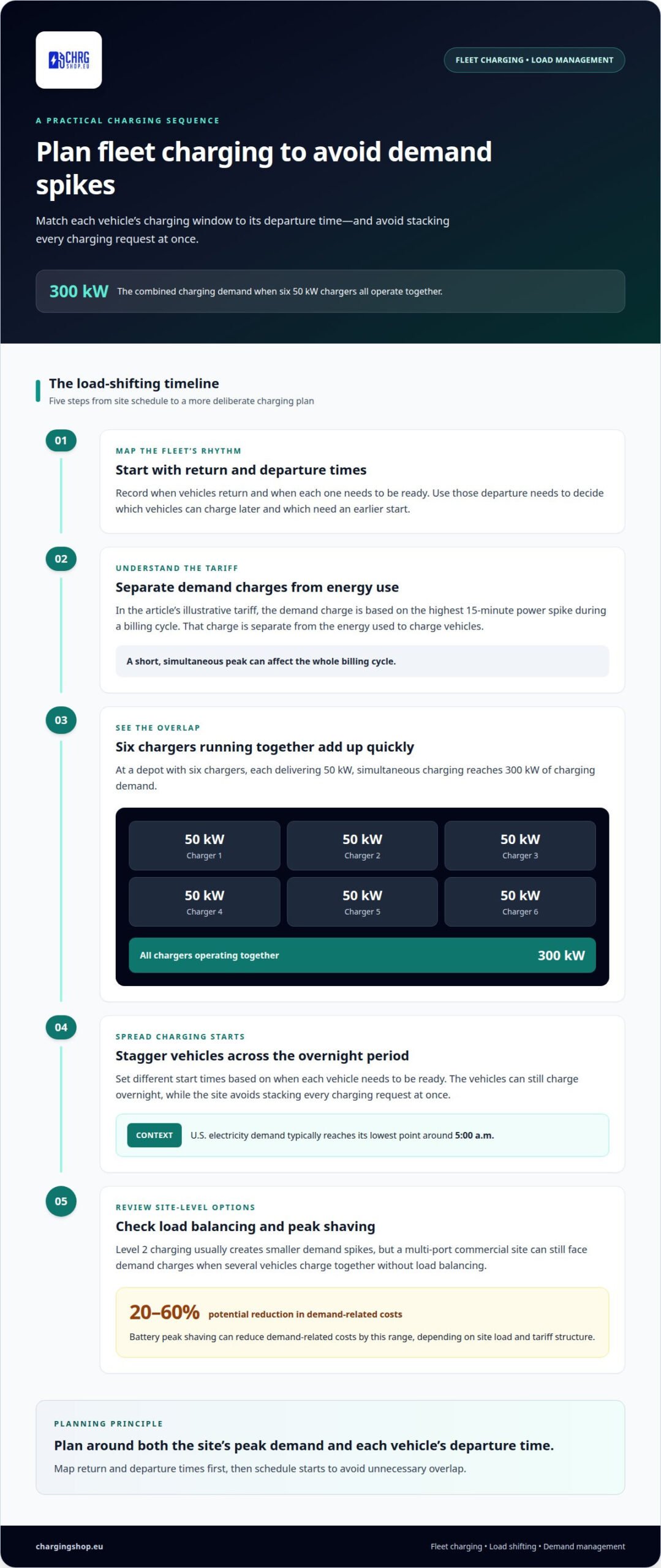
For commercial sites, a short power spike can affect the whole billing cycle. In the illustrative tariff, the demand charge is based on the highest 15-minute power spike during a billing cycle. That charge is separate from the energy used to charge vehicles.
Consider a depot with six chargers, each delivering 50 kW. If all six operate together, the site reaches 300 kW of charging demand. Staggering start times spreads that load across the night instead of creating one simultaneous peak. The vehicles can still charge within the overnight period, while the site avoids stacking every charging request at once.
For fleets, combine overnight charging with staggered starts. Set different start times for each vehicle based on when it needs to be ready. This load-shifting approach can reduce a site’s peak demand without requiring every vehicle to charge as soon as it returns.
Level 2 charging usually creates smaller demand spikes, but a multi-port commercial site can still face demand charges when several vehicles charge together without load balancing. Battery peak shaving can reduce demand-related costs by 20-60%, depending on site load and tariff structure. Treat that range as dependent on how the site uses power and how its utility calculates charges.
Plan around both the site’s peak demand and each vehicle’s departure time. Spreading charging starts across lower-demand hours can help balance these priorities. At a depot, first map vehicle return and departure times, then schedule charging to avoid unnecessary overlap.
3. Time-of-use electricity rates and off-peak windows
Time-of-use rates assign different electricity prices to different hours. U.S. examples vary: one schedule sets weekday on-peak hours from 7:00 a.m. until 11:00 p.m., then off-peak hours from 11:00 p.m. until 7:00 a.m. Another typical example places peak rates from 4 PM to 9 PM and off-peak rates from 9 PM to 6 AM. These are examples, not one nationwide schedule.
Some utilities offer EV-specific rates that are lower than their standard off-peak rates. Review your utility’s plan, identify its lower-cost window, and set the vehicle or charger schedule to match.
Smart EV chargers with time-of-use scheduling can start charging during a selected rate window. Demand response is different: participation depends on a utility program and compatible equipment, so a scheduling feature alone does not confirm program support.
At home, the utility’s time-based tariff generally determines when electricity costs less. At a public station, prices may follow the station’s own pricing structure, so your home utility’s off-peak hours may not apply. Check the specific station’s prices before relying on your home charging schedule.
Utility EV programs can reduce charging costs through a dedicated lower rate or an incentive for participating in managed charging. Where available, rebates may lower the upfront cost of eligible equipment rather than the cost of each charging session. The program’s terms determine which benefit applies.
To make a schedule work, enter your utility’s off-peak start and end times in the vehicle or charger controls. A midnight-to-5:00 a.m. schedule, for example, keeps charging within that selected window if it matches the local plan. Midday charging can also suit homes where solar panels support charging. Businesses can shift charging to nighttime or early morning to avoid demand spikes.
4. What are typical EV off-peak and peak charging hours by utility?
There isn’t one off-peak schedule for every U.S. utility. One example places weekday on-peak hours from 7:00 a.m. until 11:00 p.m., with off-peak hours from 11:00 p.m. until 7:00 a.m. Another typical schedule places peak rates from 4 PM to 9 PM and off-peak rates from 9 PM to 6 AM. Treat these as examples, not universal hours.
Regional conditions help explain why rate schedules differ. U.S. electricity demand varies with weather, and load patterns also depend on the electrical equipment people use. A utility’s rate periods may reflect local patterns rather than a single national timetable. Weekends and holidays may follow a separate schedule; one U.S. example lists them as off-peak.
To find the right window, start with your utility’s rate plan, not a general online schedule. Identify the on-peak and off-peak periods for the days you charge, including weekend or holiday rules. Then schedule the vehicle or charger to start within the lower-rate window. If hours vary by day, use a schedule that reflects those differences.
Check how your plan prices the entire charging session. If charging begins before off-peak hours and continues after they start, the applicable rate may depend on your utility’s billing rules. Set the start time within the listed window to avoid beginning during a higher-rate period. At a workplace or public station, your home utility’s schedule may not determine the price.
Seasonal weather can affect local electricity demand, but utility rate periods follow their own published schedules. Review your plan when your utility updates its rate calendar or your routine changes. For example, if you switch from weekday home charging to weekend charging, follow the weekend periods rather than assuming weekday hours apply.
Explore charging solutions for your schedule and plan around the rate periods that apply to your location.
Charging Shop
Charging Shop offers EV charging hardware for home and commercial settings. If you’re planning charging around off-peak periods, a Personalised Charging Offer can help narrow the options to your needs. Share your intended setup and charging priorities so your vehicle, charging location, and routine can guide the recommendation.
The range includes the V2C Trydan 22kW, V2C DENKA 20kW DC Wallbox, and Alfen Single Pro Line 22kW. Choosing hardware is one part of the setup; your vehicle or charger schedule still needs to match your utility’s rate window. Start with the hours that apply to your electricity plan, then consider which charging option fits your environment.
For help choosing a charging setup, contact Charging Shop.
Make Your Charging Plan Work for You
To put your plan into practice, make your charging setup fit your everyday routine. Consider where the vehicle is parked, when it needs to be ready, and how its charging schedule can follow your utility’s rate plan. A plan based on your actual journeys is easier to maintain than one built around an ideal schedule.
As your driving needs change, revisit the timing and charging equipment that support your routine. A move, a different commute, or a new charging location can make your setup less practical. Keep the goal simple: charge when it suits your vehicle and avoid higher-rate periods when your schedule allows.
Charging Shop can help you consider a charging setup that fits your needs. Contact Charging Shop today to discuss your next step, and build a charging routine with confidence.
Frequently Asked Questions
Should you charge your EV during off-peak hours?
Yes, if your electricity plan charges less during those hours and the vehicle will be ready when you need it. Set a recurring schedule that fits your usual parking routine, then adjust it before an unusually early departure or a long trip. This makes lower-rate charging practical without leaving you short on range when plans change.
Day or Night: When is the Best Time to Charge Your EV?
Night is often a good option if your utility offers lower overnight rates and your EV stays parked at home. Daytime charging may suit you if workplace charging is convenient or solar power is available at home. The best choice depends on your tariff, where the car is parked, and when you need it ready.
How much can I really save by scheduling EV charging?
Your savings depend on how much electricity you shift and the difference between peak and off-peak rates. Estimate them by multiplying the kilowatt-hours moved to the lower-rate period by the rate difference. A driver who charges less often may save less than someone who charges frequently and uses more energy, even on the same utility plan.
Why does the time of day matter?
Charging time can affect both the price per kilowatt-hour and, at some commercial sites, demand-related charges. For a household, the main consideration is often the utility’s time-based energy rate. At a depot, overlapping charging sessions can also create a high power peak. Consider these separately when choosing a schedule for home use or fleet operations.
How do EV time-of-use electricity rates work in the United States?
Time-of-use plans divide the day into periods with different electricity prices. Your bill reflects when you use electricity under your selected plan, so the same charging session may cost different amounts at different times. Some utilities also offer EV-specific plans, with charging windows and terms that may differ from a general residential tariff.
How can I find my utility’s EV charging time-of-use rates?
Check your utility account, bill, or rate-plan documents for terms such as “time-of-use,” “EV charging,” and “peak period.” Note the applicable hours, days, and seasonal schedule. Then compare them with your regular parking routine and program the vehicle or charger to match the lower-rate window.
