
 Deutsch
 Dansk
 Suomi
 Latviešu
 Lietuvių
 Norsk bokmål
 polski
 Русский
 Svenska

No products in the cart.
Uncategorized
EV Charging Stations for Shopping Malls: How They Work
17
Nov
Nov
A mall’s charging setup works best when it matches how long customers park. An EV charging station for a shopping mall draws power from the site’s electrical supply and delivers it to parked vehicles. AC chargers suit longer visits, while DC fast chargers can provide quicker charging but place greater demands on site infrastructure.
That balance matters. Drivers want a useful charge during their visit, while property teams need equipment that suits the building’s electrical capacity, parking layout, and operating needs.
Here, you’ll learn how mall charging works, how AC and DC charging differ, and what infrastructure and upkeep involve. You’ll also see how charging can make visits more convenient and give shoppers another reason to return. These fundamentals can help you assess a practical setup, from power delivery to ongoing management.
Key Takeaways
- Match charger type to parking duration: AC suits longer visits, while DC fast charging supports quicker stops but needs more power.
- Plan infrastructure around site electrical capacity, parking layout, and ongoing upkeep, including connector and port inspections.
- Use charging as a practical amenity that can make visits more convenient and give customers another reason to return.
- Explore Charging Shop’s V2C, Alfen, and ABB charging hardware or a Personalised Charging Offer to match equipment to your retail setting.
What Is EV Charging for Shopping Malls?
Shopping mall charging gives EV drivers access to power while they park to shop, dine, or attend events. The right setup aligns customer dwell time with the site’s electrical capacity and operating needs.
Retail Charging Benefits
Retail charging makes a shopping visit useful for drivers who want to add energy to their vehicle battery while parked. For malls, it can strengthen the customer experience by pairing a practical service with shops, restaurants, and entertainment in one destination. Global electric car sales exceeded 20 million cars in 2025, and electric cars accounted for approximately one in four new cars sold worldwide that year. That expanding market makes charging a relevant amenity for retail operators planning customer facilities.
Charging Solutions for Retail Businesses
Retail charging combines AC or DC equipment with a commercial site’s electrical supply, parking layout, and operating model. Malls often use AC charging because its speed suits multi-hour parking and standard electrical service. Federal, state, and local incentives depend on location and program rules; eligibility can also depend on ownership, charger type, and project scope. An EV charging station for a shopping mall needs to match both the site’s electrical capacity and how customers use its parking.
Malls and Other Retail Locations
Mall visitors may shop, dine, and attend events during a single visit, while customers at smaller retail outlets often make shorter stops. That difference shapes charging demand: longer stays can suit AC charging, while quick-stop locations may prioritize faster charging. A grocery store, for example, has a different visit pattern from a mall with dining and entertainment. Operators can use these patterns to plan charger locations, parking access, and the customer experience.
Operator and Tenant Charging Use
Mall operators can manage charging as shared site infrastructure, coordinating placement and access across common parking areas. Retail tenants can treat it as an amenity that supports visits, especially when customers combine shopping with dining or other activities. Clear operating arrangements define who manages the charging area, how drivers access it, and how it fits the property’s parking plan. For example, a central parking zone can serve several tenants rather than tying chargers to one storefront.
Charging infrastructure supply, installation, management, and maintenance
A mall charging project brings together equipment, electrical capacity, parking design, and ongoing management. Each decision affects how reliably the infrastructure can deliver power to vehicles.
Charger Selection and Site Planning
Choose chargers to suit power needs, parking patterns, site capacity, and how drivers will access them. Start with an electrical assessment, then map parking locations, cable routes, and customer access. Load management can distribute available power, but it neither replaces an assessment nor increases the site’s physical electrical capacity. A consistent connector standard can also simplify upkeep. The California Air Resources Board says using one charging standard can reduce public charger maintenance costs compared with supporting competing technologies.
Installation and Implementation Support
Implementation involves equipment placement, electrical work, utility coordination, network software, and activation. A charger farther from existing electrical service, for example, may require more infrastructure work than one near suitable capacity. Plan maintenance that covers connector cleaning, checks for loose connections or faults, and software updates. Mall owners should also address risks such as damaged connectors, equipment faults, and unclear responsibility for inspections and repairs, all of which can affect safe access and site management.
Installation Costs and Timelines
Installation costs depend on charger type, available electrical capacity, mounting method, site layout, and any necessary utility or electrical upgrades. DC fast charging can demand more power and coordination than AC equipment, while complex parking layouts can add construction work. Timelines also depend on design, utility coordination, permits, equipment delivery, construction, and activation. These stages determine when chargers can serve drivers, making project sequencing important for retail centers.
Permits and Electrical Requirements
Permit, electrical, and accessibility requirements depend on the jurisdiction and project design. The project must account for local permitting processes, the site’s electrical capacity, utility coordination, and accessible routes and parking arrangements. These factors shape charger placement and construction scope. A site assessment brings them together before installation decisions are finalized, helping operators plan charging infrastructure around the building, parking flow, and customer access. For a tailored equipment plan, explore commercial charging options.
How do EV charging stations work?
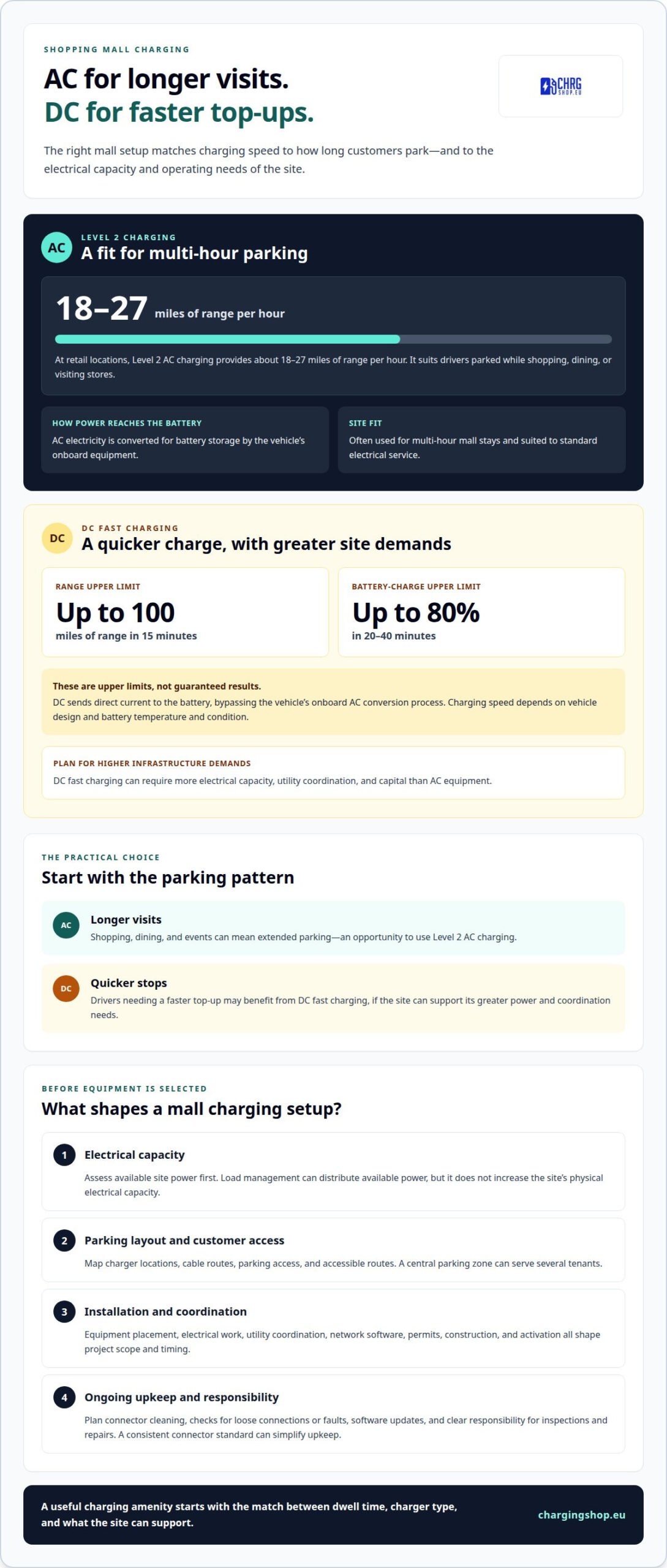
Level 2 AC charging suits mall visits that last several hours; DC fast charging serves drivers needing a quicker top-up. Many malls can use both selectively, since DC equipment places greater demands on electrical capacity, utility coordination, and capital.
With Level 2 charging, electricity reaches the vehicle as alternating current, and the vehicle’s onboard equipment converts it for battery storage. At retail locations, Level 2 charging provides about 18-27 miles of range per hour. That makes it a practical fit for drivers who park while shopping, dining, or visiting stores. The vehicle’s own charging limit also affects how quickly it accepts power.
DC fast charging sends direct current to the battery, bypassing the vehicle’s onboard AC conversion process. A DC fast charger can provide up to 100 miles of range in 15 minutes, or charge a battery up to 80% in 20-40 minutes. These are upper limits, not fixed results: vehicle design, battery temperature and condition, and current state of charge all affect performance.
For a mall, Level 2 is often the better match for longer parking, while DC fast charging can serve short visits or high-turnover areas. High-power DC units are used less often at retail properties because they may require more grid capacity, utility coordination, and electrical upgrades. That makes site capacity a key factor in deciding whether faster charging can be delivered without extensive infrastructure work.
Charging speed also changes during a session. A vehicle may accept power quickly when its battery is low, then slow as the battery fills. Drivers should therefore treat advertised range and charging times as estimates shaped by the vehicle and conditions, not identical results for every electric car. A balanced mall setup can combine Level 2 parking options with selected DC fast charging where quicker turnover supports the site’s use.
Charging as a customer attraction and retention amenity
Vehicle charging adds energy access to a shopping visit and makes parking more useful for EV drivers. Its value depends on how well the amenity fits customers’ routines.
Customer Incentives and Dwell Time
Incentives can connect charging access with the time customers spend at a property. For example, a mall could explore validating parking or offering a shopping-related benefit to drivers who charge during a visit. The right approach depends on the site’s goals and operating model, not just on offering cheaper energy.
Match the incentive to the visit. A driver stopping for groceries may value convenient access, while a family spending time at restaurants and stores may value charging during a longer stay. Consider how the offer affects parking turnover, charger access, and the customer experience. An incentive works best when it supports a visit without encouraging drivers to leave vehicles in charging spaces after charging ends.
Attraction and Customer Loyalty
Charging can help attract customers by meeting a practical need before they arrive. An EV driver choosing between destinations may consider whether a mall offers charging near the stores, dining, or services they plan to visit. Clear signs and straightforward access help customers find the amenity and factor it into their trip.
To encourage repeat visits, make charging part of a consistent customer experience. A shopper who can charge while browsing or dining, for example, may see the mall as a convenient destination for future visits. Operators can use charger activity, customer feedback, and parking patterns to refine placement and access. Charging may support retail activity, but its effect on revenue depends on customer behavior and how the service is managed.
Use a tailored charging plan to align the amenity with your site’s customer experience and operating goals.
Charging Shop
Charging Shop helps mall operators connect charging needs with suitable hardware and a project-focused offer. If you’re assessing equipment for a retail property, its range includes the V2C Trydan 22kW, V2C DENKA 20kW DC Wallbox, and Alfen Single Pro Line 22kW. A Personalised Charging Offer can help frame the choice around your site’s charging goals and operating context.
Use this guide to decide whether your property needs AC charging, DC fast charging, or a mix. Then consider which equipment suits the site’s electrical capacity, parking patterns, and intended customer experience. Charging Shop offers charging hardware and personalised charging offers to support these decisions.
Contact Charging Shop to discuss charging options for your mall.
Shape Your Mall’s Next Charging Move
Turn your charging plan into a clear operating decision. An EV charging station for a shopping mall should support the property’s broader customer experience, not operate in isolation. Define what success means for your site, such as convenient access, smooth parking flow, or a service that fits the mall’s tenant mix.
Next, build a practical plan. Align the project owner, property operations team, and retail stakeholders around the intended use. As charging activity develops, use customer feedback and station usage to guide adjustments. This grounds planning in how people use the property and helps the amenity evolve with changing needs.
Charging Shop can help you explore charging hardware and a personalised offer for your site. Contact Charging Shop to discuss mall charging and take the next step with a plan that fits your property.
Frequently Asked Questions
Are there any costs to be incurred?
Yes. A mall charging project can involve charger equipment, electrical work, utility coordination, network access, and ongoing energy use. The scope depends on the property’s existing electrical infrastructure and the charging setup. A site near suitable electrical service, for example, may need different work from one requiring major upgrades. Budget for both project delivery and ongoing operation, not just equipment.
What Affects Charging Costs and Revenue?
Charging costs depend on electricity rates, equipment, network fees, maintenance, and any electrical upgrades. Revenue depends on the operating model, such as charging drivers directly or offering charging as a customer amenity. Usage patterns matter too: financial performance changes with customer demand, pricing decisions, and how often ports are occupied. Treat revenue as an outcome to assess, not a guaranteed return.
What benefits do you offer to shopping centers?
Charging Shop offers EV charging hardware, a Personalised Charging Offer, and CHRG Network Access. These options can help a shopping center match equipment and network access to its intended setup. A property planning public access, for example, may consider network management alongside charger selection. The right combination depends on site requirements, customer experience goals, and how the property plans to operate charging.
Who Will Own and Operate the Chargers?
The property owner, mall operator, tenant, or contracted charging operator may own or operate the chargers, depending on the project agreement. Before launch, assign responsibility for equipment, pricing, customer access, network administration, and maintenance. A mall might retain ownership while assigning daily network management to an operator. Clear roles help tenants understand how the shared charging amenity fits the property.
How many EV charging ports should a shopping mall install based on parking spaces and visitor demand?
Set the number of charging ports based on observed EV demand, parking turnover, expected dwell time, and electrical capacity, rather than applying a fixed ratio to every parking area. Review customer travel patterns and existing charging use, then plan a scalable rollout. For example, a mall could start with priority areas and expand when utilization data shows where more ports would serve drivers effectively.
How much does it cost to install EV chargers at a shopping mall in the United States?
Installation costs vary with charger type, electrical capacity, utility work, mounting method, parking layout, and required upgrades. A project that can use existing electrical infrastructure differs from one that needs a transformer or extensive site work. Include equipment, construction, utility coordination, activation, and ongoing network expenses in the budget. Because these factors vary by mall, one figure cannot fit every project.
