
 Deutsch
 Dansk
 Suomi
 Latviešu
 Lietuvių
 Norsk bokmål
 polski
 Русский
 Svenska

No products in the cart.
Uncategorized
Workplace EV charging costs and what affects them

13
Nov
Nov
There’s no single price for EV charging for staff. The total depends on the charger setup, the building’s electrical capacity and any upgrades required. The main cost drivers are equipment, installation work and management of the charging service. A workplace with spare electrical capacity may need a different scope of work from one that requires infrastructure upgrades.
Workplace charging makes it easier for employees to charge while they work, but the setup needs to suit the building and budget. This guide explains what affects installation costs, how workplace charging complements home charging, and how charger capacity and service models shape ongoing decisions. It also covers why planning for future demand matters, helping you weigh the trade-offs before choosing an approach.
Key Takeaways
- Estimate workplace charging costs by considering equipment, installation needs, and the building’s available electrical capacity.
- Compare charging at work with home charging to understand how each option can support employees’ routines and commuting needs.
- Weigh charging-as-a-service against upfront installation costs to choose a model that fits your workplace’s priorities.
- Plan electrical capacity with future expansion in mind, since building upgrades can affect both project scope and timing.
1. How much does it cost to install EV chargers at the workplace?
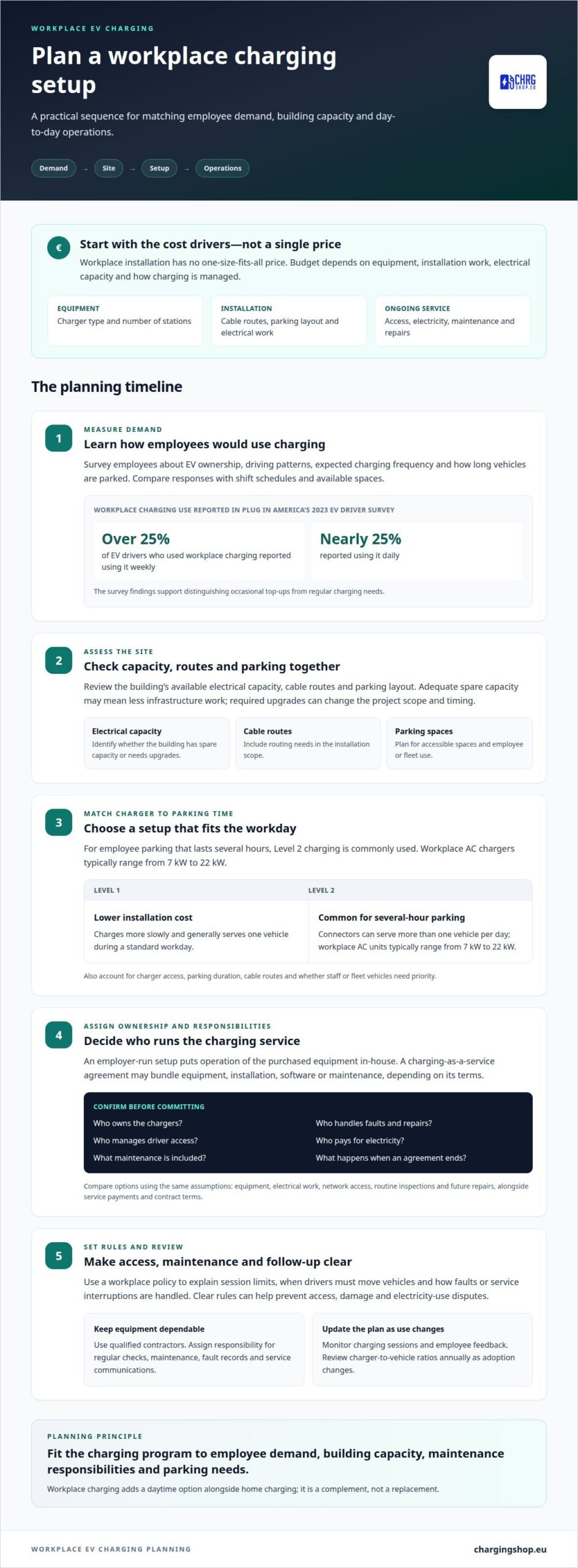
There’s no single installation price for workplace charging. The budget depends on charger type, the number of stations, electrical capacity, cable routes and parking layout. A site with adequate electrical capacity may need less infrastructure work than one that requires upgrades. Ongoing costs also depend on who manages access, electricity use, maintenance and repairs. A clear plan for EV charging for staff helps employers compare these factors with their workplace needs.
Use qualified contractors for installation and keep records of regular checks. Assign responsibility for inspecting equipment, arranging maintenance, recording faults and communicating service interruptions. Plan parking carefully: charging spaces need to be accessible, and a workplace policy should explain session limits and when drivers must move their vehicles. Clear rules help prevent disputes about access, damage, electricity use and responses to equipment faults.
Start by measuring demand. Survey employees about electric vehicles, driving patterns, expected charging frequency, and how long their cars stay parked. Compare responses with shift schedules and available spaces, then review charger-to-vehicle ratios annually as adoption changes. In Plug In America’s 2023 EV driver survey, over 25% of EV drivers who used workplace charging reported using it weekly; nearly 25% reported daily use. These findings show why an EV charging for staff plan should distinguish occasional top-ups from regular charging.
Charging access can also support recruitment and retention. Employees who commute by electric vehicle may value the option to charge during the workday, particularly when home charging is inconvenient. A workplace program can demonstrate a practical commitment to sustainability, but its value depends on reliable equipment, fair access and straightforward rules. Consider employee feedback alongside usage data before expanding the setup.
Some Ohio workplaces have earned EV-Friendly Workplace recognition through the EMPOWER project, which has engaged over 100 workplaces. This example shows how a charging program can connect infrastructure with broader workplace goals. Treat certification or recognition as one possible outcome, not the purpose of installation. First match charging access to employee demand, building capacity, maintenance responsibilities, and parking needs.
2. Workplace charging compared with home charging
Home charging suits vehicles parked overnight; workplace charging adds an option during the working day. A full day at work can often provide enough time to replenish an employee’s daily commuting range. This can reduce reliance on public rapid charging and help drivers manage longer commutes. Workplace charging can also support sustainability goals, although any emissions benefit depends on how the electricity is generated.
For employee parking that lasts several hours, Level 2 charging is commonly used. Workplace AC chargers typically range from 7 kW to 22 kW. Level 1 costs less to install but charges more slowly and generally serves one vehicle during a standard workday. Level 2 connectors can serve more than one vehicle per day. Site design should account for parking duration, charger access, cable routes, and whether staff or fleet vehicles need priority.
Permits and building requirements depend on the location. Workplace Level 1 receptacles should meet the National Electrical Code and local building codes, using commercial-grade NEMA outlets on dedicated circuit breakers. In California, the 2019 Green Building Standards Code, Chapter 11B Section 821, defines accessible EV spaces for van, standard, and ambulatory use. U.S. incentives vary by program and location; the U.S. Department of Energy’s Workplace Charging Challenge partnered with organizations from 2013 to 2017 to provide employee charging stations, rather than setting a tax-credit amount.
Set access rules before launch. Drivers can authenticate with an RFID card or app, while session cut-offs and move-vehicle notifications help manage limited availability. A policy can set eligibility, pricing, maximum session duration, and consequences for misuse. Some programs offer free charging for up to four hours, then charge $10 per hour. Decide whether employees pay a defined tariff, contribute to cost recovery, or receive subsidized charging. Clear billing and idle-time rules help prevent conflicts.
For a mix of employee and fleet use, assign access based on vehicle schedules and operational needs. Monitoring charging sessions can reveal busy periods and help you adjust the program. Workplace charging is a useful complement to home charging, rather than a replacement.
3. Charging-as-a-service and upfront installation costs
Workplace EV charging can be funded and managed in different ways. With an upfront purchase, the employer pays for the charging equipment and takes responsibility for operating it. A charging-as-a-service agreement may bundle equipment, installation, software, maintenance or other services, depending on its terms. Check who owns the chargers, handles faults, manages driver access and pays for electricity before committing.
Compare the options by mapping responsibilities across the charger’s lifecycle. For an upfront purchase, account for equipment, electrical work, network access, routine inspections and future repairs. For a service agreement, review ongoing payments, contract length, included maintenance and what happens when the agreement ends. These details affect total cost and control, even if the initial outlay seems lower. The contract determines which tasks and costs remain with the employer.
Consider a workplace where employees park for a full day and fleet vehicles return at different times. The charging plan must serve both schedules without blocking access or leaving vehicles short of charge for their next trip. Decide whether staff or fleet use takes priority, how sessions will be tracked and who can change access rules. A managed service may handle some tasks, while an employer-run setup keeps them in-house.
Compare each option using the same assumptions. Include equipment and site work, ongoing management, maintenance, electricity and expected expansion, then assign each cost to the responsible party. This separates the purchase price from longer-term commitments and highlights costs that may shift over time. A Personalised Charging Offer can help match hardware to workplace charging requirements, while recognising that the equipment decision is only one part of the service model.
Choose an arrangement that matches your team’s capacity to manage charging infrastructure. If your staff can handle access, billing and maintenance coordination, direct ownership may suit your operation. If those duties need to be part of a broader service agreement, review the contract’s responsibilities before deciding.
4. Electrical capacity and building upgrades
Available electrical capacity can shape a workplace charging project before you select equipment. An electrical assessment should review the building’s electrical supply, distribution panels, existing loads, parking layout and cable routes. This helps determine whether the site can support the planned charging load or needs upgrades. Utility coordination and permits can also affect the schedule, so include them in early planning.
Installation timelines can range from a few weeks to several months, depending on permitting, electrical upgrades, and utility coordination. A phased plan can help an organization manage the work: assess the site, define current charging needs, then plan infrastructure that can expand. For example, a workplace that initially installs four EV chargers may eventually need 40 sockets. Planning the electrical pathway early can make future expansion more practical.
Choose a charging solution that suits the building’s capacity and vehicle use. Commercial sites where employees park for longer periods may plan around AC charging, while operations with shorter vehicle turnaround may consider DC fast charging. The equipment, number of simultaneous sessions and existing building loads all affect the electrical capacity required. Avoid sizing only for current demand; plan a clear route to adding stations as adoption grows.
Code and safety requirements matter, too. Workplace Level 1 receptacles should meet the National Electrical Code and local building codes. They should be commercial-grade NEMA outlets connected to dedicated circuit breakers. Outdoor Level 1 charging requires ground-fault circuit interrupter outlets. Have an electrician inspect receptacles before use, and check them annually to confirm safe operation. For outdoor sites, protect cords from strain and avoid setups where a cord hangs unsupported.
Bring the building’s electrical constraints into equipment planning, not just the final installation stage. A Personalised Charging Offer can help align hardware choices with a site’s charging needs. Explore a workplace charging solution with capacity and future expansion in mind.
Charging Shop
Charging Shop helps workplaces move from questions about cost and capacity to a suitable charger choice. If you’re assessing staff charging, consider how long vehicles are parked, how many drivers need access and whether the building can support the planned load. These details help guide equipment selection without treating the charger as the entire installation project.
The range includes the V2C Trydan 22kW, V2C DENKA 20kW DC Wallbox, and Alfen Single Pro Line 22kW. A Personalised Charging Offer can help connect your workplace requirements with a relevant charging option. Compare charger type and power with parking patterns, electrical capacity, and your planned approach to managing access.
Bring your workplace charging priorities into the decision, especially if you’re planning for future expansion. Contact Charging Shop to discuss a suitable charging option for your workplace.
Turn your workplace charging plan into a clear next step
Start with a practical decision: define what a successful charging program should enable for your organization. EV charging for staff could make daily commuting easier, smooth fleet schedules or provide a useful employee benefit. Choose the outcome first, then align the equipment and operating approach with it.
Involve the people who will manage the program from the outset. Facilities teams can clarify site constraints, finance can assess spending options, and employees can explain how they expect to use charging access. Agreeing on responsibilities and priorities helps turn a technical project into a workplace service people can understand and use.
When you’re ready to explore equipment for your workplace, contact Charging Shop to discuss your charging requirements. Take the next step with a plan shaped around your workplace and its drivers.
Frequently Asked Questions
How much does it cost to install EV chargers at the workplace?
Installation costs depend on the project scope, so no single price fits every workplace. A site with nearby electrical infrastructure and parking may require different work from one with longer cable routes or building upgrades. For a useful estimate, define the number of chargers, parking locations, expected usage and project responsibilities. A phased plan can separate immediate needs from future expansion.
Why should companies offer workplace charging?
Companies can offer charging to make the workday more convenient for employees who drive electric vehicles. It can also support recruitment and retention by adding a practical workplace benefit. For example, a business with employees commuting by EV may offer charging access as part of its employee experience. Set clear usage rules and operating responsibilities so the program supports staff without disrupting daily parking.
Can existing buildings support workplace charging?
Yes. Existing buildings can support charging if their electrical systems and layout can accommodate the planned setup. Parking close to electrical infrastructure may simplify cable routing, while more distant spaces can affect the project scope. A site assessment should consider current building loads, equipment locations and employee parking patterns. The findings help determine whether the existing setup is suitable or needs upgrades.
Can workplace charging be powered by renewable energy?
Yes. Workplace charging can use renewable electricity when it’s available through the site’s energy supply or an on-site generation system. For example, a workplace with solar generation can coordinate charging with its energy setup. The charging equipment, electrical design and energy arrangement need to work together. Consider when vehicles are parked and when renewable power is available, then plan charging around those patterns.
What are the benefits of providing EV charging for employees?
Employees gain another place to charge while their vehicles are parked, which can make commuting easier to manage. Workplace access may be especially useful for drivers without convenient home charging or those whose routines include longer journeys. Employers can also offer a tangible workplace benefit. A clear access policy helps distribute charging fairly across different schedules, teams, and vehicle needs.
How much does workplace EV charging equipment and installation cost?
Equipment and installation are separate parts of the project budget. Equipment selection depends on charging speed and use case, while installation scope depends on the site’s electrical infrastructure, parking layout and cable routes. For a clearer comparison, assess both costs using the same charger configuration and site plan. This helps distinguish hardware choices from building work and ongoing program decisions.
