
 Deutsch
 Dansk
 Suomi
 Latviešu
 Lietuvių
 Norsk bokmål
 polski
 Русский
 Svenska

No products in the cart.
Uncategorized
EV Charging for Office Buildings: Costs, Benefits and Options
12
Nov
Nov
The fastest charger isn’t automatically the right fit. EV charging for office buildings works best when charging speed matches how long employees and visitors park: Level 2 supports daily workplace charging, while DC fast charging suits locations where drivers need a quicker top-up. Charging time varies by vehicle and charger, so Level 2 can be a practical option when employees park for extended periods.
It’s sensible to weigh equipment and installation costs against the benefits, particularly if electrical upgrades may be needed. The right setup depends on the building’s electrical capacity, parking patterns and the charging experience you want to provide.
Here, you’ll see how workplace charging can benefit developers, what shapes installation costs and infrastructure needs, and how Level 1, Level 2 and DC fast charging compare. Use the practical differences to identify options that fit your building, rather than paying for speed your parking patterns don’t require.
Key Takeaways
- Match charger speed to employee and visitor parking habits to choose between Level 2 and DC fast charging.
- Workplace charging can support employee needs and strengthen a building’s appeal to tenants and developers.
- Installation costs depend on electrical capacity, required upgrades, charger type and site layout.
- Compare Level 1, Level 2 and DC fast charging to find an option that fits your building’s use and infrastructure.
Commercial EV Chargers: Do Benefits Outweigh Costs?
For office properties, charger value depends on how long employees and visitors park. Level 2 suits daily workplace charging, while DC fast charging prioritizes shorter sessions.
Level 2 and DC Fast Charger Choices
Level 2 chargers deliver AC power for vehicles parked over several hours; DC fast chargers provide a quicker charge for drivers with less time. That difference helps you match charging speed to building use, rather than selecting the fastest option by default.
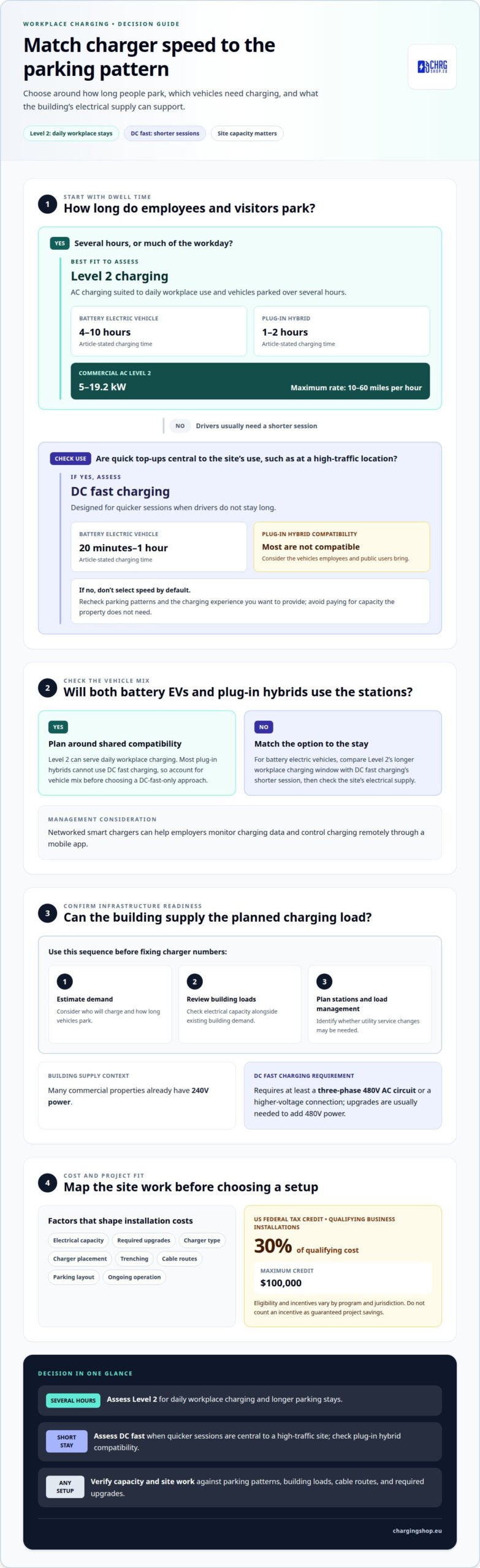
A Level 2 charger takes 4-10 hours to charge a battery electric vehicle and 1-2 hours for a plug-in hybrid. DC fast charging takes 20 minutes to an hour for a battery electric vehicle, but isn’t compatible with most plug-in hybrids. The American Clean Power Association describes Level 2 as suitable for daily use and DC fast charging for high-traffic locations.
Level 2 Compatibility and Charging Levels
Level 2 charging uses AC power, while Level 3 commonly refers to DC fast charging, which supplies direct current to the vehicle. For office managers, the distinction affects which drivers can use a station and how long they may need to park.
Before selecting Level 2 charging stations, match the charger connection to the vehicles employees and public users bring. A site serving both battery electric vehicles and plug-in hybrids should account for the fact that most plug-in hybrids can’t use DC fast charging. Vehicle mix matters as much as charging speed.
Commercial AC Level 2 chargers are rated at 5 kW-19.2 kW and can provide a maximum charging rate of 10-60 miles per hour. Networked smart chargers can also help employers monitor charging data and control charging remotely through a mobile app. These functions support day-to-day station management as EV adoption grows.
For a workplace where cars stay parked through much of the workday, Level 2 can align charging time with employee schedules. Choose DC fast charging when quicker sessions are central to the site’s use, such as a high-traffic location serving drivers who don’t stay long.
How Does Installing EV Charging Stations Benefit Developers?
EV charging for office buildings can be a useful parking amenity for employees, tenants and visitors. Its value depends on who uses the property, how much charging they need and the available electrical supply.
Financial Benefits of Workplace Charging
Workplace charging can help a commercial property appeal to businesses seeking practical employee amenities and support tenant retention. Developers can also include it in leasing discussions, particularly for office campuses with private parking.
A shared office building has different needs from a retail site: employees may park for much of the workday, while public visitors may need a shorter session. Match station access and charging speed to those users to avoid paying for capacity the property doesn’t need. Stations can also provide a primary charging location for employees without off-street parking.
Workplace Charging Incentives and Tax Credits
Federal, state and local incentives depend on the program and jurisdiction. At the federal level, the Internal Revenue Service says the US federal Alternative Fuel Refueling Infrastructure Tax Credit has a maximum credit of $100,000 for qualifying business installations.
State and local incentives are set separately, so available support varies by location. Identify the property’s jurisdiction and assess applicable programs alongside project costs. Don’t count an incentive as guaranteed savings in the project budget.
Property type shapes the business case. An office tower can provide charging for employees and tenants; a commercial campus can plan stations across multiple buildings; and a mixed-use property can serve private parking users and public visitors. Each setting has distinct parking patterns and access needs.
Workplace charging can support environmental goals by making it easier for employees to charge during the workday. Access can be especially useful for drivers without home charging, while a managed network helps property teams administer shared stations. Developers can make charging a defined part of the building’s transport amenities.
For a project-specific equipment approach, a Personalised Charging Offer can help align charger selection with the property’s intended use.
Charging installation costs and electrical infrastructure
Project costs depend on electrical capacity, charger placement, trenching, equipment and ongoing operation. Map these factors before choosing a charging setup.
Installation Costs and Electrical Upgrades
Installation costs cover the equipment and site work needed to connect chargers safely to a building’s electrical supply. The Internal Revenue Service says the US federal Alternative Fuel Refueling Infrastructure Tax Credit provides qualifying businesses with a 30% tax credit, up to a maximum of $100,000, for installing EV charging infrastructure.
Electrical upgrades and trenching can add costs if the existing supply or parking layout can’t support the planned stations. Unlike LNG or hydrogen infrastructure, EV charging relies on a suitable electrical connection. Account for cable routes, parking locations and utility work when planning fleet or employee charging.
Electricity Supply and Grid Capacity
Grid capacity is the electrical supply available to serve chargers alongside a building’s existing demand. Many commercial properties already have 240V power, while DC fast chargers require at least a three-phase 480V AC circuit or a higher-voltage connection.
DC fast charging usually requires electrical upgrades to add 480V power. The sequence is practical: estimate charging demand, review current building loads, then plan charger numbers and load management. This helps align the installation with available supply and identifies where utility service changes may be needed.
Codes, Accessibility, Permits, and Utility Requirements
Office charging projects must account for applicable building codes, accessibility rules, permits and utility requirements. Requirements depend on the project location and site design, including charger placement, parking access and electrical work.
Planning typically moves from reviewing the site and electrical load to design, permitting, utility coordination, installation and operation. This sequence clarifies responsibilities and timing without assuming a fixed project duration. Local authorities and the serving utility determine the approval and connection steps.
Equipment, Software, and Network Fees
Commercial charging budgets can include charger equipment, installation labor, electrical work, software, network access and electricity. Software and network fees cover station management, usage data and driver access; their structure depends on the operating setup.
First decide whether office charging will be private for employees or open to the public. Then account for the equipment, management tools and network access that model requires. Include operating expenses alongside installation costs to understand the project’s full requirements.
Charging options for office buildings
Choose charging infrastructure based on parking duration, driver demand and building operations. The right setup balances vehicle access with practical management.
Charger Ownership and Service Models
Ownership, leasing and charging-as-a-service differ in who owns the equipment and manages operations. That choice determines the building’s control and responsibilities. With ownership, the property controls its chargers; leasing provides equipment under an agreement, while a service model assigns charging operations through an external arrangement. Compare responsibilities, desired control and payment structure before choosing. For example, a building team seeking direct control may prefer ownership.
Charging Port Counts and Employee Demand
Port planning matches the number of usable charging connections to parking supply and employee demand. Start with employee vehicle needs, parking patterns and typical parking duration. Then compare them with available electrical capacity and space for charging infrastructure. Don’t assume every parking space needs its own port: employees parked all day may share charging access differently from drivers making shorter visits. Review actual demand as workplace use changes.
Access, Pricing, and Reservations
Access rules establish who can use each charger, while pricing and reservations help manage demand. A workplace could reserve some stations for employees and make others available to visitors. Set clear rules for access, session charges and reservations before opening stations to drivers. Smart chargers can let employers monitor usage data and control charging remotely through a mobile app, supporting day-to-day oversight.
Employee Charging Billing
Employee billing depends on whether workplace charging is free, subsidized or paid for by drivers. Set the policy before use, including who pays for electricity and how shared access works. Monitored charging data can help a business review usage under its chosen policy. Apply the process consistently and communicate changes clearly to keep charging straightforward to administer and separate from private use.
Choose an operating model that fits your workplace, then explore charging options for your building.
Charging Shop
Charging Shop helps match workplace charging needs with suitable EV charging hardware and a Personalised Charging Offer. When your building’s parking patterns, electrical capacity and preferred charging speed are clear, Charging Shop can help narrow down equipment options.
The range includes the V2C Trydan 22kW, V2C DENKA 20kW DC Wallbox and Alfen Single Pro Line 22kW. These options support different charging requirements, so focus on the type of vehicles using the site and how long they typically park. A tailored offer can help connect those project priorities with a hardware choice.
Ready to discuss charging options for your building? Contact Charging Shop.
Turn Your Workplace Charging Plan Into Action
Make the next decision practical: define who the charging experience should serve and how it should fit into daily building operations. A clear brief turns EV charging for office buildings from a broad sustainability goal into a project with specific priorities. Identify the intended users, charging’s role in the property and how the building team wants to manage access.
Bring those priorities together before choosing equipment. Consider the building’s long-term plans, expected user needs and how the charging setup can adapt as they change. This helps keep the project aligned with the property rather than treating chargers as a standalone purchase.
Ready to discuss the right direction for your building? Contact Charging Shop to explore your options. Take the next step with a clear plan and move your workplace charging project forward.
Frequently Asked Questions
What is workplace charging?
Workplace charging means providing EV charging access at an office or other place of work. Employees may charge while parked during the workday, and the building can decide whether stations serve staff only or visitors too. For drivers without off-street parking at home, a workplace station can become a primary place to charge. Set clear access rules so users know who can charge and when.
What types of EV chargers are best for office buildings: Level 1, Level 2, or DC fast charging?
Level 2 is a practical fit for many office schedules, while DC fast charging serves drivers needing a quicker session. Level 1 can suit vehicles parked all day, but takes 40-50 hours to fully charge a battery electric vehicle and 5-6 hours for a plug-in hybrid. A 120-volt outlet can provide workplace charging. Choose based on parking duration, vehicle mix and available electrical capacity.
How much does it cost to install EV chargers in an office building, including electrical upgrades?
There isn’t one installation price that applies to every office building. The total depends on charger type, electrical supply, site layout, trenching, utility work and any required upgrades. A property with suitable existing power may need less electrical work than one adding DC fast charging, which usually requires upgrades to provide 480V power. Include equipment, software and network expenses in the project budget.
What are the benefits, risks, and maintenance requirements of EV charging for office buildings?
Charging can provide a useful amenity for employees and visitors and support drivers without home charging. Key planning risks include insufficient electrical capacity, poorly matched charger access and conflicts over shared parking. Assign responsibility for monitoring stations and handling reported faults. Networked chargers can provide usage data for oversight; establish a maintenance process to check station condition and address operational issues.
