
 Deutsch
 Dansk
 Suomi
 Latviešu
 Lietuvių
 Norsk bokmål
 polski
 Русский
 Svenska

No products in the cart.
Uncategorized
EV charger with timer: Set charging to finish on time
30
Oct
A charging timer is useful when charging times affect your routine or electricity costs. An EV charger with a timer can schedule charging for a chosen window, helping you use lower-rate periods and plan when your vehicle will be ready. To finish on time, account for how much charge the battery needs and how quickly the vehicle can charge.
It’s easy to think of a timer as a simple convenience. But if you charge overnight, use a flexible electricity tariff, or want your vehicle ready for a trip, timing can shape how you use your charger. The right setup depends on your vehicle, electricity plan and wallbox features.
Learn how charging schedules work, how to align them with lower electricity rates, and what to consider when comparing smart wallbox features and costs. You’ll also see when a timer helps and when your vehicle’s own charging controls may be enough.
Key Takeaways
- Match your charging schedule to the amount of charge you need and when you need the vehicle ready.
- Use your tariff’s lower-cost periods to decide when charging should run, rather than relying on a fixed overnight routine.
- Compare smart wallbox features against your actual needs, including whether scheduling is already handled by your vehicle.
- See how charging controls, electricity rates and hardware features work together before choosing a wallbox.
Charging to a target amount by a set time
Set a charge target and departure time, then choose a charging window that suits your vehicle’s needs. A timer schedules when charging runs; it does not guarantee the battery will reach a particular level by departure.
Timer Functions and Charging Targets
An EV charging timer starts, pauses or limits charging according to a schedule, while the vehicle’s charge limit sets the desired battery level. Used together, these controls help you plan for departure without assuming charging happens instantly.
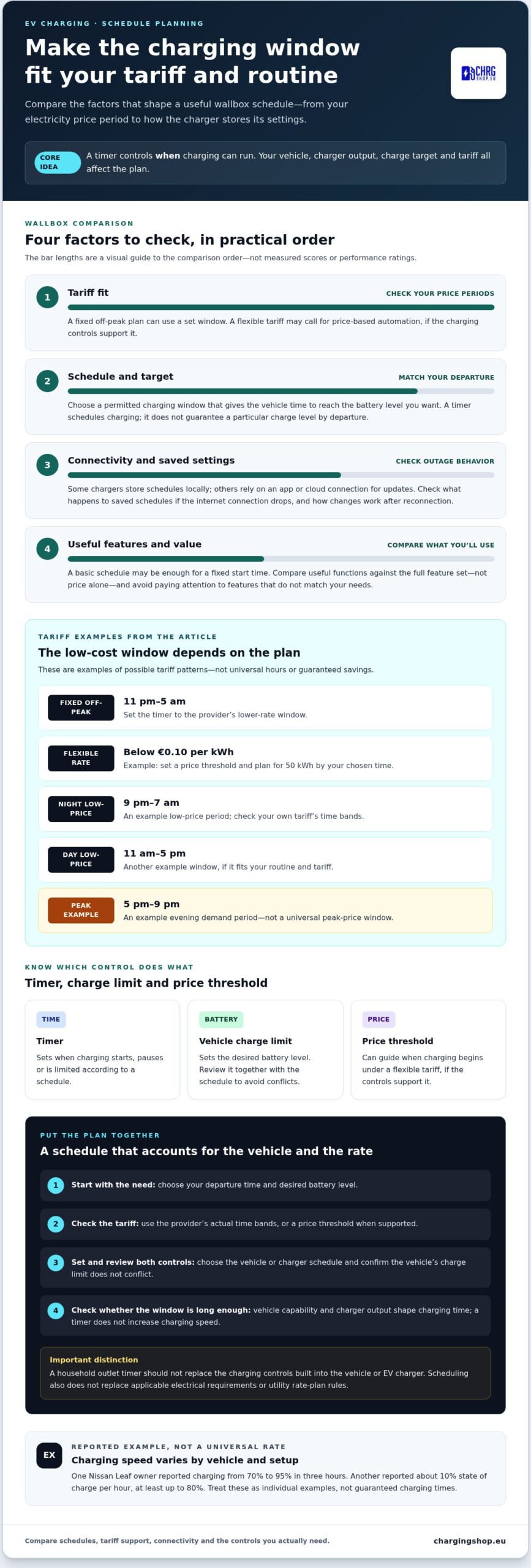
For example, one Nissan Leaf owner reported charging from 70% to 95% in three hours. Another reported about 10% state of charge per hour, at least up to 80%. Treat those as examples, not universal charging rates: the vehicle and charging setup affect timing.
A forum participant recommended an 80% onboard charge limit for older Nissan Leafs. A target limit can prevent charging beyond the level you intend, while a timer helps define when charging can take place.
Car and Charger Scheduling Controls
Scheduled charging can be controlled through the vehicle or the charger, depending on their settings. Check both before setting a schedule: overlapping start times or conflicting charge limits can keep a session from matching your plan.
In the U.S., scheduled charging must still meet the electrical requirements that apply to the installation and the utility’s rate plan. There is no universal schedule for every utility. A timer sets when charging runs; it does not replace applicable electrical requirements.
Scheduling itself doesn’t determine charging speed. The vehicle’s charging capability and the charger’s output shape the session. A listed example says many vehicles limit AC charging to about 48 amps or 11.5 kW, so a timer alone can’t make a vehicle charge faster.
Setting a Home Charging Schedule
Start with your departure time and desired battery level. Open the vehicle or charger’s schedule controls, choose a permitted charging window, and set the vehicle’s charge limit if available. Review both settings together to avoid conflicts.
A standard outlet timer should not replace the charging controls built into a vehicle or EV charger. Use the equipment’s own schedule settings for the charging session rather than treating a household timer as a charging control.
Compare the planned window with your actual charging needs. If the vehicle needs more time than the window allows, adjust the start time or target level. Revisit the schedule when your departure routine or tariff period changes.
Nighttime and flexible electricity tariffs
A timer can align charging with lower-cost electricity periods, but the tariff determines when those periods occur. A fixed overnight window, such as 11 pm to 5 am, suits a predictable schedule. A flexible tariff may require charging to respond to changing prices instead.
For example, set automatic charging to begin when electricity costs fall below €0.10 per kWh, with 50 kWh needed by your chosen time. The charger can use the price threshold and target amount to guide the session. The example shows how price and timing work together, not a guaranteed cost or charging duration.
Check your tariff’s actual time bands before setting a schedule. Example demand periods place the evening peak at 5:00 pm to 9:00 pm, with nighttime low prices from 9:00 pm to 7:00 am. A separate example gives daytime low prices from 11:00 am to 5:00 pm. These windows illustrate possible patterns, not universal tariff hours.
- Fixed off-peak tariff: Set the timer to use the provider’s lower-rate window, such as 11 pm to 5 am.
- Flexible tariff: Use a price threshold, such as €0.10 per kWh, if your charging controls support it.
- Daytime charging: Consider a low-price period such as 11:00 am to 5:00 pm when it fits your routine.
Compare the full tariff structure, not just one low-price period. If your schedule misses the cheaper window, charging may happen at a different rate. A narrow window also leaves less time to meet your target. Align it with both the price period and your departure needs.
If you’re matching charging hardware to a tariff-led setup, a Personalised Charging Offer can help shape the choice around your requirements.
Smart wallbox prices and features
Smart chargers with built-in scheduling let you set charging windows through their interface or connected software. Features vary by model, so compare schedule controls, tariff support and connection options instead of assuming every smart wallbox works the same way.
A basic schedule may be enough if you only need charging to start at a set time. More advanced controls can coordinate charging with electricity prices or other energy settings. Focus on the functions you’ll use, not the longest feature list.
For a practical comparison, ask what each control actually does. A timer sets when charging can run. A price threshold can determine when a session begins under a flexible tariff. Connectivity may let you manage schedules through an app or online account, but the charger’s design determines what happens if the connection drops.
Smart chargers handle outages differently. Some save schedules on the charger; others rely on an app or cloud connection for updates. If the internet connection fails, a locally stored schedule may remain available, while remote changes may require connectivity. Before choosing, check how the charger handles saved settings, reconnection and schedule changes.
- Scheduling: Confirm that the controls support your preferred start times and charging windows.
- Tariffs: Look for price-based automation if you want charging to respond to changing rates.
- Connectivity: Find out whether schedules are stored locally or depend on online access.
- Value: Compare useful functions against the total feature set, not price alone.
For example, a driver with a fixed overnight routine may value reliable time controls more than tariff automation. A driver on a flexible plan may prioritize price thresholds. Match the wallbox features to your tariff, vehicle controls and charging habits so you are not paying attention to functions you will not use.
Smart chargers with built-in scheduling let you set charging windows through the charger interface or connected software. Controls vary by model, so check whether schedules are stored locally or depend on an app or internet connection.
What does a timer do on an EV charger?
An EV charger timer controls when a charging session can start or run. It can hold charging until a selected time, stop it at a chosen time, or repeat a schedule. The exact controls depend on the charger. Think of the timer as a charging window, not a measure of energy delivered.
For example, a driver arriving home in the evening can schedule charging to begin later rather than start as soon as the cable is connected. The car then draws power during the permitted window. If it reaches its own charge limit first, charging can stop before the timer window ends.
The distinction matters: a schedule controls access to charging, while the car’s battery settings govern its requested charge level. A timer does not increase the charger’s output or change the vehicle’s charging capability. It organizes the session around your routine, tariff or preferred timing.
- Start delay: Keep charging paused until the scheduled start.
- Time window: Allow charging only during selected hours.
- Repeat schedule: Apply the same timing to recurring charging days.
- Manual override: Use immediate charging when your plans change, if the charger provides that control.
To use a schedule effectively, connect the vehicle and set a charging window that fits your departure routine. Then check the charger and car settings together. If both have schedules, make sure their start times overlap. A conflicting vehicle setting can keep charging paused even when the wallbox is ready.
A timer is useful when charging needs a clear start window, but the best controls depend on how you charge. If you’re comparing equipment for scheduled charging, request a Personalised Charging Offer tailored to your requirements.
Charging Shop: V2C Trydan 22kW
Charging Shop can help you compare charging hardware when you’re choosing a setup for your needs. The V2C Trydan 22kW is one option to consider alongside the V2C DENKA 20kW DC Wallbox and Alfen Single Pro Line 22kW.
Choosing a charger involves more than its power rating. Consider your vehicle, charging environment, electricity tariff and whether scheduling suits your routine. A Personalised Charging Offer can help you assess suitable options without treating every feature as essential.
Use what you’ve learned about charging windows and tariffs to guide your choice. Contact Charging Shop for a Personalised Charging Offer or explore its available charging hardware.
Make your charging routine work for you
Your charging routine may shift as your driving, home energy use or electricity plan changes. Treat the schedule as a setting to revisit, not a one-time decision. An EV charger with a timer can support that flexibility, while the right hardware depends on how you charge and which controls matter most.
Before choosing, consider your priorities: do you need a straightforward charging window, or equipment for a more tailored setup? Think about how your vehicle, tariff and everyday routine fit together. A clear answer helps narrow the options without focusing on features you will not use.
Charging Shop offers charging hardware and a Personalised Charging Offer to help you consider suitable options for your requirements. Take the next step when you’re ready to explore what fits your setup: contact Charging Shop for advice. A well-matched charging plan can make your next charging decision easier.
Frequently Asked Questions
EV Charger With Timer: Do You Really Need It?
Not necessarily. A timer is useful if you want charging to follow a routine or avoid starting as soon as you plug in. If your vehicle’s scheduling controls already meet your needs, a separate charger timer may add little. For example, a driver with changing departure times may value adjustable scheduling, while someone who charges immediately may not need it.
Do EV charger timers work with time-of-use electricity rates?
Yes, a timer can help align charging with time-of-use rates. Whether it responds automatically to changing prices depends on the charger’s controls and tariff integration. With fixed rate periods, set the schedule around the hours specified by your plan. If those periods change, update the schedule to match.
What is the cost of EV chargers with scheduling features?
There is no standard price for chargers with scheduling; cost depends on the hardware and its features. Compare whether scheduling is built in, whether tariff-based controls are available, and what connectivity or energy-management functions you need. Then compare models on the same basis. Choose features that address a real charging need rather than paying for controls you will not use.
