
 Deutsch
 Dansk
 Suomi
 Latviešu
 Lietuvių
 Norsk bokmål
 polski
 Русский
 Svenska

No products in the cart.
Uncategorized
Smart EV Charger with Load Management: How It Works at Home
26
Oct
Oct
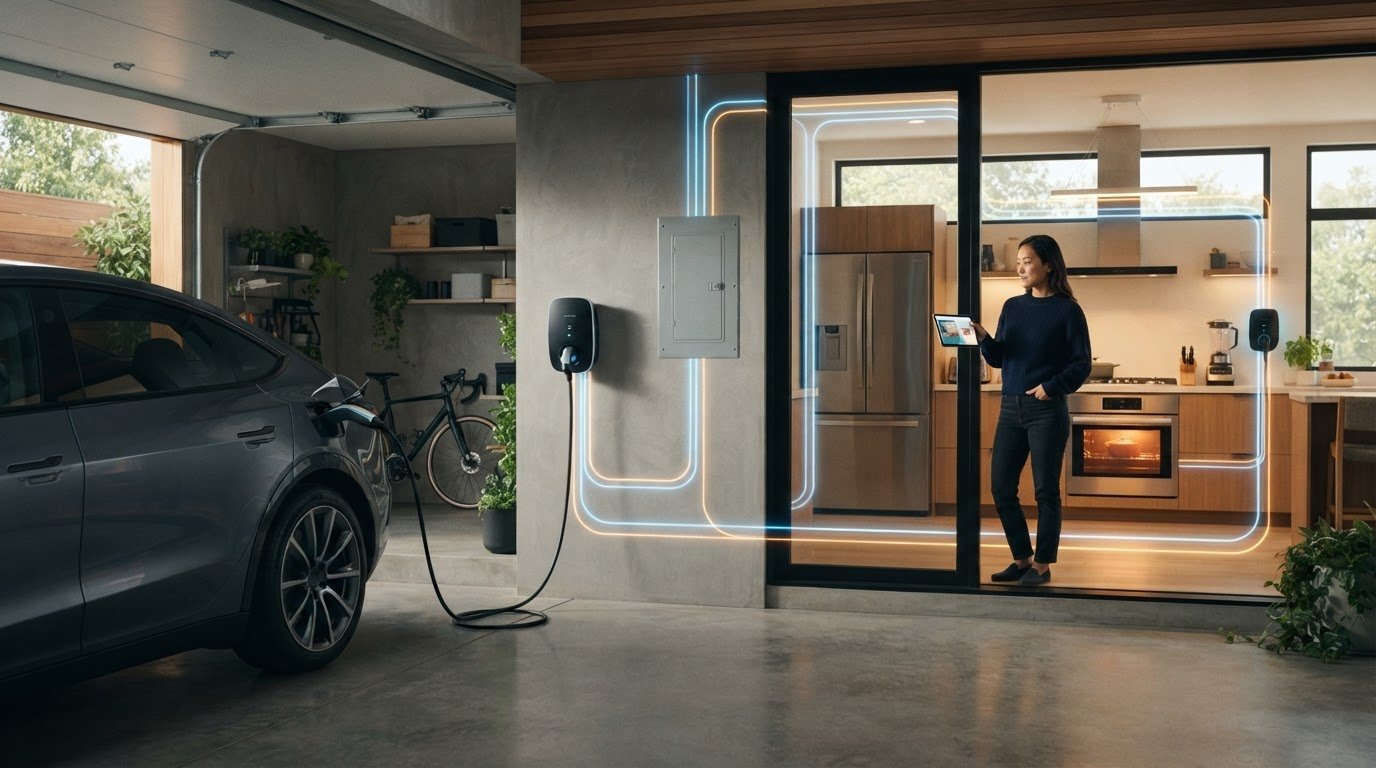
Your EV charger shouldn’t draw power your home needs for other essentials. A smart EV charger with load management shares available electrical capacity between vehicle charging and household demand. Depending on the setup, it can divide a fixed supply among chargers or adjust charging as the building’s power use changes.
Fast, reliable charging matters, but it also needs to fit your home’s electrical capacity. Load management coordinates charging with other demands, helping it use the power available instead of competing blindly with household equipment.
This guide explains why load management matters and how basic charging differs from static and dynamic systems. You’ll learn how each approach allocates available capacity, what happens when multiple vehicles charge at once, and which features to weigh when choosing a home charging setup.
Key Takeaways
- Understand how monitoring household electricity use helps a charger adjust its power draw as other demands change.
- Compare basic charging with fixed-capacity sharing and dynamic allocation to see which approach fits your setup.
- Learn how available capacity can be divided among active chargers instead of being locked into one fixed share.
- Explore Charging Shop’s V2C Trydan 22kW and Personalised Charging Offer as options for matching charging hardware to your needs.
Why is load management important for EV charging?
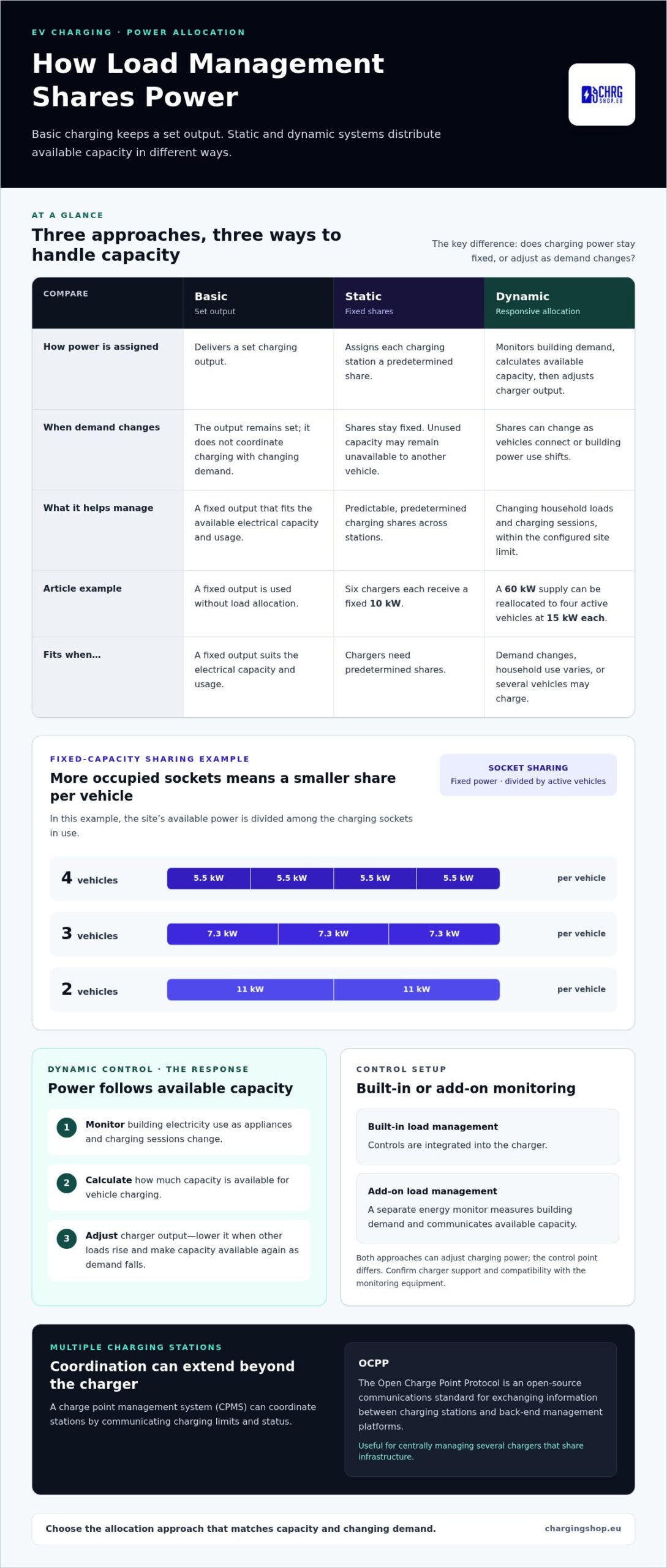
Household demand changes as appliances switch on, so an EV charger must work within the capacity left for charging. With dynamic control, a 60-kilowatt supply can be reallocated to give each of four active vehicles 15 kilowatts.
Sharing Power Across Charging Sockets
Socket sharing divides a site’s available fixed power among the charging points in use. In one example, four sockets share capacity so each vehicle receives 5.5 kilowatts when all four are occupied; with three vehicles, each gets 7.3 kilowatts, and with two, each gets 11 kilowatts. That allocation helps you understand how adding a vehicle affects charging speed. Aggregated charging can also offer flexibility to a virtual power plant, which coordinates participating energy resources.
Redistributing Power When Vehicles Plug In
Power redistribution changes the share assigned to each charger as vehicles connect or building demand shifts. A dynamic system monitors energy use, calculates available capacity, then adjusts charger output; if a fourth vehicle joins a 60-kilowatt site, it can rebalance power to 15 kilowatts per vehicle. This keeps EV charging within the site’s capacity while distributing power across its infrastructure, rather than leaving a new vehicle to draw unchecked power.
Built-In and Add-On Load Management
Built-in load management uses controls integrated into the charger. An add-on system uses an energy monitor to measure building demand and communicate available capacity. Both can adjust charging power, but the control point differs: one is within the charger, while the other relies on separate monitoring equipment. Choose according to whether you prefer an integrated charger or a coordinated charger-and-monitor setup.
Costs, Charger Support, and Installation
In the U.S., costs depend on the charger, available electrical capacity, cable route, and any required panel work. Smart chargers manage loads through integrated controls or compatibility with an energy-monitor add-on, so confirm the control method before buying. Installation generally involves assessing the panel and circuit, selecting compatible equipment, mounting and connecting the charger and monitor, then configuring and testing the power limit. Use a qualified electrician for electrical work.
Basic charging versus static and dynamic load management
Basic charging delivers a set output; managed charging coordinates demand with available capacity. The key distinction is whether the power limit stays fixed or responds to changing use.
Static and Dynamic Load Balancing
Static balancing assigns each charging station a fixed share; dynamic balancing adjusts shares as demand changes. In one example, six chargers each receive a fixed 10 kilowatts under static limits. That setup is predictable, but unused capacity can remain unavailable to another vehicle. Dynamic control can reallocate available power as chargers and household loads change, helping you use capacity more flexibly.
Dynamic Management and CPMS Integration
Dynamic load management monitors building consumption, calculates available capacity, and adjusts charger output. A charge point management system (CPMS) can coordinate stations by communicating charging limits and status. OCPP, the Open Charge Point Protocol, is an open-source communications standard for exchanging information between stations and back-end management platforms. This integration lets operators manage charging centrally, particularly when several chargers share infrastructure.
Dynamic Management Benefits and Overload Prevention
Dynamic control helps keep vehicle charging within the capacity left after household demand is accounted for. How does dynamic load management prevent home electrical overload? It monitors building power use and lowers charger output when other loads rise, then makes capacity available again as demand falls. Unlike a fixed limit, this adjustment responds to changing conditions and helps keep charging within the configured site limit.
Choose basic charging when a fixed output suits your electrical capacity and usage. Choose static balancing when chargers need predetermined shares. Dynamic load management fits changing demand, especially where household use varies or several vehicles may charge. A personalised charging setup can help match the control approach to your charging needs.
Real-time allocation of available electrical capacity
A load manager balances charger demand against the site’s usable electrical capacity. Its allocation changes as building loads and charging sessions change.
Site Capacity Limits and Unmanaged Loads
Site capacity is the electrical supply available for chargers and other equipment to use at the same time. Household appliances and other unmanaged loads reduce the power left for vehicle charging. Panel capacity and equipment requirements depend on the service rating, existing demand, charger limits, and monitoring controls. Permits, electrical codes, and utility rules vary by location, so local requirements apply.
At home, account for total electrical demand, not just the charger’s rating. This shows how much charging power can fit alongside other household use.
Grid Capacity and Charging Demand
Grid capacity sets the supply available to a property, while charging demand competes with other electric uses. A fixed 22 kW site allocation can be divided among active charging points, limiting each point’s share as more vehicles connect. At commercial sites, demand charges are typically based on the site’s highest power draw during a 15-minute interval in a billing cycle. Managing peaks can therefore matter alongside meeting charging demand.
For a SAK-60MS, usable load-management capacity depends on its equipment rating and the electrical load being monitored. Match those limits to the site’s supply and charging needs.
Managing Site Electrical Capacity
A dynamic system monitors site demand, calculates available capacity, then adjusts charger output. With 100 amps available, four vehicles can receive 21, 21, 29, and 29 amps, keeping their combined draw within that capacity. This allocation responds to demand instead of reserving the same share for every charger. It helps make use of available power while respecting the site limit.
The control equipment needs to measure relevant loads and communicate usable capacity to the charging system. This connection enables real-time power allocation.
Load Management Risks and Limitations
Load management may slow charging when household demand uses more of the available capacity. Its allocation also relies on accurate monitoring, compatible controls, and a correctly configured site limit. If those inputs do not reflect actual electrical use, the system may allocate power poorly. Treat managed charging as a way to coordinate demand, not as extra electrical capacity or a substitute for suitable equipment.
EV charger load management definition
EV charger load management controls how much power charging receives, when it draws power, and how available electricity is shared. It coordinates vehicle charging with existing building demand, with the aim of keeping total electrical use within the property’s available capacity. A smart charger can adjust its power draw instead of operating independently of household or site loads.
Two common approaches are static and dynamic management. Static management sets a fixed limit or allocation for chargers. Dynamic management monitors building demand and adjusts charging power as demand changes. For example, household equipment can reduce the capacity available for charging. Dynamic control responds to that change, while static control keeps its assigned limit. Both manage charging, but rely on different information to set power.
Think of the system as a control loop: a monitor measures electrical use, a management system calculates available capacity, and the charger receives an output limit. When demand rises, the system can reduce charging power; when demand falls, it can make more capacity available. The charger does not create electricity. It controls how the existing supply is shared between the vehicle and other loads.
Load management is different from a charging schedule. A schedule controls when charging starts; load management controls power draw in response to available capacity. Some systems use both, but power allocation is the defining function of load management. OCPP, the Open Charge Point Protocol, supports information exchange between charging stations and back-end management platforms, helping connect charging equipment to a wider management system.
Before you install a charger, identify whether your setup needs a fixed limit or live adjustment based on building demand. To match your requirements with a suitable configuration, request a Personalised Charging Offer.
Charging Shop: V2C Trydan 22kW
Charging Shop offers the V2C Trydan 22kW for drivers comparing charging hardware with their home’s electrical capacity and daily charging needs. The right choice depends on the available supply, existing household loads, and how you plan to charge. Load management is a system-level decision, so consider the charger alongside the monitoring and control approach your setup requires.
Other options include the V2C DENKA 20kW DC Wallbox and Alfen Single Pro Line 22kW. If you’re weighing different requirements, a Personalised Charging Offer can help frame the hardware choice around your charging setup. Review the options, then contact Charging Shop with your questions or visit Charging Shop online to explore the available offerings.
Make Your Next Charging Choice Count
Start with your home’s electrical capacity. Consider how household loads change throughout the day, whether charging demand varies, and whether a fixed limit or adaptive control better suits your routine. These factors provide a clearer basis for choosing a smart EV charger with load management than charger output alone.
Charging Shop offers the V2C Trydan 22kW, V2C DENKA 20kW DC Wallbox, and Alfen Single Pro Line 22kW. Compare these options with your charging requirements, or explore a Personalised Charging Offer to frame a choice around your needs.
Ready to take the next step? Contact Charging Shop about EV charging and move toward a setup that fits your home.
Frequently Asked Questions
How does EV charging load balancing work?
EV charging load balancing shares available electrical capacity among chargers and other active loads. A system may apply fixed limits or adjust charger output as demand changes. For example, with 100 amps available, three vehicles drawing 30, 30, and 40 amps use the full site capacity together. This lets multiple vehicles charge while keeping their combined draw within the configured limit.
What Happens When an Additional Vehicle Plugs-in at a Charging Station?
When another vehicle connects, the charging system recalculates how much capacity each active session can use. Dynamic control can reduce existing charger outputs and assign capacity to the new vehicle. The exact allocation depends on site capacity, current building demand, and charger limits. Charging may slow across several vehicles rather than allowing their combined demand to exceed the available supply.
What is load management for a smart EV charger?
Load management controls the power an EV charger draws so charging fits the electrical capacity available at that time. A smart EV charger with load management can adjust its output based on measured demand, or follow a preset limit in a static setup. For example, when household equipment increases electrical use, managed charging can reduce charger demand until more capacity is available.
Can load management avoid an electrical panel upgrade for an EV charger?
Load management may help avoid a panel upgrade if the existing electrical service can support charging at a controlled output alongside other loads. It cannot increase panel capacity or make an undersized service larger. Key factors include available panel capacity, household demand, charger requirements, and the charging power your routine requires. Managed charging may mean a lower charging rate during busy periods.
How much do smart EV chargers with load management and installation cost in the U.S.?
U.S. costs depend on the charger, electrical capacity, cable route, and any panel work.
Which smart EV chargers support load management in the United States?
Smart chargers support load management through integrated controls or a compatible energy-monitor add-on. Check the charger’s control method and compatibility before buying.
