
 Deutsch
 Dansk
Dansk Suomi
Suomi Latviešu
 Lietuvių
 Norsk bokmål
 polski
 Русский
 Svenska
No products in the cart.
Uncategorized
Best EV Charger for Two Cars: How to Choose the Right Setup in 2026
05
Oct
Oct
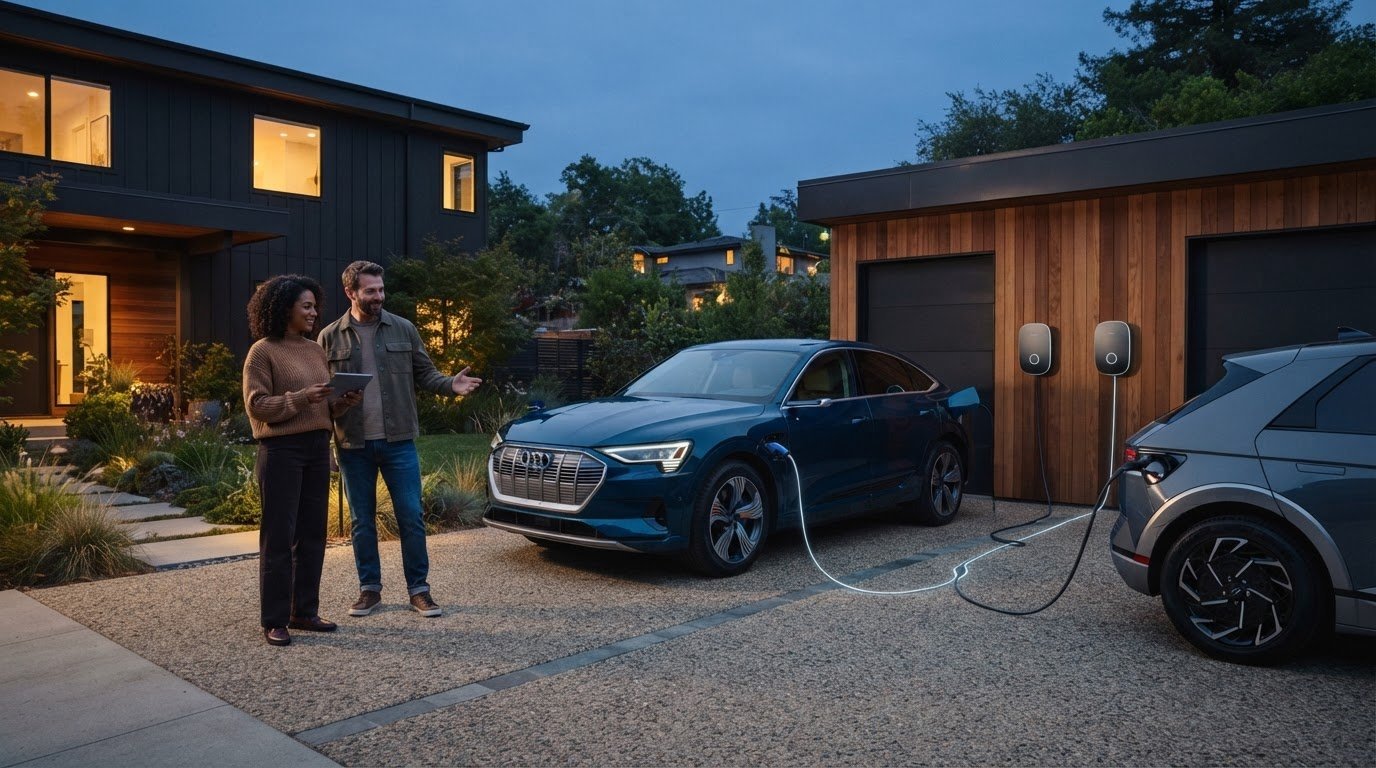
Two electric cars don’t automatically need two charging units. The best EV charger for two cars depends less on the biggest headline rating and more on how your household shares power and when each vehicle needs to be ready.
It’s understandable to worry that two cars will compete for limited electrical capacity or that one shared unit will leave someone waiting. The right setup depends on your daily driving, parking layout, available electrical capacity, and each car’s connector. One charger used in sequence may suit your routine; separate units or a power-sharing setup may work better for others. Match charging access to your actual needs rather than choosing by a product label alone.
This guide compares shared and separate charging options, explains how power sharing affects charging, and highlights the connectors, cable reach, and controls to consider. It also covers options such as the V2C Trydan 22kW, Alfen Single Pro Line 22kW, and ABB Terra AC as products to research, without assuming a particular model supports dual-car charging. Use the practical checklist to identify a setup that works for both vehicles and your routine.
Key Takeaways
- The best ev charger for two cars depends on both vehicles’ charging limits, connector needs, parking positions, and daily schedules.
- Compare a shared charging point, a dual-connector unit, and separate chargers by access, cable reach, and how each setup allocates available power.
- A charger’s rated capacity doesn’t guarantee that both cars will charge at that rate; each vehicle’s onboard charger also affects AC charging speed.
- Map departure times and typical daily driving to see whether sequential overnight charging fits your household or simultaneous access matters more.
- Use your requirements to narrow down compatible hardware options and explore a personalised charging offer for a setup tailored to your needs.
Best EV Charger for Two Cars: Which Setup Fits Your Household?
Choosing a home charging setup for two EVs means balancing both cars’ connector requirements, daily schedules, parking layout, and the power available at the property. A higher-rated charger alone won’t settle the decision. The best ev charger for two cars is the setup that gets both vehicles ready when needed without assuming your home can supply maximum power to both at once.
Consider the charging equipment and household electrical supply together. A charger’s number of connectors doesn’t tell you how power is divided, and each vehicle’s charging limit matters too. For an overview of charging equipment and terminology, see this guide to electric vehicle supply equipment (EVSE).
One shared charger or two separate charging points?
One charging point can work well if the cars are usually parked near it or need charging at different times. You can charge one vehicle, then the other. This is practical when your routine leaves enough time between departures for both cars to charge.
Separate points give each car its own place to plug in, making access easier when both vehicles need regular charging. But two points don’t automatically mean two full-speed charging sessions. Simultaneous charging depends on the equipment’s capabilities and the power available at the property.
What does a dual-connector EV charger actually change?
A dual-connector unit gives you two charging connections from one piece of equipment, but that doesn’t guarantee two independent, full-power sessions. Check how the unit allocates power when both vehicles are connected, whether it supports simultaneous charging, and what controls are available. Power sharing means dividing the available charging capacity between connected vehicles instead of giving each one the full amount.
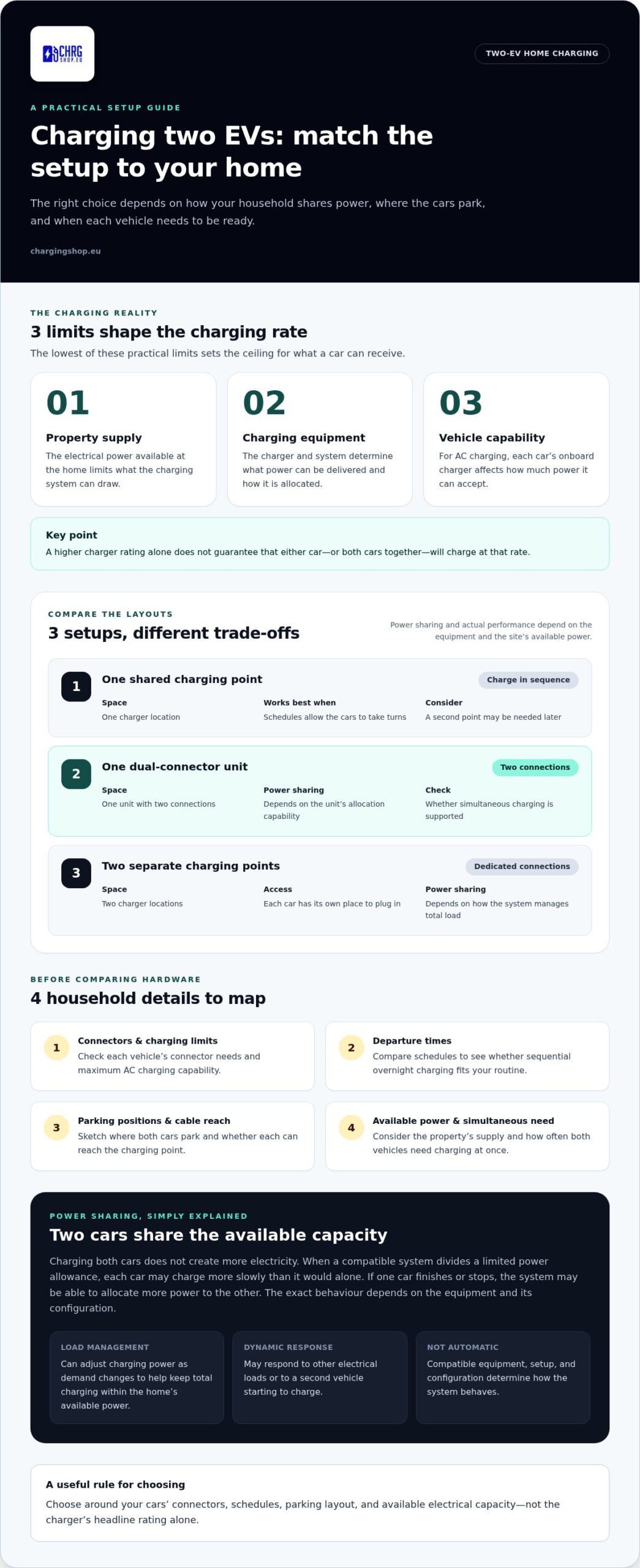
Use this comparison to narrow down the layout that suits your home. Actual performance depends on the equipment and the site’s available power.
| Setup | Space | Power sharing | Flexibility | Future expansion |
|---|---|---|---|---|
| One shared point | One charger location | Usually charges vehicles in sequence | Best when schedules allow turns | May require a second point later |
| Dual-connector unit | One unit, two connections | Depends on its power-allocation capability | Two vehicles can connect at the unit | Depends on unit capacity and site power |
| Two separate points | Two charger locations | Depends on how the system manages total load | Each car has a dedicated connection | Can suit changing parking or vehicle needs |
Before choosing, sketch where both cars park and note cable reach, departure times, and how often both need charging at once. This simple check helps you compare access and power needs before focusing on specific hardware.
How Two EVs Share Charging Power at Home
Charging two cars at once doesn’t create more electricity. The power each vehicle can receive is limited by three things: what the property can supply, what the charging equipment can deliver, and what each vehicle can accept. The lowest limit sets the practical ceiling. A home may have a capable charger, for example, but the electrical supply or car may not support its full rated output.
For AC home charging, the vehicle’s onboard charger converts incoming AC power for the battery. If that onboard charger accepts less power than the wall unit can provide, the car determines the charging rate. The California Air Resources Board’s overview of Level 2 charging offers helpful background on common charging types and their use.
Charging both vehicles together can take longer than charging one at a time if they share a limited power allowance. For example, imagine a compatible system has a set amount of capacity to distribute between two plugged-in cars. If it divides that capacity, each car may charge more slowly than it would alone. If one car finishes or stops charging, the system may be able to allocate more to the other. The exact result depends on the equipment and its configuration, so don’t assume a fixed split or charging time.
How load management can help two cars charge
A compatible load-management system can adjust charging power as demand changes, helping keep total charging within the power available to the home. Dynamic load management responds to conditions such as other electrical loads or the second vehicle starting to charge. A higher-rated charger alone won’t manage the load or increase the property’s supply. The system’s behaviour depends on compatible equipment, setup, and configuration.
Why charger rating is not the whole answer
Compare a charger’s output with each car’s maximum AC charging capability. If one vehicle accepts less, it won’t use the charger’s full rating. If the property can’t supply that rating, the charger may also operate below its headline capacity. When two cars are charging, available power may be allocated between them, further affecting how quickly each gains charge.
Real charging speed is limited by the property’s available power, the charger’s output, the vehicle’s AC charging limit, and how power is shared between cars. Keep those limits in view as you compare the best ev charger for two cars. To compare hardware options against your requirements, explore a personalised charging offer.
Shared, Dual-Connector, or Two Chargers: Compare the Trade-Offs
The right layout depends on how both cars are used, where they park, and how much charging power the property can supply. Compare the everyday trade-offs first. Then check each charger’s specifications, including connector type, power-allocation capability, simultaneous-use support, and controls. These features vary by product.
| Setup | Access and simultaneous use | Power and cable reach | Future flexibility |
|---|---|---|---|
| One shared charging point | Vehicles take turns; one connection is available at a time. | One cable must reach each vehicle’s parking position. Charging is sequential. | Simple to start with, but a second point may be needed if routines change. |
| Dual-connector unit | Two cars can connect to one unit; simultaneous charging depends on its capability. | Power may be allocated between the vehicles. Check reach to both parking spots. | Two connections in one location; future compatibility depends on connectors and controls. |
| Two separate charging points | Each car has its own connection; simultaneous use depends on the system. | Placement can suit separate parking positions, but the property’s total power still matters. | Offers separate access if vehicle needs or parking patterns change. |
This comparison describes configurations, not guaranteed capabilities of a particular model. Two sockets don’t necessarily mean two independent full-power sessions, and installing two units doesn’t automatically double the home’s available electrical capacity. Check product specifications for power sharing and simultaneous operation, then assess site power and cable routes.
When a shared charging point may be enough
A shared point can suit households where one car is usually away while the other is parked, or where departure times leave room to charge in sequence. Compare each car’s daily driving and charging needs with the time it is parked. Lower daily mileage and staggered routines may make turns practical, but convenience still depends on the vehicles’ charging limits and available supply.
When separate charging points may offer more flexibility
Two regular drivers with overlapping schedules may value a dedicated connection for each car, especially if both need access at similar times. Plan the locations around parking and cable reach. Separate points improve access, not necessarily total capacity: the electrical supply and power-management setup determine what both cars can draw together. For related home-charging context, see this 22kW home wallbox guide. If you’re weighing a dual-socket arrangement, explore the dual EV charger buying guide.
The best ev charger for two cars is the arrangement that fits your parking, daily schedule, and power limits, with the equipment’s capabilities verified before you decide.
How to Choose the Best EV Charger for Two Cars
Make the decision in order: start with the vehicles, then match the equipment to your routine and property. This helps you avoid choosing by headline charger rating alone.
- Check both cars’ AC limits and connectors. Find each vehicle’s charging connector and maximum AC charging rate in its manual or specifications. A charger’s output may exceed one car’s limit, and different vehicle limits can mean the cars charge at different rates.
- Map your parking and cable reach. Mark where each car sits, where a charging point could go, and whether the cable can reach both vehicles without awkward routing. Note whether the cars park side by side, in separate spaces, or in different locations.
- Compare charging windows and driving needs. Write down typical arrival and departure times, how often both cars are home together, and each vehicle’s usual daily driving. This shows whether sequential charging fits your household or whether both cars need charging access at once.
- Assess the property’s electrical supply. Available power affects what one or two chargers can deliver. A qualified site assessment can determine the property’s capacity and whether the proposed setup suits it. Don’t assume that adding a second point doubles the power available.
- Check power-management compatibility. If you want simultaneous charging or load management, confirm that the equipment supports the required arrangement and controls. Capability depends on the specific hardware and configuration.
- Plan for what may change. Consider a future second EV, a different vehicle connector, a new parking arrangement, or changing driving routines. Choose a setup that works for today without overlooking likely changes.
Check vehicle compatibility and charging needs
Compare each car’s connector and maximum AC charging rate with the equipment you’re considering. Two EVs may have different onboard charging limits, so they can receive power at different rates even when plugged into the same type of charger. Use vehicle-specific information rather than assuming both cars will charge alike.
Check the property and future requirements
Include the electrical supply, parking layout, cable route, and preferred charging schedule in your assessment. If both cars regularly need power at the same time, factor that into your equipment and power-management choices. A qualified electrician can assess the site’s electrical capacity and installation requirements before work begins.
For one product example, explore the V2C Trydan 22kW home charger guide. Once you’ve mapped your vehicle, routine, and site requirements, explore a personalised charging offer to compare relevant hardware options.
Explore Two-Car Charging Hardware and Your Next Steps
You’ve now mapped the key decisions: one shared point or separate charging points, how available power may be allocated, whether the equipment suits both vehicles, and how charging fits your household routine. Use those details to compare hardware, not just headline ratings. The best ev charger for two cars is the setup that aligns with your vehicle requirements and property limits.
Which Charging Shop options belong in the comparison?
Include the V2C Trydan 22kW and Alfen Single Pro Line 22kW in your hardware research. Their product ratings alone don’t establish that either supports two-vehicle charging or power sharing. Check the product specifications against your connector needs, charging arrangement, and site capacity. For more context on the Alfen option, read the Alfen Single Pro Line 22kW product guidance.
The V2C DENKA 20kW DC Wallbox is a DC option, so consider it when DC charging is relevant to your requirements. It isn’t interchangeable with an AC home-charging setup. For every product, verify connector details, power allocation, and support for simultaneous charging before choosing it for a two-car configuration.
Turn your requirements into a personalised charging offer
Bring your household’s practical details together before choosing: the number of vehicles, each connector, the property’s power constraints, parking positions and cable reach, and when each car needs to be ready. Include typical driving and whether both vehicles need charging at once. A clear brief makes it easier to match your needs with suitable charging hardware.
Charging Shop offers personalised charging offers to help connect those requirements with hardware options. Keep equipment selection distinct from installation planning: the offer is for charging hardware, not on-site installation. Share your two-car requirements and explore a personalised charging offer as your next step.
Build a Two-Car Charging Setup That Fits Your Routine
The best ev charger for two cars isn’t automatically the highest-rated unit or the setup with the most connectors. Choose between shared and separate charging points based on your vehicles’ connector and AC charging requirements, parking layout, daily driving, and departure times. Then account for available property power and verify how the chosen equipment manages power if both cars charge together.
Charging Shop offers a curated selection of hardware, including V2C, Alfen, and ABB options, alongside CHRG Network access for charging infrastructure management. A personalised charging offer can help match your household’s requirements with relevant hardware options.
Ready to turn your notes into a practical next step? Explore personalised EV charging options and compare a setup around your vehicles, power needs, and routine.
Frequently Asked Questions
What is the best EV charger for two cars?
The best ev charger for two cars is the setup that matches both vehicles, your charging routine, and your property’s available power. A shared point may suit cars charged at different times, while dual-connector or separate-point setups offer different access options. Compare connector compatibility, each vehicle’s AC charging limit, cable reach, power allocation, and whether you need both cars to charge simultaneously.
Can one EV charger charge two cars at the same time?
It can if the charging equipment has two connections and supports simultaneous charging. Two sockets alone don’t guarantee that both vehicles can charge at once or receive full power. The unit’s power-allocation controls, the property’s available electrical capacity, and each car’s charging limit all affect the result. Check the specific charger’s capabilities and configuration before relying on simultaneous use.
Is a dual-socket EV charger better than two separate chargers?
Not necessarily. A dual-socket unit can provide two connections in one location, while separate chargers can offer more flexibility for cars parked in different places or requiring independent access. Simultaneous charging with either option depends on product capabilities and the property’s available power. Compare cable reach, connector compatibility, power management, and likely future needs before deciding which arrangement fits your household.
How do two electric cars share power from one charger?
If equipment supports power sharing, it allocates available charging power between connected vehicles according to its capabilities and configuration. The allocation may change if one car finishes or stops charging, but the exact behaviour varies by system. Each vehicle’s onboard AC charging limit also matters. A dual-connector charger doesn’t automatically provide two full-power charging sessions, so review its power-sharing controls and specifications.
Do I need a higher electrical supply to charge two EVs at home?
Not always. Whether your existing supply can support one or two charging points depends on household electrical demand, charger output, and how the charging system manages load. Two chargers don’t automatically double available power. A qualified electrician can assess the property’s capacity and determine whether the planned setup needs load management or electrical changes. Don’t assume the charger can run at its full rating.
Can two different electric cars use the same home charger?
Often, but compatibility depends on the connector, charging equipment, and each vehicle’s requirements. Compare both cars’ connector types and maximum AC charging rates with the charger’s specifications. If the vehicles differ, they may charge at different rates even on the same unit. For a shared point, also consider who plugs in when and whether the cable can comfortably reach both parking positions.
How long does it take to charge two electric cars at home?
There’s no single charging time for two cars. It depends on how much energy each battery needs, the charger and property’s available power, each vehicle’s AC charging limit, and whether the cars charge sequentially or share power simultaneously. Two cars sharing capacity may take longer than one charging alone. Use your vehicles’ charging information and actual routines to estimate the time you need.
What should I check before buying an EV charger for two cars?
Check both vehicles’ connectors and maximum AC charging limits, then map parking positions, cable reach, departure times, and typical daily driving. Assess the property’s electrical capacity and decide whether you need sequential or simultaneous charging. If considering a dual-socket unit or two chargers, verify supported power allocation and controls in the product specifications. A qualified site assessment can help clarify electrical requirements.
