
 Deutsch
 Dansk
Dansk Suomi
Suomi Latviešu
 Lietuvių
 Norsk bokmål
 polski
 Русский
 Svenska
No products in the cart.
Uncategorized
EV Charging for Small Business: A Practical Buying Guide
04
Oct
Oct
The charger is only half the decision. A setup can look right on paper but fall short if its power, access rules, or day-to-day management don’t match how people will use it. A practical plan for EV charging for small business starts with operating needs, not just hardware.
You may be weighing slower charging for employees or longer visits against faster charging for vehicles that need a quick turnaround. You also need a clear approach to who can charge, when they can plug in, and how energy use will be managed. Consider those choices together, because they shape the setup.
This guide will help you match charging capacity to your business use, compare AC and DC hardware, and understand how network management fits alongside the charger. You’ll also see what to map out before choosing equipment, from parking patterns and expected charging sessions to your site’s electrical capacity. Start with a realistic picture of demand, then choose a setup that fits your operations and site conditions.
Key Takeaways
- Define who will use the chargers and how long vehicles typically stay before choosing a setup.
- For EV charging for small business, align AC or DC charging with the pace of workplace, customer, fleet, or destination use.
- Decide whether standalone operation is enough or whether connected network management better fits your access and oversight needs.
- Map parking demand and electrical capacity before settling on hardware or project scope.
- Use the selection checklist to set a clear next step, including a review of electrical design against applicable local requirements.
Why EV charging for small business starts with a clear use case
Who will charge, where will vehicles park, and for how long? Answer those questions first. An employee lot where cars stay through a full workday has different needs from customer parking used for short appointments or a fleet yard where vehicles rotate between routes. These patterns shape charger capacity, access rules, and the level of oversight that makes sense.
Think of charging as part of your site’s operating model. A destination business, such as a hotel or attraction, may serve guests who stay for hours. A shop with brief visits may prioritize vehicle turnover. In every case, available electrical capacity and your goal, such as employee convenience, visitor service, or fleet readiness, influence the practical options. For background on charging technology and terminology, see this overview of the EV charging station.
Which small-business charging use case fits your site?
Employee charging often follows predictable workplace parking. Decide whether access is limited to staff, shared across shifts, or available to visitors too. Customer and visitor charging depends on visit duration and the experience you want to provide. Fleet charging depends on vehicle schedules, turnaround time, and when each vehicle must be ready. Match the setup to actual parking patterns, not just the number of spaces.
What should you decide before comparing EV chargers?
Use observed activity or a realistic operating plan to estimate charging sessions and typical parking duration. Then set the rules: who can plug in, who pays, and whether usage needs to be recorded for tracking or billing. These decisions help you distinguish a simple, limited-access setup from one that needs more active management.
Separate what you need now from what you may add later. For example, a business could start with employee spaces and plan for visitor access as demand grows. That doesn’t mean building for every possible future scenario today. Identify the likely next step and consider how the initial choice fits your site’s capacity and operations.
A business charger should fit its users, dwell time, and operating model. That’s the starting point for EV charging for small business: define what the chargers need to do, then compare solutions against that need.
AC or DC EV charging: match hardware to business dwell time
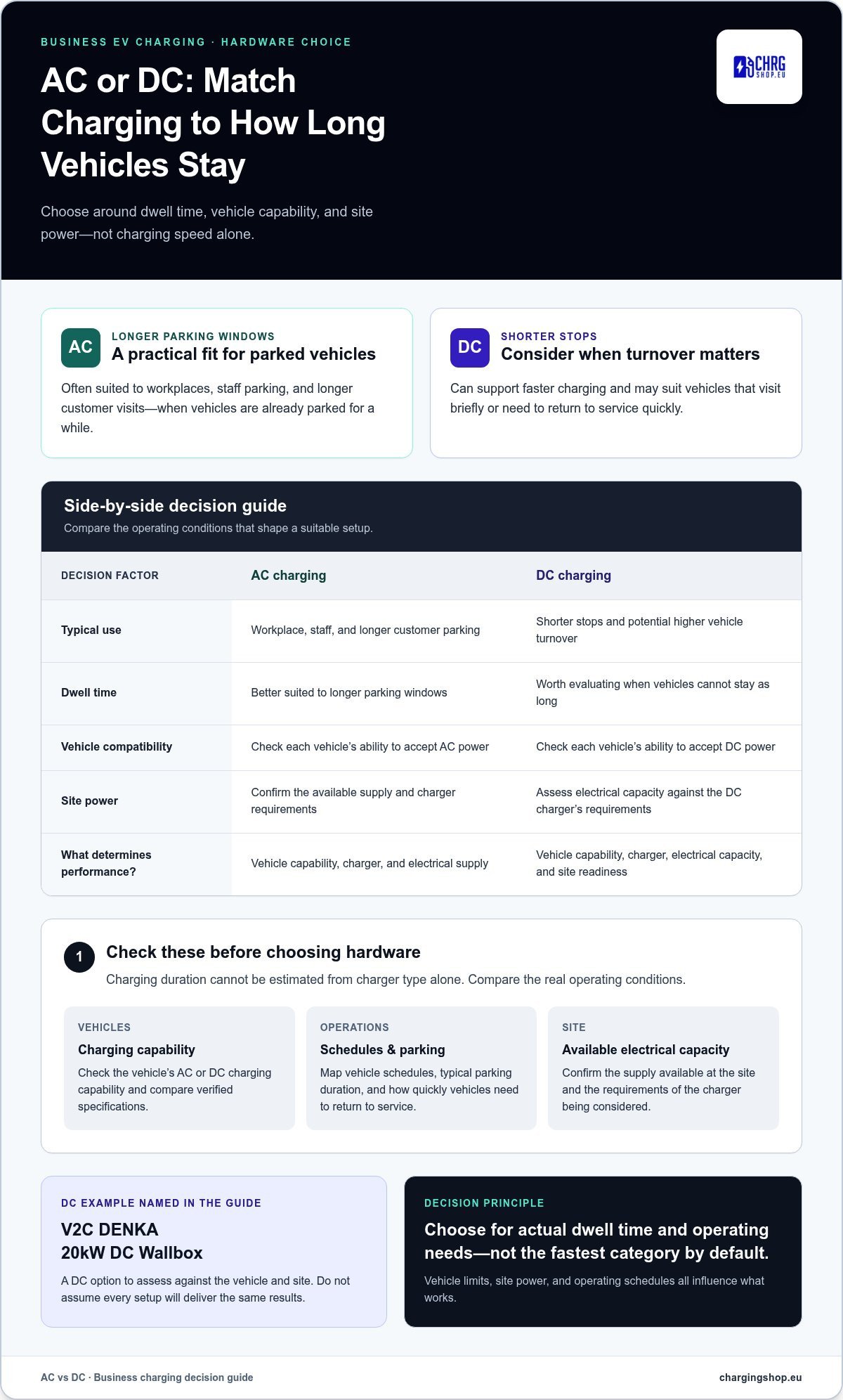
Choose charging speed around how long vehicles typically stay. AC charging is often a practical fit when cars are parked for longer periods. DC charging can support faster charging and may suit shorter stops or higher vehicle turnover. Neither is automatically the better choice: vehicle capability, site power, and the operating schedule all affect what works.
When can AC charging work well for a small business?
Staff parking, workplaces, and longer customer visits can give vehicles time to charge while they’re already parked. Actual performance depends on the vehicle’s ability to accept AC power, the charger, and the electrical supply available at the site. Don’t estimate charging duration from charger type alone. Compare vehicle and site specifications before planning around a particular turnaround.
When might a business consider DC charging?
Assess DC if vehicles make shorter visits or need to return to service quickly. Faster charging may support higher turnover, but electrical capacity and site readiness are central to the decision. The V2C DENKA 20kW DC Wallbox is one DC option; compare its verified specifications with the vehicle and site rather than assuming every setup will deliver the same results. For a deeper DC-focused comparison, see this 40kW DC wallbox business guide.
| Decision factor | AC charging | DC charging |
|---|---|---|
| Typical use | Workplace, staff, and longer customer parking | Shorter stops and potential higher turnover |
| Vehicle compatibility | Check the vehicle’s AC charging capability | Check the vehicle’s DC charging capability |
| Site power | Confirm available supply and charger requirements | Assess electrical capacity against the DC charger’s requirements |
| Dwell time | Better suited to longer parking windows | Worth evaluating when vehicles cannot stay as long |
Before selecting either type, map vehicle schedules, parking duration, and the power available at the site. The U.S. Department of Transportation’s resource on planning electric vehicle charging infrastructure can help frame infrastructure considerations. Then compare verified charger and vehicle specifications. For EV charging for small business, choose the setup that fits actual dwell time and operating needs, not the fastest category by default. Browse business EV charging options as you narrow your hardware choice.
Compare business EV chargers by power, access, and management
Compare the charger and its operating setup as a pair. Power matters, but so do vehicle compatibility, available supply, user access, and whether you need session records or remote oversight. A higher power rating alone doesn’t determine how many vehicles your site can serve. Parking turnover, vehicle limits, and the site’s electrical capacity all play a part.
| Power category | Typical user group | Access needs | Management considerations |
|---|---|---|---|
| AC | Employees, visitors, or customers parked for longer periods | Decide whether charging is open, staff-only, or assigned | Standalone use may suit a simple setup; consider connected management if you need oversight or session records |
| DC | Fleet vehicles or visitors with shorter parking windows | Set clear rules for who can charge and when | Assess operational oversight and site capacity alongside charger specifications |
Which hardware criteria matter most for business charging?
Start with vehicle compatibility, connector requirements, the site’s power supply, and how long vehicles will remain parked. Then consider charger placement, user access, and the number of sessions you expect. Check product documentation for details such as RFID access, metering, connectivity, load management, and OCPP support. Don’t assume these features are included based on the charger category or power rating. For a product-specific reference, see the Alfen Single Pro Line 22kW review.
How do access control and station management affect operations?
Access rules can keep employee, visitor, and fleet charging distinct. Depending on the equipment and management setup, session records may also support internal usage tracking and cost allocation. A simple site with known users may not need network management. If you need more visibility across charging assets, connected management may be relevant. See the CHRG Network station-management guide for network-level detail.
For EV charging for small business, choose features around real operational needs. Confirm each product’s specifications before relying on a particular access, metering, connectivity, or load-management function.
Plan business EV charging around site readiness and daily operations
A workable charging plan starts with the site, not the charger catalogue. Map parking and expected demand, review electrical capacity, choose hardware, and then plan daily operations. This sequence connects equipment choices to actual parking patterns and site conditions before you settle on a project scope.
- Map the layout: Mark parking bays, potential charger locations, cable routes, and how drivers and pedestrians move through the area.
- Review capacity: Document available electrical information and have a qualified local professional assess the proposed electrical design.
- Match hardware: Use the site assessment and expected charging activity to guide charger type and placement.
- Plan operations: Set access, user guidance, oversight, and a process for reviewing utilization.
What should a business assess before deployment?
Look beyond the parking stall. Consider cable reach, weather exposure, visibility, signage, access for intended users, and whether the layout leaves room for future expansion. A qualified local professional should assess the electrical design against requirements that apply at the project location. Utility processes, codes, permits, and incentives can vary, so review current location-specific information before finalizing plans.
How can a business prepare for day-to-day charger use?
Decide who may charge, how access will work, and how sessions will be tracked. Give users clear instructions and signage, define who handles routine oversight, and set an internal process for questions or operating issues. If network management is part of the setup, align it with the records and visibility your business needs rather than assuming every site requires connected tools.
Keep expansion practical. Review utilization over time, note busy periods and unmet demand, then use those observations to decide whether additional charging points make sense. This staged approach helps avoid designing around assumptions while keeping future growth in view. Explore a personalised charging offer for your business charging needs.
Choose a small-business EV charging setup and define your next step
Turn your site and operating needs into a shortlist before comparing specific chargers. For EV charging for small business, the right choice isn’t simply the highest-power option. It’s the setup that works for your users, parking patterns, electrical capacity, and approach to access and oversight.
How can a business shortlist its charging solution?
Start with the use case. Identify who will charge, how long vehicles are likely to stay, and how many sessions you expect. Then compare suitable charger categories against your site’s electrical readiness, vehicle compatibility, access rules, and management needs. This creates a focused shortlist instead of a catalogue-wide search.
- Use case: Identify employee, visitor, customer, fleet, or destination charging.
- Dwell time and power: Match expected parking duration with suitable AC or DC charging, while accounting for vehicle and site limits.
- Access and management: Decide who can use the chargers and whether session records or connected oversight are important.
- Site readiness: Include the electrical assessment and practical charger placement in your decision.
Before selecting a model, review project-specific details such as connector requirements, available supply, access-control options, metering, connectivity, and any relevant load-management or network requirements. These product and site details affect whether a charger fits your intended operation. Employee or visitor charging with longer parking periods often points toward an appropriate AC setup; consider DC when shorter turnover is central to the use case.
What can Charging Shop contribute to the next step?
Charging Shop offers business charging hardware options including V2C Trydan 22kW, V2C DENKA 20kW DC Wallbox, Alfen Single Pro Line 22kW, and ABB Terra AC. Compare each against your shortlist rather than assuming a model’s name or power rating tells the whole story. Review the specifications that matter for your vehicles, site, and operating plan before making a final selection.
CHRG Network access is another option for charging-asset management. Consider whether network-level management fits how you’ll oversee charging, and base feature decisions on the relevant product details. Hardware and management are connected decisions, but your site may not need every capability from day one.
Bring your use case, parking duration, expected demand, and site-readiness information into the next step. Explore a personalized charging offer tailored to your business charging needs.
Build a charging plan that fits your business
The strongest charging choice starts with the way your site works. Match AC or DC hardware to vehicle dwell time, then factor in electrical readiness, user access, and the management your day-to-day operations need. That’s the practical approach to EV charging for small business: choose for real demand, not assumptions.
Charging Shop brings together commercial AC and DC hardware, CHRG Network access for charging-asset management, and personalized charging offers. Treat the charger and its management approach as connected parts of your plan, while keeping immediate needs and future growth in view.
Ready to turn your use case into a shortlist? Explore a personalized charging offer for your business and take the next step with a clear plan.
Frequently Asked Questions
Is EV charging for a small business worth considering?
It can be worth considering if charging supports a clear business goal, such as serving employees, customers, visitors, or a fleet. Start by estimating who would use the chargers, how long vehicles stay, and how much electrical capacity the site can support. Then weigh those needs against your operating plans. A defined use case helps you decide whether charging is a practical fit without relying on assumed benefits or costs.
What type of EV charger does a small business need?
The right type depends on parking duration, vehicle capability, and site power. AC charging is commonly suited to workplace parking or longer visits, while DC may be appropriate when vehicles stop for shorter periods and need faster charging. For EV charging for small business, compare the charger’s verified specifications with your vehicles and available electrical supply. Don’t select by power rating alone, because it doesn’t guarantee a particular charging result.
Can a small business charge employees and customers at the same station?
Yes, a shared station can serve both groups if its access rules and operating plan suit your site. Decide who can charge, when the station is available to each group, and whether any usage needs to be recorded separately. A workplace with staff parking during the day and customer visits at other times may use a shared setup, but access credentials or management features depend on the chosen equipment and network.
How many EV chargers does a small business need?
Base the number on expected charging sessions, parking patterns, and how often vehicles need access at the same time. Track or estimate peak demand rather than sizing only for the total number of employees, customers, or fleet vehicles. Site electrical capacity and charger operation also affect how many points are practical. A staged plan can start with current needs, then use actual utilization to inform future expansion.
Does a small business need networked EV chargers?
Not always. Standalone operation may suit a simple site with a small number of known users and limited reporting needs. Network management can be useful if you need centralized oversight or charging-asset management across stations. Check the specific charger and network features before relying on access controls, session records, metering, or connectivity. CHRG Network access is an option for charging-asset management, with feature-level decisions guided by product details.
Can a small business use DC fast charging?
Yes, a business can consider DC charging if shorter dwell times or frequent vehicle turnover make it a suitable fit. The decision should also account for vehicle compatibility, site electrical capacity, and operating needs. DC isn’t automatically better for every business; longer employee or visitor parking may be served by an appropriate AC setup. The V2C DENKA 20kW DC Wallbox is one DC hardware option to assess against project requirements.
What should a business check before installing an EV charger?
Map parking spaces, charger locations, cable routes, user access, and expected demand. Review available electrical capacity, then have a qualified local professional assess the electrical design against requirements that apply at the project location. Also review current utility processes, codes, permits, and incentives locally. Plan signage, user instructions, routine oversight, and possible expansion. Confirm charger compatibility and relevant product features before settling on the final setup.
