
 Deutsch
 Dansk
Dansk Suomi
Suomi Latviešu
 Lietuvių
 Norsk bokmål
 polski
 Русский
 Svenska
No products in the cart.
Uncategorized
EV Charging Data Analysis: Turn Charging Sessions into Better Decisions

01
Oct
Oct
What if your busiest charger is also your least profitable? EV charging data analysis can help you investigate, but a dashboard full of session records won’t make the decision for you. Start with an operational question, then identify the metric and context that can help answer it.
Charging activity alone doesn’t explain what it means for costs, reliability, or the driver experience. More sessions may signal demand, but they don’t show whether capacity is in the right place or service is meeting expectations. Tracking a small set of relevant indicators can make the data more useful.
This guide explains how to choose practical charging KPIs, interpret what they reveal, and use the findings to inform decisions about capacity, operations, and user experience. You’ll review measures such as utilisation, energy delivered, session outcomes, and charger availability, along with practical ways to compare analytics and management approaches. Start with the decision you need to make, then choose the metric that can inform it.
Key Takeaways
- Use ev charging data analysis to connect charger records with specific operational questions, not just collect more metrics.
- Group KPIs into energy, utilisation, availability, and session patterns to spot what may need attention.
- Compare spreadsheets, charger interfaces, and network platforms by data access, reporting needs, charger count, and staff capability.
- Follow a repeatable workflow from setting a question to reviewing the impact of your next action.
- Match your charging setup to site size, charger mix, user access, and reporting needs, and assess hardware and network access as distinct requirements.
EV Charging Data Analysis: What It Is and Why Operators Need It
Chargers generate records, but records alone don’t tell you what to change. A session log might show that charging began at 8:15 a.m. That’s raw data. EV charging data analysis means interpreting charging and operational records to answer practical questions, such as whether demand regularly peaks at the start of the workday or whether a particular charger is often unavailable when drivers need it.
The data becomes useful when you compare it with other sessions, site schedules, charger availability, and the decision at hand. A pattern in start times, for instance, could prompt a review of capacity or access arrangements. It may also show that you need more information before making an investment. For background on the equipment involved, see this overview of electric vehicle supply equipment (EVSE).
Useful analysis depends on reliable data, enough context to interpret it, and a clear decision to inform. Missing sessions or inconsistent records can distort a pattern. A busy period may reflect workplace arrival times, fleet dispatch schedules, or shared access, so interpret the numbers alongside how the site operates. Start with a question, not a dashboard.
What data does an EV charging station generate?
Session-level records may include start time, session duration, energy delivered, and a charger identifier. These fields can help you explore when charging happens, how much energy is supplied, and whether activity differs between chargers. Other operational details may also be available, but fields vary by charger, software, configuration, and data access. Before relying on a metric, verify which data, reports, exports, and integrations are available for your setup. Check data access, retention, and privacy details as well.
Who benefits from analysing EV charging data?
Workplaces, fleets, commercial sites, and shared charging locations can use analysis to inform operating decisions. Fleet managers may want to know whether vehicles can access chargers when required and whether chargers are used throughout the day. Total energy alone won’t answer either question. Site managers can examine demand patterns, user access, and whether current capacity appears aligned with charging needs.
At a workplace, recurring activity at the same time could prompt a closer look at charger access or site capacity. At a shared location, it may be more useful to check whether sessions cluster in particular periods. These are prompts for investigation, not conclusions. Confirm the pattern and its context before acting. Tie each analysis to a specific operational decision so the findings can guide a practical next step.
Which EV Charging Metrics Matter Most?
Choose metrics based on the decision you need to make. A KPI describes what happened; a diagnostic indicator may help narrow down why. Neither proves cause on its own. For example, more failed sessions during a busy period is a pattern to investigate, not proof that congestion caused the failures. The Joint Office of Energy and Transportation provides resources on EV charging data and analytics for infrastructure planning and transparency.
Energy, session, and utilisation metrics
Energy delivered is the total electricity supplied, measured in kilowatt-hours (kWh). It can help you assess site demand over time. Session count is the number of charging sessions in a period, useful for comparing activity across days or chargers. Session duration is how long each session lasts. Compare duration with energy delivered to identify sessions that take longer relative to the energy supplied, then investigate the context.
Utilisation measures how much of a charger’s defined available time is occupied by charging during a specified period. Define the period and denominator before comparing results. For example, calculate occupied charging time divided by scheduled available charger time for each week. State whether scheduled downtime is excluded, and use the same method across chargers.
Availability and demand-pattern metrics
Availability can be defined as the time a charger is operational and able to start a session divided by its scheduled service time. Calculate it using consistently timestamped charger-status and maintenance records, and confirm those records capture status changes and scheduled downtime. Time-of-day and day-of-week patterns show when sessions tend to begin or demand rises. These descriptive trends can guide staffing reviews or prompt a capacity assessment, but they don’t establish why demand occurs.
Failed-session counts and support incidents can add diagnostic context, provided teams record them consistently. A change in how failures are logged can look like a change in reliability. Before building decisions around these measures, verify which fields and reports your charger or network platform provides.
| Metric | Definition | Useful decision | Data-quality caveat |
|---|---|---|---|
| Energy delivered | Total kWh supplied | Review demand and energy needs | Check for missing or inconsistent readings |
| Session count and duration | Number of sessions and time per session | Compare charger activity and session patterns | Confirm start, end, and session records are complete |
| Utilisation | Occupied time divided by scheduled available time in a set period | Assess how charger capacity is being used | Keep the denominator and period consistent |
| Availability and failures | Operational time share and recorded failed sessions | Investigate service interruptions | Validate status data and failure logging |
Use these measures to frame your next operational question, then check that your setup supports the data you need. You can explore EV charging hardware as one part of planning a suitable charging setup.
How to Compare EV Charging Data Analysis Approaches
The right tool depends on what you need to decide, how many chargers you manage, and how much time your team can spend handling data. For practical ev charging data analysis, compare three broad approaches: spreadsheets, charger-native interfaces, and network-management platforms. Don’t assume a platform includes specific reports or integrations. Confirm the details for your equipment and configuration.
| Approach | Typically suited to | Confirm before choosing |
|---|---|---|
| Spreadsheets | Reviewing a small, consistent dataset with manual analysis | How data is entered, who maintains it, and how versions are controlled |
| Charger-native interface | Reviewing information associated with a specific charger or manufacturer | Available fields, reporting period, user access, and export options |
| Network-management platform | Managing information across a network of chargers, depending on platform features | Supported chargers and protocols, reports, integrations, data access, and privacy terms |
When are spreadsheets enough for charging data analysis?
A spreadsheet may be practical if you’re reviewing a small dataset with consistent fields and a clear question, such as comparing session counts by week. Keep the process controlled: manual entry can introduce errors, labels can vary between people, and multiple file versions can create conflicting results. Document KPI definitions, data sources, and review frequency before comparing periods. If the dataset grows or updates become difficult to manage, reassess the approach.
What should operators check in a charging data platform?
Ask vendors or providers which charger models and communication protocols are supported, including OCPP where relevant. Verify the exact version and compatibility rather than assuming support. Then check who can access data, what can be exported, which reports are available, what those reports cover, and whether required integrations are supported. Confirm data retention and privacy details too. Capabilities vary, so verify them directly before selecting a platform.
A network-management option may be one part of the workflow, but its fit depends on the records and access your operation needs. For an example of network access, review this CHRG Network access guide, then verify current platform features and data availability before making a decision.
Keep hardware and management requirements separate in your evaluation. A charger’s suitability for a site doesn’t confirm that your preferred data workflow is supported. Compare the charger, network access, and reporting requirements as distinct parts of the setup.
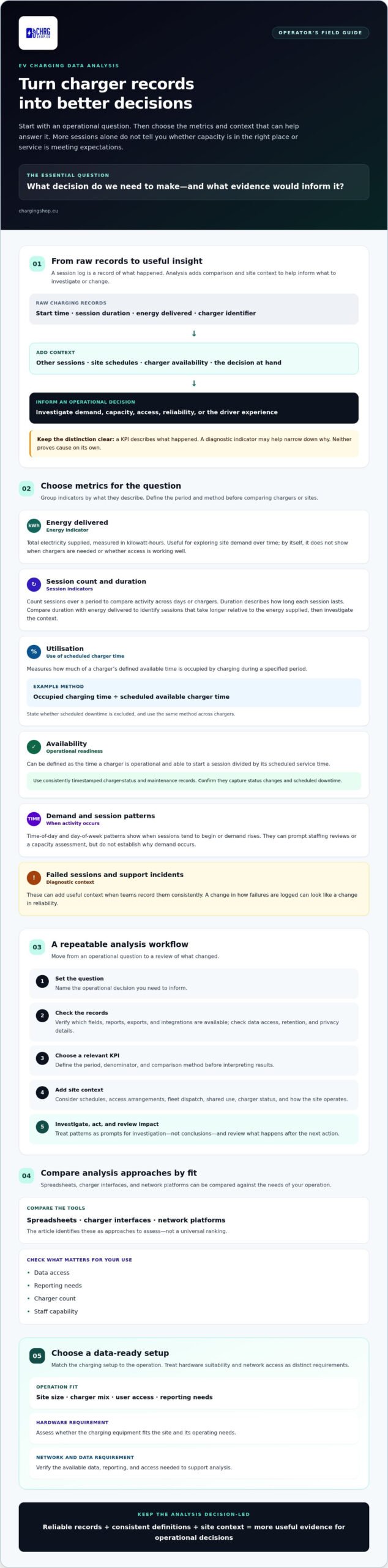
How to Analyse EV Charging Data Step by Step
A repeatable workflow keeps EV charging data analysis focused on decisions, not just charts. Follow the steps: set a question, gather relevant data, check its quality, analyse the pattern, take an appropriate action, and review what happens next.
How do you prepare charging data for analysis?
Before comparing sessions, check that the records are fit for purpose. Confirm timestamps use a consistent time zone and format, energy units match, missing values are visible, duplicate sessions are identified, and charger identifiers are consistent. Record the data source, period covered, metric definitions, and any filters applied. Don’t combine datasets until you understand differences in their fields and measurement methods.
Limit personal data to what’s necessary for the analysis, restrict access to people who need it, and follow your organisation’s data-handling process. Privacy requirements vary by location and context, so verify applicable rules with a qualified source before making legal decisions.
How do you turn a metric into an operational action?
Start with a question, such as: “Is charging demand concentrated at particular times?” Gather session records and, where available, charger-status information for a defined period. Compare like-for-like days or weeks, then segment by site, charger, user group, and time if those fields exist and are appropriate to use. Check other possible explanations, such as site schedules, access arrangements, or incomplete records, before recommending a change.
A recurring peak in session starts can justify reviewing staffing or capacity, provided the records are complete and comparable across the periods analysed. It is a prompt for investigation, not proof that more chargers or a staffing change is needed.
- Set the question: Name the decision the analysis should inform.
- Gather the data: Select relevant records and a clear time period.
- Check quality: Validate fields, units, timestamps, and identifiers.
- Analyse: Compare consistent periods and useful segments.
- Act and review: Record the decision, then check whether the pattern changes.
For example, if drivers report congestion during a recurring peak, first check whether session starts cluster in that window. Compare similar days and review charger availability and user access records, if available. The analysis may point to a need for further investigation, but don’t assume congestion has a single cause or that the data supports a specific fix. Document the action taken and review the same measures afterward.
Need to align your charging setup with operational needs? Explore EV charging hardware and CHRG Network access.
Choose a Data-Ready EV Charging Setup for Your Operation
A data-ready setup starts with your operation, not a feature list. Site size and number of locations affect how much information you need to manage. Charger mix can influence which records are available, while user access shapes what you need to understand about demand. Your reporting requirements determine whether a simple review is enough or whether you need information consolidated across sites.
Keep four requirements distinct: hardware supplies charging equipment; network access may connect chargers to a management environment; installation is a separate project requirement; and ongoing operations cover how your team monitors and acts on site activity. One choice doesn’t automatically provide the others. Charging Shop sells charging hardware and CHRG Network access. Confirm specific data, reporting, export, integration, and privacy capabilities before deciding whether they fit your needs.
What should you confirm before choosing chargers or network access?
Write down the metrics you need, the number of locations, the user groups involved, and any existing systems or constraints. Then ask providers to demonstrate reports and data exports relevant to those needs and explain available access controls. Confirm compatibility with your intended chargers and workflow rather than relying on broad claims. If you’re evaluating professional charging hardware alongside management requirements, see the ABB Terra AC buying guide.
Before committing, verify which chargers are supported, what data can be accessed, how it is retained, and whether required integrations are available. Treat installation arrangements and ongoing operational responsibilities as separate items to confirm for your project.
How can operators start small and improve their analysis?
Begin with one operational question and a manageable set of consistently defined metrics. For example, review session timing and charger availability to understand whether a site’s current setup aligns with observed demand. Set a regular review cadence, record the decisions made, and note what information you used. Expand the analysis only when a new question or need justifies it.
Before selecting CHRG Network access for this workflow, verify current offer details and whether the data and features you require are available. Don’t assume that network access guarantees a particular report or analytics capability. Match the option to your site, charger mix, user access, and evidence needs.
For a practical next step, explore Charging Shop’s charging solutions and assess which hardware and network-access options align with your operational requirements.
Turn Charging Data into Your Next Decision
Useful ev charging data analysis starts with a clear operational question. Choose a small set of reliable metrics, define how you’ll measure them, and compare consistent periods before deciding what to change. Session totals and busy periods can reveal patterns, but they need context before they can inform an investment or operational shift.
Your setup matters too. Match charger hardware and network access to your site, users, and reporting requirements. Confirm what data, reports, exports, and integrations are available before relying on them. Charging Shop offers charging hardware for residential and commercial requirements, alongside CHRG Network access for EV stations.
Ready to assess options for your operation? Explore Charging Shop’s charging solutions and consider which hardware and network access align with your needs. Start with one decision, measure what matters, and build a more informed approach from there.
Frequently Asked Questions
What is EV charging data analysis?
EV charging data analysis is the process of interpreting charging and operational records to answer practical questions. It turns details such as session start times, energy delivered, and charger identifiers into patterns an operator can investigate. For example, session records may reveal recurring periods of higher demand. Reliable conclusions depend on data quality, site context, and a clear decision the analysis is intended to inform.
Which EV charging data should a business track?
Track data that connects to your operational questions. Useful starting points include energy delivered in kilowatt-hours, session count, session duration, charger utilisation, availability, and session timing. These measures can help you review demand, usage, and potential service issues. Available fields depend on the charger, software, configuration, and access arrangements. Verify what your setup records, and define each metric consistently before comparing chargers or time periods.
How do you calculate EV charger utilisation?
Calculate utilisation by dividing the time a charger is occupied by charging by its defined available time during a set period, then multiplying by 100 for a percentage. For example, specify whether available time means scheduled operating hours or all hours in the period. Apply the same denominator and period across chargers. State how you handle planned downtime, since different assumptions can make utilisation figures difficult to compare fairly.
Can EV charging data help reduce operating costs?
Charging data can help identify operational patterns that may be worth investigating, but it can’t guarantee lower costs. Comparing energy use, session timing, utilisation, and availability may help operators assess whether capacity or operating practices align with actual demand. Before changing a site or investment plan, check data quality and consider other explanations for the pattern. Treat analysis as decision support, then review the impact of any action taken.
What software is used for EV charging data analysis?
Operators may use spreadsheets, charger-native interfaces, or network-management platforms. Spreadsheets can work for a small, consistent dataset; other options may suit teams that need information across chargers, depending on their verified features. Compare data access, reports, export options, integrations, access controls, and staff capability. Don’t assume a platform includes a particular metric or report. Confirm supported chargers and current data, retention, and privacy details with the provider.
Is EV charging data analysis useful for a small charging site?
Yes. A small site can use a focused review to answer questions such as when sessions tend to start or whether chargers are available when users need them. Begin with a manageable set of consistent metrics and a defined time period. A spreadsheet may be enough if records are reliable and easy to maintain. Choose the simplest approach that provides useful information, and expand it only when your needs change.
How can I ensure EV charging data is accurate?
Check that timestamps, time zones, energy units, and charger identifiers are consistent. Look for missing fields and duplicate sessions, and record the data source, period, definitions, and any filters used. Compare datasets only after understanding differences in their fields and measurement methods. Also confirm who can access the records and verify applicable privacy requirements for your location and use case. Consistent checks make trends more dependable, though they don’t prove a cause.
