
 Deutsch
 Dansk
Dansk Suomi
Suomi Latviešu
 Lietuvių
 Norsk bokmål
 polski
 Русский
 Svenska
No products in the cart.
Uncategorized
Effect of EV Charging on Your Electricity Bill: A Practical 2026 Guide
26
Sep
Sep
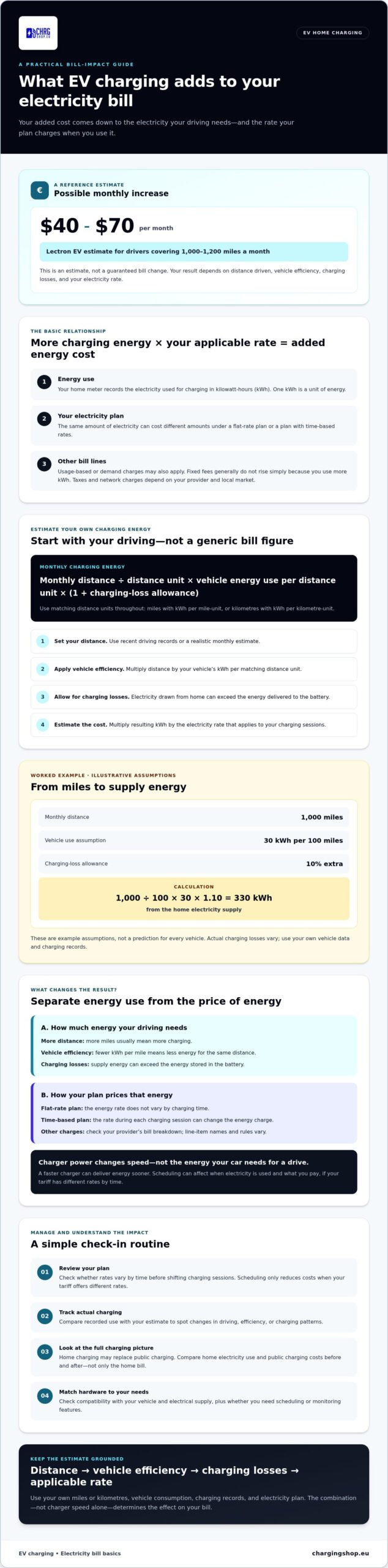
Could charging at home add $40 to your monthly electricity bill, or closer to $70? Lectron EV estimates that drivers covering 1,000 to 1,200 miles a month may see an increase in that range. Your actual result depends on how far you drive, how efficiently your vehicle uses energy, and the rate you pay. The effect of EV charging on electricity bill costs comes down to added energy use, shaped by your driving habits and tariff.
If it’s hard to translate miles and kilowatt-hours into a bill, you’re not alone. Charging losses, time-of-use rates, and utility bill line items can make the impact less obvious than expected. A charger’s power level doesn’t determine how much energy your car needs, but scheduling can affect when you use electricity and what you pay for it.
This guide shows you how to estimate charging-related electricity use from your driving, understand the factors that change the cost, and spot where EV charging appears on your bill. You’ll also find practical ways to schedule and monitor charging, so you can make informed choices before your next billing cycle.
Key Takeaways
- Estimate monthly EV energy use from your distance, vehicle efficiency, and charging losses, then apply your own electricity rate to estimate the bill impact.
- The effect of EV charging on your electricity bill depends on both the energy your car uses and the tariff you pay. Assess those factors separately.
- Review your electricity plan before shifting charging times. Scheduling can reduce costs only when your tariff offers different rates by time.
- Track actual charging use and compare it with your estimate to spot changes in driving, efficiency, or charging patterns.
- When evaluating a charger, check whether its capabilities match your vehicle, electrical supply, and need for scheduling or monitoring.
How does EV charging affect your electricity bill?
Charging an electric vehicle increases the electricity your home uses. The amount added to your bill depends on how much energy you need and the tariff that applies when you charge. Electricity use is commonly measured in kilowatt-hours (kWh). One kWh is a unit of energy, and your meter records the energy used by your home, including EV charging.
The effect of EV charging on your electricity bill is the cost of the charging energy your home uses, calculated under your electricity plan and any applicable usage-based charges. That cost is separate from your household’s other electricity use. Your total bill may also include fixed fees, taxes, or network charges, depending on how your provider and local market structure the bill.
Which parts of an electricity bill can EV charging affect?
Charging adds to the electricity consumption billed under your plan. If your tariff has different rates at different times, the rate in effect during each charging session may change the energy charge. Some plans also include charges linked to usage or demand, while fixed fees generally don’t rise simply because you use more kWh. Bill formats and charge names vary, so check your provider’s breakdown rather than assuming every line item works the same way.
Does charging at home always increase the bill by the same amount?
No. The energy needed changes with your monthly driving distance and your vehicle’s efficiency. More miles usually mean more charging, while a vehicle that uses fewer kWh per mile needs less energy for the same distance. Charging losses also mean the electricity drawn from your home can exceed the energy delivered to the vehicle’s battery. How often you plug in affects when that energy is used, not necessarily the total needed for your driving.
Your tariff determines how that consumption translates into charges. The same amount of electricity can cost different amounts under a flat-rate plan and a time-based plan. Charging methods range from standard outlet charging to faster options. This charging hardware overview explains common types. A faster charger can deliver energy sooner, but your driving needs and tariff remain central to the bill impact.
There’s another useful distinction: home charging may replace some public charging rather than add energy for entirely new driving. Your home electricity bill can rise as you move charging sessions home, while your public charging spend falls. To understand the full change, compare home electricity use and public charging costs before and after the switch, not just the home bill alone.
How to estimate the electricity your EV charging will use
Start with energy use, then calculate the cost using your own electricity tariff. This keeps your estimate grounded in your driving rather than a generic bill figure. Vehicle efficiency may be listed in kWh per 100 miles or per 100 kilometres. Use the matching distance unit throughout the calculation.
“Monthly charging energy (kWh) = monthly distance ÷ distance unit × vehicle energy use per distance unit × (1 + charging-loss allowance).” Monthly distance is how far you drive; vehicle energy use is the stated kWh needed per distance unit; the loss allowance accounts for electricity drawn from your supply but not stored in the battery.
What information do you need for a personal estimate?
Use your recent driving records or a realistic monthly estimate. Check your vehicle’s energy-consumption figure, then find your electricity rate and plan details. If rates vary by time, use the rates that apply to your charging sessions rather than assuming one flat price.
- Set your distance: Record monthly miles or kilometres.
- Apply vehicle efficiency: Multiply the distance by the vehicle’s kWh per matching unit.
- Allow for charging losses: Add an estimate for energy lost during charging.
- Estimate the charge: Multiply the resulting kWh by your applicable electricity rate.
For example, suppose you drive 1,000 miles a month, your vehicle uses an assumed 30 kWh per 100 miles, and you allow an illustrative 10% extra for charging losses. The estimate is 1,000 ÷ 100 × 30 × 1.10 = 330 kWh from the supply. These are example assumptions, not a prediction for every vehicle. Check your own vehicle data and charging records.
How do charging losses change the calculation?
The battery may receive less energy than the amount drawn from the home supply. In this example, the 10% allowance means adding 10% to the energy the vehicle needs. Actual losses vary, so treat this percentage as an assumption to verify, not a guaranteed figure.
Keep the energy estimate separate from the bill estimate until you apply your tariff. At an assumed rate of $0.20 per kWh, 330 kWh would work out to $66 for the charging energy in this illustration. Your actual rate, time-based pricing, and other bill charges may change the total. Compare the estimate with available charger, vehicle, or meter records, then adjust it to match what you observe. If you’re reviewing equipment for your setup, explore EV charging hardware options.
Understanding the effect of EV charging on electricity bill costs
The effect of EV charging on your electricity bill depends on two separate things: how many kilowatt-hours your driving requires and the rate your plan applies to those units. Keep them separate when comparing scenarios. More energy use raises consumption; a different tariff can change the cost of that consumption without changing the amount of energy your vehicle needs.
| Factor | Changes energy used (kWh)? | Changes rate paid? |
|---|---|---|
| Driving distance | Yes. More driving generally requires more charging energy. | No, though the extra energy is billed under your plan. |
| Vehicle efficiency | Yes. A vehicle using fewer kWh per mile or kilometre needs less energy for the same distance. | No. |
| Charging losses | Yes. Supply energy can exceed the amount stored in the battery. | No, but the additional consumption is charged at the applicable rate. |
| Tariff structure and charging time | No. The vehicle’s energy requirement stays the same. | Potentially. Your plan may apply different rates at different times. |
Does a faster charger use more electricity?
A charger’s power rating describes how quickly it can deliver energy, not how much energy your vehicle needs for the same journey. A faster-rated charger doesn’t automatically increase monthly kWh. Actual charging speed depends on the vehicle’s limits, the charger, the electrical supply, and charging conditions. Focus on energy consumed over time, not the charger’s maximum kW rating alone.
How do electricity tariffs and charging times affect the bill?
A flat-rate plan applies the same energy rate regardless of charging time. A time-varying plan may set different rates for different periods, as defined by the provider. Neither structure is automatically cheaper for every driver or in every market. The result depends on the plan’s rates and your charging pattern.
Scheduling can shift charging into another period, but it changes the bill only if your plan’s rates differ by time. Check the eligible hours, rate conditions, and any plan fees with your electricity provider before changing your routine. Then compare the actual rates for the hours you can use with the times you typically need to charge. That’s how to assess whether a schedule may help your specific bill.
How can you manage EV charging’s effect on your electricity bill?
Manage the effect of EV charging on your electricity bill by checking your plan, choosing charging times that suit its rates, and comparing recorded charging energy with each bill. Make one change at a time, then review the results. This helps you identify whether a bill change came from EV use, a tariff difference, or another household expense.
Can scheduled charging lower your electricity bill?
It can, if your electricity plan offers a lower rate during specific hours and your charging schedule can use them. First, confirm the eligible hours and rates with your provider. Then set a schedule that fits your driving routine and review the next bill. A schedule shifts when electricity is used; it doesn’t guarantee savings if your plan has no time-based rates or other charges offset the difference.
Check the bill’s dates and compare them with charging records for the same period. If the billing cycle covers only part of a month, compare like periods rather than monthly totals. Also account for changes in mileage and household electricity use. Keep a simple record of dates, charging energy, and relevant tariff periods to make patterns easier to spot.
What should you monitor after installing a home charger?
Use whatever records are available from the vehicle, charger, or utility meter. Look for charging-session energy and total household consumption, then compare them with your estimate and the bill period. Readings may not line up exactly if systems use different dates or measure energy at different points, so treat them as complementary checks rather than identical figures.
If you have solar panels, note when they generate power and when the vehicle charges. Solar generation can reduce electricity drawn from the grid when output is available during charging, but the result depends on system output and charging conditions. For setup-specific context, consult the related guide on integrating solar panels with the V2C Trydan. A related guide to smart charging hardware and reducing EV charging costs can also help you assess scheduling and monitoring options without assuming every charger supports the same capabilities.
Review the tariff, charging records, and bill together before changing your routine. If you’re comparing equipment for a setup where scheduling or monitoring matters, check the capability against current product documentation, your vehicle, and your electrical supply. Explore EV charging hardware options.
Choosing charging hardware with your electricity bill in mind
Choose a charger for the way you drive and the capabilities you’ll actually use. Scheduling may be worth evaluating if your electricity plan has time-based rates and you want to set charging for eligible hours. Energy monitoring can help if you want to compare charging sessions with vehicle or utility records. Managed charging may suit a setup where coordinating charging is important, but check what a specific unit supports before you buy.
Hardware can help you manage charging, but it can’t set your household tariff or guarantee a particular bill. The effect of EV charging on electricity bill costs still depends on the energy used and the rates in your electricity plan. Treat scheduling and monitoring as tools for visibility and control, not promises of lower costs.
Which charger features are relevant to tracking electricity use?
Verify scheduling and energy-monitoring functions in the current product documentation. Don’t assume they’re included based on a charger’s name or power rating. For home charging, compare the V2C Trydan 22kW and ABB Terra AC against your vehicle, electrical supply, and preferred charging routine. Consult the existing V2C Trydan 22kW guide for model-specific information, then confirm any feature that matters to your setup with the product documentation.
Charging Shop’s range also includes the V2C DENKA 20kW DC Wallbox and Alfen Single Pro Line 22kW. These are different hardware options, so compare their intended use and specifications rather than selecting by rating alone.
What should you check before buying and arranging installation?
Use this checklist to narrow your options:
- Vehicle compatibility: Confirm the connector and charging capability suit your vehicle.
- Electrical supply: Check that your property’s supply can support the proposed charger and charging setup.
- Charger rating: Match the unit’s capabilities to the vehicle and your usual charging needs.
- Features: Verify scheduling, monitoring, or managed charging support in the specific documentation.
- Installation: Arrange a qualified professional to assess the site and install the hardware.
Charging Shop sells EV charging hardware and CHRG Network access, but doesn’t provide on-site installation. Confirm your requirements before choosing, and arrange installation separately with a qualified professional.
Ready to compare the available options? Explore EV charging hardware and check the product documentation against your vehicle and electrical setup.
Make your next charging decision with confidence
You now have a practical way to understand the effect of EV charging on your electricity bill: estimate the energy your driving requires, apply your actual tariff, and check the result against your bills and charging records. Keep energy use and electricity rates distinct. That makes it easier to see whether a change comes from driving, charging patterns, or your plan.
Before choosing hardware, focus on compatibility with your vehicle and electrical supply. Then verify whether the specific model supports the scheduling or monitoring capabilities you want. A charger can help you manage charging, but it can’t set your tariff or promise a particular bill.
Charging Shop offers residential and commercial charging hardware options, plus CHRG Network access for charging infrastructure management. Compare the available options with your requirements and review product documentation before deciding. Installation must be arranged separately with a qualified professional.
Explore EV charging hardware at Charging Shop and take the next step toward a charging setup that fits your needs. With the right information and a clear plan, you can make a confident choice.
Frequently Asked Questions
Does charging an electric car at home increase your electricity bill?
Yes, home charging adds electricity use, which can raise the bill if other usage and plan terms stay the same. The effect of EV charging on electricity bill depends on how much energy your driving requires and the rate applied to it. Fixed fees may not change with consumption. Home charging can also replace some public charging, shifting where you pay for the electricity rather than adding energy for new driving.
How do I calculate the electricity cost of charging my EV?
Multiply the electricity used for charging by the rate that applies to those charging sessions. To estimate energy, combine your monthly driving distance with your vehicle’s consumption figure, making sure the distance units match, then account for charging losses. If your plan has rates that vary by time, calculate each period at its applicable rate. This estimates the charging energy charge, not necessarily fixed fees, taxes, or other bill items.
Does a faster EV charger use more electricity?
Not simply because it has a higher power rating. Charging power affects how quickly energy is delivered; it doesn’t determine how much energy the vehicle needs for a given journey. Actual charging speed depends on the vehicle, charger, electrical supply, and charging conditions. A faster-rated charger won’t automatically raise monthly electricity use. Your driving and vehicle efficiency are better guides to the energy your charging will require.
Can charging an EV overnight reduce my electricity bill?
It can if your electricity plan offers a lower rate during overnight hours and your sessions qualify for that rate. Check the provider’s eligible time windows, rates, and any relevant fees before setting a schedule. If your plan charges the same rate at all times, moving charging overnight won’t reduce the energy rate. Compare the bill after scheduling rather than assuming the change guarantees savings.
How much electricity does charging an electric car use per month?
There’s no single monthly amount that applies to every driver. Estimate yours using monthly distance and your vehicle’s energy consumption, then allow for charging losses. Someone driving less will generally need less charging energy than someone covering more distance in the same vehicle. Check your vehicle’s consumption information and compare your estimate with available charger, vehicle, or meter records to refine it.
Do EV charging losses increase the electricity used from the grid?
Yes. The electricity drawn from your home supply can exceed the energy stored in the vehicle’s battery because some energy is lost during charging. The amount varies with the vehicle, charger, and charging conditions, so avoid treating a generic loss percentage as exact. Use available charging-session or meter records to compare supply energy with your estimate and improve future calculations.
Can solar panels reduce the electricity drawn from the grid when charging an EV?
Yes, solar generation can reduce the electricity drawn from the grid when power is available as the vehicle charges. The result depends on solar output at that time and the charging conditions. If generation is low or doesn’t align with charging, the home may still draw electricity from the grid. Compare solar production and charging records where available to understand how your setup performs.
