
 Deutsch
 Dansk
Dansk Suomi
Suomi Latviešu
 Lietuvių
 Norsk bokmål
 polski
 Русский
 Svenska
No products in the cart.
Uncategorized
DC Fast Charger for Business: 2026 Hardware & ROI Guide
17
Sep
Sep
Is your parking lot a cost center or a high-octane revenue engine? The era of slow charging for business is dead. If customers or employees are still waiting hours for a top-up, you’re losing valuable foot traffic and productivity to the competitor down the road. We know the barriers feel high. High upfront costs and the confusing gap between 20kW, 40kW, and ultra-fast hardware can stall any project. You need a DC fast charger for business that delivers a measurable return, not a management nightmare.
This guide cuts through the technical noise to help you master the financial requirements of high-performance charging in 2026. You’ll learn how to select reliable, OCPP-compliant hardware like the compact V2C DENKA 20kW DC Wallbox or professional-grade units from Alfen and ABB. We provide a clear ROI framework to turn charging into a profitable service. You’ll also discover how to handle billing and remote management effortlessly through the CHRG Network. It’s time to stop overthinking the tech and start building your charging destination. Let’s dive into the hardware and numbers that matter.
Key Takeaways
- Learn why standard AC charging is falling behind and how speed drives revenue for short-stay locations like gyms and restaurants.
- Identify the 20kW “sweet spot” with hardware like the V2C DENKA to bypass grid limitations without sacrificing performance.
- Compare ownership versus hosting models to maximize your long-term ROI and maintain full control over your billing rates.
- Understand how to select and deploy a DC fast charger for business that meets the rigorous demands of high-traffic commercial environments.
- Simplify complex asset management by using the CHRG Network to automate customer billing and real-time load monitoring.
The Business Case for DC Fast Charging in 2026
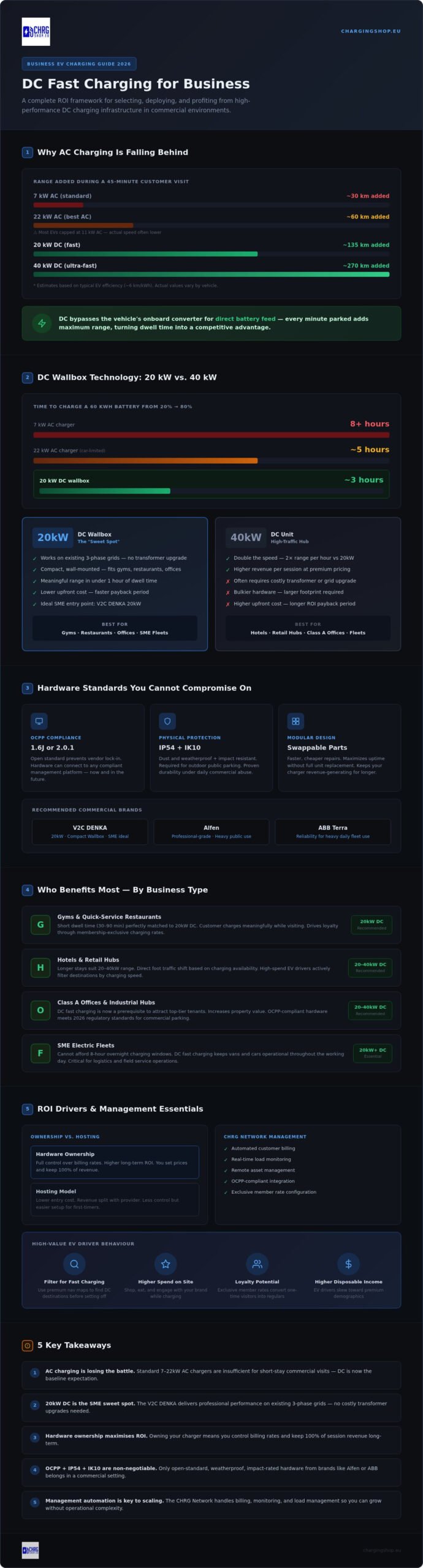
The era of slow charging is over. By 2026, EV drivers no longer view a 22kW AC plug as a primary solution for short-stay visits. If a customer spends 45 minutes at your gym or quick-service restaurant, an AC charger only adds a handful of miles. That’s a missed opportunity. A DC fast charger for business changes the dynamic. It delivers a substantial charge in the time it takes to finish a workout or a meal. You aren’t just providing a utility; you’re matching your infrastructure to the “dwell time” of your specific business model.
Market saturation in 2026 means EV charging is now a baseline expectation for property value. High-value business types like hotels, gyms, and retail hubs are seeing a direct shift in foot traffic based on charging speeds. If your competitor offers 20kW DC speeds while you offer 7kW AC, the high-spend driver will choose them every time. Speed sells. Reliability keeps them coming back. Direct battery feed through DC hardware bypasses the vehicle’s onboard converter, ensuring every minute the car is parked adds maximum range.
Attracting High-Value EV Drivers
EV drivers are proactive planners. They use premium navigation maps to filter for fast charging destinations. Installing a DC fast charger for business ensures your location appears at the top of these searches. This visibility attracts a demographic with higher disposable income. These customers don’t just park; they shop, eat, and engage with your brand while their vehicle powers up. Use high-speed charging as a powerful loyalty tool. Offering exclusive rates for members or recurring visitors turns a simple parking spot into a high-performance revenue engine.
Future-Proofing Commercial Real Estate
Infrastructure is the new currency in commercial real estate. Class A office spaces and industrial hubs now require DC fast charging to attract top-tier tenants. For SMEs, this is about more than just customer service; it’s about fleet readiness. If your business operates a small fleet of electric vans or cars, you can’t afford to wait eight hours for a full charge. Professional-grade hardware from brands like Alfen or ABB provides the reliability needed for heavy daily use. Meeting 2026 regulatory standards for parking lots is easier when you invest in scalable, OCPP-compliant hardware today. Don’t let your property become obsolete as the market moves toward rapid charging as the standard.
Understanding DC Wallbox Technology: 20kW vs. 40kW
Standard AC charging relies on the car’s internal equipment to convert power. A DC fast charger for business bypasses the vehicle’s onboard converter for direct battery feed. This makes 20kW DC significantly more effective than even the best 22kW AC units. Most electric cars are capped at 11kW for AC charging; however, they can accept the full 20kW or 40kW from a DC source. For a standard 60kWh battery, a 7kW charger takes over 8 hours. A 22kW AC unit might still take 5 hours due to car limitations. A 20kW DC wallbox finishes the job in just 3 hours.
Assessing your building’s spare electrical capacity is the first step. Every commercial property has a power limit. A 40kW unit provides more speed but often demands expensive transformer upgrades or grid expansion. The 20kW V2C DENKA is the ideal solution for businesses with 3-phase grids that cannot support massive power draws. It delivers professional performance without a total electrical overhaul. You get the speed your customers want without the infrastructure headache that usually comes with high-power charging.
Compact DC Wallboxes: Power Without the Grid Overhaul
Small businesses don’t need 150kW ultra-fast hubs. Those units are expensive, bulky, and complex. Compact 20kW DC units are manageable and cost-effective. They provide enough speed for customers at gyms or restaurants to gain meaningful range in under an hour. Explore our range of compact hardware to find a solution that fits your existing power supply. A compact DC wallbox acts as the bridge between AC convenience and ultra-fast charging.
OCPP Compliance and Hardware Standards
Hardware longevity depends on open standards. OCPP 1.6J or 2.0.1 is non-negotiable for commercial assets. It prevents “vendor lock-in” by allowing your hardware to communicate with different management platforms over time. Professional units like those from Alfen or the ABB Terra AC are built for heavy, public use. Look for IP54 and IK10 ratings. These certifications prove the hardware can survive harsh weather and physical wear in public parking areas. Modular components are also a major plus. They make future repairs faster and cheaper, ensuring your DC fast charger for business stays online and profitable for years.
Calculating ROI: How Hardware Ownership Drives Revenue
Stop letting third-party providers eat your margins. Many companies offer to “host” your charging station for free, but they take a massive cut of every session. Direct ownership of a DC fast charger for business means you keep every cent of the margin. You pay for the hardware upfront, but you control the pricing and the profits. It’s a straightforward transactional model that pays for itself faster than most realize. When you own the asset, you aren’t just a host; you’re a service provider with full control over your financial destiny.
Revenue models should match your customer behavior. Retailers often prefer pay-per-kWh for transparency. High-traffic gyms might add a flat session fee to ensure quick turnover. If parking space is at a premium, time-based billing prevents drivers from overstaying. Balance these gains against your operating expenses: wholesale electricity costs, small network fees for backend management, and minimal hardware maintenance. Review our 40kW DC wallbox guide for deeper pricing context on higher-output hardware and its impact on your initial capital expenditure.
Direct Billing and Passive Income
Manual payment processing is a relic of the past. Modern hardware automates every transaction via RFID cards or integrated mobile apps. You can set dynamic pricing to match real-time grid costs. Charge a premium during peak hours or offer discounts during slow periods to lure shoppers. This passive income stream does more than just pay for the unit; it can effectively offset your business’s own corporate energy bills. It turns a static parking lot into a self-sustaining, high-margin profit center that requires zero daily oversight.
Tax Incentives and Grants in 2026
In 2026, governments prioritize high-speed infrastructure over basic AC plugs. DC fast chargers often qualify for top-tier green subsidies and enhanced capital allowances. These incentives significantly lower your net investment from day one. On your company balance sheet, these units aren’t just equipment; they’re high-value assets that boost your overall property valuation. Investing in rapid charging hardware allows you to take advantage of accelerated depreciation benefits, making the financial case even stronger for SMEs looking to scale.
Selecting the Best DC Fast Charger for Your Business
Choosing the right hardware is about matching power to purpose. You don’t need a massive, industrial tower if you’re running a boutique hotel or a local gym. The DC fast charger for business you select should fit your footprint, your electrical capacity, and your customer’s expectations. Get it right the first time. Reliability is the only metric that matters when a driver is low on range and looking at your property on a map. Don’t settle for unproven hardware that lacks professional support.
For most SMEs, the V2C DENKA 20kW stands out as the professional choice for rapid charging. It is compact enough to mount on a wall but powerful enough to outperform any AC unit. If you’re operating in a high-traffic industrial environment or managing a large delivery fleet, you might need the heavy-duty build quality of ABB or Alfen. If your budget or grid isn’t ready for a full DC rollout, consult our ABB Terra AC 22kW guide to explore high-performance AC alternatives that still offer professional management features.
Top Hardware Picks for 2026
- V2C DENKA: This is the best choice for retail and hospitality. It offers a compact size and an intuitive interface that doesn’t intimidate new EV drivers.
- Alfen Single Pro Line: Ideal for employee parking and private fleets. Learn more about the Alfen Single Pro Line 22kW and its industry-leading smart grid features.
- Industrial Alternatives: When your throughput exceeds 10 vehicles per day, it’s time to step up to 40kW+ solutions to ensure every driver gets the speed they expect.
Durability and User Experience
Public-facing hardware takes a beating. You need an informative display that clearly shows charging status, costs, and instructions. This reduces customer frustration and support calls. Cable management is equally critical. Use retractable systems or robust holsters to prevent trip hazards and keep the heavy DC connectors off the ground. Tethered DC units simplify the user experience by keeping the heavy charging cable attached to the station, ensuring your DC fast charger for business is always ready for the next session. Ready to secure your hardware? View our professional DC charger inventory today.
Custom branding is the final touch. Many of our professional units allow for custom wraps or screen logos. This turns your charging station into a marketing asset, reinforcing your brand’s commitment to innovation every time a customer plugs in. Focus on hardware that offers modular components; if a screen or a cable is damaged, you want to replace a part, not the entire unit.
Scaling Your Infrastructure with CHRG Network Management
Hardware alone is a static asset. Without a robust backend, even the most advanced DC fast charger for business is just a plug. You need digital intelligence to track usage, set dynamic prices, and ensure 99% uptime. The CHRG Network provides this essential management layer. It connects your physical hardware to a centralized, cloud-based dashboard. From there, you can manage a single unit or a massive network across multiple geographic sites. This isn’t just about convenience; it’s about total operational control. For a comprehensive look at the technical requirements, check our CHRG Network Access Guide to see how to integrate your chargers into a professional ecosystem.
Managing multiple locations shouldn’t mean multiple headaches. A unified dashboard allows you to push firmware updates, change pricing structures, and monitor health across all assets simultaneously. This scalability is what separates a hobbyist setup from a professional charging destination. When you can see every session and every cent from one screen, you can make data-driven decisions about where to expand next. Direct ownership combined with professional software is the ultimate strategy for long-term growth.
Remote Monitoring and Load Balancing
Grid capacity is a finite and expensive resource. Dynamic load management is the only way to scale your infrastructure without triggering massive utility upgrades. If you install multiple DC units, the CHRG software balances the power draw in real-time. It automatically shifts energy to where it’s needed most based on your specific priorities. You can easily whitelist employee RFID tags for free or subsidized charging while simultaneously billing the general public at premium rates. Remote monitoring allows your team to troubleshoot and fix common software glitches from a phone or laptop. If a station goes offline, the system alerts you immediately, minimizing downtime and protecting your reputation.
Automated Billing and Reporting
Manual accounting is a silent profit killer. The CHRG Network eliminates this friction by automating the entire revenue cycle. It generates detailed monthly reports that simplify your tax filings and internal accounting. You get a real-time view of total kWh sold, session durations, and net revenue. The platform integrates seamlessly with major international payment gateways. This allows your customers to pay via mobile app, credit card, or RFID with zero friction. It’s a professional experience for the driver and a hands-off, high-margin revenue stream for your company. Don’t leave your infrastructure to chance. Get a personalized charging offer for your business hardware and start scaling your DC fast charger for business network with confidence today.
Build Your High-Performance Charging Destination
The transition to electric mobility is no longer a future trend; it’s a current commercial reality. By choosing the right DC fast charger for business, you move beyond simple utility and create a high-margin revenue stream. You’ve seen how compact 20kW units provide the perfect balance of speed and grid compatibility without expensive overhauls. You also know that direct hardware ownership is the only way to protect your long-term profits from third-party fees. It’s about taking control of your parking assets and your financial future.
Don’t leave your infrastructure to guesswork. As an authorized V2C and Alfen distributor, we provide the professional-grade hardware and integrated CHRG Network management you need to scale with confidence. Whether you need a single wallbox or a multi-site network, we offer personalized business quotes to match your specific technical and financial requirements. Shop Professional DC Fast Chargers for Business today and secure your property’s value for 2026 and beyond. Your high-performance charging destination starts here.
Frequently Asked Questions
What is the difference between AC and DC charging for a business?
AC charging relies on the car’s internal converter to turn electricity into a usable form, which often limits speed. A DC fast charger for business bypasses this internal equipment and feeds power directly to the battery. This results in significantly faster charging times. While AC is suitable for employees parked all day, DC is the professional standard for retail or hospitality where customers only stay for an hour or two.
Does my business need a new transformer for a 20kW DC fast charger?
In most cases, a 20kW unit like the V2C DENKA is designed to work with your existing 3-phase electrical supply without a transformer upgrade. These compact wallboxes are the “sweet spot” for SMEs because they provide high-speed charging without the massive infrastructure costs of 50kW+ units. You should always have a professional check your building’s spare capacity, but 20kW units are specifically built to avoid expensive grid overhauls.
Can I charge customers for using my EV charging station?
Yes, you have full control over your pricing strategy. By using the CHRG Network management platform, you can set custom rates per kWh, per session, or even per minute of dwell time. You can whitelist employee RFID tags for free access while billing the general public at a premium. Automated billing handles every transaction, turning your DC fast charger for business into a hands-off, passive revenue stream for your company.
What is OCPP and why does my business charger need it?
OCPP is the universal language that allows your charging hardware to talk to management software. It is a non-negotiable requirement for any commercial asset. It prevents vendor lock-in, meaning you can switch your billing provider or network without replacing your physical chargers. Professional hardware from Alfen or V2C uses the latest OCPP standards to ensure your investment stays flexible and functional as your business grows or your software needs change.
How long does it take to charge a car with a 20kW DC wallbox?
A 20kW DC wallbox can add approximately 100 to 120 kilometers of range in just one hour. For a standard 60kWh battery, a full charge from near-empty takes about 3 hours. This is a massive improvement over standard 7kW AC chargers, which often take 8 hours or more. It provides the perfect “top-up” speed for customers at gyms, restaurants, or retail parks who are only parked for a short duration.
Is a DC fast charger worth the investment for a small office?
If your employees park for eight hours, a high-quality AC unit like the Abb terra ac is usually sufficient. However, if your office manages a fleet of delivery vehicles or service vans that need a quick turnaround, DC is essential. It ensures your fleet is back on the road in a fraction of the time. For most offices, the ROI depends on whether you need rapid vehicle rotation or plan to offer public charging.
What maintenance is required for a commercial DC charging station?
Professional DC chargers are built for durability and require minimal daily maintenance. You should perform regular visual inspections of the cables and connectors to check for physical wear or damage. Most software updates and troubleshooting are handled remotely through the CHRG Network. Because units like the Alfen Single Pro Line use modular components, repairing a specific part is much faster and cheaper than replacing an entire station if a fault occurs.
How do I manage multiple charging stations across different locations?
You can manage your entire charging infrastructure through a single, centralized dashboard. The CHRG Network allows you to monitor every charger, set global pricing rules, and generate revenue reports across multiple sites from your laptop. This eliminates the need for on-site management at every location. You can see real-time status updates and fix minor software issues remotely, ensuring your network stays online and profitable with minimal administrative effort from your team.
