
 Deutsch
 Dansk
Dansk Suomi
Suomi Latviešu
 Lietuvių
 Norsk bokmål
 polski
 Русский
 Svenska
No products in the cart.
Uncategorized
EV Charging Network Software: The 2026 Guide to Smart Management

19
Sep
Sep
In 2026, your EV charging hardware is only as good as the code running it. Without the right ev charging network software, even the most advanced charger is just a expensive pedestal. You need a system that works as hard as you do. You’ve likely felt the frustration of hardware-software mismatches or the looming dread of peak-hour grid overload. Managing complex billing and revenue collection shouldn’t feel like a manual chore. It’s time to stop worrying about compatibility and start focusing on growth.
We agree that your infrastructure should be an asset, not a liability. This guide breaks down exactly how to master the complexities of smart management. You’ll learn to leverage OCPP standards to build a future-proof network that drives revenue automatically. We’ll preview how CHRG Network Access transforms hardware like the V2C Trydan 22kW and Alfen Single Pro Line into a seamless, remote-managed ecosystem. From automated billing to intelligent load balancing, get ready for a professional breakdown of the tools that turn chargers into profit centers.
Key Takeaways
- Master your infrastructure by treating ev charging network software as a high-performance operating system rather than a basic dashboard.
- Protect your facility from grid overload using Dynamic Load Balancing and industry-standard OCPP communication protocols.
- Unlock automated revenue streams through smart billing tools and MID-certified meters for legal energy resale.
- Build a scalable stack by pairing premium hardware like Alfen or V2C with the advanced management capabilities of CHRG Network Access so you don’t get left behind.
What is EV Charging Network Software in 2026?
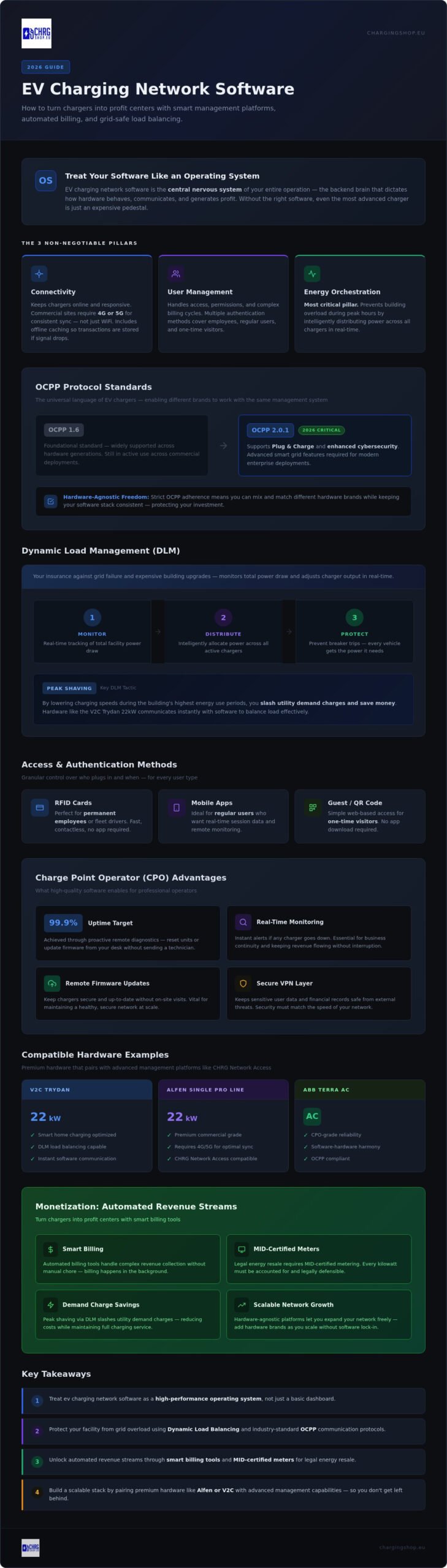
In 2026, ev charging network software is the central nervous system of your entire operation. It isn’t just a basic interface; it’s the backend brain that dictates how your hardware behaves, communicates, and generates profit. We’ve moved far beyond simple mobile apps. Today, enterprise-grade management platforms handle the heavy lifting of EV charging station infrastructure; ensuring that every kilowatt is accounted for and every user experience is seamless. This software acts as the bridge between the physical charger and the digital world.
Modern platforms rest on three non-negotiable pillars: connectivity, user management, and energy orchestration. Connectivity ensures your chargers stay online and responsive. User management handles access, permissions, and complex billing cycles. Energy orchestration is the most critical; it prevents your building from blowing a fuse during peak hours by intelligently distributing power. Don’t confuse this with a driver app. While a driver app is a simple tool for starting a session, the management software is a full-scale command center for the operator. It’s the difference between using a remote control and managing the entire broadcast station.
The Core Role of the Charge Point Operator (CPO)
As a CPO, you’re responsible for the harmony between hardware like the Abb terra ac and your chosen software. High-quality ev charging network software enables 99.9% uptime through proactive remote diagnostics. Instead of sending a technician to the site for every minor glitch, you can reset units or update firmware from your desk. Real-time monitoring is essential for business continuity. If a charger goes down, you’ll know immediately. This proactive approach keeps your customers happy and your revenue flowing without interruption.
Why Connectivity Matters: From WiFi to 4G/5G
Reliability starts with the connection. While WiFi works for residential use, commercial sites require 4G or 5G for consistent software sync. These cellular connections offer better stability and security for premium hardware like the Alfen Single Pro Line 22kW or V2C Trydan 22kW. Look for software that includes offline caching. This feature ensures that if the signal drops, the charger continues to function and stores transaction data until the connection returns. Secure VPNs add another layer of protection, keeping sensitive user data and financial records safe from external threats. Your software must be as secure as it is fast.
Essential Features of Modern Management Platforms
Don’t buy a platform that just looks pretty. You need features that solve real-world problems and eliminate manual work. Your management platform isn’t just a list of chargers; it’s a suite of tools designed to optimize performance and prevent downtime. High-performance ev charging network software must handle complex tasks like load balancing and user authentication without constant human intervention. Choosing the right ev charging network software ensures your hardware remains a long-term asset rather than a technical burden.
Mastering OCPP 1.6 and 2.0.1 Protocols
The Open Charge Point Protocol (OCPP) is the universal language of EV chargers. It allows different charger brands to talk to the same management system seamlessly. In 2026, OCPP 2.0.1 is critical because it supports advanced smart grid features like Plug & Charge and enhanced cybersecurity. Strict adherence to these protocols means you aren’t locked into one manufacturer. You can mix and match different hardware brands while keeping your software stack consistent. This hardware-agnostic approach protects your investment and gives you the freedom to scale your network as you see fit.
Dynamic Load Management (DLM) and Grid Stability
Dynamic Load Management is your insurance against grid failure and expensive building upgrades. It monitors the total power draw of your facility and adjusts charger output in real-time. This prevents your building from tripping a breaker when everyone plugs in at once. Peak Shaving is a key tactic here. By lowering charging speeds during the building’s highest energy use, you slash utility demand charges and save money. High-end units like the V2C Trydan 22kW excel at this. They communicate instantly with the software to balance the load effectively, ensuring every vehicle gets the power it needs without overloading the system.
Security and accessibility go hand-in-hand in a professional setup. You need granular control over who plugs in and when. Modern systems allow for multiple authentication methods:
- RFID cards: Perfect for permanent employees or fleet drivers.
- Mobile apps: Ideal for regular users who want real-time data.
- Guest protocols: Simple QR code or web-based access for one-time visitors.
Remote firmware updates are just as vital for maintaining a healthy network. They allow you to keep your chargers secure and compliant with the latest regulations without ever leaving your office. Site visits are expensive and slow. Software that pushes updates automatically ensures your infrastructure stays modern. If you’re ready to streamline your operations, browse our full range of smart charging solutions to see these features in action.
Monetization: How Software Drives Revenue
Stop treating your chargers as a sunk cost. High-performance ev charging network software transforms your infrastructure into a reliable revenue stream. It automates the entire financial cycle, from tracking energy consumption to depositing funds into your account. You can set specific tariffs for different user groups effortlessly. Charge guests a public rate, provide employees with a subsidized tariff, and offer fleet drivers free access. This flexibility ensures you recover energy costs while maximizing your return on investment. Automation removes the headache of manual invoicing and ensures you never miss a payment.
MID Meters and Legal Billing Compliance
If you plan to sell electricity by the kilowatt-hour, MID certification is non-negotiable. Measuring Instruments Directive (MID) standards ensure the meter inside your charger is accurate and tamper-proof. Without this, billing users for energy consumption is often legally restricted in many commercial jurisdictions. Your ev charging network software must pull data directly from these hardware meters to generate compliant invoices. The Alfen Single Pro Line is a leader in this space. It offers high-precision metering that integrates perfectly with management platforms, ensuring every cent is accounted for and every bill is legally sound.
Frictionless payments are the key to high utilization rates. Your software should support a wide range of payment methods to cater to every driver. Integration with gateways allows you to accept credit cards, Apple Pay, and Google Pay directly through a mobile app or a web portal. RFID cards remain a staple for corporate environments, providing quick tap-and-go access for authorized personnel. By offering multiple ways to pay, you remove barriers to entry and keep your stations busy. It’s about making the transaction as invisible as possible for the user.
Unlocking Roaming Revenue
Don’t limit your station’s visibility to your own user base. E-roaming allows drivers from other networks to find and use your chargers. Platforms like Hubject and Gireve act as intermediaries, connecting thousands of different charging networks across the globe. When you enable roaming through your software, your stations appear on major public charging maps used by millions of drivers. This massive increase in visibility drives higher traffic to your site. While there’s typically a revenue split between the station host and the service provider, the volume of additional sessions often outweighs the small fee. It’s the most efficient way to turn a quiet parking lot into a high-traffic charging hub.
Choosing Your Stack: Hardware Agnosticism vs. Integration
Don’t fall for the myth that software can fix bad hardware. While many promote “hardware-agnostic” ev charging network software, the reality is more complex. Cheap, non-compliant chargers often lack the internal sensors and processing power to execute advanced commands sent by the cloud. When the hardware is limited, your ev charging network software is limited too. You need a stack where the physical unit and the digital brain work in perfect harmony.
Premium hardware acts as a high-performance foundation. It ensures that every command, from a remote reset to a dynamic load adjustment, happens instantly and reliably. Investing in quality from the start prevents technical debt that kills your ROI later. You want an API-first platform that allows for deep integration, rather than a closed ecosystem that locks you into a single vendor’s limited roadmap. Rapid business deployment requires a turnkey solution that’s ready to scale the moment you plug it in.
V2C and Alfen: Software-Ready Hardware
The V2C Trydan 22kW isn’t just a charger; it’s a smart home hub. It features native integration with solar software, allowing you to prioritize green energy without expensive third-party bridges. For industrial sites, Alfen’s Single Pro Line offers the rugged reliability needed for multi-charger clusters. If you’re managing a commercial fleet, the ABB Terra AC provides the deep data logging required for professional fleet software. These brands don’t just “work” with software; they enhance its capabilities through superior internal components.
The Total Cost of Ownership (TCO) Calculation
Look beyond the initial price tag. Your TCO includes subscription fees, electricity costs, and long-term maintenance. High-quality software reduces “truck rolls” by allowing for remote diagnostics and resets. If a charger glitches, you fix it from your phone instead of paying for a site visit. These savings add up fast and often pay for the software subscription itself within the first year. Site visits are profit killers; remote management is a profit protector.
High-quality software ensures your infrastructure is future-proof and ready for the grid demands of 2026. You don’t want to replace your hardware in two years because it can’t handle a software update. Start with the right foundation to ensure maximum uptime and user satisfaction. To get started with the best equipment in the industry, shop our smart hardware collection today.
Executing Your Strategy with CHRG Network
Stop waiting for the future to arrive. It’s already here. You’ve seen how ev charging network software manages power and drives revenue. Now, you need the right tool to execute that vision. CHRG Network is the professional management solution designed to bridge the gap between high-end hardware and daily operations. It isn’t just a dashboard; it’s your command center. Whether you’re starting with a single V2C Trydan or deploying a nationwide commercial fleet, this platform scales with your ambition. We provide the digital infrastructure so you can focus on growth.
Scalability is the core of our approach. You might start small, but your software shouldn’t hold you back. CHRG Network handles the transition from a single wallbox to a complex multi-site network with ease. We help you move beyond basic connectivity to true energy orchestration. By choosing a system that grows with you, you avoid the costly mistake of switching platforms later. Get started with a personalized charging offer that matches your specific site requirements and business goals.
Seamless Onboarding with CHRG Network Access
Activating CHRG Network access is a streamlined process designed for speed. Once your hardware is installed, you can get online in minutes. The dashboard interface provides a bird’s-eye view of every asset in your network. You’ll track energy consumption in real-time and manage multi-user permissions without breaking a sweat. Assigning RFID cards to specific employees or fleet drivers takes seconds. This level of control ensures your chargers are used exactly how you intended, with zero guesswork. Reliability is built into every step of the onboarding process.
Custom Solutions for Every Business Case
Every business case is unique. Hotels need guest billing that’s easy to use. Offices require subsidized employee charging. Apartment complexes need a fair way to split utility costs. Our combined approach of premium hardware and advanced ev charging network software solves these challenges simultaneously. By pairing industrial-grade units from Alfen or ABB with CHRG Network, you eliminate the risk of hardware-software friction. You get a unified system that works from day one. This integration is why our clients see faster ROI and fewer technical headaches.
- Hotels: Drive guest loyalty with seamless, branded charging experiences.
- Offices: Manage fleet and employee access through a single portal.
- Apartments: Automate billing for residents and reduce administrative load.
Don’t leave your infrastructure to chance. A fragmented system will cost you time and money. Invest in a professional stack that prioritizes uptime and revenue generation. Execute your charging strategy today and turn your parking lot into a high-performance asset.
Secure Your Lead in the EV Charging Race
In 2026, staying competitive means moving beyond basic connectivity. You’ve learned that the right ev charging network software acts as a profit center, balancing your grid and automating your billing without manual intervention. By pairing industrial-grade hardware with intelligent management tools, you eliminate technical friction and maximize uptime. It’s about building a scalable ecosystem that works today and stays relevant as technology evolves. Your infrastructure should be a seamless extension of your business goals, not a maintenance headache.
We provide the professional tools you need to succeed. With OCPP 2.0.1 ready solutions and global hardware distribution, we ensure your infrastructure is world-class from day one. Our team offers expert commercial support to help you navigate every technical hurdle and optimize your setup. Don’t let complex management slow your growth or eat into your margins. Take control of your energy future and maximize your charging ROI with CHRG Network and premium hardware at Charging Shop. Your high-performance network is ready for deployment. Let’s build something powerful together.
Frequently Asked Questions
What is the difference between EV charging software and a mobile app?
EV charging software is the backend operating system for site owners, while a mobile app is just a driver’s tool to start a session. The software manages energy loads, processes payments, and monitors hardware health across multiple locations. Apps are simply the front-facing interface for the end user. Professional management requires the full backend suite to ensure high uptime and complex data logging that a basic app cannot handle.
Does my charging station need to be OCPP compliant?
Yes, OCPP compliance is the industry standard that prevents vendor lock-in. It allows your hardware to communicate with any management platform. In 2026, choosing an OCPP 2.0.1 compliant unit like the Alfen Single Pro Line ensures you can access advanced smart grid features and better cybersecurity. Without this universal language, you’re stuck with a single manufacturer’s ecosystem. This limits your ability to scale or switch software providers as your business grows.
How do I bill users for the electricity they consume?
Billing requires a combination of MID-certified meters and integrated payment gateways. Your ev charging network software pulls precise energy data from hardware like the ABB Terra AC to generate legally compliant invoices. You set the tariffs, such as per kWh or flat fees, and the software automates collection via credit cards or RFID. This setup turns your infrastructure into a hands-off revenue stream while ensuring absolute financial accuracy for every single charging session.
Can I manage chargers from different brands on one software platform?
You can manage multiple brands on a single platform if all units support the Open Charge Point Protocol. This hardware-agnostic approach is a core benefit of professional ev charging network software. It allows you to mix industrial-grade Alfen chargers with residential V2C Trydan units in the same management dashboard. This flexibility is vital for commercial sites that need different hardware types to meet power requirements while maintaining a unified billing and monitoring system.
What happens if the internet connection to my charger fails?
If the internet fails, high-quality chargers use offline caching to keep the station functional. The hardware stores transaction data and user authorizations locally until the connection is restored. Once back online, the charger syncs this data with the management platform for billing. This prevents driver frustration and ensures business continuity during network outages. Reliable hardware like the V2C DENKA is built to handle these interruptions without losing critical session information or power.
Is dynamic load balancing a software or hardware feature?
Dynamic load balancing is a hybrid feature that requires both hardware sensors and software logic. The hardware monitors the building’s total energy consumption in real-time, while the software calculates how much power to distribute to each vehicle. This coordination protects your facility from grid overload and avoids expensive infrastructure upgrades. It’s an essential tool for multi-charger sites where simultaneous charging could otherwise trip breakers or incur high peak-demand charges from your utility.
How much does an EV charging network subscription cost?
Subscription costs depend on the number of chargers, required features, and the level of technical support needed. Most providers offer tiered pricing based on whether you need simple monitoring or full commercial billing and roaming capabilities. Instead of a flat fee, many commercial operators choose a per-socket monthly model. For a precise estimate tailored to your specific fleet or site, request a Personalised Charging Offer to match your exact business requirements.
What is the role of an eMSP in an EV charging network?
An e-Mobility Service Provider (eMSP) focuses on the driver’s experience rather than the physical hardware. They provide the apps and RFID cards drivers use to find and pay for charging across different networks. While the Charge Point Operator (CPO) manages the stations, the eMSP manages the customers. In a professional network, these roles often work through roaming agreements to ensure your chargers are visible to the widest possible audience of electric vehicle owners.
