
 Deutsch
 Dansk
Dansk Suomi
Suomi Latviešu
 Lietuvių
 Norsk bokmål
 polski
 Русский
 Svenska
No products in the cart.
Uncategorized
Smart EV Charging Schedule to Save Money: The 2026 Hardware Guide
09
Sep
Sep
Did you know that charging your car at 6 p.m. could cost you more than double what it costs at midnight? With PG&E peak rates hitting $0.62/kWh in 2026, plugging in at the wrong time is a luxury you can’t afford. Setting a smart ev charging schedule to save money isn’t just a convenience; it’s a financial necessity. You’re likely tired of surging utility costs and the expiration of federal tax credits. You need a solution that works while you sleep.
Stop overpaying. You’ll master high-efficiency charging strategies using pro-grade hardware to slash your energy bills by up to 70%. We’ve stripped away the fluff to focus on high-performance tools like the V2C Trydan and ABB Terra AC. This guide breaks down the best 2026 hardware for automated off-peak scheduling, seamless solar integration, and the detailed cost reporting you need for tax season. Get ready to turn your charger into a profit-saving tool.
Key Takeaways
- Avoid 2026 peak-rate spikes by syncing your charger with utility-specific off-peak windows to slash costs by up to 70%.
- Use dynamic load balancing to maximize charging speed without the high cost of expensive main fuse upgrades.
- Implement a smart ev charging schedule to save money using hardware that automates your energy consumption while you sleep.
- Leverage V2C Trydan’s native solar integration to achieve near-zero costs through surplus photovoltaic utilization.
- Gain total cost transparency and eliminate energy waste with professional cloud dashboards and CHRG Network access.
Understanding the Variables: What Drives Your EV Charging Bill?
Your monthly electricity bill isn’t just a reflection of how much you drive. It’s a result of three critical pillars: utility rates, hardware efficiency, and timing. In 2026, the gap between “smart” and “standard” charging has widened into a massive financial divide. If you plug in without a plan, you’re walking straight into the Peak Hour Trap. Grid volatility is at an all-time high; utilities now use aggressive surge pricing to manage demand during the late afternoon and early evening.
Phantom load is another silent budget killer. Basic, non-intelligent chargers often waste energy even when they aren’t actively pumping juice into your battery. They pull standby power 24/7. Modern Smart charger technology eliminates this waste by entering deep-sleep modes and only activating during your pre-set windows. Mastering a smart ev charging schedule to save money requires understanding these variables before you buy your hardware.
Residential and commercial users face different hurdles. Homeowners struggle with fluctuating Time-of-Use (ToU) tiers, while businesses deal with high demand charges. Regardless of your setup, the goal remains the same: move your energy consumption to the periods of lowest demand and highest efficiency.
Time-of-Use (ToU) Rates Explained
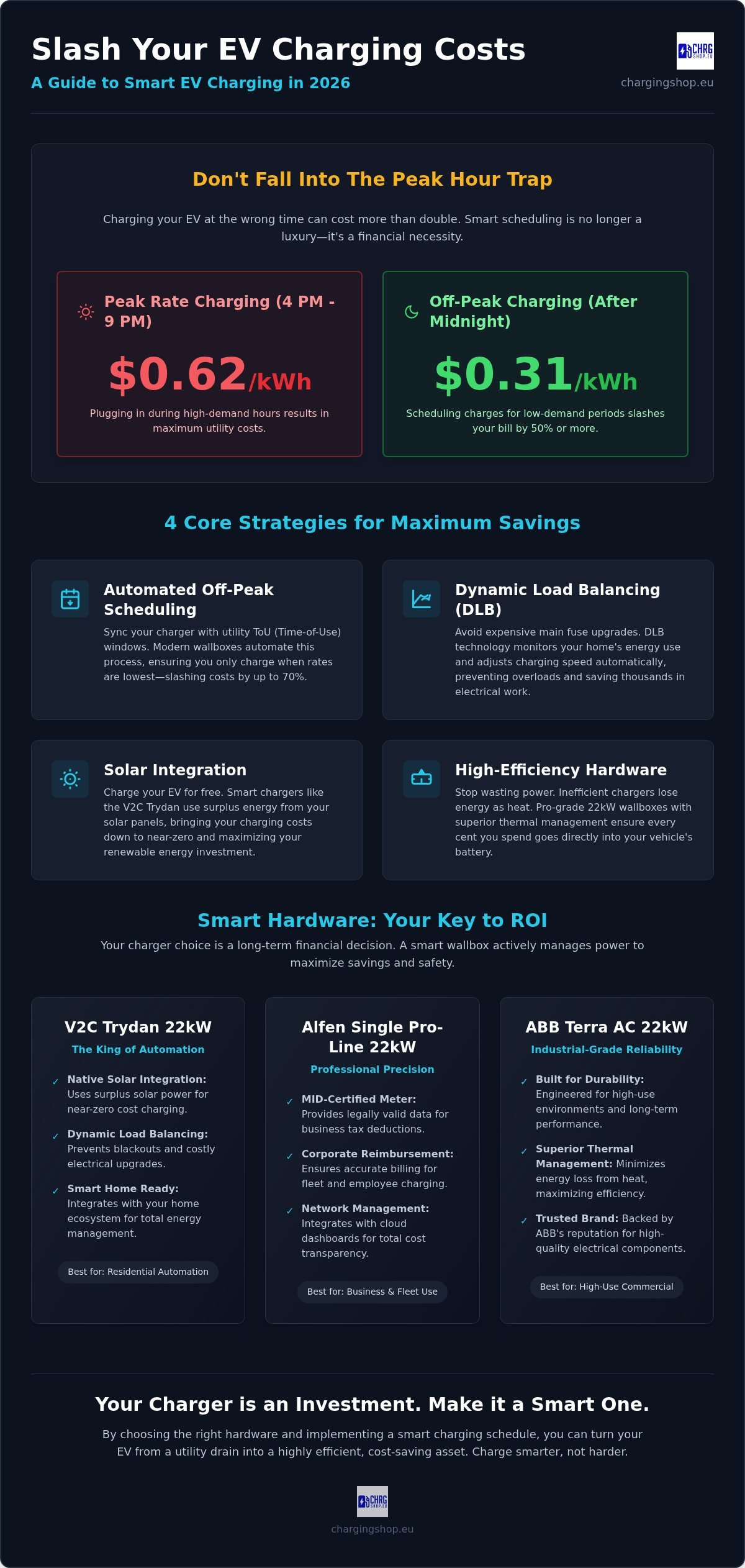
Smart grids in 2026 are designed to penalize daytime charging. For example, PG&E customers now face peak rates of approximately $0.62/kWh between 4 p.m. and 9 p.m. Compare that to the super off-peak rate of $0.31/kWh after midnight. That is a 50% discount just for changing your timing. Level 1 charging is too slow to take full advantage of these narrow windows. It often takes 20 hours to charge, forcing you to bleed into high-cost daytime hours. High-speed 22kW wallboxes are now the industry standard because they allow you to finish a full charge entirely within the cheapest utility window.
The Hidden Cost of Inefficient Hardware
Not all electricity you pay for reaches your battery. Low-quality internal components and thin cables generate significant heat during long charging sessions. This heat loss represents pure financial waste. Investing in a 22kW wallbox for home provides a better ROI because superior thermal management reduces energy bleed. When you use a smart ev charging schedule to save money, you also reduce the wear on your home’s electrical infrastructure. High-performance hardware like the ABB Terra AC or V2C Trydan ensures that every cent you spend on power actually moves your vehicle.
Smart Hardware: Why Your Wallbox Choice Dictates Your ROI
Your charger choice is a long-term financial decision. A “dumb” charger simply delivers power; a smart wallbox manages it. Dynamic Load Balancing (DLB) is your most effective tool for avoiding hidden costs. This technology monitors your home’s total energy consumption in real-time. If you turn on a heavy appliance, the wallbox automatically reduces the car’s power draw. This prevents your main breaker from tripping. More importantly, it eliminates the need for expensive main fuse upgrades, which can cost thousands in utility fees and electrical labor.
Accuracy matters for your bottom line. High-end hardware utilizes MID-certified meters to track every watt. This ensures you aren’t paying for phantom energy or grid loss. When you implement a smart ev charging schedule to save money, these precise metrics allow you to audit your energy provider’s billing with total confidence. Choosing the right hardware today prevents technical bottlenecks tomorrow.
V2C Trydan: The King of Automation
The V2C Trydan 22kW is the ultimate choice for residential automation. It doesn’t just follow a static timer. It integrates directly with your smart home ecosystem to balance household loads dynamically. This wallbox automates your smart ev charging schedule to save money by syncing with real-time utility price feeds. It waits for the exact moment rates bottom out. By avoiding grid overloads, the Trydan keeps your infrastructure costs at zero. It’s a proactive guide for your home’s energy economy.
Alfen and ABB: Professional Precision
Professional and fleet environments require a different level of control. The Alfen Single Pro Line 22kW is the gold standard for those needing business tax deductions. Its MID-certified metering provides the legal proof required for corporate reimbursement. You only pay for the energy that actually reaches the battery, not the heat lost in the cable.
For industrial-grade reliability, the ABB Terra AC 22kW charger allows you to set fleet-wide energy limits. This is crucial for avoiding peak demand charges that utilities levy on commercial properties. It ensures your facility stays within its power budget while keeping vehicles ready for the road. If you need help choosing between these high-performance options, browse our Personalised Charging Offer for a tailored hardware match.
Solar Integration: The Path to Near-Zero Charging Costs
Solar self-consumption is the most effective way to eliminate your fuel costs. In 2026, selling excess energy back to the utility for a few cents is a losing game. You should use that power yourself. By integrating your photovoltaic system with your wallbox, you create a smart ev charging schedule to save money that relies on free energy. This setup uses CT clamps, small sensors clipped to your electrical lines, to feed real-time production data to your charger. If your panels produce a surplus, the charger directs it into your car instead of letting it bleed back to the grid.
Calculating your payback period is simple. Compare the cost of your solar-integrated hardware against your annual grid-charging expenses at 2026 rates. Most high-performance setups pay for themselves within three to five years by maximizing self-consumption. This turns your vehicle into a mobile battery that stores your home’s excess energy production.
Direct Communication Between Inverter and Wallbox
The V2C Trydan leads the market because it offers native solar inverter compatibility without requiring expensive third-party hubs. It speaks directly to your inverter. This eliminates the need for complex energy management systems that add unnecessary cost and failure points. Smart hardware also prevents solar clipping. Solar clipping occurs when your panels generate more power than your system can handle or store, leading to wasted potential; a smart wallbox captures this clipped energy and stores it in your EV battery.
Managing Intermittent Power
Smart chargers are built to handle the volatility of solar production. When a cloud passes, the system doesn’t just cut the connection. It manages power dips gracefully. Most EVs require a minimum threshold of 1.4kW to maintain a charging session. Smart hardware optimizes this limit. It ensures your car continues to charge even from smaller arrays by intelligently balancing household appliance demand. Your dishwasher and fridge take priority, while the wallbox mops up every remaining watt of surplus for your vehicle. This level of automation is the backbone of any smart ev charging schedule to save money.
Network Management: Using Software to Kill Energy Waste
Hardware is the body, but software is the brain of your energy strategy. To truly maximize your ROI, you need professional-grade oversight. This is where dedicated management platforms take over. Utilizing CHRG Network access for EV stations allows you to manage multiple charging points from a single, centralized dashboard. You can implement a smart ev charging schedule to save money across an entire fleet or a residential complex with a few clicks. Cloud dashboards provide real-time visibility into energy consumption, identifying high-cost charging behaviors before they inflate your monthly statement.
Energy caps are a critical tool for commercial sites. Utilities often levy “demand charges” based on your highest peak of usage during a billing cycle. Software prevents these expensive spikes by automatically throttling charging speeds when the building’s total load reaches a predefined limit. For companies with employees charging at home, automated billing and reimbursement modules eliminate manual spreadsheets. You receive precise, MID-certified data sent directly to your accounting software, ensuring every cent is accounted for without administrative friction.
Remote Monitoring and Control
Vampire drain is a silent threat to your savings. Even after a car reaches 100%, some internal systems continue to pull small amounts of power. Use your mobile app to terminate sessions remotely the moment the battery hits its target. Modern platforms integrate directly with dynamic energy markets to track price fluctuations in real-time. This allows your system to pause charging if rates suddenly spike due to grid instability. If you want to eliminate energy waste, view our high-performance wallbox collection to find hardware that supports these advanced cloud features.
OCPP 1.6 and 2.0.1 Compatibility
Avoid the trap of proprietary software. Open Charge Point Protocol (OCPP) is the universal language that ensures your hardware can communicate with any management platform. While OCPP 1.6 remains common, 2026 deployments prioritize OCPP 2.0.1 for its superior security and advanced smart charging capabilities. These open standards prevent “hardware lock-in.” If your current software provider increases their fees, you can switch to a new backend provider without replacing your expensive physical wallboxes. V2C and Alfen apps offer the most intuitive interfaces for daily tracking, turning complex electrical metrics into simple, actionable cost reports that anyone can understand.
Strategic Purchasing: Selecting Hardware for Long-Term Savings
Don’t let a low sticker price fool you. The true cost of a charger includes the electricity it wastes and the peak-rate fees it fails to avoid. Total Cost of Ownership (TCO) is the only metric that matters. A “dumb” charger might save you money at the checkout, but it will bleed your bank account dry over years of inefficient sessions. To implement a smart ev charging schedule to save money, you need hardware that acts as a sophisticated energy hedge against rising utility costs.
Investing in a 22kW wallbox today is a strategic move for future-proofing. Even if your current vehicle only accepts 11kW, the electrical infrastructure for a 22kW circuit is a one-time expense. When you upgrade your car in a few years, you won’t need to pay for a second installation or new wiring. You’re buying capacity and efficiency now to avoid inflation-driven labor costs later. This proactive approach ensures your home or business is ready for the next generation of high-capacity batteries.
The “Save as You Charge” Checklist
Every budget-conscious buyer needs these five features to guarantee a rapid ROI:
- Dynamic Load Balancing: Protects your main fuse and avoids expensive grid upgrade fees.
- Native Solar Integration: Essential for near-zero fuel costs using surplus photovoltaic energy.
- MID-Certified Metering: Necessary for accurate tax deductions and corporate reimbursement.
- OCPP 2.0.1 Compatibility: Prevents hardware lock-in and allows you to switch software providers.
- Automated Scheduling: The core requirement for a smart ev charging schedule to save money during off-peak windows.
Residential vs. Commercial ROI
For home users, the V2C Trydan offers the fastest payback period due to its native solar logic and seamless smart home integration. It’s built for the typical residential energy profile, focusing on maximizing self-consumption. Businesses with high vehicle turnover require a different approach. While the initial 40kw DC wallbox price is higher, the ROI comes from rapid turnaround times. These industrial units allow you to charge multiple vehicles quickly during short, super off-peak windows, avoiding high-cost daytime demand charges. Always evaluate the warranty and build quality to prevent premature replacement costs.
Your Next Steps to Lower Bills
Start your transition to high-efficiency charging today. Audit your current energy plan to identify your cheapest 2026 off-peak windows. Select a wallbox from our collection that offers dynamic power management and solar compatibility. Finally, join the CHRG Network to gain total transparency and remote control over every session. Stop guessing and start measuring. The right hardware choice today dictates your savings for the next decade.
Take Control of Your 2026 Energy Strategy
You now have the blueprint to dismantle high electricity bills and optimize your vehicle’s performance. The right hardware transforms your EV from a passive consumer into a high-performance asset. By selecting pro-grade units like the V2C Trydan or ABB Terra AC, you ensure every watt is delivered with technical precision. Implementing a smart ev charging schedule to save money is the most direct path to consistent monthly savings. Whether you’re leveraging native solar integration or professional network management through CHRG, the tools for 2026 are ready for immediate deployment.
We provide global shipping on all V2C, Alfen, and ABB hardware to get you started quickly. Our team offers expert technical support for complex solar integrations, ensuring your setup is flawless from day one. As an official CHRG Network partner, we provide the professional oversight needed for total cost transparency across your entire fleet or household. Stop overpaying for grid power and start charging on your own terms. Shop Smart EV Chargers and Start Saving Now. Your bank account will thank you.
Frequently Asked Questions
Is it actually cheaper to charge an EV at home than use gas in 2026?
Yes, home charging remains significantly cheaper than gasoline in 2026. While the average U.S. residential electricity rate is 18.34¢/kWh, the per-mile cost of an EV is typically a fraction of a gas-powered vehicle. By avoiding the markup of public fast chargers and gas stations, you lock in lower rates. Homeowners using smart scheduling often pay even less by targeting super off-peak windows where rates drop below the national average.
How much can a smart charger really save me per year?
A smart charger typically saves drivers between $360 and $960 annually. If you live in a high-mileage or two-EV household, these savings can exceed $1,500 per year. These figures come from shifting your energy draw away from expensive peak times. Without a smart ev charging schedule to save money, you’re likely paying 50-70% more per kilowatt-hour than necessary. Smart hardware automates this process to ensure you never miss a discount window.
Do I need a special electricity plan to reduce charging costs?
You don’t strictly need one, but Time-of-Use (TOU) plans are essential for maximum savings. Utilities like PG&E offer specialized EV-2A plans where super off-peak rates are approximately $0.31/kWh, compared to $0.62/kWh during peak hours. Switching to an EV-specific plan allows your smart hardware to target these deeply discounted periods. Check with your local provider for “electrification” or “EV-only” rates to unlock the best ROI on your high-performance hardware.
Can I charge my EV for free using solar panels?
You can achieve near-zero charging costs by using a solar-integrated wallbox like the V2C Trydan. This hardware uses “Green Mode” to detect when your panels produce more power than your home needs. Instead of selling that surplus back to the grid for a low credit, the charger directs it into your car battery. While the solar hardware requires an initial investment, the daily energy used for your commute becomes effectively free once the system is paid off.
What is the most energy-efficient EV charger in 2026?
Efficiency in 2026 is defined by minimal heat loss and advanced standby modes. High-performance units like the V2C Trydan and ABB Terra AC are engineered with superior internal components that reduce energy bleed during long sessions. These chargers also feature “deep sleep” technology to eliminate vampire drain when not in use. Choosing hardware with MID-certified metering ensures that you’re tracking actual energy delivered to the battery with 99% accuracy.
Does charging at 22kW cost more than charging at 7kW?
Charging at 22kW doesn’t cost more per kilowatt-hour, and it can actually save you money. Because a 22kW wallbox charges your car three times faster than a standard 7kW unit, it allows you to complete a full charge entirely within the cheapest off-peak window. If your utility only offers a four-hour “super off-peak” discount, a slower charger might bleed into expensive partial-peak hours; this increases your total bill for the same amount of energy.
How does dynamic load balancing help me save money?
Dynamic load balancing saves you money by preventing expensive electrical infrastructure upgrades. It monitors your home’s total power draw and adjusts the charger’s output in real-time. This prevents your main breaker from tripping when you use heavy appliances. By managing these loads intelligently, you avoid the need for a costly main fuse upgrade from your utility company. These upgrades often run into thousands of dollars in labor and permit fees that smart hardware eliminates.
What happens if I charge my EV during peak electricity hours?
Charging during peak hours, typically between 4 p.m. and 9 p.m., can double or triple your costs. In 2026, some California utilities charge roughly $0.62/kWh during these windows. This is why a smart ev charging schedule to save money is so critical. Without automation, you risk plugging in after work and paying a massive premium. Smart hardware keeps the session paused until rates drop to off-peak levels, usually after midnight.
