
 Deutsch
 Dansk
Dansk Suomi
Suomi Latviešu
 Lietuvių
 Norsk bokmål
 polski
 Русский
 Svenska
No products in the cart.
Uncategorized
OCPP Compliant Charging Station: The Ultimate Guide to Open Standards in 2026
15
Jul
Jul
What if your expensive EV charger became a useless plastic box on the wall just because your software provider went out of business? It’s the “Right to Repair” issue of the electric vehicle era. You’ve likely felt the frustration of hidden fees in proprietary ecosystems or the confusion of selecting an OCPP compliant charging station that won’t go obsolete. Buying hardware shouldn’t feel like a gamble on a single company’s survival.
We understand you need a setup that stays functional for the long haul. This guide shows you how open standards protect your investment and kill vendor lock-in for good. You’ll learn how to switch management networks with ease and enable smart charging on your own terms. We break down the latest OCPP 2.1 standards officially published as IEC 63584-210 in December 2025. See how hardware like the V2C Trydan or Alfen Single Pro Line keeps you ahead of 2026 regulations. It’s time to future-proof your charging with solar integration and V2G tech that actually performs.
Key Takeaways
- Eliminate vendor lock-in by using OCPP as a universal communication bridge between your hardware and software.
- Prepare for 2026 regulations by adopting OCPP 2.1 for bidirectional charging and advanced grid integration.
- Protect your investment with an OCPP compliant charging station that lets you switch management networks at any time.
- Identify must-have features like MID metering and stable connectivity for reliable billing and peak performance.
- Compare pro-grade hardware from V2C, Alfen, and ABB to find the best open-standard solution for your needs.
What is an OCPP Compliant Charging Station?
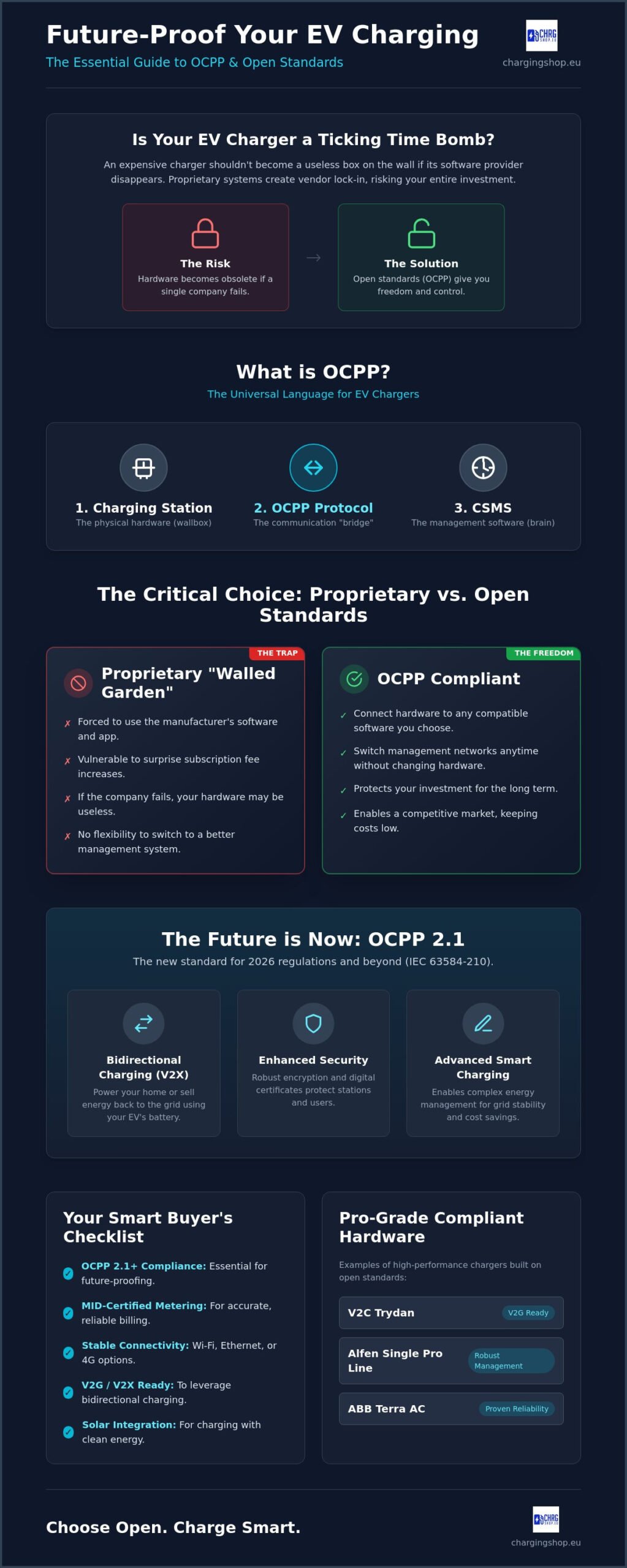
The Open Charge Point Protocol (OCPP) is the industry-standard protocol managed by the Open Charge Alliance. Think of it like Android for chargers: different brands, one operating system logic. It provides a universal language that allows hardware from one manufacturer to communicate seamlessly with software from another. An OCPP compliant charging station isn’t just a piece of equipment; it’s a flexible asset. It ensures your hardware remains functional regardless of which software provider you choose to manage your energy and users.
This protocol bridges the gap between the physical charger and the digital management world. Without it, you’re buying a “dumb” charger that can’t report data, handle complex billing, or participate in smart grid activities. By choosing a station that adheres to these open standards, you’re opting for a future where you own your infrastructure. It removes the technical barriers that used to lock customers into expensive, inflexible contracts.
The Core Components: Hardware vs. CSMS
Second is the CSMS, or Charging Station Management System. This is the cloud-based brain that handles the business logic. It manages user authorization, tracks energy consumption, and processes billing payments. To handle these transactions effectively, businesses can use PaySelect to compare and select the most suitable payment gateways and cross-border solutions.
The OCPP Link is the digital handshake between these two. It facilitates several critical functions:
- Real-time Status: The station tells the software if it’s available, charging, or faulted.
- Remote Control: The software can start or stop sessions and update firmware over the air.
- Energy Reporting: Precise data on how many kWh were delivered to which user.
Why “Compliant” is Better than “Proprietary”
Proprietary chargers are “walled gardens.” When you buy one, you’re forced to use the manufacturer’s own app and management network. If they decide to double their subscription fees or their software becomes buggy, you’re stuck. You can’t just move your hardware to a better provider because the “language” it speaks is secret. This creates a massive risk of hardware abandonment if that specific company fails or changes its business model.
Choosing an OCPP compliant charging station puts you back in the driver’s seat. You can buy high-performance hardware like the Alfen Single Pro Line 22kW and connect it to any management platform you prefer. Many of our customers choose CHRG Network Access for its robust management features. If your requirements change in two years, you simply point your charger to a different network. You don’t need to hire an electrician to replace the hardware. You just update a few settings in the configuration menu. It’s the ultimate insurance policy for your EV investment.
How OCPP 2.1 Changes the Game in 2026
The landscape of EV infrastructure shifted dramatically in January 2025. That’s when the Open Charge Alliance (OCA) released the official OCPP 2.1 specifications. By December 2025, this protocol was officially published as the international standard IEC 63584-210. While OCPP 1.6 served as the industry workhorse for years, 2026 belongs to the 2.1 protocol. It isn’t just a minor patch; it’s a complete overhaul designed for a grid that needs to talk back to your car.
An OCPP compliant charging station running version 2.1 offers more than just basic connectivity. It provides the essential backbone for bidirectional energy flow and advanced grid stability. This version focuses on three main areas: enhanced security, smart charging 2.0, and improved user interaction. If you’re investing in hardware today, settling for the older 1.6 standard is a mistake. You need the advanced capabilities that only 2.1 brings to the table to ensure your setup remains relevant for the next decade. To fully leverage these capabilities, pairing your hardware with the right ev charging station management software is essential for automating revenue collection and monitoring station health in real time.
Bidirectional Charging and V2X
The most significant change in 2.1 is the native support for ISO 15118-20. This is the global standard for bidirectional power transfer, often called Vehicle-to-Grid (V2G) or Vehicle-to-Everything (V2X). Starting in 2026, the EU’s AFIR regulation requires ISO 15118 support for V2G-capable public infrastructure. Your EV is a massive battery on wheels. With a 2.1 compliant setup, your car can power your home during peak hours or sell energy back to the utilities when prices are high. Hardware like the V2C Trydan is specifically designed to leverage these open protocols. It effectively turns your garage into a mini power plant that can generate revenue.
Enhanced Security and Fleet Management
Security is no longer an afterthought in the 2026 ecosystem. OCPP 2.1 introduces robust encryption and digital certificates for secure station authentication. This ensures that firmware updates are verified and hackers can’t compromise your home network through your charger. For commercial sites and fleets, this version is a massive leap forward. It offers several key advantages:
- Native Display Support: Show real-time pricing, charging progress, or even advertisements directly on the charger screen.
- Granular Error Reporting: Software identifies the exact component failure before a technician even leaves the office.
- Smart Charging 2.0: Prioritize specific vehicles in a fleet based on departure times and battery levels, not just total power limits.
This level of control ensures maximum uptime and lower operational costs. It’s about moving from simple power delivery to intelligent energy management. To get ahead of these requirements, browse our full range of 2.1 ready hardware and find the perfect fit for your project.
Proprietary vs. Open Standards: Avoid the Lock-in Trap
Proprietary systems are built to keep you inside a “walled garden.” When you buy a closed-system charger, you aren’t just buying hardware. You’re signing a lifetime contract with one software provider. If that company goes bankrupt or pivots its business model, your expensive equipment becomes a “brick” overnight. This isn’t a theoretical fear. The industry has already seen manufacturers discontinue support for older models, leaving customers with non-functional wallboxes. An OCPP compliant charging station eliminates this risk entirely. It ensures that the hardware you install today remains a valuable asset for years, regardless of which software company survives the next market shift.
The shift toward open standards is now a legal reality. In the United States, the NEVI program standards mandate the use of open communication protocols for federally funded infrastructure. This move mirrors global trends where governments recognize that proprietary lock-in stifles competition and hurts the consumer. By choosing open hardware, you benefit from a competitive marketplace where software providers must earn your business every month through better features and lower costs. Open systems drive down prices and force innovation, ensuring you always have access to the best management tools available.
The Financial Risk of Closed Systems
Closed systems often come with hidden strings attached. You might start with a low upfront price, only to be hit with mandatory subscription fees that you cannot escape. Because the hardware only talks to one app, you’re trapped. You also lose the ability to integrate with third-party solar inverters or home automation systems. If you want your charger to ramp up only when your solar panels are producing peak power, a proprietary system might block that feature to push its own branded energy manager. For apartments or offices, this lack of choice makes billing and user management unnecessarily complex and expensive. It limits your ability to scale without replacing every single unit.
The Freedom of the CHRG Network
Managing your infrastructure shouldn’t be limited by the brand on the box. The CHRG Network allows you to take full control of any OCPP compliant charging station you own. You get a centralized dashboard that handles mixed-brand fleets with ease. You can run an Alfen Single Pro Line 22kW alongside an Abb terra ac without switching between different apps or management tools. This flexibility is the key to scaling your charging setup efficiently. With CHRG Network Access, you get real-time monitoring and automated billing that works across your entire portfolio. You don’t have to worry about brand restrictions. You focus on utility and value. It’s the most efficient way to manage electricity in shared spaces while keeping your options open for future upgrades.
Key Features to Look for in an OCPP Wallbox
Buying an OCPP compliant charging station isn’t just about picking a shell and a plug. You’re investing in a data hub. To maximize your return, you need specific hardware features that transform a simple cable into a professional energy tool. Prioritize connectivity, precision metering, and safety protocols that work right out of the box. These components ensure your station remains a high-performance asset rather than a maintenance headache.
Hardware performance directly impacts your software experience. If the sensors inside are cheap, your management dashboard will be inaccurate. If the communication module is weak, your remote commands will fail. Look for professional-grade units like the Alfen Single Pro Line 22kW or the Abb terra ac to ensure every feature translates into real-world utility. High-quality internals are the difference between a seamless charging network and a system that constantly needs a manual reset.
Connectivity and Reliability
Wi-Fi is fine for a living room, but it’s a liability in a concrete parking garage or an outdoor lot. For a truly reliable OCPP compliant charging station, prioritize Ethernet or 4G/5G modules. A dropped connection shouldn’t kill your session. This is why “Offline Mode” is a critical requirement. Quality hardware caches authorization data locally. This means your RFID cards still work and sessions continue even if the internet goes down. Your charger must also support remote firmware updates. This allows the unit to evolve as new OCPP patches arrive, keeping your infrastructure modern without a site visit. For a complete breakdown of how to monitor and control your hardware from anywhere, see our guide on remote EV charger management to automate billing and troubleshoot errors instantly.
Billing and Compliance
Reselling electricity to tenants or employees requires legal precision. If you plan to bill for power, you need a MID-certified meter integrated into your wallbox. Standard internal meters aren’t legally sufficient for commercial billing in most regions. MID certification ensures billing accuracy to 1%. These meters send precise values directly to your management software via the OCPP link. This automation eliminates manual reading and prevents disputes before they start. It’s the only way to maintain professional-grade transparency for every kWh delivered.
Security and safety round out the essential checklist. An integrated RFID reader is the simplest way to secure your power in shared environments. Only authorized users with a registered tag can initiate a session. Combine this with Dynamic Load Balancing to protect your building’s main fuse. The charger monitors total building load and throttles power in real-time to prevent outages. Ready to upgrade? Shop our collection of MID-certified OCPP chargers today and secure your energy future with hardware built for 2026 standards.
Top OCPP Compliant Chargers: V2C, Alfen, and ABB
Technical specs are useless without the right hardware. You need a station that matches your specific environment. Whether it’s a home garage or a high-traffic fleet lot, the choice of your OCPP compliant charging station determines your long-term success. We’ve vetted the market for the best-in-class options for 2026. These brands lead the way in interoperability, build quality, and protocol support.
Selecting the right hardware is about balancing immediate needs with future growth. You don’t want to overspend on industrial features for a driveway, but you can’t afford residential-grade failures in a commercial lot. Every model we recommend supports the latest open standards. This ensures your investment is protected from software obsolescence. You own the hardware. You choose the network. You control the energy.
V2C Trydan: Smart Home Leader
The V2C Trydan 22kW is the ultimate open-standard home charger. It doesn’t just deliver power. It manages your entire home energy ecosystem. It features dynamic power management that talks directly to your solar inverter via OCPP. This allows you to prioritize charging with 100% green energy. It also integrates seamlessly with the CHRG Network for comprehensive home monitoring. It’s the top choice for users who want a smart, sustainable setup without being locked into a proprietary ecosystem.
For those needing faster turnarounds, the V2C DENKA 20kW DC Wallbox is a game-changer. It delivers fast-charging performance with full OCPP 2.1 support. It bridges the gap between slow AC charging and massive commercial pedestals. It’s perfect for residential buildings that need a premium, high-speed option that stays compliant with 2026 grid requirements. This OCPP compliant charging station ensures you’re ready for the next generation of bidirectional energy transfer.
Professional Solutions: Alfen and ABB
Commercial projects have higher stakes and stricter regulations. The Alfen Single Pro Line 22kW is the gold standard for MID-certified billing. It offers professional-grade reliability for offices and fleets where every watt counts. It’s designed to work perfectly with CHRG Network Access for automated billing and user management. If you need industrial-strength hardware for high-traffic environments like hotels or public parking lots, the Abb terra ac is the rugged choice. It’s built to handle extreme weather and constant use while maintaining a secure OCPP link to your management software. Operators running multiple sites will benefit from a structured approach to remote EV charger management to gain real-time visibility and stop unauthorized usage directly from a smartphone. Pairing this hardware with dedicated ev charging station management software transforms your infrastructure from a cost center into a scalable revenue engine.
For public charging hubs requiring specialized hardware or integrated payment kiosks, you can discover Keiteq Co Ltd to explore their end-to-end manufacturing and product development solutions.
Large-scale deployments require more than just off-the-shelf parts. You need a strategy that covers hardware, software, and future scalability. Get a Personalised Charging Offer for your project today. We help you select the right mix of hardware and management tools to ensure your facility is ready for the 2026 EV landscape. Don’t settle for closed systems. Choose the freedom of open standards and professional-grade reliability.
Secure Your EV Infrastructure for 2026 and Beyond
The transition to open standards isn’t just a trend; it’s a necessity for any serious EV investment. By choosing an OCPP compliant charging station, you effectively eliminate the risk of hardware abandonment. You gain the power to switch management networks at will, integrate with solar assets, and unlock bidirectional V2G capabilities as they become standard. Don’t let proprietary “walled gardens” lock you into escalating fees or obsolete software. High-performance hardware should work for you, not the other way around.
We simplify the selection process by offering only the most reliable, future-proof equipment on the market. As an authorized V2C and Alfen distributor, we ensure your hardware arrives ready for the 2026 landscape. We provide full CHRG Network integration support for every unit we sell, so you can manage your fleet or home setup with professional-grade precision. Benefit from our global shipping on all AC and DC stations to get your project moving immediately.
Your energy future depends on the choices you make today. Shop the best open-standard hardware now and build a charging network that stays flexible, secure, and profitable for years to come.
Common Questions About Open Charging Standards
What is the difference between OCPP 1.6 and 2.1?
OCPP 2.1 is the latest international standard that introduces native support for bidirectional charging and advanced security. While 1.6 is the legacy version found in older hardware, 2.1 is required for modern features like Vehicle-to-Grid (V2G) and ISO 15118-20 integration. This update ensures your OCPP compliant charging station stays compatible with the next generation of EVs and grid requirements.
Can I use any app with an OCPP-compliant charger?
You can use any management software or app that also adheres to the OCPP standard. This protocol acts as a universal bridge between your hardware and the digital management world. It means you aren’t restricted to the manufacturer’s native software. You can choose a provider like CHRG Network based on specific features or lower subscription costs rather than brand loyalty.
Do I need an internet connection for my OCPP charger to work?
A stable internet connection is required for the smart features and data reporting of the protocol to function. Your charger uses Ethernet, Wi-Fi, or 4G/5G to communicate with the management system. While many units include an “offline mode” that allows basic charging without a signal, you need a connection for real-time monitoring, remote firmware updates, and automated billing.
Is an OCPP charger more expensive than a non-compliant one?
Open-standard hardware often carries a small upfront premium due to higher-quality communication modules and certified internals. However, it’s much cheaper over its lifespan. You avoid the hidden fees and “lock-in” traps of proprietary systems. It’s a one-time investment that prevents your hardware from becoming a useless brick if a single software company goes out of business.
Can I switch my charging network provider after installation?
Switching your network provider is a simple software update that requires no physical changes to your hardware. You just update the configuration URL in your charger’s settings to point to a new management system. This flexibility is the core strength of an OCPP compliant charging station. It keeps providers competitive and ensures you always have the best management tools available.
Does OCPP compliance help with solar panel integration?
Compliance is essential for advanced solar management and energy optimization. It allows your charger to receive precise commands from a home energy management system to utilize excess solar power. Instead of a basic “on or off” function, the protocol enables granular control over charging speeds. This ensures you maximize your self-consumption and reduce your reliance on the grid.
What is a CSMS and do I need one for my home charger?
A Charging Station Management System (CSMS) is the cloud-based “brain” that controls your hardware. While home users can operate without a complex system, a light CSMS like CHRG Network provides essential data tracking and smart charging schedules. It’s the software layer that makes your hardware intelligent, allowing you to monitor energy costs and automate your charging sessions.
Is the V2C Trydan OCPP compliant?
The V2C Trydan is fully OCPP compliant and stands as a leader in open-standard home charging. It’s designed to integrate seamlessly with various solar inverters and management networks right out of the box. This compliance gives you the freedom to choose your preferred software and ensures the charger can evolve with future grid regulations and vehicle technology.
