
 Deutsch
 Dansk
Dansk Suomi
Suomi Latviešu
 Lietuvių
 Norsk bokmål
 polski
 Русский
 Svenska
No products in the cart.
Uncategorized
22kW EV Charger Power Requirements: The 2026 Technical Guide
25
Aug
Aug
A 22kW wallbox is the ultimate future-proofing move, but your existing electrical panel might not be ready for the heavy load. Many drivers assume a simple plug-and-play setup, only to face expensive grid upgrades or tripped breakers. Mastering the 22kw ev charger power requirements is the difference between a high-speed charging hub and a costly hardware ornament. It’s frustrating to invest in premium tech like the ABB Terra AC only to find your local grid can’t handle the sustained 32-amp delivery.
We agree that technical specifications shouldn’t stand in the way of your performance goals. This 2026 guide promises to clear the confusion around 3-phase power, cable sizing, and dynamic load balancing. You’ll learn exactly what infrastructure you need to ensure your hardware delivers its maximum rated output safely. We’ll provide a clear checklist of electrical components, compare the real-world ROI of 22kW versus 11kW, and guide you toward selecting compatible high-performance wallboxes like the V2C Trydan or Alfen Single Pro Line. Get ready to power up without the guesswork.
Key Takeaways
- Confirm your site supports a 3-phase electrical supply capable of delivering 32 Amps per phase at 400V.
- Ensure your infrastructure meets the 22kw ev charger power requirements with a dedicated circuit and 6mm² to 10mm² copper cabling.
- Check your EV’s onboard charger compatibility to ensure your vehicle can actually process the full 22kW AC output.
- Implement dynamic load balancing to protect your property from fuse trips while maximizing your hardware’s performance.
- Choose between the V2C Trydan for smart solar integration or the Alfen Single Pro Line for professional grade billing and durability.
Technical Fundamentals: The Anatomy of a 22kW EV Charger
To master 22kw ev charger power requirements, you must understand the jump from standard residential power to industrial-grade delivery. A 22kW charger isn’t just a bigger box; it’s a high-capacity gateway that utilizes a 3-phase AC supply. This standard operates by delivering 32 Amps across three separate conductors simultaneously. In the European Union and most global markets, this translates to a 400V nominal voltage. For commercial sites in the United States, 22kW performance is typically achieved via 208V 3-phase systems. This setup represents the absolute peak of AC charging technology before you cross into the complex territory of DC fast charging.
Efficiency is the primary driver behind the 3-phase architecture. By splitting the electrical load across three phases, the system reduces the current needed on any single wire. This distribution minimizes heat buildup and energy loss during long charging sessions. It’s a cleaner, more stable way to move massive amounts of energy into a battery. If you’re looking for the fastest possible AC turnaround, 22kW is your ceiling. Anything higher requires a direct-to-battery DC connection, which involves significantly higher hardware costs and grid complexity.
The 32A vs 16A Debate
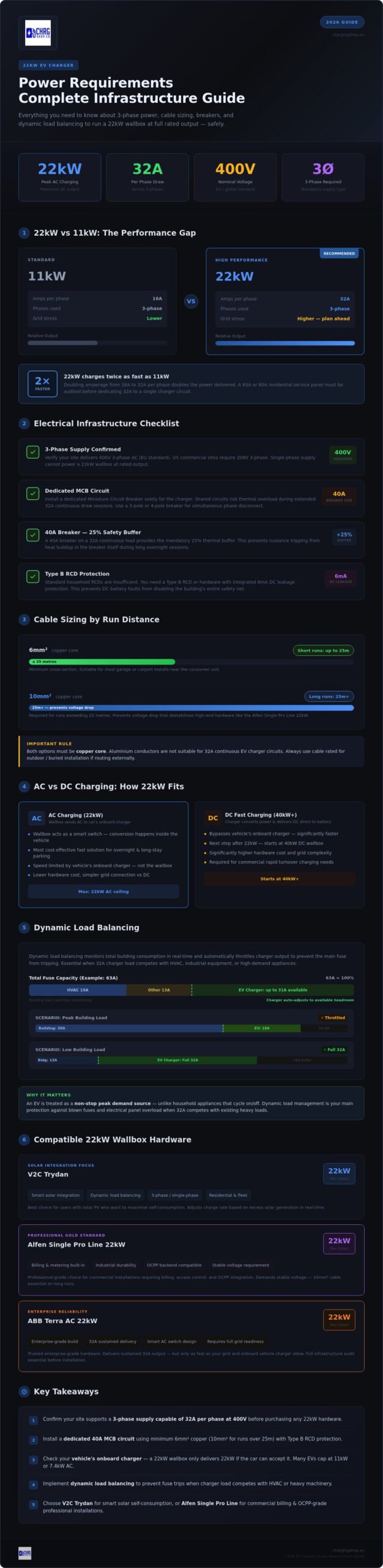
The difference between 11kW and 22kW charging comes down to amperage. An 11kW unit draws 16 Amps per phase. Stepping up to 22kW doubles that draw to 32 Amps per phase. This jump has a massive impact on your main breaker capacity. Many residential properties have a total limit of 63A or 80A per phase; dedicating 32A to a single charger can strain the rest of your building’s operations. You’ll need to verify that your service panel can handle this sustained load without compromising your HVAC or heavy machinery. A 32A 3-phase requirement is the absolute baseline for 22kW charging to function at its rated speed.
AC vs DC Power Delivery
AC chargers, such as the ABB Terra AC 22kW charger, act as smart switches. They don’t convert power themselves; they deliver high-voltage AC to the car’s onboard converter. The car then does the heavy lifting of turning that AC into DC for the battery. This makes 22kW the most cost-effective “fast” solution for overnight charging or long-stay parking. If your business needs even more speed, the 40kW DC wallbox is the next step up, bypassing the car’s internal converter entirely. However, for most users, 22kW provides the perfect balance of speed and infrastructure investment.
Electrical Infrastructure: Preparing Your Grid for 22kW Power
Installing a high-performance wallbox requires more than just wall space. Your electrical grid needs a dedicated circuit. This ensures that the high sustained draw doesn’t interfere with other appliances or sensitive electronics. Meeting 22kw ev charger power requirements starts at the consumer unit. You must install a Miniature Circuit Breaker (MCB) specifically for the charger to prevent thermal overload during long sessions. This dedicated line is the only way to guarantee the stability needed for 32A continuous delivery across three phases.
Safety is non-negotiable in high-power setups. Standard RCDs used for household lights or sockets aren’t enough here. You need Type B RCDs or hardware with integrated 6mA DC leakage protection. This specialized protection prevents “blinding” of the upstream safety devices if a fault occurs in the vehicle’s battery system. Without it, a DC fault could disable your entire building’s electrical safety net. Don’t cut corners on protection; it’s the most critical part of your infrastructure investment.
Breaker and Fuse Specifications
Select a 40A breaker for your 32A continuous load. This 25% buffer is essential to avoid nuisance tripping caused by heat buildup in the breaker itself. For a 3-phase 22kW system, you must use 3-pole or 4-pole breakers. These ensure that all phases disconnect simultaneously during a fault, preventing partial power issues. Always account for the “Diversity Factor” in your calculations. This metric determines if your total building load can support the charger while other heavy equipment is active. Since an EV is a continuous load, your electrician must treat it as a non-stop peak demand source.
Cable Cross-Section and Distance
Cable choice is a matter of both safety and performance. Use a minimum 6mm² copper core for short runs. If the distance from the breaker to the wallbox exceeds 25 meters, step up to 10mm² to combat voltage drop. High-end hardware like the Alfen Single Pro Line 22kW demands stable voltage to maintain peak efficiency. Voltage drop is the enemy of speed; as voltage falls over a long wire, the car may reduce its intake rate to stay safe. Under-speccing your cables isn’t just a performance bottleneck; it’s a serious fire hazard in high-performance setups. Need a tailored hardware match for your specific grid capacity? Check out our Personalised Charging Offer to find the right fit for your site.
The 22kW Performance Gap: Onboard Chargers and Compatibility
You’ve prepped your grid and sized your cables. But there’s a catch. Your car’s internal hardware often dictates the final charging speed. This is the Onboard Charger (OBC) bottleneck. Even if your wallbox meets all 22kw ev charger power requirements, an EV with an 11kW OBC will only draw 11kW. The wallbox provides the potential; the car decides the consumption. It’s a common point of confusion for new owners who expect maximum speed regardless of their vehicle’s specs.
In 2026, full 22kW AC support remains a premium feature. The Renault Zoe is the classic champion of high-speed AC charging, utilizing its Caméléon charger to the fullest. Audi e-tron models frequently offer an optional 22kW onboard charger, and specific Tesla Model S and X units equipped with dual chargers can also hit these speeds. Most modern Teslas and Volkswagens currently cap at 11kW. If you plug an 11kW car into a 22kW charger, it’s perfectly safe. The two devices negotiate a safe 11kW limit via the charging cable. You won’t damage the battery, but you won’t get that 22kW boost either.
So why install 22kW now? Future-proofing is the primary driver. Replacing a wallbox and re-running 10mm² cables in three years is a waste of capital. Doing it once ensures you’re ready for the next generation of EVs. Many manufacturers are considering 22kW AC as a standard to reduce the heavy reliance on public DC networks. Build the capacity today so you don’t have to rebuild it tomorrow.
Understanding Onboard Charger Limits
The OBC acts as a bridge. It converts the AC power from your wallbox into the DC power your battery stores. Entry-level EVs often use a 1-phase 7.4kW OBC. Mid-range models typically move to a 3-phase 11kW setup. Only high-end or specialized models utilize the full 3-phase 22kW capacity. A charger cannot “force” more power than the car is rated to receive. The vehicle’s battery management system (BMS) always has the final say on the intake rate to protect the cells from heat and degradation.
Smart Handshaking and Communication
Charging isn’t just about raw electricity. It’s a digital conversation. The Control Pilot (CP) signal handles the negotiation between your hardware and the car. Premium units like the V2C Trydan 22kW excel at this. They use advanced protocols to ensure a rock-solid handshake. This prevents the “ghost” interruptions that plague cheaper, generic units. High-quality communication ensures that when you plug in, the session starts instantly and stays stable until the battery is full. Reliability starts with the handshake.
Dynamic Load Balancing: Managing High-Power Draw Safely
Meeting the 22kw ev charger power requirements doesn’t have to mean calling the utility company for a costly line upgrade. Even with the right cables, pulling 32 Amps per phase can push a standard residential or small office main fuse to its limit. Dynamic Load Balancing (DLB) acts as the brain of your charging setup. It monitors your building’s real-time energy consumption and adjusts the charger’s output instantly. When your HVAC or industrial machinery kicks in, the DLB system throttles the wallbox to protect your fuses. Once the demand drops, it ramps your EV back up to full speed. It’s an automated, software-driven shield against blackouts.
Integrating solar power takes this efficiency to the next level. If your site features a 3-phase solar array, DLB hardware can prioritize charging your car with 100% green, excess production. Instead of feeding energy back to the grid for minimal returns, you’re using it to fuel your vehicle at peak 22kW speeds. This approach offers a massive economic benefit. You avoid expensive infrastructure surcharges from your utility provider while maximizing the ROI of your renewable energy investment. Protect your infrastructure today by choosing a wallbox with integrated dynamic load balancing.
How V2C Trydan Executes Load Management
The V2C Trydan is a standout performer in smart power distribution. It uses simple CT clamps or direct smart meter integration to feed live data to the wallbox. Through the V2C app, you get a clear visualization of how your power is being spent. You can set strict priorities, ensuring that critical home appliances or office servers always take precedence over the EV during peak hours. This level of control turns a high-power hardware asset into a manageable, intelligent part of your electrical ecosystem.
Commercial Multi-Station Balancing
Managing a fleet requires a deep understanding of 22kw ev charger power requirements at scale. While a 22kW wallbox for home focuses on a single vehicle, commercial parking lots use Dynamic Power Sharing to distribute a limited supply across multiple units. Static sharing is inefficient, giving every car a small, slow slice of power. Dynamic sharing is the pro move; it directs the maximum available current to the cars that need it most. This ensures your fleet is ready for the road without ever exceeding the building’s transformer capacity.
Choosing the Right 22kW Hardware: V2C, Alfen, and ABB
Selecting hardware that aligns with your 22kw ev charger power requirements is the final step in your infrastructure project. You need a unit that handles a sustained 32A load while offering the smart features required for 2026. Generic wallboxes often fail under high thermal stresses. Stick to proven brands that prioritize communication and safety. The right choice depends on whether you are powering a private garage or a high-traffic commercial lot. Each of these premium units offers distinct advantages for specific high-power scenarios.
The V2C Trydan 22kW is the undisputed champion for residential solar integration. It doesn’t just charge; it communicates directly with your inverter to soak up every watt of excess 3-phase energy. It’s the smart choice for homes with limited capacity that need intelligent distribution. If your priority is professional durability, the Alfen Single Pro Line 22kW is the gold standard. It features MID-certified meters, which are mandatory if you plan to bill tenants or employees for their energy usage. For those seeking industrial-grade reliability, the Abb terra ac provides a “fit and forget” solution with integrated safety features that simplify the installation process.
Feature Comparison for High-Power Units
Connectivity is the backbone of high-performance charging. While Wi-Fi works for home use, Ethernet provides the rock-solid stability needed for complex load balancing. For remote parking lots, 4G/LTE connectivity ensures your station stays reachable without local network dependencies. Always verify OCPP 1.6J or 2.0.1 compliance to ensure your hardware remains compatible with modern management software. In high-usage environments, a socket-only model is often superior to a tethered one. It prevents the common issue of cables being run over or damaged by heavy use, allowing users to bring their own high-quality 32A leads.
Professional Management with CHRG Network
High-power assets are most effective when they are visible and manageable. Integrating your hardware with CHRG Network access allows you to monetize your 22kW charger in semi-public areas easily. You can set custom tariffs, automate billing, and control user access via RFID tags or a mobile app. This level of cloud management is essential for maintaining high uptime. It provides real-time diagnostics and remote troubleshooting, ensuring your high-power points stay online and profitable. If you are unsure which unit fits your specific grid capacity, our Personalised Charging Offer can help you match your infrastructure to the perfect hardware.
Future-Proof Your Charging Infrastructure Today
Mastering the 22kw ev charger power requirements is the only way to guarantee a seamless, high-speed charging experience. You’ve learned that a robust 3-phase setup, 10mm² cabling, and Type B protection are the foundations of site safety. Choosing the right hardware, like the solar-ready V2C Trydan or the billing-certified Alfen Single Pro Line, ensures your investment delivers maximum performance for years to come. Don’t let technical complexity slow your transition to high-power mobility. It’s time to align your infrastructure with the best tech on the market.
As an authorized distributor of V2C, Alfen, and ABB, we provide the expert technical support you need to navigate global hardware standards. Combine your new wallbox with our integrated CHRG Network management solutions for total control over your energy assets. Ready to upgrade? Browse our Professional 22kW Hardware Collection and secure your site’s energy future now. You’re just one click away from professional-grade power and reliable, long-term performance. Get your project moving today.
Frequently Asked Questions
Do I need 3-phase power for a 22kW EV charger?
Yes. Achieving 22kW is impossible on a standard single-phase 230V supply. You must have a 400V connection across three phases at 32A each. If your site only provides single-phase power, your output drops to 7.4kW. Upgrading to a 3-phase supply is a non-negotiable prerequisite for reaching the full speed of high-power hardware like the V2C Trydan or Alfen Single Pro Line.
What size cable is required for a 22kW charging station?
Install a minimum 6mm² copper core for short cable runs. If the distance from the breaker to the wallbox exceeds 25 meters, use 10mm² to prevent voltage drop and overheating. Meeting the 22kw ev charger power requirements ensures your system stays efficient and safe. Always select high-quality copper conductors to handle the sustained 32A load across three separate phases without any thermal degradation.
Can I install a 22kW charger if my car only supports 11kW?
Yes, you can install the unit, but your car will cap the intake at 11kW. The vehicle’s onboard charger acts as the gatekeeper and only draws its maximum rated capacity. This is a smart future-proofing move. Installing a 22kW unit now ensures your infrastructure is ready for your next EV, which may support higher speeds, without requiring a costly and time-consuming rewiring job in the future.
Will a 22kW charger work on a single-phase supply?
No, a 22kW output requires a 3-phase connection. While some 22kW chargers can connect to a single-phase supply, they will automatically down-rate to 7.4kW (32A on one phase). To get the full 22kW speed, you need 400V across three phases. Attempting to pull 22kW from a single phase would exceed standard residential breaker limits and create a dangerous fire hazard for your property.
How much amperage does a 22kW EV charger draw?
A 22kW charger draws 32 Amps per phase. Because it uses three phases, the load is distributed across three separate conductors. Your electrician must install a dedicated 40A breaker to provide a necessary safety margin. Understanding these 22kw ev charger power requirements is vital for ensuring your main service fuse and distribution board can handle the sustained demand alongside your other building appliances.
What is the difference between a 22kW and an 11kW wallbox?
The main difference is the amperage capacity. An 11kW wallbox draws 16A per phase, while a 22kW unit draws 32A per phase. This allows 22kW hardware to charge twice as fast, provided your car’s onboard charger is compatible. While 11kW is perfect for overnight home charging, 22kW is the preferred choice for commercial sites and fleet depots where fast turnaround times are essential for operations.
Is a Type B RCD mandatory for 22kW EV charger installation?
Yes, specialized DC leakage protection is mandatory for all 22kW installations. You need either a Type B RCD or a Type A RCD combined with a 6mA RDC-DD device. This prevents DC faults from the vehicle battery from blinding your building’s electrical safety systems. Many premium units like the ABB Terra AC or V2C Trydan include this protection internally, which simplifies your external switchgear and reduces installation complexity.
How does dynamic load balancing work with a 22kW charger?
Dynamic load balancing uses a sensor to monitor your building’s real-time energy consumption. If your HVAC or machinery creates a power spike, the system instantly throttles the charger to prevent a main fuse trip. Once the building’s demand drops, the charger ramps back up to full 22kW speed. It’s an essential software tool for maximizing performance without paying for expensive and unnecessary utility grid upgrades.
