
 Deutsch
 Dansk
 Suomi
 Latviešu
 Lietuvių
 Norsk bokmål
 polski
 Русский
 Svenska

No products in the cart.
Uncategorized
Charging Stations for Electric Vans and Fleets
25
Nov
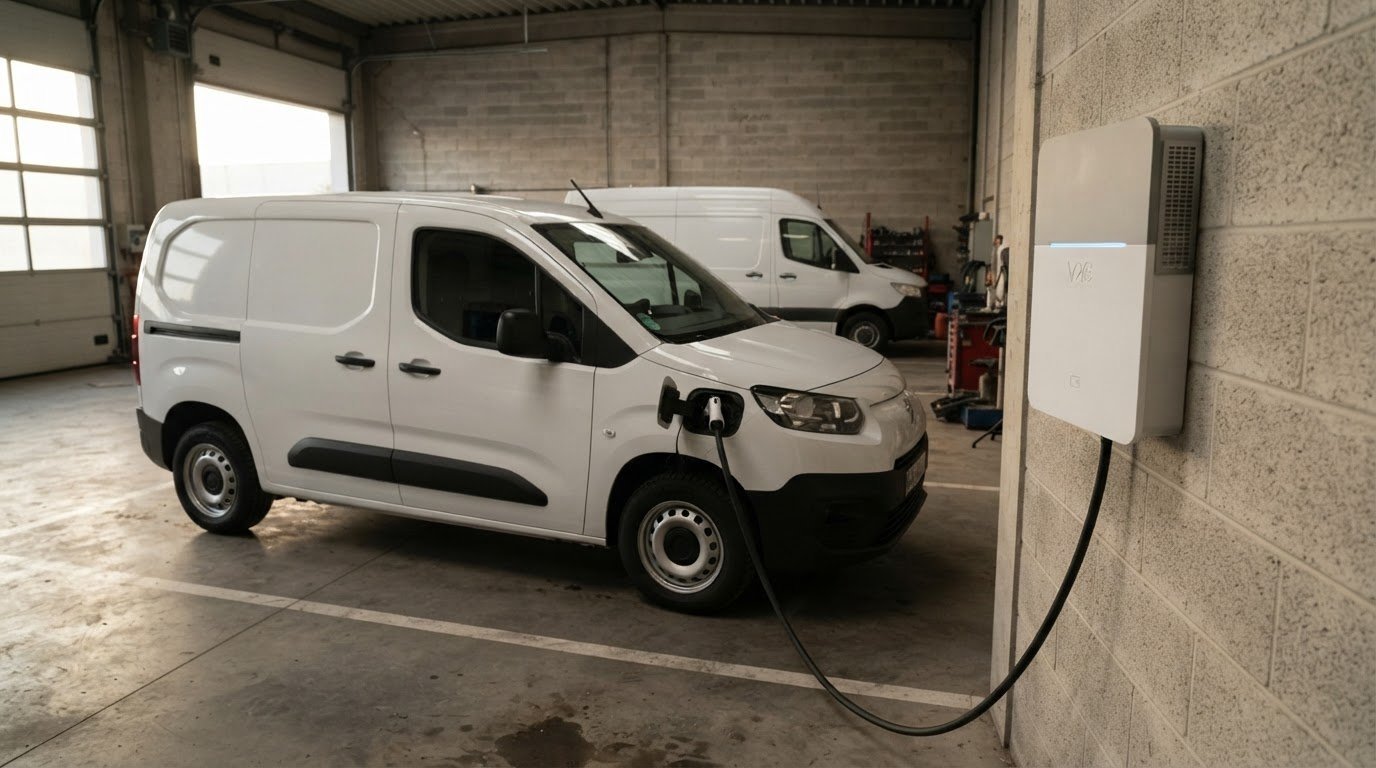
The most powerful charger isn’t automatically the fastest choice for your van. A charging station for electric vans supplies power to the vehicle’s battery, with charging speed shaped by the station’s output and the van’s ability to accept that power. For fleets, the right setup also has to fit vehicle connectors and daily operating schedules.
It’s easy to focus on charger speed alone. But a practical charging plan depends on more: whether AC or DC charging fits the time available, how many vans need to charge, and whether each connector matches the vehicle. A higher-output station cannot make a van charge beyond its own limit.
This guide explains how AC Level 1, AC Level 2, and DC fast charging differ, what affects charging time, and how to assess connector compatibility. You’ll also learn what to consider when choosing commercial charging equipment, including ports, power output, location, and payment options. Use these points to narrow down a solution that fits your fleet’s routes and charging windows.
Key Takeaways
- Match AC or DC charging to how long each van is parked and when it needs to return to the road.
- Estimate charging speed by considering both the station’s output and the van’s maximum charging capability.
- Confirm connector compatibility before building a charging plan, and avoid relying on stacked adapters.
- Plan commercial charging around site location, ports, power output, payment options, and fleet routines.
AC Level 1, AC Level 2, and DC fast charging
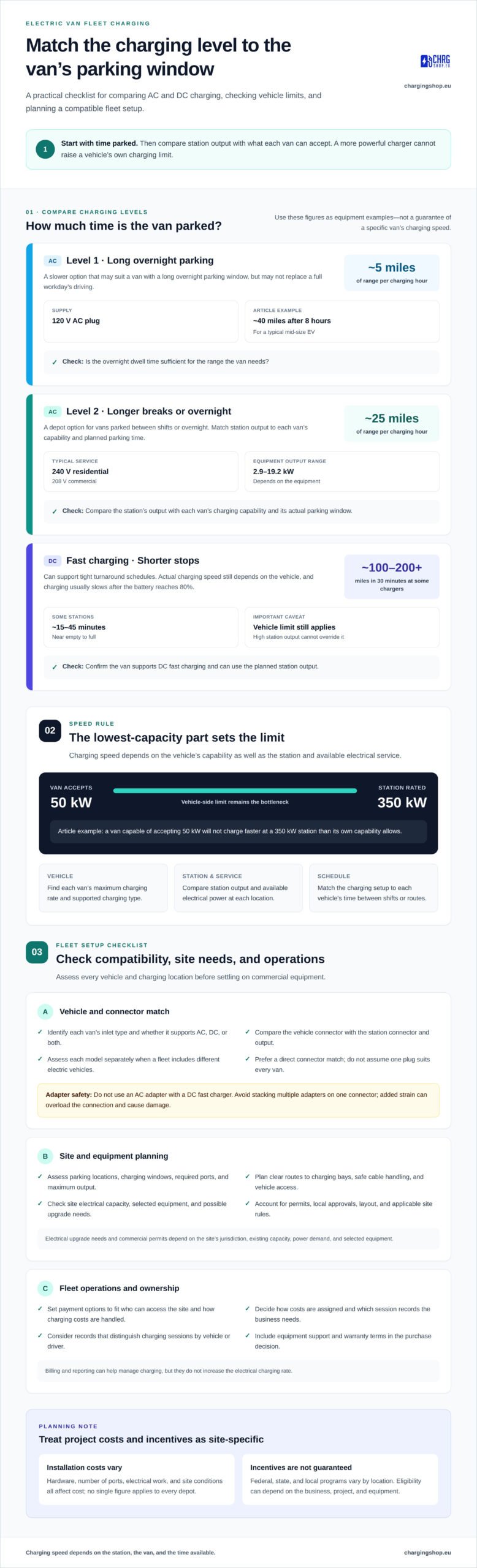
Choose a charging level based on how long each van is parked. Level 1 uses a 120 V AC plug and adds about 5 miles of range per charging hour. That pace can suit a van with a long overnight parking window, but it may not replace a full workday’s driving. A typical mid-size EV can gain about 40 miles after 8 hours of Level 1 charging.
Level 2 uses 240 V service in typical residential applications or 208 V in typical commercial applications. Depending on the equipment, output can range from 2.9 to 19.2 kW, with about 25 miles of range added per charging hour. For a depot, Level 2 can recharge vans during longer breaks or overnight. Match its output to each van’s charging capability and planned parking time.
DC fast charging is designed for shorter stops. Some fast chargers can add approximately 100 to 200 or more miles of range in 30 minutes. Charging from near empty to full can take about 15 to 45 minutes at some stations, but charging usually slows after the battery reaches 80%. Commercial DC fast chargers can support tight turnaround schedules, though a vehicle’s own charging limit still affects speed.
Commercial permits and electrical upgrades depend on the site’s jurisdiction, existing electrical capacity, and selected equipment. Local approval may be required, while upgrade needs depend on the power demand and available service. For example, a site planning higher-output DC fast charging has different electrical demands from one choosing Level 2 equipment, often requiring professional contractors like ALElectrical to assess existing infrastructure and carry out necessary commercial electrical upgrades safely.
Installation costs depend on the hardware, number of ports, electrical work, and site conditions, so no single figure applies to every van depot. Federal, state, and local incentives vary by location and program; eligibility can depend on the business, project, and equipment. Treat any potential incentive as a project-specific factor, not a guaranteed saving.
What Affects Charging Speed?
Charging speed is limited by the lowest-capacity part of the charging setup. A van capable of accepting 50 kW won’t charge faster at a 350 kW station than its own capability allows. Before you install equipment, determine each van’s maximum charging rate and compare it with the station’s output. A higher-rated charger alone won’t remove a vehicle-side limit.
Charging time depends on the battery, equipment, and electrical service. The same van may charge differently at different locations if the available power or station differs. Fleet schedules matter too: a vehicle parked between shifts has a different charging window from one returning briefly before its next route. Match those windows to the vans’ charging capabilities to choose a setup that fits daily operations.
Billing and reporting help a fleet manage charging, but they do not increase the electrical rate. Decide how drivers or teams will pay, how costs will be assigned, and which session records the business needs. For example, a depot with several vehicles may need records that distinguish sessions by vehicle or driver. Set these requirements before choosing payment options, so the system supports the intended workflow.
Payment arrangements can differ between a private depot and a site serving outside users. Choose an approach that fits who can access each location and how charges should be handled. Include warranty terms and equipment support in the purchase decision; they affect how the business can address equipment issues over time. For help shaping hardware choices around a fleet’s operating needs, explore a Personalised Charging Offer.
Charging connectors and vehicle compatibility
Electric vans can charge only when the vehicle and station support a compatible connection. Match the plug, charging type, and vehicle’s power capabilities before selecting equipment.
Checking Vehicle and Plug Compatibility
Start with the van’s charging specifications: identify its inlet type and supported AC or DC charging. Then compare them with the station’s connector and output. For a fleet with different electric vehicles, assess each model separately; one connector may not suit every van. Compatibility also affects charging speed: the station’s maximum output cannot override the vehicle’s charging limit.
For commercial parking, plan clear routes to charging bays, safe cable handling, and access to vehicles. Layout and accessibility requirements depend on the site and applicable local rules, so account for them in the space design.
Adapter Compatibility and Safety
An adapter can bridge some connector differences, but it must be suitable for both the vehicle and charging equipment. Don’t use an AC adapter with a DC fast charger. Avoid connecting multiple adapters to one charging connector, since the added strain can overload the connection and cause damage.
Keep the setup simple by matching the charger’s connector directly to the van wherever possible. If an adapter is needed, use one suited to that specific charging connection rather than stacking adapters. This supports a safer, more dependable charging process without assuming every plug combination will work.
Charging Speeds and Connector Types
Electric vans use different connector types and charging speeds, depending on their vehicle design and charging capability. Confirm both the inlet and whether the van supports AC, DC, or both. SAE International announced adoption of the J3400 connector by several vehicle manufacturers as early as 2025, so connector choices can vary across fleets.
The Megawatt Charging System is under development for DC charging up to 3.75 MW for medium- and heavy-duty vehicles. That figure describes the system’s target for those applications, not a charging rate for every van. For fleet planning, prioritize each vehicle’s supported connector and charging capability.
Commercial EV charging solutions
A commercial charging plan starts with the site and the vans it must serve. Assess parking locations, charging windows, required ports, maximum output, payment options, and equipment support. A workplace depot with vans parked overnight, for example, needs a different operating plan from a site serving vehicles between routes.
In the United States, a charging station for electric vans is compatible when its connector matches the vehicle and its output suits the van’s capabilities. No network name alone establishes compatibility across every van. Check the connection and charging type for each model before planning fleet access.
To find public stations, use a charging map or mobile app to search along planned routes and near destinations. Filter results by connector, charging type, and power where available. Then consider whether the station’s location and access arrangements work for a commercial van, including its parking and charging needs. A nearby point is useful only if the van can connect and charge within the time available.
At workplaces, assign ports around vehicle schedules rather than simply choosing the highest-output equipment. A vehicle returning for a short turnaround may need a different option from vans parked through a shift. Also decide how drivers will pay, how sessions will be recorded, and who handles equipment support. These decisions shape daily operations as much as the charger itself.
Before selecting equipment, map each site’s location, expected use, number of ports, power needs, payment process, safety certifications, and warranty support. These criteria help fleet operators choose a charging station for electric vans that fits the way their vehicles operate. A commercial charging plan can help align hardware choices with your fleet’s needs.
Charging Shop
Charging Shop helps fleet buyers match charging hardware to vehicle needs, charging windows, and site plans. If you’re narrowing down options for a commercial fleet, its Personalised Charging Offer can help shape a solution around your requirements.
The range includes the V2C Trydan 22kW, V2C DENKA 20kW DC Wallbox, and Alfen Single Pro Line 22kW. These options span different charging outputs and equipment types, giving fleet planners hardware choices to assess against vehicle compatibility and operating schedules. Focus on the specifications that matter for your vans, rather than choosing by output alone.
Share your fleet’s charging needs with Charging Shop to explore suitable hardware. Contact Charging Shop to discuss your requirements.
Make Your Fleet’s Next Charging Decision
Turn your charging plan into a practical equipment shortlist. Start with your fleet’s routes and parking patterns, then prioritize the needs at each site. A charging station for electric vans should suit the vehicles and the work they need to complete, not just look right on a specification sheet.
Charging Shop offers the V2C Trydan 22kW, V2C DENKA 20kW DC Wallbox, and Alfen Single Pro Line 22kW. Use these options as starting points for a fleet discussion, alongside your connector and operating requirements. The right next move is to clarify those needs and consider which hardware direction makes sense for your setup.
Ready to take that step? Contact Charging Shop about van charging and discuss your requirements. A clear plan can help your team move forward with confidence.
Frequently Asked Questions
How do EV charging stations work?
An EV charging station manages the connection between the electricity supply and a vehicle’s battery. The driver connects the cable, and the vehicle and charger coordinate power delivery. With AC charging, the vehicle converts incoming power for battery storage; a DC fast charger supplies direct current to the battery. Charging stops when the session ends or the vehicle’s charging controls limit it.
What types of charging stations are suitable for electric vans?
Level 2 AC chargers suit vans parked for longer periods, while DC fast chargers can serve shorter stops. Level 1 can work where charging needs are modest and parking time is extensive. When choosing a charging station for electric vans, match its connector and output to the vehicle’s capabilities and typical schedule. The right option depends on charging access and time between routes.
How many charging ports are needed for a fleet of electric vans?
There’s no fixed port count for every fleet. Start by identifying how many vans need to charge at the same time, then map arrival and departure patterns across shifts. A depot where vehicles return together may need more simultaneous access than one with staggered returns. Each charging port serves one vehicle at a time, even if a unit has multiple connectors.
How much does it cost to charge an electric van at home, at a depot, and at public stations?
Charging costs depend on the electricity rate, the energy the van uses, and any public-session fees. To estimate a home or depot session, multiply the energy used by the applicable electricity rate. Public charging may use a different payment arrangement. Compare bills and session records for each location, since rates and fee structures vary by provider and region.
What should businesses consider when choosing depot charging versus public charging for electric vans?
Depot charging gives a business control over where vehicles charge and how access fits the workday. Public charging can support routes beyond the depot or cover charging needs away from the workplace. A fleet operating across several destinations, for example, may combine planned depot sessions with public stops. Weigh route coverage, driver access, payment handling, and the time available at each stop.
What are the best electric van charging station options for fleet operators?
The right option depends on vehicle connectors, charging limits, parking duration, and whether vans need AC charging or faster DC charging. For a fleet with long depot parking windows, suitable AC equipment may work well; for shorter turnarounds, assess DC options. When selecting a charging station for electric vans, also consider port access, payment processes, reporting needs, and equipment support.
