
 Deutsch
 Dansk
Dansk Suomi
Suomi Latviešu
 Lietuvių
 Norsk bokmål
 polski
 Русский
 Svenska
No products in the cart.
Uncategorized
Commercial Property EV Charging: The 2026 Buyer’s Guide to Hardware & ROI
18
Sep
Sep
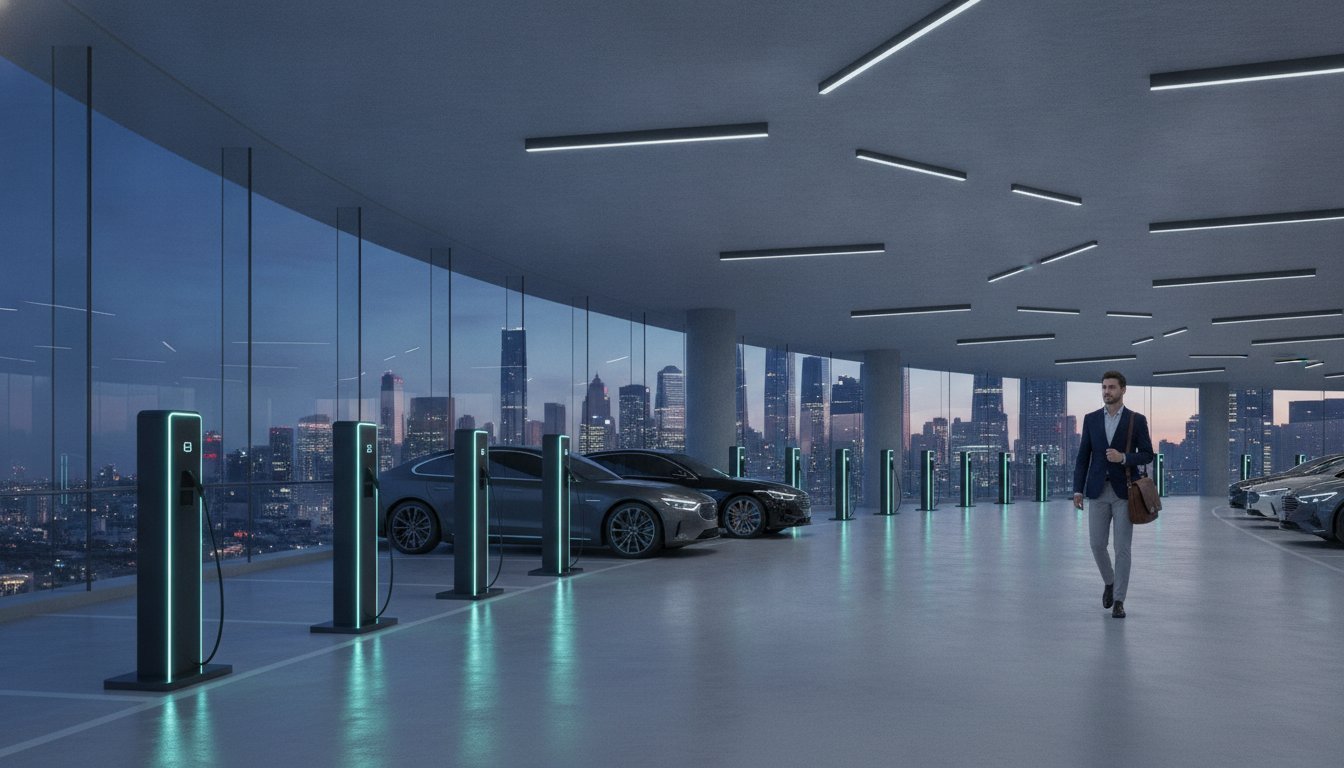
Your parking spaces are the most undervalued assets in your portfolio. In 2026, treating commercial property ev charging as a simple tenant perk is a massive financial oversight. It is a dedicated revenue stream. If you aren’t thinking about kilowatt-hour margins and automated billing, you’re leaving money on the table. The shift from utility to profit center is happening now, and the hardware you choose today dictates your ROI for the next decade.
We know the hurdles. You’re likely worried about grid overload, confusing OCPP standards, and the headache of manually chasing tenants for charging costs. It’s frustrating when technical hardware choices feel like a gamble. This guide solves that. You’ll learn how to deploy a scalable charging network that handles its own billing and attracts high-value occupants without the administrative nightmare. We promise to strip away the fluff and focus on the technical and commercial requirements that drive performance.
We’ll break down the industry gold standards like the Alfen Single Pro Line and the high-speed V2C DENKA DC wallbox. You’ll see how the CHRG Network simplifies user access and automates your revenue collection. From hardware selection to calculating your long-term gains, this is your roadmap to a high-performance charging infrastructure.
Key Takeaways
- Learn why commercial property ev charging is now a mandatory requirement for Grade A office space and how to meet 2026 regulatory standards.
- Select the right hardware for your site by choosing 22kW AC units for long-stay parking or the V2C DENKA 20kW DC wallbox for rapid retail turnover.
- Future-proof your assets with OCPP 2.0.1 compatibility and integrated MID-certified meters for legal, transparent electricity resale.
- Automate your billing and manage diverse user groups effortlessly through the CHRG Network management platform.
- Request a Personalised Charging Offer to simplify your procurement and secure durable hardware that attracts high-yield tenants.
The 2026 Business Case for Commercial EV Charging
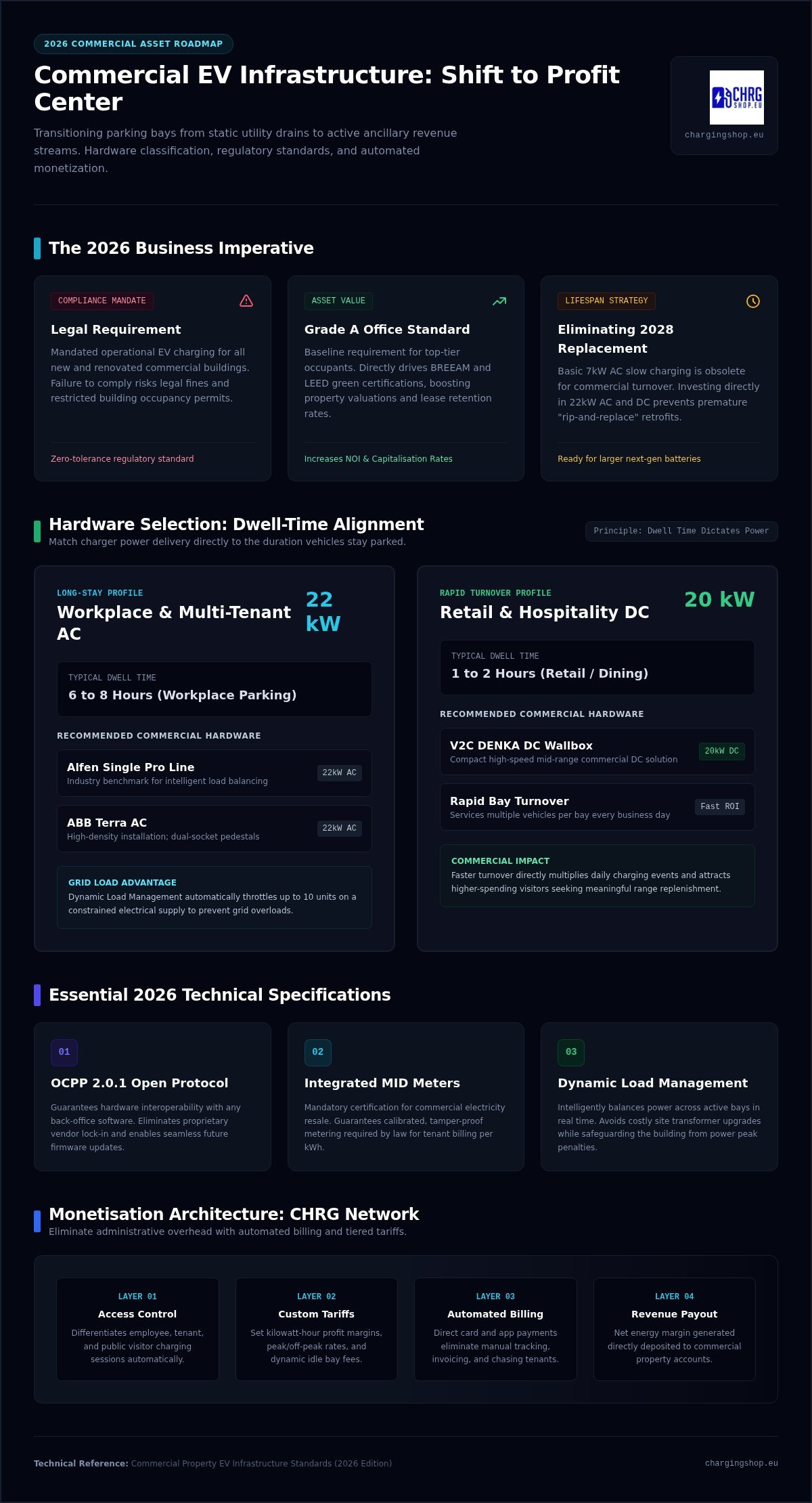
2026 is the definitive tipping point for parking assets. Regulatory mandates across global markets now require operational charging points for all new and renovated commercial buildings. Installing commercial property ev charging is no longer a “nice-to-have” sustainability project; it’s a legal compliance necessity. If your site doesn’t meet these standards, you risk fines and restricted occupancy permits. Beyond the legal stick, there’s a powerful commercial carrot. Grade A office space without high-performance charging is becoming obsolete. Top-tier tenants now view EVSE as a baseline requirement, just like high-speed internet or climate control.
Stop viewing chargers as a static cost or a drain on your utility bill. They are dynamic revenue generators. By utilizing smart management software, you can set custom tariffs and turn your parking bays into active ancillary income streams. To keep underlying supply rates competitive as electricity consumption increases, commercial landlords can explore Business Energy Brokerage to secure better utility contracts. Investing in 22kW AC and DC hardware today prevents the expensive “rip-and-replace” cycles predicted for 2028. High-capacity hardware handles the next generation of larger vehicle batteries and faster onboard chargers. You need a solution that scales. It’s about future-proofing your power distribution before the grid becomes even more congested.
Driving Property Value through Infrastructure
Modern EVSE installations do more than charge cars; they boost your asset’s pedigree. These systems are critical for achieving high BREEAM and LEED sustainability certifications, which directly correlate with higher property valuations. For retail landlords, the math is simple. Customers with EVs have higher disposable income and stay on-site longer to secure a meaningful charge. This demographic also increasingly values micro-mobility options, often turning to specialists like Sherwood E-Bikes Ltd. for high-quality electric transport. Integrating advanced EV infrastructure directly improves net operating income and capitalisation rates by securing long-term lease commitments from premium tenants.
The 2026 Demand Curve
The data is clear. By 2026, corporate EV fleets will dominate urban traffic, placing immense pressure on existing parking. Basic 7kW “slow charging” is no longer viable for commercial turnover. It simply doesn’t move the needle for a visitor staying two hours. You must deploy hardware that aligns with professional EV charging station hardware classifications, focusing on 22kW AC or rapid DC options. See how the Alfen Single Pro Line sets the standard for professional charging by combining durability with intelligent load balancing. High-performance hardware ensures your site remains relevant as the demand for rapid energy delivery spikes.
AC vs. DC: Matching Hardware to Your Property Type
Choosing between AC and DC hardware isn’t about which is “better.” It’s about dwell time. For commercial property ev charging, the hardware must match how long a vehicle stays parked. Installing a massive DC station in an office where cars sit for eight hours is a waste of capital. Conversely, a slow AC charger at a roadside cafe won’t attract a single customer. You need a strategic hardware mix that balances equipment costs with user expectations. Don’t overspend on power you don’t need.
Equipment price is only one factor in your ROI. You must also consider turnover. Faster charging means more cars per bay, which increases your total daily revenue potential. However, DC units require more power from your site’s supply. To navigate these choices, consult the latest EV charging infrastructure procurement guidelines. These standards help you coordinate with utilities and understand the ownership models that best fit your asset class.
Workplace and Office Solutions
Employee parking requires reliability and scale. The ABB Terra AC 22kW is the industrial-grade choice for these environments. It handles high-density parking without a sweat. One of its biggest advantages is dynamic load management. You can install 10 units on a limited power supply; the system automatically throttles power to prevent grid overload. Dual-socket models allow you to serve two bays from a single pedestal, saving on both hardware and installation space.
Retail and Hospitality Rapid Charging
Retail turnover demands speed. The 20kW DC Wallbox advantage is clear. It provides the perfect “mid-range” solution for customers. The V2C Denka is a standout here. It adds about 100km of range in 30 to 40 minutes. This is the ideal window for shoppers or hotel guests grabbing a quick meal. It provides a professional rapid-charge experience without the massive price tag of 50kW or 150kW units. You get the fast-charge draw without the extreme infrastructure upgrades.
Mixing AC and DC units on a single management network is the ultimate 2026 strategy for commercial property ev charging. You can offer slow, affordable charging for staff and premium, rapid charging for visitors. To see how these units fit your specific site requirements, request a Personalised Charging Offer today. We’ll help you map out a scalable network that maximizes both utility and profit.
Essential Technical Standards for 2026 Commercial Projects
Technical standards aren’t just fine print; they’re the difference between a functional asset and a liability. For commercial property ev charging, OCPP 2.0.1 is the new baseline. It ensures your hardware talks to any management software, preventing vendor lock-in. Interoperability means you own the hardware, not the provider’s ecosystem. It also introduces advanced remote diagnostics and enhanced cybersecurity. Your network must be hardened against unauthorized access to protect both user data and your building’s energy infrastructure. Verify that your chosen units adhere to the latest charging infrastructure standards and reliability protocols to ensure maximum uptime.
MID Certification and Billing Accuracy
Reselling electricity to tenants or the public requires precision. The Measuring Instruments Directive (MID) ensures that every kilowatt-hour billed is measured by a certified, tamper-proof meter. For a commercial landlord, MID compliance is the legal requirement to use only certified hardware for any transaction where electricity is sold as a commodity. It’s about consumer protection and legal transparency. Without this certification, you cannot legally automate revenue collection through platforms like the CHRG Network. This management layer relies on the hardware’s internal MID meter to generate transparent, audit-ready invoices that stand up to financial scrutiny.
Smart Grid Integration and V2G Readiness
Don’t risk tripping your building’s main fuse during peak hours. Dynamic Load Balancing is essential for any site with more than two chargers. It monitors the property’s total energy consumption and adjusts charger output in real-time. This protects your supply while maximizing charging speeds when the building’s internal demand is low. Hardware like the V2C Trydan and Denka goes a step further with Vehicle-to-Grid (V2G) readiness. These units prepare your property for a future where vehicle batteries act as temporary energy storage. This allows for intelligent software scheduling to reduce peak demand charges significantly. For 2026 commercial standards, always insist on 3-phase power distribution. It is the only reliable way to deliver the 22kW speeds that modern professional fleets and high-end tenants now expect as standard.
Monetisation and Management: The CHRG Network Advantage
Owning the hardware is only half the battle. To turn your parking assets into high-yield revenue streams, you need a management layer that prioritizes your profit. Many competitors lock you into “hosting” models where the network provider swallows the transaction fees and dictates the terms. The CHRG Network flips this script. It gives you total control over your commercial property ev charging ecosystem. You decide who charges, when they charge, and exactly how much they pay. It’s your infrastructure; you should keep the margins.
The platform allows you to set dynamic tariffs based on your specific business goals. You can price by the kilowatt-hour (kWh) to cover energy costs, by the hour to encourage bay turnover, or by the session for flat-rate convenience. Access control is equally flexible. Use RFID cards for authorized staff and tenants, or open the chargers to the public via a mobile app. Every transaction is tracked and reported automatically. This simplifies your tax filings and energy auditing, providing property managers with audit-ready data at the click of a button. Cloud-based diagnostics also allow for remote maintenance, identifying issues before they lead to downtime.
Setting Up Your Revenue Stream
Starting your charging business is a straightforward three-step process. First, select high-performance, OCPP-compliant hardware from our catalog, such as the Alfen Single Pro Line or ABB Terra AC. Next, connect your assets to the CHRG Network management platform for instant visibility. Finally, define your user groups. You can set discounted rates for long-term tenants while maintaining premium pricing for public “top-up” users. This tiered approach ensures you remain competitive while maximizing your ROI.
User Experience and Branding
A clunky interface kills repeat business. A seamless app experience ensures that drivers return to your site rather than searching for a competitor. The CHRG Network provides the reliability and speed that modern EV drivers demand. You can even tailor your infrastructure with customized charging offers for specific fleet requirements or corporate partners. For large-scale assets, our management software integrates directly with existing Building Management Systems (BMS). This allows you to monitor total site load alongside your HVAC and lighting systems for maximum operational efficiency. Don’t let your parking revenue remain untapped. Explore our CHRG Network management plans today and start scaling your network.
Strategic Procurement: Selecting Your 2026 Hardware
Procurement is the final bridge between strategy and reality. For commercial property ev charging, your hardware must withstand more than just the weather. It must survive high-frequency usage, potential impact, and the rigors of public access. Stainless steel housings provide the ultimate protection for exposed retail bays, whereas reinforced polycarbonate units offer a durable, cost-effective solution for secure corporate garages. Don’t compromise on build quality. Professional-grade units from ABB and Alfen are engineered for a long service life, far outlasting consumer-grade alternatives that fail under commercial stress.
Cable management is a critical operational decision. Tethered units, with cables permanently attached, offer maximum convenience for staff fleets. However, socketed units are often superior for public-facing commercial environments. They prevent cable-related downtime caused by wear or vandalism. Drivers simply bring their own lead; this reduces your liability and your long-term maintenance costs. When you invest in industrial heritage, you’re buying uptime. You’re ensuring that your revenue stream doesn’t go dark because of a damaged plug.
The Premium Selection
The Alfen Single Pro Line remains the top choice for high-reliability office deployments. Its internal components are designed for continuous 22kW output without thermal throttling. For showrooms and retail hubs, the V2C Denka is the compact DC powerhouse you need. It delivers rapid charging without the massive footprint of a traditional substation. If you need a mix of industrial pedigree and modern connectivity, the ABB Terra AC provides a robust platform that integrates seamlessly with existing building infrastructure. These units aren’t just chargers; they’re the anchors of your parking asset’s value.
Ordering and Logistics
Managing a multi-site rollout requires a partner that understands global procurement. We offer streamlined shipping for international portfolios and significant bulk hardware discounts for large-scale commercial developments. Securing your 2026 infrastructure today protects you from future supply chain volatility and price hikes. It ensures your property is ready to meet tenant demands the moment they move in.
To get a tailored roadmap for your specific site, request a Personalised Charging Offer. Or, if you’re ready to procure your hardware now, Browse our Commercial Hardware Range and secure your assets today. Don’t wait for the 2026 rush to deplete available stock.
Secure Your Competitive Edge for 2026
The shift is clear. By 2026, commercial property ev charging will be the baseline requirement for every Grade A asset. You’ve seen how the right mix of 22kW AC and rapid DC hardware turns a parking cost into a high-yield revenue stream. Success relies on choosing hardware that meets modern standards like OCPP 2.0.1 and leveraging the CHRG Network for automated, audit-ready billing. Don’t wait for the regulatory crunch to force your hand; early movers secure the highest tenant retention and the best grid capacity.
As an authorized distributor for V2C, Alfen, and ABB, we provide the industrial-grade solutions your portfolio requires. We offer global shipping and technical expertise to ensure your rollout is seamless and scalable. It’s time to stop treating your parking bays as static spaces and start treating them as active energy assets. Take the first step toward a future-proof property today.
Request a Personalised Commercial Charging Offer today. Let’s build a charging network that attracts premium tenants and delivers long-term ROI.
Frequently Asked Questions
Do I need a special permit to install commercial EV charging stations in 2026?
You generally need electrical permits and building consent for commercial property ev charging installations. By 2026, many jurisdictions mandate a specific ratio of EV-ready spaces for all new commercial developments. You should consult with your local planning authority or a qualified electrical contractor to ensure compliance with regional safety codes. We provide the hardware and technical documentation to support your application, but the legal permits remain your responsibility.
What is the difference between a managed and unmanaged commercial charger?
A managed charger connects to a platform like the CHRG Network to allow remote monitoring, automated billing, and load balancing. It is essential for commercial sites to prevent grid overload and generate revenue. An unmanaged charger is a simple plug-and-charge device with no data connectivity. For professional environments, unmanaged units are rarely suitable because they lack the tracking and security features needed to manage multiple users effectively.
Can I charge customers for electricity if I don’t have a MID-certified meter?
Reselling electricity without a MID-certified meter is illegal in most professional jurisdictions. The Measuring Instruments Directive ensures billing accuracy and consumer protection. If you plan to generate revenue from your parking assets, you must use hardware like the Alfen Single Pro Line or V2C Trydan with integrated MID meters. This certification provides the audit trail required for transparent transactions. Without it, you cannot legally charge users based on their kilowatt-hour consumption.
How many EV chargers should I install for my office building size?
Your installation volume depends on your parking capacity and tenant demographics. A common 2026 benchmark for Grade A office space is equipping 10% to 20% of bays with active charging. However, you should also ensure the remaining spaces are EV-ready with cable containment to avoid future excavation costs. We recommend starting with a Personalised Charging Offer to map your site’s power capacity against projected vehicle turnover and user demand.
What is the ROI for a 20kW DC wallbox compared to a 22kW AC station?
A 20kW DC wallbox like the V2C DENKA offers faster turnover, allowing you to charge more customers per bay and set higher premium tariffs. This is ideal for retail sites with 30 to 60 minute dwell times. A 22kW AC station is more cost-effective for long-stay office parking where cars remain for several hours. Your ROI calculation should balance the higher initial hardware cost of DC against the increased revenue frequency it generates.
Is the CHRG Network compatible with non-V2C hardware?
Yes, the CHRG Network is designed for broad interoperability. It is fully compatible with any hardware that supports the OCPP standard. While we specialize in V2C, Alfen, and ABB units, you can connect other professional-grade chargers to our management platform. This flexibility prevents vendor lock-in and allows you to manage a diverse hardware fleet through a single, unified dashboard for billing, remote diagnostics, and user access control.
How do I prevent non-tenants from using my property’s EV chargers?
You can restrict access using RFID cards, mobile app authentication, or digital whitelisting via the CHRG Network. This ensures only authorized employees or tenants can activate the chargers. You can also set different pricing tiers; for instance, you might offer discounted charging to staff while requiring public users to pay a premium rate. This granular control protects your infrastructure and ensures your power supply is reserved for your primary occupants.
Does Charging Shop provide installation for commercial properties?
