
 Deutsch
 Dansk
Dansk Suomi
Suomi Latviešu
 Lietuvių
 Norsk bokmål
 polski
 Русский
 Svenska
No products in the cart.
Uncategorized
Dual EV Charger Guide 2026: The Ultimate Setup for Two-EV Households
16
Jul
Jul
Buying a second electric vehicle shouldn’t trigger a $3,000 invoice for a service panel upgrade. Most homeowners assume two cars require two separate circuits and twice the power. That is a costly misconception. If you are currently juggling cables in the driveway or stressing about grid overload, you are fighting a hardware problem with an outdated strategy. A high-performance dual ev charger eliminates these bottlenecks by intelligently distributing your existing power capacity between both vehicles.
You need a charging routine that works as hard as you do. It is entirely possible to charge two EVs simultaneously without risking a blackout or sacrificing overnight speeds. You don’t have to settle for slow charging or manual cable swaps. This guide outlines the definitive 2026 setup for two-EV households. We will show you how to bypass expensive utility work using smart hardware like the V2C Trydan or Alfen Eve Double Pro-line. We will also cover the industry transition to the NACS standard and how dynamic load balancing keeps your home grid safe. Stop managing cables and start managing your power.
Key Takeaways
- Learn why dynamic load balancing is the secret to charging two cars at maximum speed without tripping your home’s main breaker.
- Compare the installation complexity and hardware costs of a single dual ev charger versus running two separate circuits.
- Identify the essential 2026 technical standards, including OCPP compliance and MID meters, to ensure your setup is future-proof.
- Discover professional-grade hardware solutions from Alfen and V2C that offer integrated power management for multi-vehicle households.
The Two-EV Dilemma: Why Your Current Setup Might Fail in 2026
The multi-EV household is no longer a futuristic concept. It’s the new standard for 2026. However, most residential electrical systems are still stuck in the 20th century. Adding a second electric vehicle creates an immediate “overload” bottleneck that can cripple your home’s power grid. You can’t simply plug two cars into standard domestic sockets and expect results. These sockets are designed for low-draw appliances, not for the sustained high-amperage demands of modern EVs. Using them for dual-car charging is slow, inefficient, and potentially dangerous.
A dual ev charger provides a professional solution. This is a single hardware unit equipped with two independent charging ports. It replaces the need for messy clusters of single chargers and ends the “driveway shuffle” forever. You shouldn’t have to wake up at 2 AM to swap a cable just so both cars have enough range for the morning commute. It is about reclaiming your time and ensuring your infrastructure matches your lifestyle.
To ensure your home is fully prepared for this transition, Your Home Electrical and Handyman Services LLC offers comprehensive electrical assessments and installation services to support your multi-vehicle charging needs.
The Electrical Capacity Bottleneck
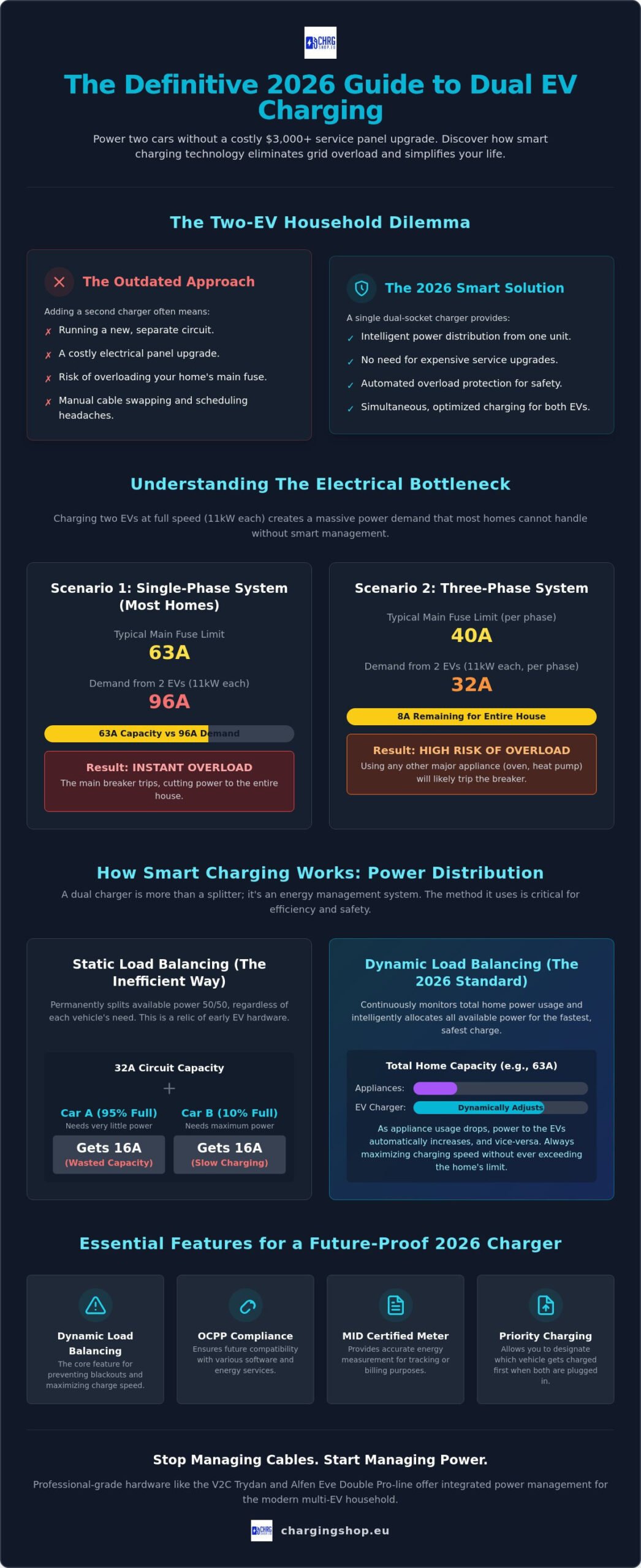
Understanding your home’s main fuse limit is critical before you buy more hardware. Most older homes operate on a 63A main fuse, while newer builds might have 100A capacity. If you attempt to charge two vehicles at 11kW simultaneously, you are pulling roughly 48A per car on a single-phase system. This total of 96A will instantly trip a 63A fuse and leave your entire house in the dark. Even with a 100A fuse, you leave almost no headroom for your oven, heat pump, or water heater. Simply adding another single charger without a management strategy is a recipe for frequent power outages and hardware failure.
The Convenience Factor: Single vs. Dual Hardware
Manual cable swapping is a hidden time-sink that drains the joy out of EV ownership. It’s an inefficient workaround that doesn’t scale. A single, professional dual-socket unit like the Alfen Eve Double Pro-line offers a streamlined aesthetic and superior performance. These units utilize smart charging technology to communicate with your vehicles and the grid. This ensures that power is distributed safely and efficiently without manual intervention. Future-proofing your home for 2026 means preparing for faster charging speeds. Newer EV models demand more from your infrastructure. A dedicated dual ev charger handles these loads effortlessly, providing a seamless routine that two separate, unmanaged chargers simply cannot match.
How Dual Charging Works: Power Sharing vs. Load Balancing
Most homeowners think a dual ev charger is just a simple splitter. It isn’t. To charge two cars simultaneously without tripping your main breaker, the hardware needs a sophisticated brain. It must decide which car gets what, when, and how fast. This is the critical difference between a basic hardware port and a professional energy management system. Stop guessing about your capacity. Start optimizing it. A high-quality unit acts as a traffic controller for your home’s electricity. It doesn’t just pass current; it manages it.
The mechanics of power distribution rely on communication. The charger “talks” to your vehicles and your home grid in real time. In 2026, this level of intelligence is mandatory. Without it, you are either charging too slowly or risking a total blackout. You need a system that adapts to your life, not the other way around.
Static vs. Dynamic Power Distribution
Static load balancing is the entry-level approach. It hard-codes a 50/50 split. If your circuit provides 32A, each car gets 16A. This is simple. It’s also incredibly inefficient. If your primary car is at 95% and your second vehicle is at 10%, the first car doesn’t need 16A, but the second car desperately does. Static systems won’t shift that surplus. You end up with one car trickle-charging while the other sits idle on wasted capacity. It’s a relic of early EV hardware that doesn’t meet modern demands.
Dynamic sharing is the real-time solution. It prioritizes the vehicle with the lowest state of charge. Dynamic Load Balancing is the real-time adjustment of EV charging based on total home consumption. The charger monitors your home’s electrical load via a CT clamp or smart meter. If you turn on a power-hungry appliance, the charger instantly throttles the cars. When the appliance goes off, the cars ramp back up. It’s seamless. It’s safe. It’s the only way to maximize a 22kW feed without upgrading your utility service. Businesses managing multiple vehicles can explore the same principles at scale in this guide to fleet EV charging hardware for 2026 infrastructure deployments.
Priority Charging and Smart Scheduling
Modern hardware lets you set the rules. You can designate “Car A” as the primary commuter. If both cars are plugged in, the system ensures the commuter is topped up first. This is crucial for households with different driving patterns. You don’t want your secondary runabout hogging power while your long-range vehicle stays empty. Efficiency is the goal. Use your app to lock charging to off-peak windows. Electricity rates are volatile. Automating your charge cycle saves hundreds of euros annually.
For those with solar panels, the V2C Trydan is a game-changer. It detects solar surplus and directs it straight to your vehicles. You are effectively driving on sunshine. It’s the ultimate setup for sustainable, low-cost charging. If you are ready to upgrade your home infrastructure, check out our Personalised Charging Offer for a tailored hardware recommendation that fits your specific grid capacity.
Dual Socket Charger vs. Two Separate Chargers: A Comparison
Deciding between one integrated unit and two separate chargers is a critical pivot point in your home energy strategy. Many homeowners assume that two entry-level chargers are more cost-effective than one premium dual ev charger. This is a mistake. When you look at the total project cost, the hardware is only half the story. You must account for labor, materials, and long-term maintenance. A single dual-socket unit streamlines every aspect of the installation. It is a cleaner, more efficient way to power two vehicles. You save on physical space and mental energy.
When One Unit is Better Than Two
The Alfen Eve Double Pro-line is the gold standard for professional dual charging. It consolidates two powerful charging points into a single, robust footprint. This significantly reduces the number of penetrations in your home exterior. Your electrician only needs to pull one set of heavy-gauge cables from the consumer unit, which cuts down on expensive wiring and labor hours. By using CHRG Network Access, you can monitor both sockets through a single dashboard. This level of integration is essential for accurate energy tracking and future-proofing your home for 2026 standards.
The Hidden Costs of Dual Single-Charger Setups
Installing two separate chargers often leads to a “Communication Gap” that compromises your home grid. Unless you invest in specialized master-slave communication hardware, these units operate in silos. They don’t know what the other is doing. If both cars demand max power simultaneously, you risk a grid conflict that trips your main breaker before the software can intervene. You also face double the maintenance. That means two sets of internal contactors to wear out and two separate firmware update cycles to manage. A dedicated dual ev charger eliminates these risks by using a unified internal controller to dictate power flow across both ports. It is the only way to ensure 100% reliability in a multi-car household.
Essential Features for Your 2026 Dual EV Charger
Selecting the right hardware for 2026 requires looking beyond raw power output. A modern dual ev charger must serve as a smart node in your home energy network. Universal compatibility is the first priority. Ensure your unit supports OCPP 1.6J or 2.0.1. This “universal language” allows you to switch between different management platforms, such as the CHRG Network, without replacing your physical hardware. It prevents vendor lock-in and ensures your charger remains functional as software standards evolve. Don’t get stuck with a proprietary system that limits your future options.
Versatility in hardware design also matters. You must choose between tethered versions, which have fixed cables, or socket versions. Socket versions are often more versatile for two-car households. They allow you to use cables of different lengths or connector types, such as NACS or Type 2, depending on the specific vehicles parked in your driveway. For shared driveways or semi-public spaces, RFID access control is a non-negotiable security feature. It prevents unauthorized users from drawing power from your unit, ensuring you only pay for the energy your own vehicles consume.
Billing and Reimbursement with MID Meters
Integrated MID meters are essential for business owners and remote workers. If you drive a company car or need to invoice a client for energy costs, you need certified accuracy. Standard internal meters often have a high margin of error. An MID-certified meter provides a legally recognized measurement of energy consumption. This allows you to separate “Car A” (Work) from “Car B” (Personal) energy costs with 100% precision. It ensures legal compliance for electricity reimbursement and makes tax reporting effortless. If your employer pays for your fuel, they will likely require this specific certification for your home setup. For businesses managing multiple company vehicles, the Alfen Single Pro Line for business offers an integrated MID-certified meter that automates employee billing and keeps your fleet infrastructure future-proof.
Connectivity: Wi-Fi, Ethernet, and 4G/LTE
Stable connectivity is the backbone of a high-performance charging routine. While most chargers offer Wi-Fi, Ethernet is the preferred choice for a dual ev charger. A physical cable provides the low-latency connection required for real-time load balancing and software updates. Wi-Fi signals often struggle to penetrate thick garage walls, leading to dropped sessions or failed schedules. For detached garages or remote parking lots, look for units with 4G/LTE modules. This ensures your charger stays online even when your home network is out of range. App-based monitoring gives you real-time data for both charging sessions, allowing you to track costs and battery health from your smartphone. Ready to find the perfect match for your home? Explore our Personalised Charging Offer to see which features fit your driving habits.
Expert Solutions: Premium Hardware from Charging Shop
Theory is useless without the right hardware. You need a dual ev charger that delivers performance, reliability, and intelligence. We curate the world’s most advanced charging points to ensure your home or small office stays powered. From industrial-grade durability to seamless smart home integration, our selection targets the specific needs of multi-vehicle environments. Don’t settle for consumer-grade plastic. Invest in infrastructure that lasts. If your needs extend beyond the home to a commercial site or vehicle fleet, our professional fleet EV charging hardware guide covers the full scope of industrial-grade deployment options from V2C, Alfen, and ABB.
The ABB Terra AC provides industrial-grade reliability for dual-vehicle driveways. It’s built to withstand harsh conditions while maintaining precise energy delivery. This unit is ideal for users who prioritize a “set and forget” approach to their charging infrastructure. It’s rugged, dependable, and ready for high-frequency use. Whether you are managing a fleet or a busy household, this hardware provides the stability you need.
Alfen Eve Double: The Commercial Standard for Home
The Alfen Eve Double Pro-line is the undisputed leader in dual-socket technology. It delivers up to 22kW per socket in a robust, high-tech housing designed for heavy use. This unit features a full-color user display and built-in load balancing. It is the top choice for small offices and premium homes where downtime isn’t an option. Because we are an authorized retailer, you get direct access to the latest firmware and professional support. It’s the ultimate professional solution for the most demanding driveway setups. If your business requires a single-vehicle charging point with the same professional-grade reliability, the Alfen Single Pro Line for business delivers 22kW performance with advanced tamper detection and OCPP-compliant network management.
For those prioritizing smart home connectivity, the V2C Trydan is a standout performer. It excels at dynamic power sharing and integrates directly with solar installations. If you want a dual ev charger that talks to your smart home ecosystem or manages your solar surplus, this is your hardware. It offers the flexibility to prioritize different vehicles based on your daily schedule, ensuring you never leave home with an empty battery.
Managing Your Infrastructure with CHRG Network
Hardware is only half the battle. You need visibility. CHRG Network Access provides centralized management for your dual-socket assets. Monitor both sockets from a single dashboard on your smartphone or desktop. Generate automated billing reports for employer reimbursement with zero manual data entry. The network offers proactive maintenance alerts and remote firmware management. It ensures your chargers are always online and optimized for the latest vehicle software. Take control of your energy data and stop guessing about your consumption.
Next Steps: Get Your Personalized Charging Offer
Every home grid is different. Your hardware should reflect your specific capacity and driving habits. Use our Personalised Charging Offer to find the right dual hardware for your needs. We ship premium hardware worldwide to ensure you get the best tech regardless of your location. Remember to consult a local qualified electrician for installation to ensure safety and compliance with local regulations. Upgrade your driveway today. Browse our Dual EV Charger Collection to secure your 2026 setup.
Secure Your 2026 Energy Strategy Today
Managing two electric vehicles doesn’t have to be a logistical nightmare. You now understand how dynamic load balancing and smart power distribution eliminate the need for expensive panel upgrades. By choosing a high-performance dual ev charger, you replace manual cable swapping with automated efficiency. It is about more than just convenience. It is about building a home infrastructure that handles the demands of 2026 and beyond. Your setup needs to be as fast and reliable as the cars you drive.
We provide the specific tools to make this transition seamless. As an authorized retailer for Alfen and V2C, we offer premium, OCPP-compliant hardware designed for long-term reliability. Integrate your system with the CHRG Network for professional-grade management and accurate reimbursement tracking. Don’t wait for your grid to fail or your cables to tangle. Take control of your home charging routine with hardware built for the multi-EV era. Your smarter driveway starts with the right choice today.
Upgrade Your Driveway: Shop Premium Dual EV Chargers Now
Frequently Asked Questions
Can I charge two EVs at 22kW simultaneously at home?
Technically yes, but only if your home supply supports a 44kW draw. Most residential connections are capped, so a 22kW dual ev charger typically splits the available power. This usually means each car receives 11kW. This is still five times faster than a standard wall outlet and easily tops up two batteries overnight without straining your infrastructure.
Does a dual EV charger require a special electrical permit?
Permit requirements depend on your local regulations and the total amperage of the circuit. High-capacity hardware often requires notification to your Distribution Network Operator (DNO) because it significantly impacts the local grid. Always consult a qualified electrician to handle the paperwork and ensure your installation complies with 2026 safety standards. Don’t skip this step; uncertified installs can void your home insurance.
Is it cheaper to buy one dual charger or two single chargers?
A single dual-socket unit is almost always the more economical choice. While the hardware itself is a premium investment, you save a fortune on installation. You only pay for one cable run, one circuit breaker, and one session of professional labor. Two separate chargers double your material costs and require twice the wall space, making them less efficient for most driveways.
What is the best dual EV charger for a home with solar panels?
The V2C Trydan is the top-tier solution for solar integration. It features native technology that detects surplus energy from your PV array and directs it straight to your vehicles. You can prioritize charging your cars with 100% green energy before drawing from the grid. It is the smartest way to minimize your charging costs while maximizing your investment in renewable energy.
How does load balancing work on a dual-socket charger?
Load balancing acts as an intelligent traffic controller for your electricity. The dual ev charger monitors your home’s total power consumption in real time. If you turn on high-draw appliances like a heat pump or electric oven, the charger instantly throttles the power sent to the cars. This prevents your main fuse from blowing while ensuring your vehicles charge at the maximum safe speed available.
Do I need a three-phase power supply for a dual EV charger?
It’s highly recommended if you want fast charging for both vehicles. A single-phase supply limits your total output to 7.4kW, which means each car only gets 3.7kW when charging together. That is barely faster than a domestic plug. A three-phase supply unlocks the full 22kW potential, providing 11kW per car for a much more practical and efficient daily routine.
Can I track energy usage separately for two different cars on one charger?
Yes, you can separate usage data with pinpoint accuracy. Most professional units use RFID cards or individual app profiles to identify which vehicle is drawing power. If you utilize CHRG Network Access, you can generate automated reports for each car. This is an essential feature for households where one vehicle is a company car and requires separate billing for tax or reimbursement purposes.
Will a dual EV charger work with all electric vehicle brands?
Universal compatibility is standard for modern dual chargers. They use standardized communication protocols to negotiate the optimal charging speed for any vehicle on the market. Whether you have a Tesla, a BMW, or a Kia, the hardware will communicate perfectly. Just make sure you select the correct socket or tethered cable type to match the inlets on your specific vehicles.
