
 Deutsch
 Dansk
Dansk Suomi
Suomi Latviešu
 Lietuvių
 Norsk bokmål
 polski
 Русский
 Svenska
No products in the cart.
Uncategorized
Getting HOA Approval for an EV Charger: A Step-by-Step Guide

11
Oct
Oct
What makes a proposal easier for an HOA to review? A clear explanation of how the project affects the property. If getting HOA approval for EV charger installation feels like a maze of governing documents, safety questions, and board reviews, start by showing exactly where the charger will go and what the project involves.
It’s reasonable to worry about a rejection, especially when electrical capacity, installation details, appearance, costs, and shared access all need answers. A complete written request gives the board practical information to evaluate instead of leaving key concerns unresolved. This guide explains how to prepare that request and what to do if a decision is delayed or denied.
Review your community’s approval process, document the proposed location and route, address electrical capacity and responsibilities, and explain how charging will be managed. With those details in hand, you can submit a focused request and keep a clear record of the board’s response.
Key Takeaways
- Getting HOA approval for ev charger starts with understanding your community’s rules, parking rights, and review process.
- Give the board a focused request that separates confirmed details from electrical questions requiring assessment.
- Compare private, common-area, and shared charger proposals by access, cable routing, electrical impact, and ongoing administration.
- Prepare for concerns about capacity, liability, appearance, and precedent, and keep communication and decisions in writing.
- Use approval conditions to shape the charger’s specifications, access plan, and future management needs.
Getting HOA approval for an EV charger starts with the community rules
Approval can feel uncertain when community rules, parking ownership, and electrical work intersect. HOA approval is the community’s review of a proposed charger installation, particularly when the plan could affect shared property, building systems, or other residents’ access. The board’s role and review process depend on your governing documents and applicable state or local requirements, so don’t assume another community’s rules apply to yours.
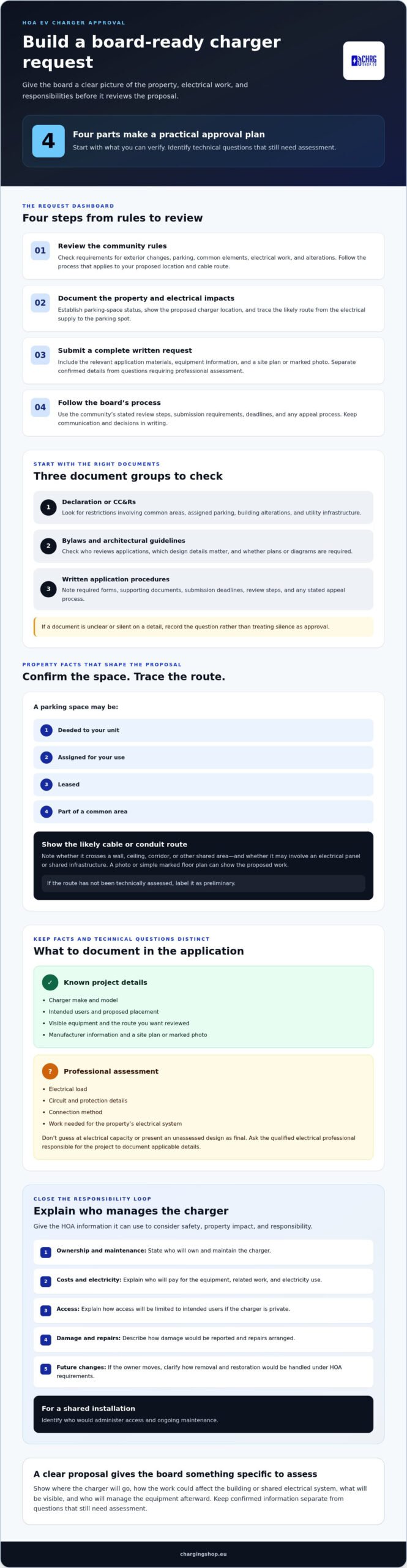
A practical plan for getting HOA approval for ev charger installation has four parts: review the rules, document the property and electrical impacts, submit a complete written request, and follow the board’s process. Start with details you can verify, then identify technical questions that still need assessment. This gives the HOA a specific proposal to evaluate.
Which HOA documents should you review first?
Collect the documents that govern your home and any shared property. Look for rules about exterior changes, parking, common elements, electrical work, and alterations. Focus on requirements that apply to your proposed location and cable route rather than assuming every charger request follows the same process.
- Declaration or CC&Rs: Look for restrictions involving common areas, assigned parking, building alterations, and utility infrastructure.
- Bylaws and architectural guidelines: Check who reviews applications, which design details the board considers, and whether plans or diagrams are required.
- Written application procedures: Note required forms, supporting documents, submission deadlines, review steps, and any stated appeal process.
Save the relevant sections and turn them into a short checklist. If a document is unclear or silent on a detail, record the question rather than treating silence as approval. State or local rules may also apply, so review requirements relevant to your property before relying on a general online example.
Who controls the parking space and electrical route?
Establish the status of your parking space before drawing the proposal. It may be deeded to your unit, assigned for your use, leased, or part of a common area. That distinction can determine who reviews the location and whether the project affects property controlled by the HOA. Don’t assume that regularly using a space means you own it.
Next, trace the likely route from the electrical supply to the parking spot. Note whether it crosses a wall, ceiling, corridor, or other shared area, and whether the project may involve an electrical panel or shared infrastructure. Photos or a simple marked floor plan can show the board where work is proposed. Label the route as preliminary if it has not yet been technically assessed.
Charger type matters to the proposal, too. A brief overview of electric car charging methods can help you describe the intended equipment and use in plain language. Once you’ve documented parking status, the route, and the intended charging method, you can build a request around the property and electrical impacts the board needs to review.
What an HOA needs to assess an EV charger request
Make the application easy to evaluate. Show where the charger will go, how the proposed work could affect the building or shared electrical system, what will be visible, and who will manage the equipment afterward. These details turn getting HOA approval for ev charger installation from a general idea into a proposal the board can review.
A complete application helps the board assess safety, property impact, and responsibility before deciding whether the proposed charger fits the community.
Document the equipment and proposed installation
Separate details you already know from those that require technical assessment. Include the charger’s make and model, intended users, proposed location, and relevant manufacturer documentation. Add a concise plan view or marked site photo showing the charger, parking space, and intended cable or conduit route. Label walls, ceilings, or shared areas that could be affected.
- Known project details: Charger model, proposed placement, intended users, visible equipment, and the route you want reviewed.
- Professional assessment: Electrical load, circuit and protection details, connection method, and any work needed for the property’s electrical system.
- Application materials: Required HOA form, supporting documents, site plan or photo, and manufacturer information requested by the community.
Don’t guess at electrical capacity or present an unassessed design as final. Ask the qualified electrical professional responsible for the project to document applicable load and protection details. The EPA’s home EV charging installation guidelines can also help explain why electrical planning belongs in the proposal. Keep the board’s review grounded in documented information, not assumptions.
Address insurance, maintenance, and ownership
State who will own and maintain the charger, pay for the equipment and related work, and cover electricity use. Explain how access will be limited to intended users if the charger is private, and describe how damage would be reported and repairs arranged. If the owner moves, clarify how removal and restoration would be handled under the HOA’s requirements.
For a shared installation, identify who would administer access and ongoing maintenance. Don’t promise a specific insurance outcome or assume the board’s rules settle every question. Provide the relevant information for review and ask the HOA to assess it under its governing documents and applicable rules. Keep proposed responsibilities clear and practical.
Before submitting, assemble the application form, equipment information, marked site image, known project details, and professional electrical assessment. If some technical details remain unassessed, identify them clearly. If you’re comparing equipment for a documented use case, you can review EV charging hardware options as part of your planning.
Compare individual and shared EV charger proposals for an HOA
The right proposal depends on who controls the parking area, where power can be routed, and who will use and manage the charger. Compare these practical impacts before settling on a plan. Feasibility depends on the property, governing documents, electrical design, and applicable local requirements. No arrangement is automatically simpler or approvable in every community.
| Proposal type | Property control | Cable route | User access | Electrical assessment | Ongoing administration |
|---|---|---|---|---|---|
| Private assigned parking | Space may be assigned or privately controlled; confirm the recorded arrangement. | May run from the owner’s supply or cross shared areas. | Usually intended for one owner or household. | Assess the proposed connection and any impact on shared systems. | Define owner responsibility for maintenance, electricity, and restoration. |
| Common-area parking | Space and related infrastructure may be controlled by the HOA. | May involve shared walls, routes, panels, or other common elements. | Access rules must fit the approved users and parking arrangement. | Consider the shared electrical system and the proposed equipment together. | Clarify who authorizes work, maintains equipment, and pays related costs. |
| Shared charging installation | Often involves common property or coordinated use of multiple spaces. | Plan routes to serve intended charging locations with clear property impacts. | Set out eligibility, access control, and how use will be tracked. | Assess capacity and the electrical design for the planned shared use. | Document administration, maintenance, and fair allocation of costs and usage. |
For any option, show who pays for equipment, electrical work, ongoing electricity, maintenance, and any future removal or restoration. Replace vague phrases such as “costs will be shared” with a proposed allocation method. Identify who will keep the related records so residents and the board can see how responsibilities are divided.
When a charger for one owner may be simpler to assess
A proposal for one owner may be more straightforward to review when the parking space is clearly assigned, the user group is limited, and the plan avoids extensive changes to shared property. The board still needs to assess electrical impact, work scope, appearance, and governing rules. Naming the owner responsible for upkeep and restoration can reduce uncertainty for the community.
When a shared charging plan may better fit the property
A shared plan may suit a property where residents use common parking or want infrastructure for multiple users. Explain who can access the chargers, how usage will be tracked, and how electricity and ongoing administration will be allocated. These are core management decisions, not details to leave until after approval.
If the proposal includes managed access or charging records, describe those needs alongside the equipment plan. CHRG Network access may be relevant when evaluating how EV charging stations are managed. For getting HOA approval for ev charger proposals, match the charging arrangement to the property’s control, electrical design, and administration needs to give the board a clear basis for review.
Submit a board-ready request and respond to HOA concerns
A board can only assess what the request makes clear. For getting HOA approval for ev charger installation, present a concise proposal with relevant documents. Treat concerns about shared electrical capacity, liability, appearance, and precedent as questions to answer, not objections to brush aside. Keeping a clear record also helps you track the review from submission through decision.
- Review the process. Confirm the required form, submission method, review stages, response timelines, and any stated appeal route in your community’s documents.
- Build the application. State the location, intended users, charger make and model, proposed work, and who will take responsibility for the equipment and ongoing costs.
- Submit in writing. Attach the marked site plan or photo, relevant equipment documentation, and available electrical information. Keep a copy of the complete application.
- Follow up and record the decision. Request confirmation of receipt and the next review step. Answer board questions with supporting details, then save the written decision and any conditions.
How to structure the written application
Lead with the request and summarize the proposal in plain language: where the charger will be installed, who will use it, what equipment is proposed, and what work is anticipated. Attach the marked plan, relevant technical documents, and an outline of responsibilities and maintenance. Ask for confirmation of receipt and the next step under the HOA’s stated process.
Keep confirmed details separate from items requiring electrical assessment. For example, show the intended cable route, but don’t claim the shared system has capacity unless that has been assessed. This distinction makes the request more credible and helps the board identify what information it still needs.
How to handle questions, conditions, or a denial
Boards may raise concerns about electrical capacity, liability, visible changes, or setting a precedent for future requests. Respond point by point with the relevant plan, technical clarification, maintenance outline, or a revised proposal. If the board asks for more information, confirm what it needs and whether the review will continue once you provide it.
- For capacity concerns: Share electrical findings or identify what still needs professional assessment.
- For appearance or property impact: Clarify the route, mounting, and visible changes, or propose an adjustment.
- For responsibility or precedent: State who owns and maintains the equipment, and which features are specific to your request.
Request the final decision and any approval conditions in writing. If the request is delayed or denied, note the stated reason, applicable deadlines, and any review or appeal route in the governing documents. Where the outcome depends on local requirements, check current jurisdiction-specific information or seek qualified advice rather than assuming a rule applies.
Once your proposal is ready, explore EV charging hardware options that fit the documented use and management needs.
After HOA approval, match the EV charger plan to the property
Approval is a project checkpoint, not a reason to choose equipment by headline specifications alone. Use the board’s written conditions to shape the final charger requirements, including permitted location, visible equipment, cable route, intended users, and any limits on shared infrastructure. This keeps the equipment plan aligned with what the HOA approved.
For getting HOA approval for ev charger installation, the goal is a charger and electrical design that fit the approved use case and the property’s actual capabilities. A charger’s stated capability doesn’t establish what a building’s electrical system can support. The site assessment and electrical design determine that.
Turn approval conditions into hardware requirements
Translate each condition into a practical requirement before comparing equipment. If the board approved one assigned parking space and a specific route, keep the selection and project design within that scope. If the location or cable path changes, determine whether the revised plan needs further HOA review. Don’t assume a different installation detail is covered by the original decision.
Then clarify the questions that guide equipment selection:
- Power: What does the electrical assessment say the property can support, and what equipment specifications fit that design?
- Access: Is charging for one household, assigned users, or multiple residents? What access controls or usage records are needed?
- Management: Who will oversee user access, electricity allocation, maintenance, and any shared charging records?
For product information, compare the V2C Trydan 22kW and Alfen Single Pro Line 22kW against the approved requirements and current manufacturer documentation. Treat their stated ratings as equipment information, not confirmation that the site can supply that power. Keep the property’s electrical assessment central to the decision.
Prepare for installation and ongoing operation
Before work begins, align the final project plan with the HOA’s written conditions and applicable electrical requirements. Keep the approval, approved drawings, equipment documentation, electrical records, permits or inspection documents where applicable, and maintenance responsibilities together. An organized project file makes it easier to confirm what was approved and manage the charger over time.
If the board approved shared use, settle access and usage administration before operation. For a private charger, keep ownership, maintenance, and responsibility for any damage or restoration clear. If the approved scope needs to change, document the change and follow the community’s review process rather than treating approval as open-ended.
Compare suitable charging hardware against the approved location, electrical design, access plan, and ongoing management needs. Use the written approval as your decision checklist, and select equipment that fits the project the HOA actually approved.
Turn your approval into a charging plan
With the HOA’s decision in hand, turn its conditions into a practical equipment shortlist. Keep the approved location, electrical design, intended users, and management approach in view as you compare options. That way, getting HOA approval for ev charger installation leads to a setup that fits your needs and the property’s constraints.
Charging Shop offers residential and commercial EV charging hardware, personalised charging offers, and CHRG Network access for charging infrastructure management. Match those options to your approved project rather than choosing by specifications alone. For shared use, give access and ongoing administration extra weight. For private charging, focus on the approved use and ownership plan.
Explore EV charging hardware for your approved project and compare options against the requirements your HOA has accepted. Use your approval conditions as the guide for choosing equipment and planning the next steps.
Frequently Asked Questions
Can an HOA deny an EV charger request?
Yes, an HOA may deny or condition a request, but what it can require depends on governing documents and applicable state or local rules. Some jurisdictions protect an owner’s ability to install a charger while allowing reasonable restrictions on placement, appearance, or safety. If you receive a denial, ask for the specific reason in writing and compare it with the applicable rules. Don’t treat a board decision as a universal statement of your rights.
What documents should I submit to my HOA for an EV charger?
Submit the HOA’s required application and enough supporting material to make the proposal understandable. This may include the charger’s make and model, manufacturer documentation, a marked photo or plan, and relevant electrical information. Add a short cover note identifying what’s confirmed and what still requires assessment. Before sending, check whether the HOA requires owner signatures, a particular file format, or submission through a property manager or architectural review portal.
Does my HOA have to allow an EV charger?
Not everywhere. Some states and local jurisdictions have right-to-charge protections, while the scope and procedures vary. The answer can depend on where the property is located, whether you own or rent, and whether the proposal involves a private space or common property. Review current jurisdiction-specific requirements alongside your community documents. If you rent, written permission from your landlord may also be needed, even where owner protections apply.
How do I get approval to install an EV charger in a shared parking area?
First establish who controls the parking area and whether the space is assigned, leased, or common property. Your request may need authorization from the HOA and, if applicable, the space’s owner or landlord. Explain how residents would access the charger, how use would be tracked, and how the proposed route affects shared areas. For getting HOA approval for ev charger use in common parking, clarify who will administer access before submitting.
Who pays for an EV charger installation in an HOA community?
For a personal charger, the homeowner is generally responsible for equipment, installation, maintenance, and electricity use. Shared projects need a documented allocation plan because costs and responsibilities may involve the association or participating residents. Specify who pays for equipment, electrical work, ongoing energy use, repairs, and removal if needed. Don’t assume expenses will be divided equally; the governing documents and an agreed project plan can shape the arrangement.
What happens if my HOA rejects my EV charger request?
Ask for the decision and its reasons in writing, then check the governing documents for any reconsideration or appeal procedure and deadlines. Identify whether the issue is missing information, property impact, electrical feasibility, or a rule the board believes applies. You may be able to respond with clarification or a revised proposal. If local protections could affect the decision, review current jurisdiction-specific requirements or seek qualified legal advice.
Can an HOA require a shared EV charging system instead of an individual charger?
It depends on the applicable law, governing documents, property ownership, and the specific proposal. An HOA may suggest shared charging to address common infrastructure or access concerns, but whether it can require that alternative varies. Ask the board to explain its position in writing, including how access, usage tracking, and responsibility would work. Check local requirements before accepting that an individual option is unavailable.
