
 Deutsch
 Dansk
Dansk Suomi
Suomi Latviešu
 Lietuvių
 Norsk bokmål
 polski
 Русский
 Svenska
No products in the cart.
Uncategorized
Fastest Way to Charge an EV at Home: Your 2026 Guide
10
Oct
Oct
The highest-rated charger isn’t always the fastest way to charge ev at home. Your EV’s onboard charger and your home’s electrical supply can both limit charging speed, so a wallbox with extra capacity may not add any usable range per hour.
When you want less time plugged in, it’s natural to look for the biggest kW rating. But the fastest practical setup depends on three limits: what your car can accept, what the charger can deliver, and what your electrical supply can support.
This 2026 guide shows you how to identify the bottleneck before spending on hardware. Learn how to compare your vehicle’s AC charging limit with charger output, assess where DC home charging fits, and estimate charging time using the specifications that matter. You’ll also see how your circuit and household electrical capacity affect the setup you can use.
By the end, you’ll have a practical way to compare home-charging options without paying for capacity your car or supply can’t use. Start with your vehicle’s charging limit, then compare the charger and electrical supply against it.
Key Takeaways
- Find the fastest way to charge ev at home by matching your car’s charging limit with the charger and electrical supply.
- Estimate charging time by dividing the energy needed for your top-up by the effective charging power.
- Compare home AC and DC charging to see which route suits your vehicle and home setup.
- Check your vehicle manual, charger documentation, electrical supply, and settings before upgrading.
- Choose home-charging hardware for the power your vehicle and electrical supply can actually use.
Fastest Way to Charge an EV at Home: Find the Real Bottleneck
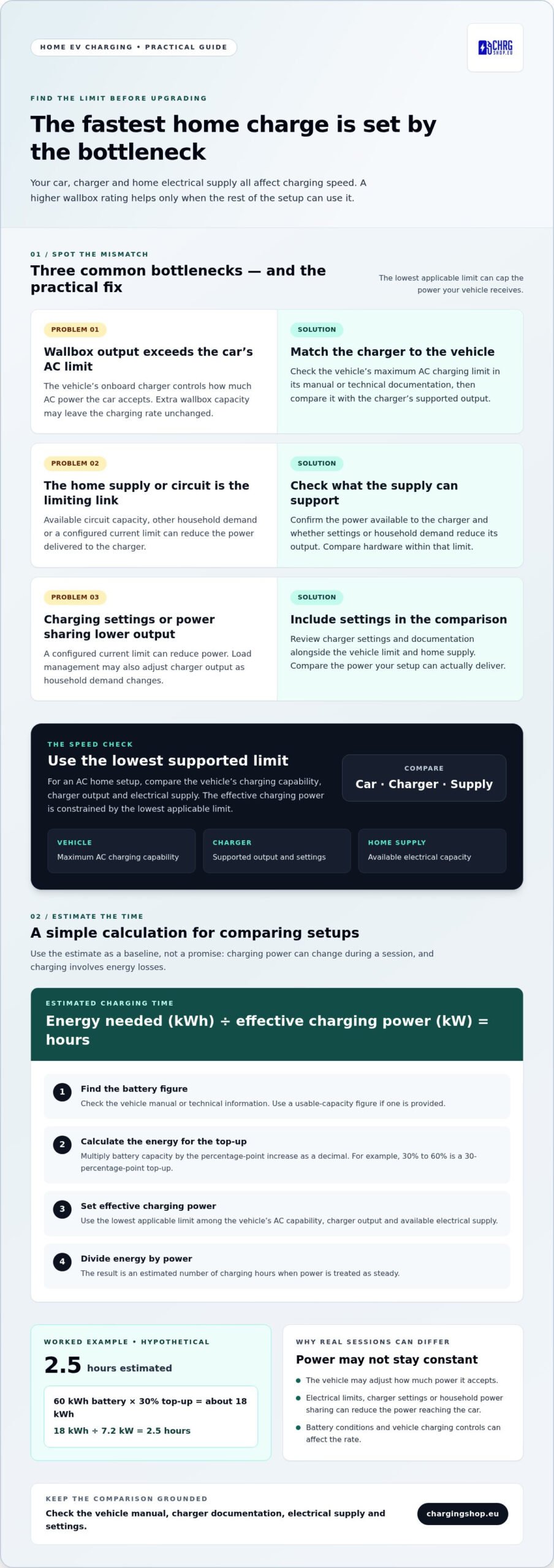
Match the charger to your car and your home’s electrical supply. That’s the practical route to faster charging without paying for power you can’t use. Home charging speed is determined by what the complete setup can deliver to the vehicle, not simply the maximum rating printed on a wallbox.
Three limits shape the result: the vehicle’s charging capability, the charger’s output, and the electrical capacity available at home. Settings can lower delivered power further. The lowest-capacity link in your home charging setup can cap the charging power the vehicle receives. Identify that limit before comparing higher-rated hardware.
Charging systems use different equipment and routes, so it helps to understand the basics of EV charging station types. With AC charging, the vehicle’s onboard charger is central to how much power the car can accept and convert for its battery.
Which part of a home charging setup controls speed?
During AC charging, power flows from the home supply through the charging equipment to the vehicle’s onboard charger. That onboard component accepts AC power and converts it for the battery. A wallbox rating describes what the charger can provide under supported conditions, not what every car will draw.
Your home supply can impose another ceiling. The circuit’s available capacity, other household demand, and a configured current limit may all reduce charging power. A charger with load management may also adjust its output as household demand changes. The practical speed is the power available across the complete chain, not the highest figure on any single component.
Why the highest charger rating may not be fastest for your car
Suppose a car can accept less AC power than a wallbox can supply. Connecting them won’t make the car charge at the wallbox’s full rating. The vehicle still controls how much power its onboard charger accepts, so a higher-capacity unit may leave the charging rate unchanged.
The reverse can happen too: a vehicle may accept more power than the home circuit or charger can deliver. Then the supply or charger becomes the bottleneck. In either case, buying the highest-rated wallbox doesn’t guarantee a faster charge. The fastest way to charge ev at home is to match all three limits, not to choose hardware by its headline rating alone.
- Check the vehicle: Find its maximum AC charging limit in the owner’s manual or technical documentation.
- Check the charger: Compare its supported output and settings with the vehicle’s limit.
- Check the supply: Confirm the power available to the charger and whether configured limits reduce its output.
Use the lowest supported limit as your starting point when choosing a setup. If your car can’t use extra charger capacity, that higher rating won’t increase its charging speed. If your electrical supply is the constraint, focus on a compatible setup that works within it. This bottleneck check helps you compare options and estimate what an upgrade can realistically deliver.
How to Estimate Home EV Charging Time Before You Upgrade
Estimate charging time before deciding whether an upgrade would make a useful difference. The basic calculation is straightforward: energy needed in kWh ÷ effective charging power in kW = estimated charging time in hours. Use the result to compare setups, not as a promise that every session will take exactly that long.
Use your battery and charging-power figures
First, work out how much energy the car needs for your planned top-up. Use the battery capacity figure in your vehicle documentation, then multiply it by the percentage-point increase you want. For example, moving from 30% to 60% is a 30-percentage-point top-up.
Hypothetical example: If a vehicle has a 60 kWh battery and needs a 30-percentage-point top-up, the battery needs about 18 kWh. At an effective charging power of 7.2 kW, the simple estimate is 18 ÷ 7.2 = 2.5 hours.
For effective power, use the lowest applicable limit among the vehicle’s AC charging capability, the charger’s output, and the power available from your electrical supply. This keeps the estimate tied to what the setup can deliver, rather than an advertised maximum the car or home can’t use.
- Find the battery figure: Check the vehicle manual or technical information, and use a usable-capacity figure if one is provided.
- Calculate the top-up: Multiply battery capacity by the percentage-point increase as a decimal.
- Set effective power: Use the lowest supported power limit for the vehicle, charger, and supply.
- Estimate the hours: Divide the energy needed by effective charging power.
This calculation is a useful baseline, but it isn’t a guaranteed charge time. Charging involves energy losses, and the amount can vary with the vehicle and setup. If you have a reliable vehicle display or charging record, use it to refine your estimate rather than adding an assumed, universal loss percentage.
Understand why actual charging time can differ
Charging power may change during a session. The vehicle can adjust how much power it accepts, while electrical limits, charger settings, or power sharing with other household loads can reduce what reaches the car. Battery conditions and the vehicle’s charging controls can affect the rate too, so a calculation based on steady power may underestimate the time required.
For practical background on home charging equipment and charging times, the U.S. Department of Energy’s home EV charging guidance is a useful reference. For model-specific information and settings, read the V2C Trydan 22kW home charging guide alongside your vehicle manual and charger documentation.
Use your estimate to compare setups before choosing an upgrade. Explore home EV charging options to review hardware against your vehicle’s needs.
Home AC vs DC Charging: Which Route Can Be Fastest?
For many homes, dedicated AC charging is the practical route to assess first. It uses the vehicle’s onboard charger, so the charging rate depends on what the car accepts and what the wallbox and home supply can provide. DC charging takes a different route and may deliver power differently, but it isn’t automatically the best or fastest option for every vehicle or property.
| Charging route | Vehicle compatibility | Supply needs | Home-use fit |
|---|---|---|---|
| AC wallbox | Vehicle must support AC charging at the connector and rate provided. | Available electrical capacity must support the configured output. | A common route to assess for residential charging. |
| DC wallbox | Vehicle must support the unit’s DC charging connection and communication. | Requires a site and electrical supply suited to the specific equipment. | A specialist option, not a universal home solution. |
When a high-power AC wallbox makes sense
A higher-output AC wallbox can be useful when the vehicle can accept that power and the home supply can deliver it. A 22kW wallbox won’t make a car charge at 22kW if the vehicle’s AC limit is lower, and the electrical supply may also constrain output. Check both limits before treating the wallbox rating as a real-world charging speed.
If your car and electrical setup can use the capacity, compare the details in this 22kW home wallbox guide. The fastest way to charge ev at home is the route your vehicle and supply can use effectively, not simply the option with the largest number on its label.
When to consider a DC wallbox at home
DC charging supplies direct current to the vehicle, bypassing its onboard AC charger, subject to vehicle compatibility. That doesn’t remove every limit: the car must support the DC charging method, and the unit, connection, and electrical site must suit one another.
The V2C DENKA 20kW DC Wallbox is a DC home-charging option. Its stated rating alone can’t establish how quickly a particular EV will charge. Review the vehicle’s DC compatibility and charging limits alongside the unit’s technical documentation and the site’s available electrical capacity. Check the required connection and installation conditions for the specific configuration before comparing it with AC.
Start with the vehicle’s supported charging route, then match the wallbox to the home supply and intended use. Choose AC when it fits those limits; assess DC as a specialist alternative when both the car and the site are compatible. This comparison helps you avoid paying for nominal output your setup can’t use.
How to Make Your Home EV Charging Setup Faster
Work through the setup before replacing hardware. The fastest way to charge ev at home starts with finding what limits power, then adjusting only what your vehicle and electrical supply can support. Use your vehicle manual and charger documentation as references, and leave electrical changes to a qualified electrician.
- Check the vehicle limit. Record the maximum AC charging rate stated in the owner’s manual or manufacturer specifications. This tells you how much AC power the car can accept.
- Check charger output. Compare the wallbox’s supported output with the vehicle’s AC limit. Review its documentation for adjustable current settings, operating modes, and load-management features that could affect charging.
- Assess the electrical supply. Before selecting a higher-output charger or changing an existing circuit, have a qualified electrician assess the available electrical capacity. A larger wallbox setting won’t create additional capacity in the home supply.
- Review configured limits. Look for charging-current limits in the vehicle, charger, or energy-management settings. Check whether power sharing with other household loads is reducing output, and change settings only within the equipment’s supported limits.
- Set a charging schedule. Choose when charging should begin or finish to suit your routine, where the vehicle and charger support scheduling.
Check your vehicle and home supply before changing hardware
Keep the key specifications together: the car’s maximum AC rate, the charger’s available output, and the capacity the home can provide to that charging point. This makes mismatches easier to spot. If the vehicle is the limit, a higher-rated AC wallbox won’t raise the power it accepts. If the supply is the constraint, increasing charger output without an electrical assessment is not a safe shortcut.
Use the charger documentation to understand current limits and load-management settings. Don’t open equipment or alter wiring yourself. Have a qualified electrician assess the circuit and carry out electrical work. Settings must still stay within the limits of the vehicle, charger, and supply.
Set up charging for the time you need
A schedule helps you charge during the window that fits your day, so you can plan around when you need to leave. Set a target and departure time using the vehicle or charger controls, then check that the schedule is enabled in the right place. If both systems offer scheduling, make sure their settings don’t unintentionally delay the start.
A schedule improves timing and convenience, but it doesn’t increase maximum charging power. The vehicle, charger, and electrical supply must still support a faster rate. Treat scheduling as a way to manage when charging happens, not as a hardware upgrade or a promise of a particular charge time.
Once you’ve identified the relevant limits and settings, compare compatible home charging hardware at Charging Shop’s EV chargers.
Choose Home Charging Hardware That Delivers the Speed You Can Use
Choose by compatibility, not headline output. The right home charger must match your vehicle’s supported charging type and power, your available electrical supply, and how you plan to charge. That’s the practical route to the fastest way to charge ev at home without paying for capacity your setup can’t use.
Match charger type to your charging requirement
Start with your vehicle’s manual. Identify which charging type it supports at home, its maximum accepted power, and the connector it uses. Then compare those details with the charger’s current product documentation and your home’s available supply. This filters out options that look powerful on paper but can’t deliver useful speed for your vehicle and setup.
The V2C Trydan 22kW is one home-charging option. Compare its current technical specifications with your vehicle’s AC charging capability and the power your home can provide. The product’s 22kW rating alone doesn’t show how quickly your car will charge; useful output depends on the complete setup.
The V2C DENKA 20kW DC Wallbox is a DC option for vehicles that support the required DC charging connection and sites suited to the equipment. Check the car’s compatibility and charging limits, along with the wallbox documentation and electrical requirements. Neither product should be called the fastest choice without matching it to the vehicle and supply.
Compare specifications before you buy
Compare each charger on details that affect real use: rated output, AC or DC charging type, connector, documented vehicle compatibility, and supported settings. Check the electrical supply requirements too. If any of these don’t align, the charger’s headline rating may not translate into usable charging power at home.
Keep product selection separate from installation planning. Choosing a compatible charger doesn’t establish that a home circuit can support it. Have electrical capacity assessed before choosing higher-power hardware, and leave wiring and installation work to a qualified electrician. Use the manufacturer’s current documentation for model-specific requirements rather than relying on a product name alone.
- Vehicle: Confirm its supported charging type, connector, and maximum accepted power.
- Charger: Compare documented output and compatibility with the vehicle.
- Home supply: Confirm the available capacity can support the intended setup.
- Useful output: Choose based on the power the complete system can deliver, not its highest individual rating.
A 22kW wallbox may suit one vehicle and supply combination, while another setup may gain no usable speed from that rating. DC hardware also requires specific compatibility and site checks. Make your selection based on the limits you’ve identified, then compare products against those needs.
Explore Charging Shop home charging options and compare the available hardware with your vehicle’s capability and home supply.
Make Your Next Charging Choice Count
Before choosing hardware, note when your vehicle is usually parked at home and how much charge you typically need before your next trip. That everyday pattern helps you decide whether your current setup meets your needs or whether a different charging option is worth considering.
The fastest way to charge ev at home isn’t necessarily the highest-rated unit. It’s hardware that suits your charging routine and works with your vehicle and home setup. Charging Shop offers the V2C Trydan 22kW home-charging option and the V2C DENKA 20kW DC Wallbox. Compare product specifications, vehicle compatibility, and electrical requirements before choosing.
Turn your charging needs into a confident hardware decision. Explore EV charging hardware at Charging Shop and compare an option with your setup. Choose with purpose and move toward a home charging routine that works for you.
Frequently Asked Questions
What is the fastest home EV charger available?
For Level 2 AC charging, the fastest units reported in 2026 deliver up to 80 amps, or 19.2 kW, according to MotorWatt. That top-end output requires a substantial dedicated circuit and may exceed what a vehicle or home supply can use. DC wallboxes are a separate, specialist route, so compare charging type, vehicle compatibility, and electrical requirements rather than assuming one rating defines the fastest option.
Can a 22kW charger charge every electric car at 22kW?
No. A 22kW rating describes the charger’s capability, not the rate every car will accept. If a vehicle’s documented AC limit is below the charger’s output, the car won’t draw the full 22kW. Check the vehicle manual for its supported charging rate and connector details, then compare them with the charger’s current specifications.
Is a DC charger faster than an AC charger at home?
It can be, but not for every vehicle or home. DC charging bypasses the car’s onboard AC charger, but the vehicle must support the DC connection and charging method, and the home setup must suit the equipment. A DC unit’s rating alone doesn’t establish your actual charging speed. Compare the car’s DC charging capability with the wallbox documentation and available supply before treating DC as the faster choice.
How do I calculate how long home charging will take?
Divide the energy needed in kilowatt-hours by the effective charging power in kilowatts. For a hypothetical example, a 75kWh battery receiving a 20-percentage-point top-up needs about 15kWh; at an effective 7.5kW, that’s roughly two hours. Treat this as a planning estimate, not an exact arrival time. Charging losses, changing power, and vehicle controls can affect the session.
Will a more powerful wallbox make my EV charge faster?
Only if the vehicle can use the additional output and the home supply can provide it. If either already sets a lower limit, a more powerful wallbox may not shorten a session. Higher-capacity hardware may be worth comparing if your charging needs or vehicle could change, but check compatibility and electrical requirements before deciding. Judge the upgrade by usable power, not the highest number on the product label.
Can I safely increase my home charger’s power settings myself?
Don’t change wiring, circuit capacity, or other electrical settings yourself. A setting that exceeds what the circuit or equipment can support can create a safety risk. Check the charger manual for user-adjustable controls and keep changes within its documented limits. If you’re considering a higher current or any electrical alteration, have the supply assessed and electrical work handled by a qualified electrician.
Does a faster home charger reduce the time needed for every charging session?
No. A higher charging rate matters only when the car needs energy and can accept the extra power. A short top-up may already fit within your usual parking window, so a faster unit may make little practical difference to that session. The energy you need, the vehicle’s charging behavior, and the power available all shape charging time. Compare your regular routine before upgrading.
