
 Deutsch
 Dansk
Dansk Suomi
Suomi Latviešu
 Lietuvių
 Norsk bokmål
 polski
 Русский
 Svenska
No products in the cart.
Uncategorized
EV Chargers for Parking Lots: Plan the Right Setup in 2026
09
Oct
Oct
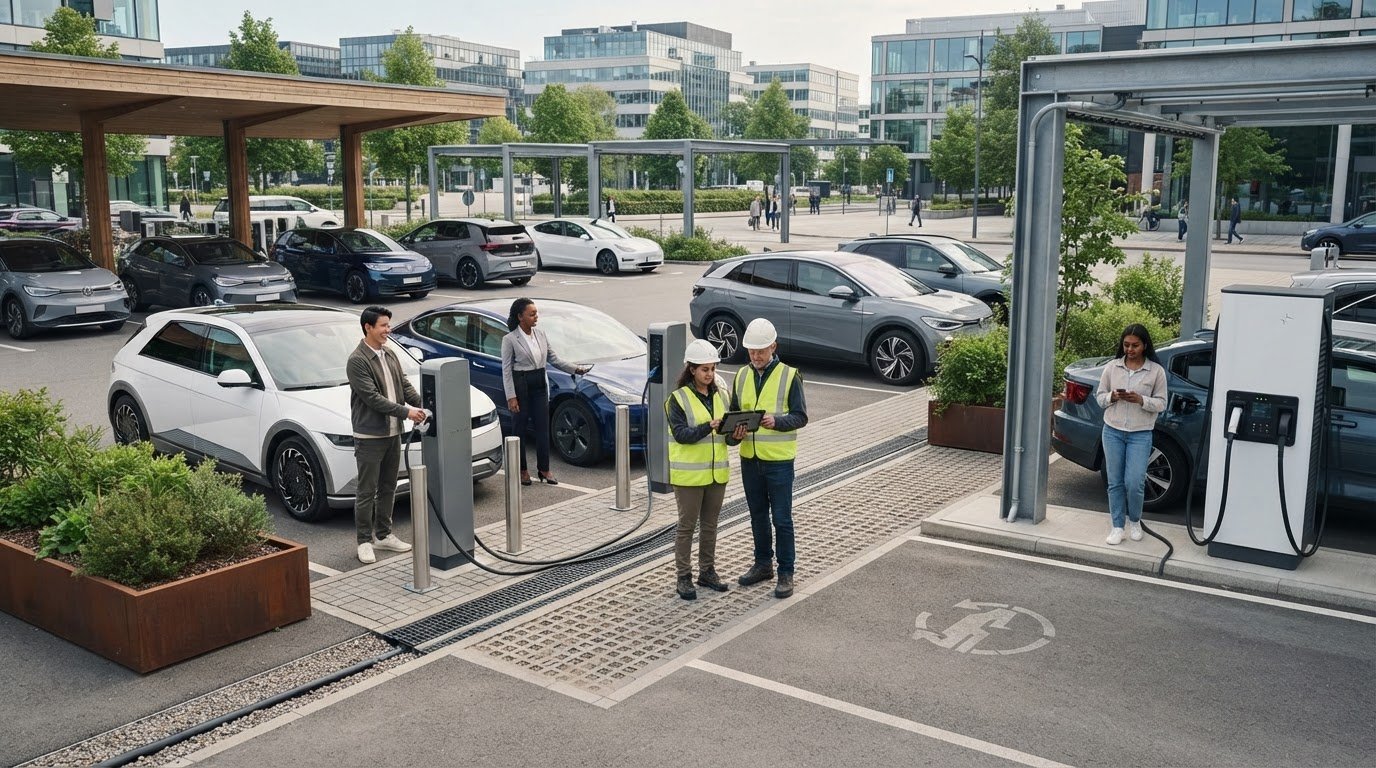
The fastest charger isn’t automatically the best fit for your parking lot. An ev charger for parking lots should suit how long vehicles stay, how much power the site can supply, and how drivers will access and use the equipment.
Start by deciding whether AC or DC charging better matches the parking pattern, then compare your expected demand with the site’s electrical capacity. Making those decisions in the wrong order can lead to equipment that doesn’t fit the way the lot operates.
This guide explains how to match charger type to parking duration, plan charger quantity and power around site capacity, and account for access, payment, and charger management. It also covers commercial options such as the Alfen Single Pro Line, ABB Terra AC, and V2C DENKA 20kW DC Wallbox. Begin with dwell time and available power, then shape the setup around how your lot is used.
Key Takeaways
- Choose an ev charger for parking lots based on who parks there and how long vehicles typically stay.
- Compare AC and DC charging against dwell time, vehicle capability, and the power available at your site.
- Estimate charger needs based on vehicles served and likely simultaneous use, then compare the result with electrical capacity.
- Plan layout, driver access, payment, and future expansion alongside equipment selection.
- Compare AC and DC hardware options and consider how charging-asset management fits your facility’s operating model.
Why Add EV Chargers for Parking Lots? Start with Drivers and Site Use
An ev charger for parking lots is part of a wider setup shaped by who uses the site, how long vehicles stay, how drivers access the chargers, and how the facility will manage charging. Start with those practical requirements rather than choosing a charger count in isolation.
Parking patterns create different needs. Public parking may serve a changing mix of visitors, while customer parking supports visits to a business. Employees often leave cars for much of the workday; residents may park overnight. Fleet vehicles can follow scheduled routes and return to the same site. Each use case calls for a different balance of charging speed, user access, and operating priorities.
Dwell time is a core planning input because it determines how long a parked vehicle has to charge. For background on charging options and systems, see this overview of electric vehicle charging infrastructure.
Which parking facilities benefit from EV charging?
Match the setup to the parking pattern. Retail and other customer lots serve visitors during errands or appointments, so charging has to fit the likely length of a visit. Workplace parking typically serves repeat users who leave vehicles for much of the day. Hotels and residential facilities often have longer or overnight stays, while public lots can see a wider mix of users and visit lengths.
Repeat users may value predictable access and a consistent routine. Visitor-focused sites benefit from clear directions and a straightforward way to use the chargers. Fleet operators can plan around vehicle schedules and the time vehicles spend on site. These are planning considerations, not guaranteed increases in occupancy, revenue, loyalty, or environmental outcomes.
What should operators define before choosing chargers?
Write down who the chargers are for, when the lot is open, how long vehicles usually stay, and when charging demand is likely to overlap. Distinguish employee or resident access from visitor access. Then identify the site’s electrical capacity and the parking areas where chargers would be practical for drivers to reach.
Separate essential driver services from optional business goals. Reliable access and a clear user process may be priorities; charging fees or sustainability targets may also matter, but they are separate decisions. Set an initial scope around current users and expected demand. Review usage over time and adjust the plan as site needs change.
AC or DC EV Chargers for Parking Lots: Match Power to Dwell Time
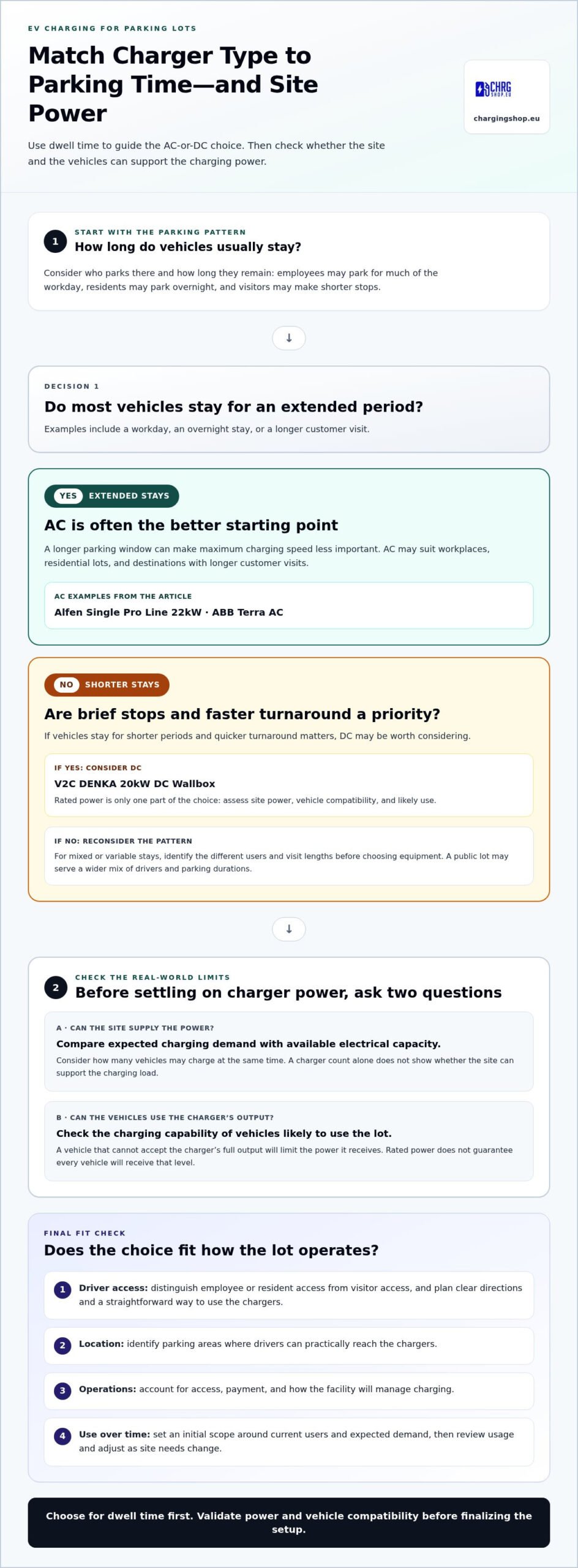
Choose charging power based on how long vehicles stay, not simply the highest rating available. AC charging often suits longer parking windows, while DC charging may suit locations where quicker turnaround matters. A charger’s rated power does not guarantee that every vehicle will receive that level of power. Vehicle capability and the site’s electrical supply also affect charging performance.
Use this comparison as a starting point, then assess how your parking lot operates:
| Charging type | Best fit by dwell time | Typical use | Planning trade-off |
|---|---|---|---|
| AC | Longer stays | Workplaces, residential lots, and longer customer visits | Charging can take place across a longer parking window, but may not suit rapid turnover. |
| DC | Shorter stays or higher turnover | Sites where drivers need to charge during a brief stop | Can support quicker charging, but requires attention to site power, vehicle compatibility, and likely use. |
Neither option is automatically better. Faster charging may bring little benefit when vehicles remain parked for hours. A long-stay site also has different requirements from a busy location serving brief visits.
When does AC charging suit a parking lot?
AC charging can suit workplaces, residential parking, and customer destinations where vehicles stay for an extended period. A workday or overnight stay gives a vehicle a longer charging window, so maximum speed may matter less than fitting equipment to the site’s electrical capacity and regular use. The Alfen Single Pro Line 22kW and ABB Terra AC are examples of AC equipment to consider for these parking patterns.
Include the vehicle’s AC charging capability in your decision. If a vehicle can’t accept the charger’s full output, the vehicle limits the power it receives. Plan around the capabilities of vehicles likely to use the lot rather than assuming every driver can draw the maximum available power.
When might DC charging make more sense?
DC charging may suit a site where vehicles stay for shorter periods and faster turnaround is a priority. The V2C DENKA 20kW DC Wallbox is one DC option to consider. Its rated power is only part of the decision: assess the site’s available power, vehicle compatibility, and how often drivers are likely to use the charger.
Faster equipment may be a poor match for a site with low or unpredictable utilization. Frequent short visits, on the other hand, can make charging speed more important. Treat expected use and electrical capacity as core inputs, then weigh the trade-offs before selecting equipment. Explore AC and DC charging options as you plan around your parking pattern.
How to Size EV Chargers for Parking Lots Without Overbuilding
Start with demand, then compare it with the power your site can support. A charger count alone won’t show whether drivers can charge when they need to. Map how long vehicles stay, how many vehicles you intend to serve, and how many are likely to charge at the same time. Compare those needs with the site’s electrical capacity before settling on equipment or power levels.
Charger count is how many vehicles can plug in; available site power is the total electrical capacity those chargers can draw from. A lot may have several charging bays but limited power to share across them. Treat charger quantity and site power as separate planning questions.
Which site details shape charger quantity and power?
Build a clear picture of the lot before choosing an ev charger for parking lots. Mark the bays under consideration, operating hours, user groups, and periods when charging demand could overlap. Note whether vehicles arrive steadily or cluster at predictable times. Record existing electrical loads and assess site capacity rather than assuming that unused capacity is available.
- Parking duration: Estimate how long vehicles typically remain parked during each operating period.
- Vehicles served: Separate current users from possible future users, such as additional staff, residents, visitors, or fleet vehicles.
- Simultaneous use: Consider how many vehicles may need power at once, not just the total number over a day.
- Electrical capacity: Identify the supply available for charging after existing site needs are considered.
Keep present demand distinct from expansion assumptions. A future phase may need more chargers, but don’t treat that possibility as current demand without a clear basis. Record what would prompt a review, such as consistent use of the initial charging bays or a change in parking patterns.
Does every parking lot need high-power DC charging?
No. Charging speed should reflect dwell time and site needs. A workplace or residential lot with long stays may be better suited to AC charging distributed across the parking area. A location where drivers stop briefly and turnover matters may have a stronger case for DC charging. Neither approach is right for every facility.
Vehicle capability and site power matter for either option. A vehicle may not accept the charger’s full output, and the electrical supply can limit what the site supports. Match the planned equipment to both factors, not just to a headline power rating.
Load management can help coordinate how available power is allocated across charging sessions. In principle, it can reduce the chance that every connected charger draws its maximum power at the same time. How it works depends on the selected system, so include the relevant hardware and management capabilities in your planning.
Consider phasing the rollout. Begin with a scope aligned to current users and site capacity, then review actual demand before adding equipment. Account for possible expansion in the layout and planning assumptions, but avoid building for an untested peak. This leaves room to adapt without treating future possibilities as immediate requirements.
EV Parking Lot Charger Deployment: A Practical Planning Sequence
Move from user needs to equipment in a clear order. A written plan connects decisions about charger locations, electrical capacity, access, payment, and future expansion. It also gives you a reference point for revisiting assumptions as parking patterns and charging demand change.
- 1. Define the users. Identify whether charging is intended for employees, residents, customers, visitors, fleet vehicles, or a mix. Decide who should be able to use each charger.
- 2. Map the parking activity. Mark likely charger locations, operating hours, typical parking duration, and periods when vehicles may need to charge at the same time. Consider how drivers will reach and use the bays.
- 3. Assess electrical capacity. Record the available site information and the assumptions used to estimate charging power. Don’t treat capacity as unlimited or assume that all planned chargers can draw full power simultaneously.
- 4. Set the operating model. Decide how users will find, access, and pay for charging, if payment applies. Include the intended approach to charging-session management and who will oversee routine operations.
- 5. Select equipment and plan for change. Match AC or DC equipment to the parking pattern, vehicle needs, and site capacity. Note what future expansion might involve, but keep it separate from the initial deployment scope.
What should the site plan capture?
Keep a site plan that records parking-bay locations, proposed charger positions, user access, and expected dwell time. Add capacity assumptions, the planned approach to managing charging sessions, and any decisions about payment. Include local technical or regulatory requirements for project-specific assessment rather than treating them as universal.
Make the assumptions traceable. Note where demand estimates came from, which user groups they cover, and what could change them. If the plan needs to change, this record can help identify whether the cause was new users, different parking behavior, a capacity constraint, or an operational decision.
How can operators phase a parking-lot rollout?
Start with a defined user group and an initial scope that fits the site’s current needs. Track charger use and driver or operator feedback, then compare actual activity with the assumptions in your plan. Use that review to decide whether to expand, adjust access, or revise equipment and network-management needs.
As operations develop, align charger selection with the way you’ll manage charging assets. CHRG Network access can form part of that plan, alongside decisions about access and payment. A phased approach gives you a practical basis for adapting the ev charger for parking lots setup without treating every future possibility as an immediate requirement.
Explore charging hardware and CHRG Network access as you plan equipment and day-to-day operations.
Choose EV Charger Hardware and Management for Your Parking Facility
Turn your site plan into a shortlist. Match equipment to parking duration, available power, who can use the chargers, and how you intend to operate them. An ev charger for parking lots should fit these conditions as part of a complete setup, not just look suitable on a product specification sheet.
Keep two decisions connected but distinct: which hardware fits the site, and what network access or management the operation needs. Equipment can be technically suitable yet fall short of the operating plan if access and session oversight haven’t been considered. Use this checklist to compare options:
- Parking pattern: Does the site mainly serve longer stays or quicker turnover?
- Electrical capacity: Does the planned equipment fit the power available to the charging area?
- Users and access: Are chargers intended for a defined group, visitors, or both?
- Operations: How will you handle charging access, sessions, and any payment process?
Which Charging Shop products fit a parking-facility shortlist?
For an AC shortlist, consider the Alfen Single Pro Line 22kW and ABB Terra AC. The V2C DENKA 20kW DC Wallbox is an option for sites assessing DC charging. These products are starting points for comparison, not a universal ranking. Match the product category and stated rating to parking duration, vehicle needs, and available site power.
Compare product information with your project requirements before narrowing the shortlist. Review the specifications and compatibility details that affect your intended use. Don’t infer ABB Terra AC ratings or features from its name, and don’t assume a vehicle will draw a charger’s full rated output.
How do hardware and charging management work together?
Hardware provides the charging equipment; network access is a separate part of managing charging assets. Consider access, session oversight, and network needs alongside product selection, especially if different user groups will use the same parking area. Charging Shop offers CHRG Network access as part of the operational options to consider. Choose a management setup based on the needs you’ve defined for the site.
Keep your requirements visible as you evaluate options. A concise shortlist can record the parking pattern, intended users, site power assumptions, AC or DC category, and network or session-management needs. That makes it easier to compare equipment on fit rather than headline power alone.
For more detail on operational planning, consult the CHRG Network access guide as you define how charging assets will be managed. Then explore Charging Shop hardware and network options to build a shortlist around your facility’s needs.
Move Your Parking-Lot Plan Toward Action
Turn your planning assumptions into a short decision brief. Record what the facility needs now, what you’re still evaluating, and what would prompt a future review. This gives stakeholders a shared reference and keeps equipment choices connected to the way the lot operates as needs evolve.
Build your shortlist around the operating model you want to support. Charging Shop offers commercial hardware options from Alfen, ABB, and V2C, as well as CHRG Network access for charging-asset management and personalized charging offers. Compare those options with your plans for drivers and day-to-day operation, rather than assuming one setup suits every site.
Ready to take the next step? Explore EV charging hardware and network options for your ev charger for parking lots project. A clear brief and practical shortlist can help turn a complex decision into a focused plan.
Frequently Asked Questions
How many EV chargers should a parking lot have?
There’s no fixed charger-to-space ratio that fits every facility. For an ev charger for parking lots, estimate how many drivers may need charging during the same time window, then compare that demand with the parking spaces you can dedicate. A workplace with repeat staff users may begin with a limited group of charging bays; a visitor site may need a different distribution. Review actual use before expanding.
Are AC or DC chargers better for parking lots?
Neither is universally better. Choose based on how the facility is used, and consider whether a mix suits different driver groups. For example, a site might evaluate AC charging for spaces used mainly by employees and DC charging for visitor bays with shorter stays. Check vehicle compatibility and the site’s power supply for each option, then compare the specific equipment information with your requirements.
Can a parking lot add EV chargers without upgrading its electrical supply?
Possibly, but it depends on the capacity available after the site’s existing electrical needs are considered. An electrical assessment can show whether a smaller initial deployment or managed charging approach may fit the existing supply. If planned demand exceeds available capacity, the project may need a different scope or electrical upgrades. Don’t assume spare capacity based only on the number of unused parking spaces.
How do EV chargers share limited power across parking spaces?
A load-management system can coordinate how available charging power is distributed among connected vehicles, rather than allowing every charger to draw its maximum at once. The approach depends on the equipment and its supported controls. Power management doesn’t create additional electrical capacity, and charging speed can vary as demand changes. Review the capabilities of the hardware and management system included in your plan.
Do parking-lot EV chargers need a charging network?
No. A network isn’t essential for every site; the need depends on how you plan to manage access and charging assets. A simple, controlled setup may have different operational needs from a facility serving multiple user groups. Network access can be part of the management plan. Charging Shop offers CHRG Network access for charging-asset management, which operators can consider alongside their chosen hardware and operating model.
Can drivers pay to charge at a parking facility?
Yes. An operator can choose to charge drivers for sessions, provide charging as a site amenity, or use another access policy. Decide who pays, how drivers will understand the terms, and how payment fits the selected equipment and network setup. Don’t assume payment is built into every charger. Make sure the planned hardware and operating arrangement support the process you intend to offer.
What should a parking-lot EV charger plan include?
Include a site layout, intended users, access and payment approach, electrical-capacity assumptions, equipment choices, and a plan for managing charging sessions. Add a decision log that records why each choice was made and what could prompt a review, such as a change in parking use or new user demand. Include project-specific technical and local requirements for appropriate assessment before deployment.
